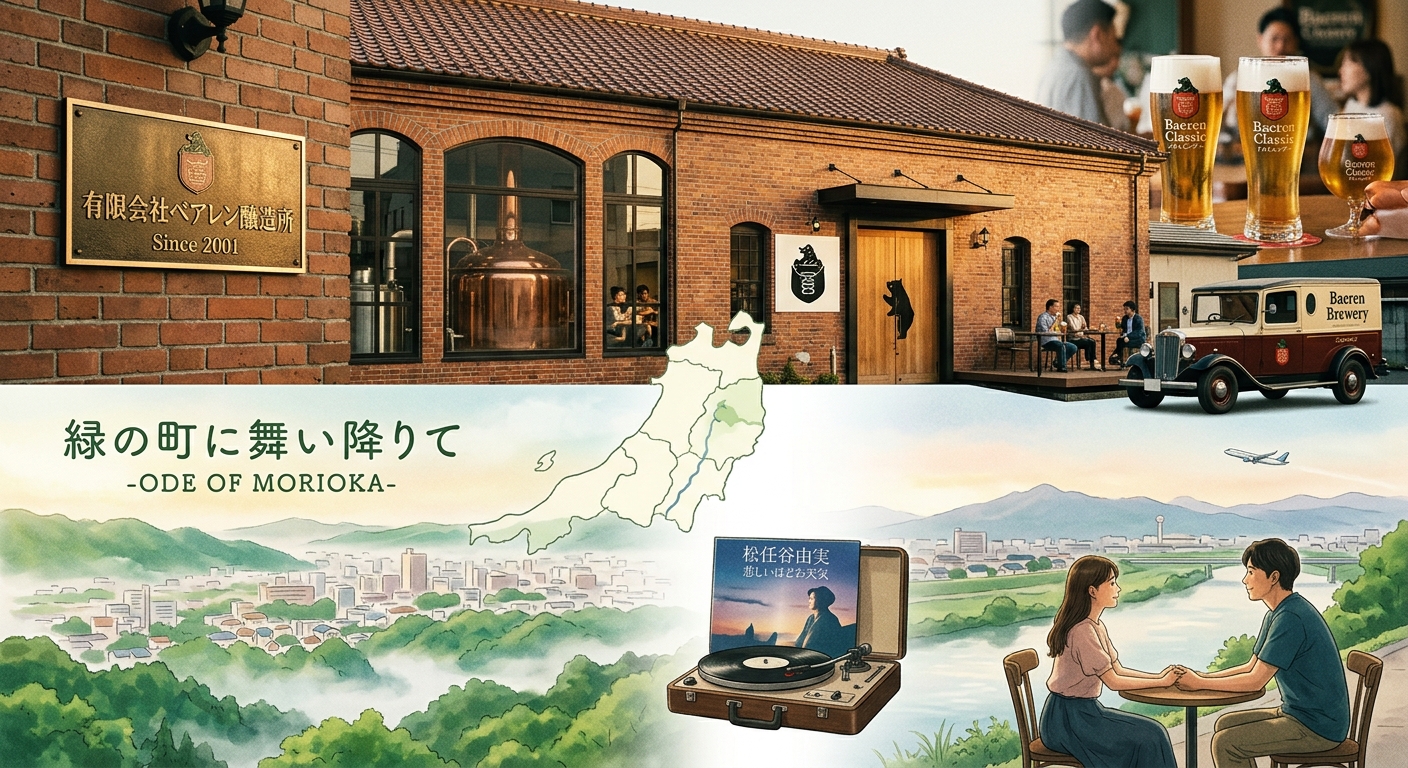
日本語で読む | This is the English version of a bilingual article.
Today’s Pairing
- Craft beer: Baeren Classic — a Dortmunder-style lager, brewed after an export recipe from 1900s Dortmund, 6.0% ABV, IBU 23 / Baeren Brewery (1-3-31 Kitayama, Morioka, Iwate)
Official site: https://www.baerenbier.co.jp/ - Music: “Midori no Machi ni Maiorite -ODE OF MORIOKA-” (“Landing in a Green Town”) by Yumi Matsutoya (1979)
YouTube: https://www.youtube.com/watch?v=GT3O6ASmeXI
▶ If the player above doesn’t play, open it on YouTube
The Story of the Brewery
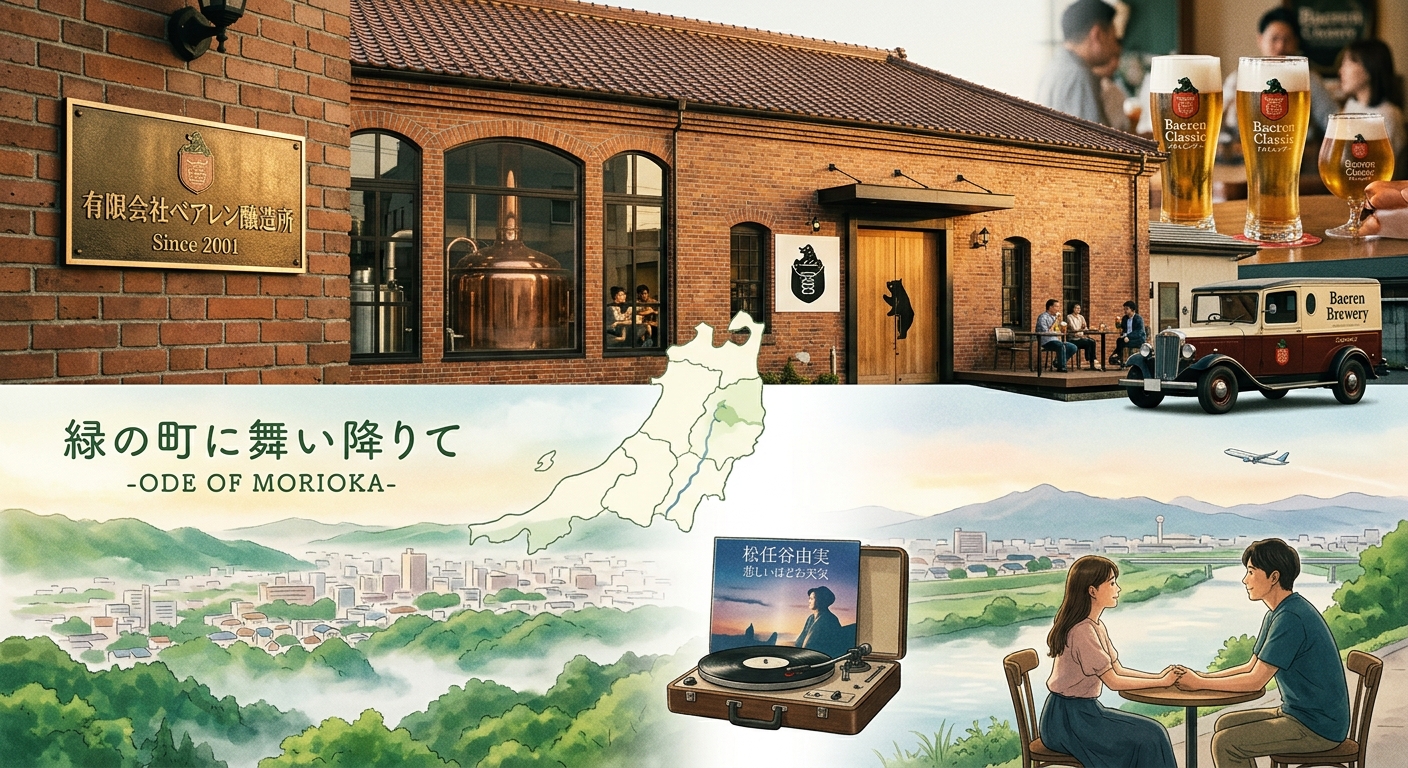
Baeren Brewery was established in Morioka on February 20, 2001, as a limited company. Its president is Yoichi Shimada. The name “Baeren” is German for “bears” (plural), chosen, the brewery says, to evoke both the bears that still live in Iwate’s mountains and the sturdy build of its brewers.
The brewery’s defining feature is a copper mash kettle relocated from a German brewery, over a hundred years old, still used to brew beer today. The building itself is a converted former brick-and-tile factory. A German brewmaster is involved in the brewing, and the malt is bought directly from the German maltster Karl Bindewald.
Its flagship, Classic, is a lager brewed after the export-style Dortmunder recipes of the 1900s, at 6.0% ABV and IBU 23. According to the brewery, Dortmunder was one of the “four great lager styles” of 19th-century Europe, brewed heavier on hops and malt than usual so it could survive the journey to export markets. Dortmund itself was a coal and mining town at the time, and the beer was said to be popular among the working-class laborers who had gathered there from many different places. On April 2, 2015, at a tasting event hosted by the Japan Beer Journalists Association at the Foreign Correspondents’ Club of Japan (FCCJ), Classic was one of eight finalists chosen from over 200 breweries nationwide, tying for the top vote count — 77 votes — with Shizuoka’s Baird Beer and its Suruga Bay Imperial IPA.
The Story of the Song
“Midori no Machi ni Maiorite -ODE OF MORIOKA-” appears on Yumi Matsutoya’s eighth original album, “Kanashii Hodo Otenki,” released by Toshiba EMI on December 1, 1979. Written and composed by Matsutoya herself, arranged by Masataka Matsutoya, and running 4 minutes 41 seconds, it’s a travel song built around a short trip to Morioka — as its English title makes clear.
Matsutoya was born in 1954 in Hachioji, Tokyo, and debuted in 1972 under the name Yumi Arai. She has no deep roots in Morioka. And yet, more than four decades after its release, the song is still sung there: it’s considered essential at her Morioka concerts, has been used in local school music classes, and became the opening theme for Iwate Asahi TV’s news program when the station launched in 1996. Since March 2009, it has played inside Hanamaki Airport as the airport’s image song.
Why This Pairing
Both are stories of something from elsewhere landing in this town and taking root. The kettle at Baeren Brewery worked in Germany for over a hundred years before crossing the sea, and it’s still brewing beer inside an old factory in Morioka today. The Dortmunder style itself, the ancestor of Classic’s recipe, was an export beer that grew up serving laborers who had gathered there from many places. A soil that welcomes what arrives from elsewhere runs through this beer’s whole history.
“Ode of Morioka” is the same kind of story: a songwriter born in Tokyo touched down briefly in Morioka, was moved by its greenery, and wrote a song about it. More than forty years later, that traveler’s song is still loved by the people of Morioka, greeting visitors as they arrive at the airport. One is a beer that landed somewhere and took root; the other is a song that landed somewhere and stayed behind. Both reflect the same thing: a town generous enough to take in whatever arrives from outside, exactly as it is.
Where to Find This Beer
The Rakuten Ichiba link below is an affiliate link.
- Brewery official site:https://www.baerenbier.co.jp/
- Buy on Rakuten Ichiba: View the product page (330ml×12本, ¥5,199)
These are Japanese storefronts. If you are visiting the brewery, drinking it fresh at their own taproom is by far the best option.
Pairing Dishes Worth Trying
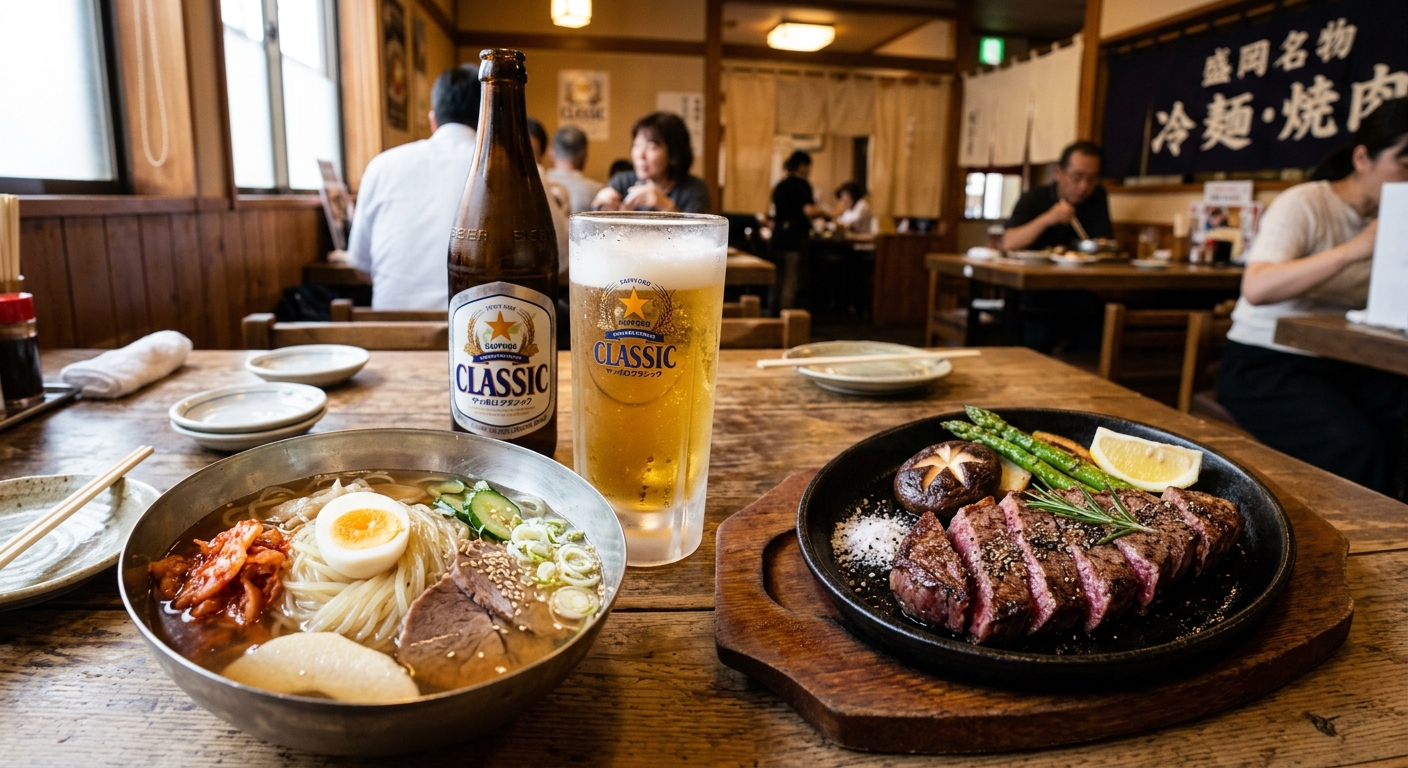
- Morioka reimen (cold noodles)
A Morioka specialty said to have been created at “Shokudoen,” open since 1954, blending the Hamhung- and Pyongyang-style cold noodles of the Korean peninsula. The firm noodles and cold, kimchi-spiked broth pair well with Classic’s firm carbonation and dry finish. - Iwate Tankaku Wagyu steak
A branded beef from Nihon Tankaku cattle, of which Iwate is by far Japan’s largest producer. Low in fat and rich in lean-meat umami, it stands up well to Classic’s malt richness and hop bitterness, matching the beef’s firm bite.
A note on the science: the amino-acid umami in lean red meat layers with the malt-derived sweetness of the beer, producing an umami synergy. Carbonation’s pressure then resets the palate, compensating for the meat’s low fat content and keeping the next bite tasting just as good.
Visiting the Brewery
Baeren Brewery (Kitayama Plant)
1-3-31 Kitayama, Morioka, Iwate. About 10 min by car from Morioka Station. Factory tours run weekdays only and require advance reservation (at least 4 days ahead, up to 10 people per session).
Sights Nearby
- Hoon-ji Temple / Five Hundred Rakan, Morioka | ~2 min, ~0.4 km by car from the brewery
499 carved rakan statues, said to have been made over four years starting in 1731 by nine Buddhist sculptors from Kyoto. Designated a Morioka city cultural property. - Ishiwari-zakura (the rock-splitting cherry tree), Morioka | ~3 min, ~1.3 km by car
On the grounds of the Morioka District Court, a cherry tree over 360 years old growing out of a crack in a granite boulder. A national natural monument. - Morioka Castle Ruins Park (Iwate Park), Morioka | ~3 min, ~1.5 km by car
A park built around the surviving stone walls of the Nanbu clan’s Morioka Castle, known both for its masonry and as a cherry-blossom spot.
Hot Springs Nearby
- Tsunagi Onsen, Hotel Shion, Morioka | ~14 min, ~13.4 km by car
Offers day-use bathing (weekdays 11:00-16:00, adults ¥1,200; weekends/holidays 11:00-15:00, adults ¥1,400; last entry 30 min before closing). Since June 2025, the only bath open for day-use is the private “Hitorijime no Yu” bath.
Opening hours, closing days and day-use bathing availability can change. Please check each facility’s official information before visiting.
A Quick Glossary of Beer Terms
- Craft beer: Beer made by small breweries that put the character of the maker front and centre, as opposed to the uniformity of mass production.
- Lager: Beer brewed by bottom fermentation, with the yeast working at low temperature and settling toward the bottom of the tank. It tends toward a clean, crisp finish, and most major Japanese beers belong to this family.
- Malt: Germinated barley. It forms the foundation of a beer’s sweetness, colour and body; how deeply it is roasted determines colour and toastiness.
- ABV: Alcohol By Volume. Beer typically runs around 5%; above 8% is considered a strong, heavier-drinking beer.
- IBU: International Bitterness Units, a scale for how bitter a beer tastes. Around 10 is barely noticeable bitterness; above 60 lands in clearly bitter IPA territory.
Sources
- Baeren Brewery official site (Company Profile)
- “About Baeren Classic (Part 3: History)” — Baeren Blog
- “About Baeren Classic (Part 2: On the Tasting Evaluation)” — Baeren Blog
- Voting Results Report, “Japanese Craft Beer to Tell the World” — Japan Beer Journalists Association
- Yumi Matsutoya — Wikipedia (Japanese)
- Hoon-ji Temple (Morioka) — Wikipedia (Japanese)
- Tsunagi Onsen, Hotel Shion — day-use bathing
If you notice any errors in this article, please don’t hesitate to reach out at info@soundrecords.jp.
Read this article in Japanese: 舞い降りた先で根を下ろして