日本語で読む | This is the English version of a bilingual article.
Today’s Pairing
- Craft beer: Otaru Beer Dunkel — a dark lager built mainly on caramel malt, brewed with the traditional German double-decoction method, 5.2% ABV / Otaru Beer, operated by Alef Co., Ltd. (Minatomachi 5-4, Otaru, Hokkaido)
Official site: https://otarubeer.com/jp/ - Music: “Otaru Unga” (“Otaru Canal”) by Miyako Harumi (1990)
YouTube: https://www.youtube.com/watch?v=HjTnq9mKZ3k
▶ If the player above doesn’t play, open it on YouTube
The Story of the Brewery
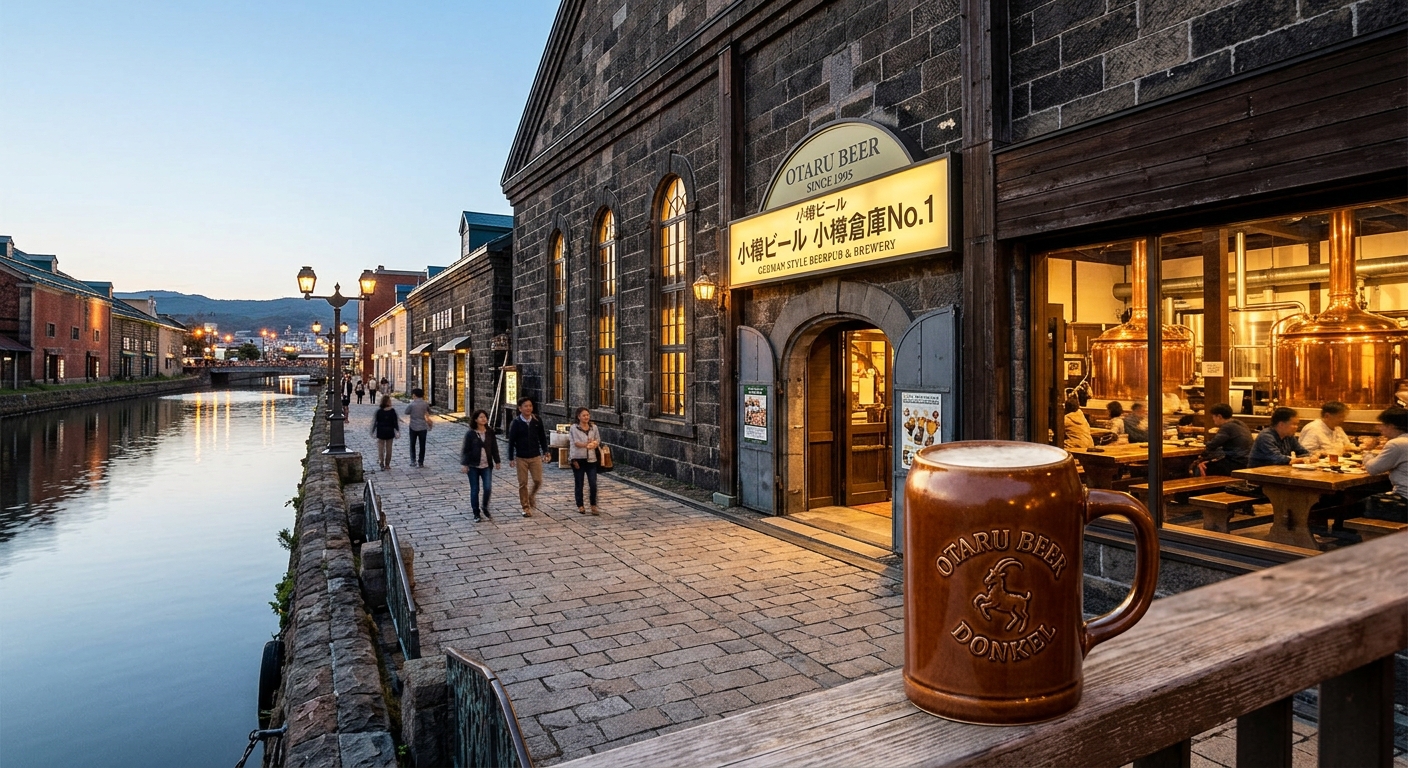
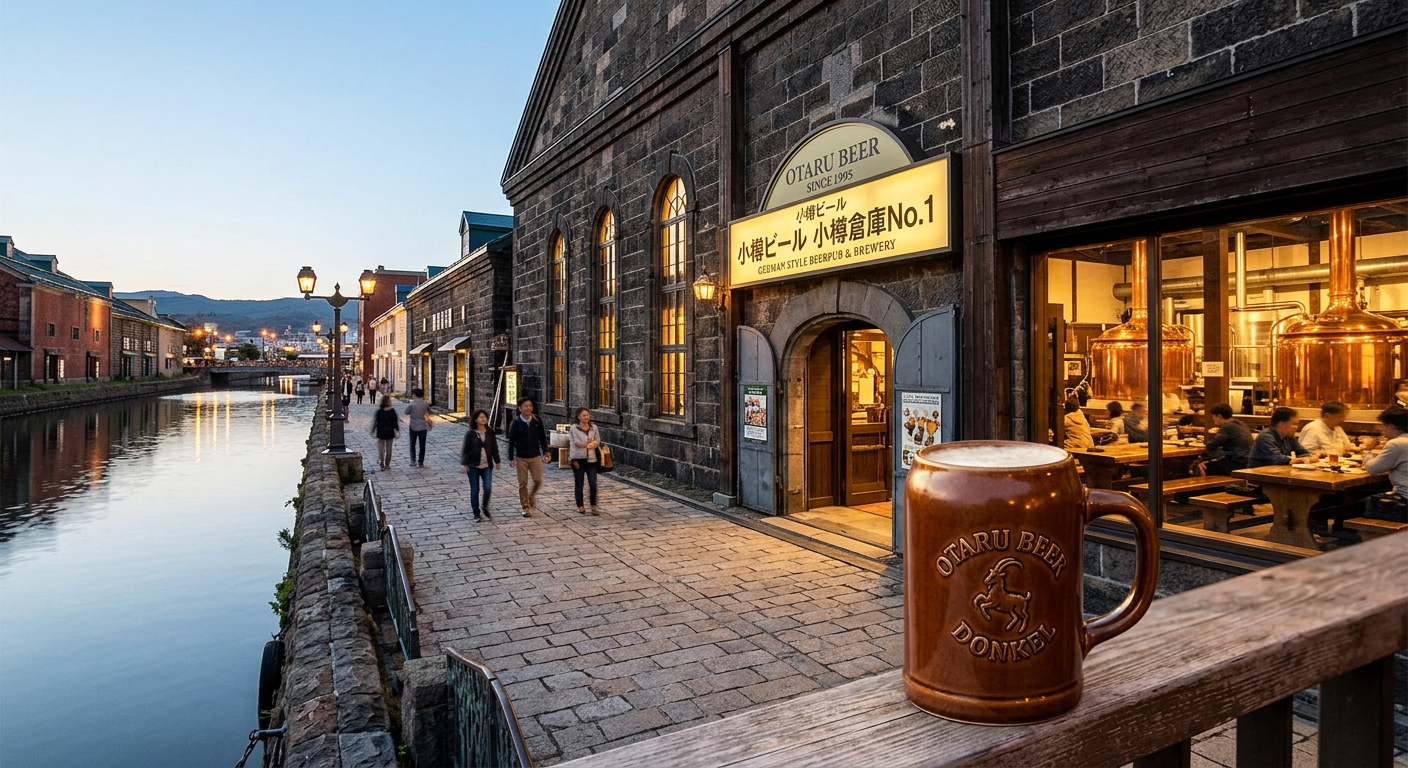
Otaru Beer began in July 1995, when one of the stone warehouses still standing along the Otaru Canal — “Otaru Warehouse No. 1” — was converted into a German-style beer pub. It is run by Alef Co., Ltd., a Sapporo-based company known nationwide for its family-restaurant chain “Bikkuri Donkey.” Alef’s founder was Shoji Akio.
Brewing was entrusted to Johannes Braun, invited from Germany, whose family had been brewing beer since 1753. He studied for five years at a brewing university in Munich, then gained further experience at breweries across Europe and at a whisky distillery in Scotland. The beer is brewed according to Germany’s 1516 Reinheitsgebot (Beer Purity Law), using only malt, hops, yeast and water. As demand grew, a second brewing site opened in Zenibako in 1999 — Braun himself chose the location and designed the equipment. Annual production capacity there is 2,000 kiloliters. The beer is also exported to Russia (Moscow and Sakhalin), Taiwan, Hong Kong, South Korea and Australia, which together account for roughly 8% of production.
The Dunkel featured here is a dark lager built mainly on caramel malt and brewed using double decoction, a traditional German technique in which part of the wort is boiled separately and returned to the mash. The hops stay in the background, letting the malt’s sweetness and roasted character lead. ABV is 5.2%.
The Story of the Land
The Otaru Canal was completed in 1923. But as motorization brought serious traffic congestion in the 1960s, a 1966 plan proposed filling in the canal to widen the road to six lanes — which would have meant demolishing the warehouses around it too. In response, citizens formed the Otaru Canal Preservation Society in 1973, and by 1983 a “Committee of a Hundred” had gathered roughly 100,000 signatures; Hokkaido’s first landscape ordinance was born out of the debate. After years of argument, the prefectural governor’s compromise won out: half the canal would be filled for a road, and the other half preserved as a promenade. The work was completed in 1986, with 63 gas lamps lining the walkway, and the old warehouses around it were converted into shops, museums and restaurants.
Otaru Beer opened its doors at Warehouse No. 1 about a decade later, in 1995 — in one of the warehouses that had survived, on the side of the canal that was never filled in. Beer is still brewed there today.
The Story of the Song
In March 1984, at the height of her popularity, Miyako Harumi announced her retirement, saying she wanted to become “an ordinary woman,” and stepped away from performing after that year’s Kohaku Uta Gassen. She returned to work as a music producer in 1987, made a guest appearance at the 1989 Kohaku, and in 1990 announced she was resuming her career as a singer. Her first single back was “Otaru Unga,” released on June 27, 1990. It was written by Yoshioka Osamu, composed by Tsuru Tetsuya, arranged by Sakuraba Nobuyuki, and released on the Nippon Columbia label. It debuted on the Oricon weekly chart at No. 13 — reportedly her best-ever entry position.
Miyako Harumi was born in Kyoto, and Otaru is not a place she was deeply tied to. Even so, she gave her comeback single the name of a canal that had just narrowly escaped being filled in and had newly established itself as a tourist landmark.
Why This Pairing
Both are stories of something nearly lost that survived in a changed form. The Otaru Canal was almost swallowed by a road, and survived at half its original width because residents spoke up. Miyako Harumi once quit singing because she wanted to be “an ordinary woman,” and found her voice again six years later. Neither came back exactly as it was. The canal is half of what it used to be; her singing was no longer quite the same either. But neither one disappeared.
The flavors connect too. The roasted notes and caramel sweetness of the Dunkel recall the amber-toned wood and brick of old warehouses that once stood at the edge of demolition — nothing flashy, but something that works on you slowly. The voice on “Otaru Unga” carries a different kind of shine than her younger years, one with more weight to it. Both have a depth that only comes from having lasted this long.
Where to Find This Beer
The Rakuten Ichiba link below is an affiliate link.
- Brewery official site:https://otarubeer.com/jp/
- Buy on Rakuten Ichiba: View the product page (330ml, ¥368)
These are Japanese storefronts. If you are visiting the brewery, drinking it fresh at their own taproom is by far the best option.
Pairing Dishes Worth Trying
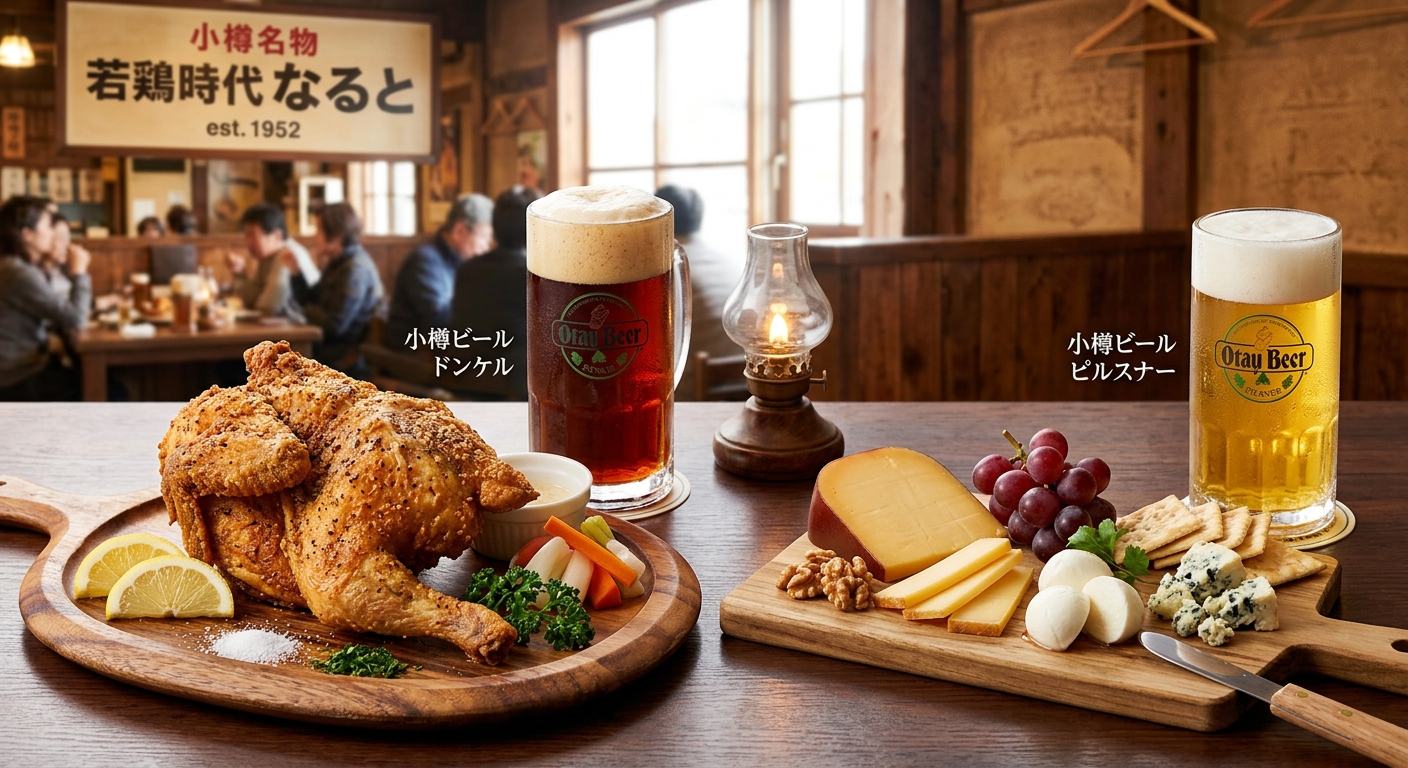
- Wakadori no hanshin-age (half-chicken fried in garlic and pepper)
An Otaru specialty said to have originated at “Wakadori Jidai Naruto,” open since 1952. The browned, garlic-pepper crust runs in the same direction as the Dunkel’s roasted character. - Hokkaido cheese
Semi-hard cheeses in particular. The malt sweetness and gentle bitterness intertwine with the richness and salt of the cheese.
A note on the science: the browning on the fried chicken’s crust comes from the Maillard reaction, sugars and amino acids bonding under heat — the same reaction that gives roasted malt its color and toasty character in a Dunkel. Carbonation’s pressure then rinses away the film of fat that fried food or cheese leaves behind, keeping the next bite feeling just as light as the first.
Visiting the Brewery
Otaru Beer, Otaru Warehouse No.1 (brewpub with an on-site brewery)
5-5 Minatomachi, Otaru City, Hokkaido. About a 12-min walk from Otaru Station.
A stone warehouse on the Otaru Canal; the brew kettle in the middle of the hall is still in use. Free self-guided tours during opening hours (no reservation, about 20 min).
Sights Nearby
- Otaru Canal / Otaru City | right in front of the brewery
A canal lined with Taisho-era stone warehouses, with a walking path; gas lamps are lit from evening. - Sakaimachi Street / Otaru City | ~10-min walk from the brewery
A retro shopping street with Kitaichi Glass, the Otaru Music Box Museum and a run of glasswork and sweet shops.
Hot Springs Nearby
- Yunohana Temiya-den / Otaru City | ~7 min, ~2 km by car from the brewery
A day-use bathhouse with open-air natural hot-spring baths and saunas, on a rise looking down over Otaru Harbour.
Opening hours, closing days and day-use bathing availability can change. Please check each facility’s official information before visiting.
A Quick Glossary of Beer Terms
- Craft beer: Beer made by small breweries that put the character of the maker front and centre, as opposed to the uniformity of mass production.
- Lager: Beer brewed by bottom fermentation, with the yeast working at low temperature and settling toward the bottom of the tank. It tends toward a clean, crisp finish, and most major Japanese beers belong to this family.
- Malt: Germinated barley. It forms the foundation of a beer’s sweetness, colour and body; how deeply it is roasted determines colour and toastiness.
- Hops: The cones of a climbing plant, which give beer its bitterness and aroma. Depending on the variety, that aroma can read as citrus, tropical fruit or open grassland.
Sources
- Otaru Beer official site
- JETRO: Otaru Beer, brewed by a German Brau-Ingenieur, expands overseas including to Russia
- Otaru Canal — Wikipedia (Japanese)
- “Otaru Unga” (song) — Wikipedia (Japanese)
- Miyako Harumi — Wikipedia (Japanese)
If you notice any errors in this article, please don’t hesitate to reach out at info@soundrecords.jp.
Read this article in Japanese: 埋め立てられなかった水面に