日本語で読む | This is the English version of a bilingual article.
Today’s Pairing
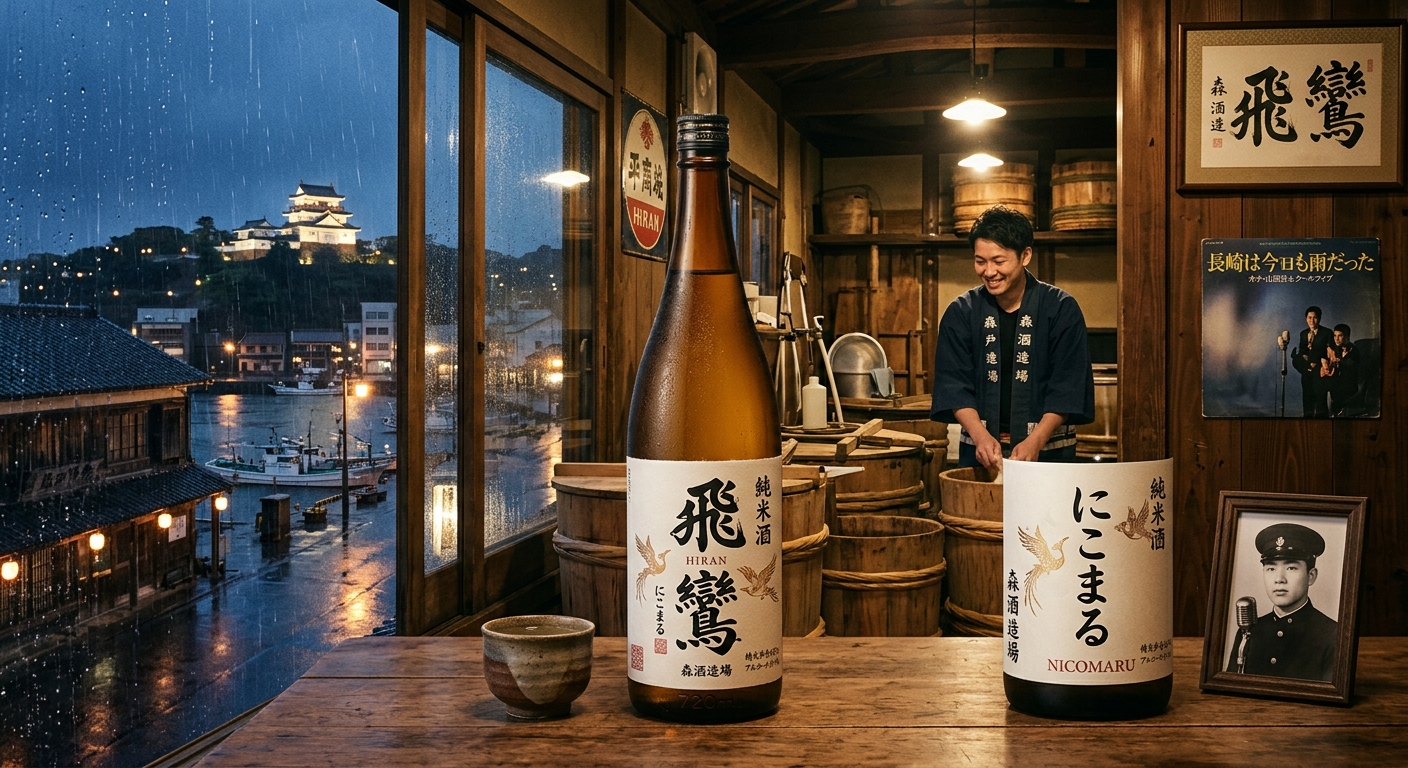
- Sake: Hiran Nikomaru (Junmai) / Mori Shuzojo Co., Ltd. (Hirado City, Nagasaki Prefecture)
Official site: https://mori-shuzou.jp/ - Kayoukyoku (classic Japanese popular song): “Nagasaki wa Kyo mo Ame Datta” (“It Was Raining Again Today in Nagasaki”), performed by Uchiyamada Hiroshi and Cool Five (1969)
YouTube: https://www.youtube.com/watch?v=Txl5MX5kwck
▶ If the player above doesn’t play, open it on YouTube
The Story of the Brewery
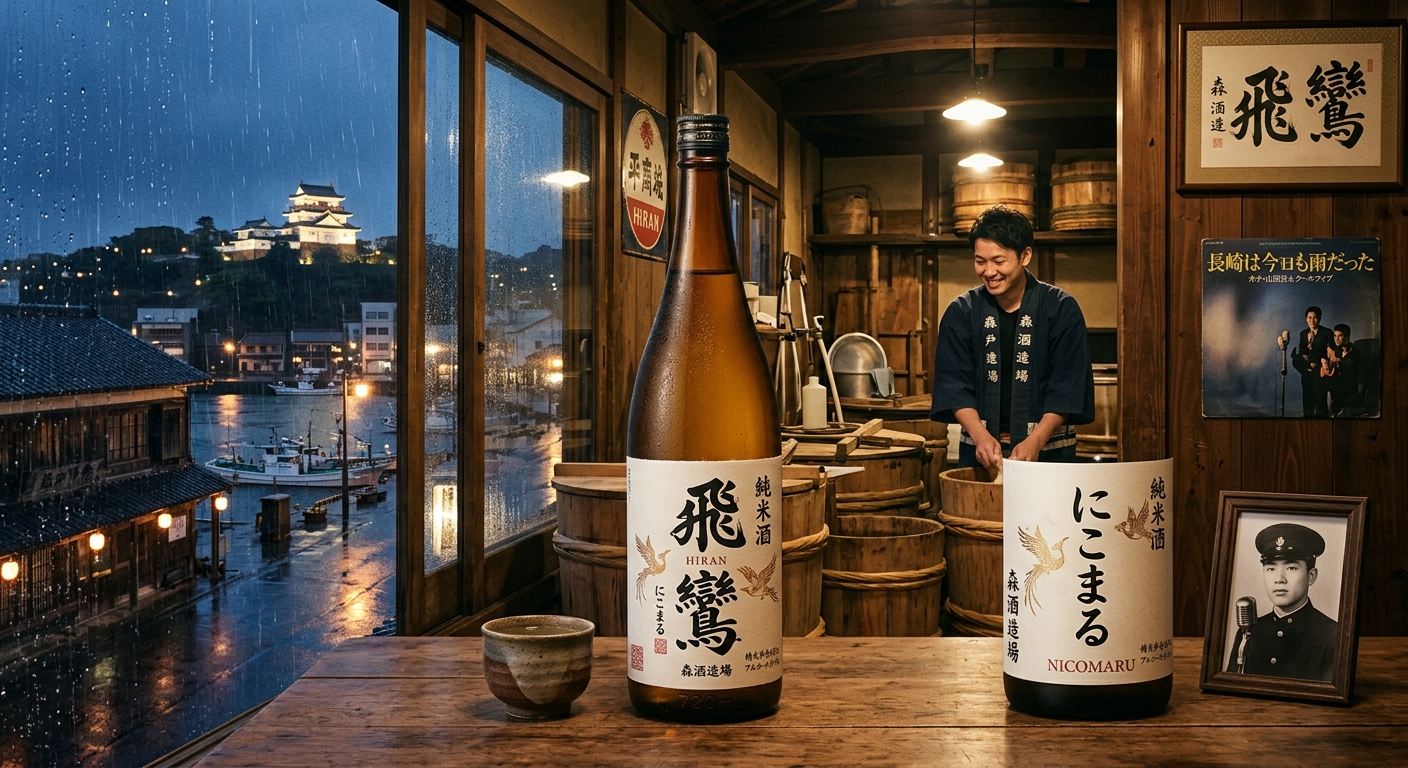
Mori Shuzojo was founded in 1895 by Mori Kokichi, under the shop name “Komatsuya.” The brewery stands at the foot of Hirado Castle, in Hirado, Nagasaki Prefecture — a port town that grew prosperous long ago on the Nanban trade with Europe. For generations it was known locally for a sake called “Kiku no Tsuyu” and a shochu called “Sentekii.” After incorporating in the late 1950s the house brand shifted to “Honen,” and later to the name it carries today: “Hiran.”
The turning point came in 2017, when the fifth-generation owner, Mori Yutaro, came home. He had studied fermentation engineering in the Faculty of Engineering and graduate school at Hiroshima University, researched advanced brewing techniques at the National Research Institute of Brewing, and then spent three years training at a brewery in Miyagi Prefecture. He returned to Hirado at twenty-seven and rebuilt a family business that had been on the verge of closing — work that earned him a reputation as a young prodigy of a toji. His guiding belief is that good sake comes less from brewing technique than from the environment the brewery keeps, and he brews accordingly: kimoto, drawing in lactic acid bacteria naturally; no stirring of the mash; no dilution with water; no filtration.
The bottle in this pairing, Nikomaru, is a junmai made with Yamada Nishiki for the koji rice and Nikomaru — a Nagasaki-grown table rice — for the main mash. Polished to a seimai buai of 65% and bottled undiluted at 14% alcohol, it keeps its aroma quiet and lets the round, generous umami characteristic of Nikomaru rice come forward. It is a bottle made to be drunk without ceremony.
The Story of the Land
Hirado is known as Japan’s first international trading port. Some four hundred years ago, Portuguese, Dutch, and English trading houses stood here, and navigators of the Age of Discovery called it “Firando, the city of the west.”
The brand name “Hiran” reaches back into that old memory of the place. The silhouette of the island was said to resemble the legendary bird known as the ran (Chinese luan), an incarnation of a divine spirit, at the moment of taking flight — so the island was called Hiran-jima, “the island of the flying luan,” and that name is said to have shifted over time into “Hirado.” The brewery took the very origin of its home’s name and made it the name of its sake.
The Story of the Song
“Nagasaki wa Kyo mo Ame Datta” was released on February 1, 1969, as the major-label debut of Uchiyamada Hiroshi and Cool Five. The lyrics are by Nagata Takako and the music by Ayaki Masao. It reached number two on the weekly Oricon chart, placed eighth for the year in 1969, and sold roughly 1.5 million copies. That year it won the Best New Artist award at the 11th Japan Record Awards.
The lead vocalist, Maekawa Kiyoshi, was born in Shikamachi, Kitamatsuura District (today part of Sasebo City), Nagasaki Prefecture. He was singing in a cabaret in Nagasaki when he was scouted and joined the group — though at first he travelled with them as a band boy, carrying the instruments. A producer heard something in him, moved him to lead vocals, and this song became his major debut.
Why This Pairing
Maekawa Kiyoshi’s hometown of Shikamachi sits directly next to Hirado, where Mori Shuzojo stands — two seaside towns on the same Kitamatsuura coast. The rain-soaked Nagasaki harbor the song describes rises from land continuous with the salt-wind memory of the brewery’s own town.
Mori Yutaro sharpened his craft far from home, in Hiroshima and Miyagi, then returned at twenty-seven to rebuild the family brewery. Maekawa Kiyoshi carried instruments before anyone heard him, then was pulled to the front of the stage and given a hit. Both are stories of a long apprenticeship, and of something opening only once the person turned back toward where they came from — a place, a voice. And like the legendary luan of the brand name lifting off toward the far side of the sea, this quietly brewed sake, made from a local rice, is a bottle preparing to fly from Hirado out into the wider country.
Where to Find This Bottle
The Rakuten Ichiba link below is an affiliate link.
- Brewery’s official site: https://mori-shuzou.jp/
- Search on Rakuten Ichiba: Hiran “Nikomaru” Kimoto, pasteurized
Note: both Rakuten and Amazon links above lead to Japan-based retailers. They’re most convenient for readers in Japan, or for those elsewhere who are able to arrange international shipping. Stock and availability change over time, so if you’re near a specialty sake shop, it’s well worth asking for this label by name.
A Pairing Dish Worth Trying
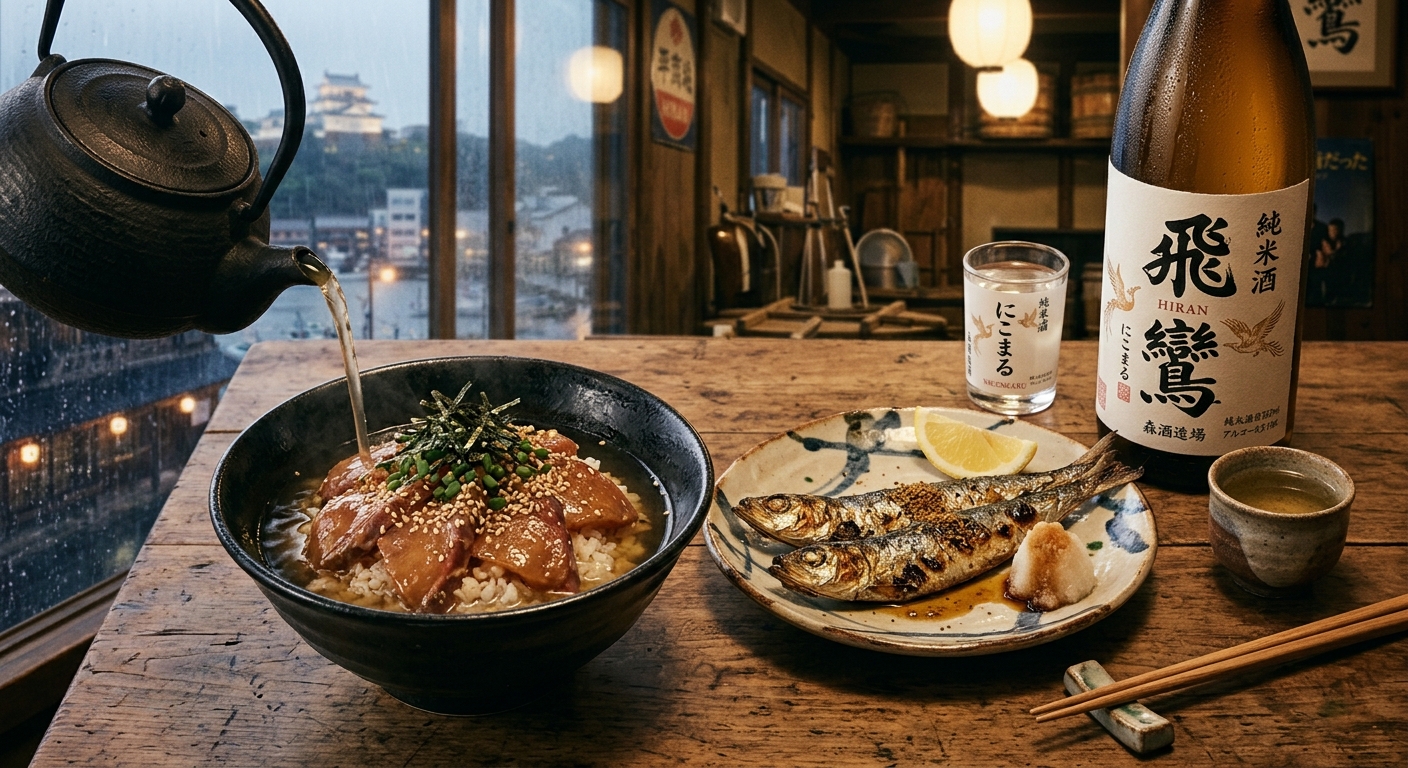
- Goma tai chazuke
Sea bream with sesame sauce over rice, with hot tea or dashi poured across it — a dish long loved in Hirado. The refined sweetness of the bream and the round, quiet umami of Nikomaru settle beside each other without either raising its voice.
Recipe (in Japanese): Kurashiru, “Goma Tai Chazuke” - Grilled whole-dried sardines
Whole sardines, salted and dried, from the waters off Nagasaki among other places. The full-bodied acidity particular to kimoto brewing gathers up the oil and the toasted edge of the fish and leaves the palate clean.
Recipe (in Japanese): Kurashiru, “Easy Pan-Grilled Whole-Dried Sardines”
A note on the science: the glutamic acid that gives sea bream its savory depth and the mild lactic acidity born of kimoto brewing lift each other’s umami in a mutual synergy; and the fragrant oil of the grilled sardine overlaps with the sake’s soft aroma, drawing the finish together and keeping it light.
Visiting the Brewery
Hiran — Mori Sake Brewery
31-2 Shinmachi, Hirado City, Nagasaki. About 5 min by car from the Hirado Ohashi bridge.
The brewery stands in the castle town facing Hirado Harbour, at the foot of Hirado Castle (shop open 9:00-17:00).
Sights Nearby
- Hirado Castle / Hirado City | ~20-min walk (~5 min by car), ~1.5 km from the brewery
The castle of the Matsura lords of the Hirado domain, on the Kameoka hill. Its exhibits were fully renewed in 2021; open 8:30-18:00 (to 17:00 from October to March), ¥520 for adults. - Hirado St. Francis Xavier Memorial Church / Hirado City | ~12-min walk, ~1 km from the brewery
A Gothic-style church built in 1931. The view from behind it, with the church spire rising over temple roofs, is a famous “temples and church” scene (please refrain from visiting during Mass and events). - Hirado Dutch Trading Post / Hirado City | ~10-min walk, ~700 m from the brewery
A 1639 warehouse reconstructed on the nationally designated historic site of the Dutch trading post. Open 8:30-17:30 (last entry 17:00).
Hot Springs Nearby
- Hirado Onsen / Hirado City | ~5 min, ~1.5 km by car from the brewery
Some of the hotels with views of Hirado Castle and the Hirado Ohashi bridge accept day-use bathers (e.g. Kokusai Kanko Hotel Kishotei and Hirado Kaijo Hotel; around ¥800 for adults; check each one’s hours).
Opening hours, closing days and day-use bathing availability can change. Please check each facility’s official information before visiting.
A Quick Glossary of Sake Terms
- Junmai (pure rice sake): Sake made only from rice, rice koji, and water, with no added brewing alcohol — letting the rice’s own umami come through directly.
- Kimoto: A traditional, labor-intensive method of building the sake starter (moto) by naturally cultivating wild lactic acid bacteria, rather than adding purified lactic acid.
- Seimai buai (rice-polishing ratio): The percentage of the original brown rice grain remaining after polishing. The lower the number, the more the rice has been polished down.
Sources
- Mori Shuzojo, brewer of Hiran – Official Site
- Nagasaki wa Kyo mo Ame Datta – Wikipedia
- Maekawa Kiyoshi – Wikipedia
If you notice any errors in this article, please don’t hesitate to reach out at info@soundrecords.jp.
Read this article in Japanese: 雨上がりの港から、鸞は世界へ飛び立つ