日本語で読む | This is the English version of a bilingual article.
Today’s Pairing
- Craft beer: Dogo Beer “Kölsch” (“Botchan Beer”) — 5.0% ABV; 330 ml; brewed from malt (produced in Germany, Canada and elsewhere), hops and wheat / Minakuchi Shuzo Co., Ltd. (3-23 Dogo-Kitamachi, Matsuyama City, Ehime Prefecture)
Official site: https://minakuchi-shuzo.jp/ - Music: “Matsuwa” (“I Will Wait”) by Amin, 1982 / Words and music by Takako Okamura
YouTube: https://www.youtube.com/watch?v=a7WhrI0Bbnk
▶ If the player above doesn’t play, open it on YouTube
The Story of the Brewery
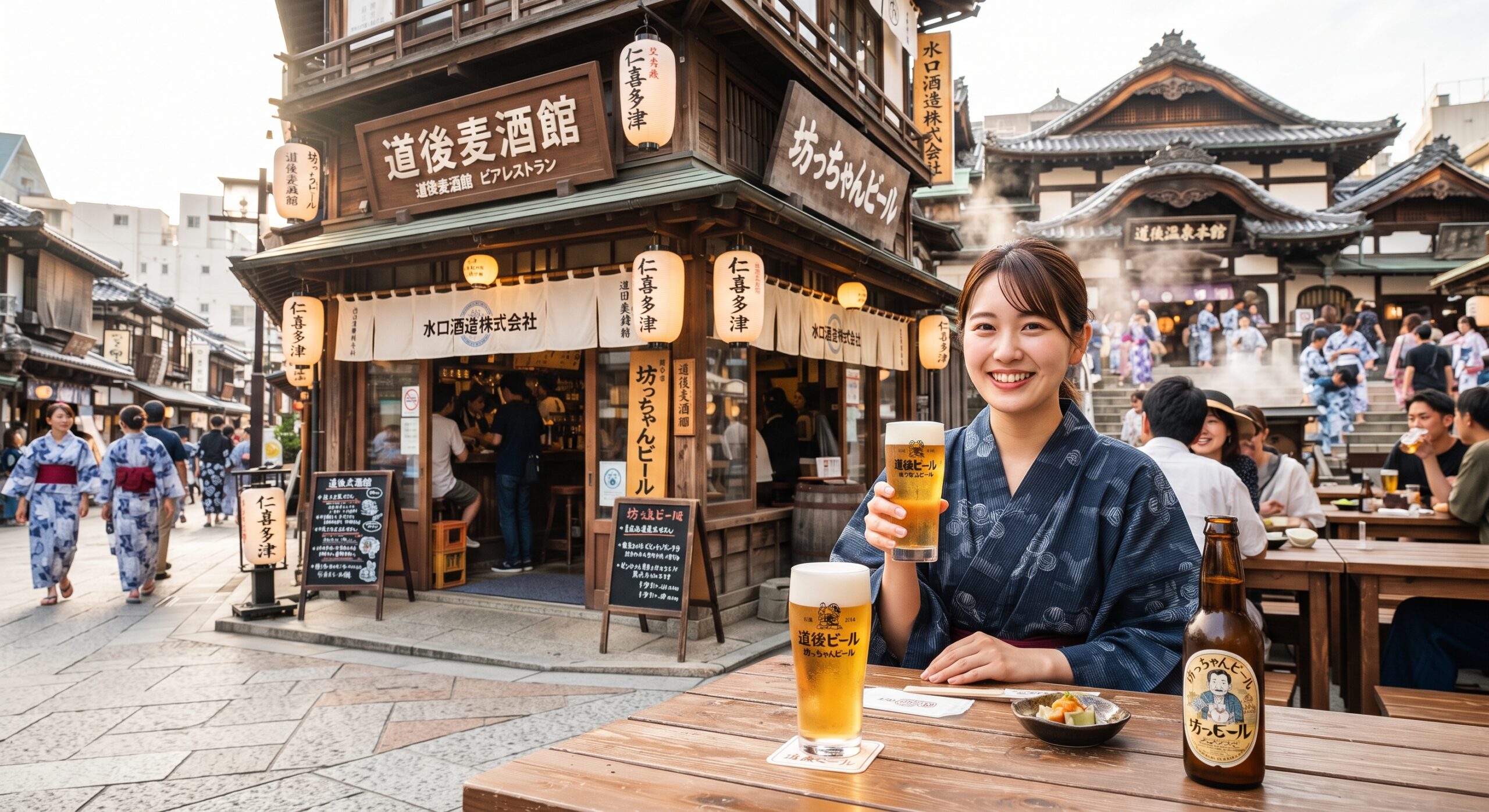
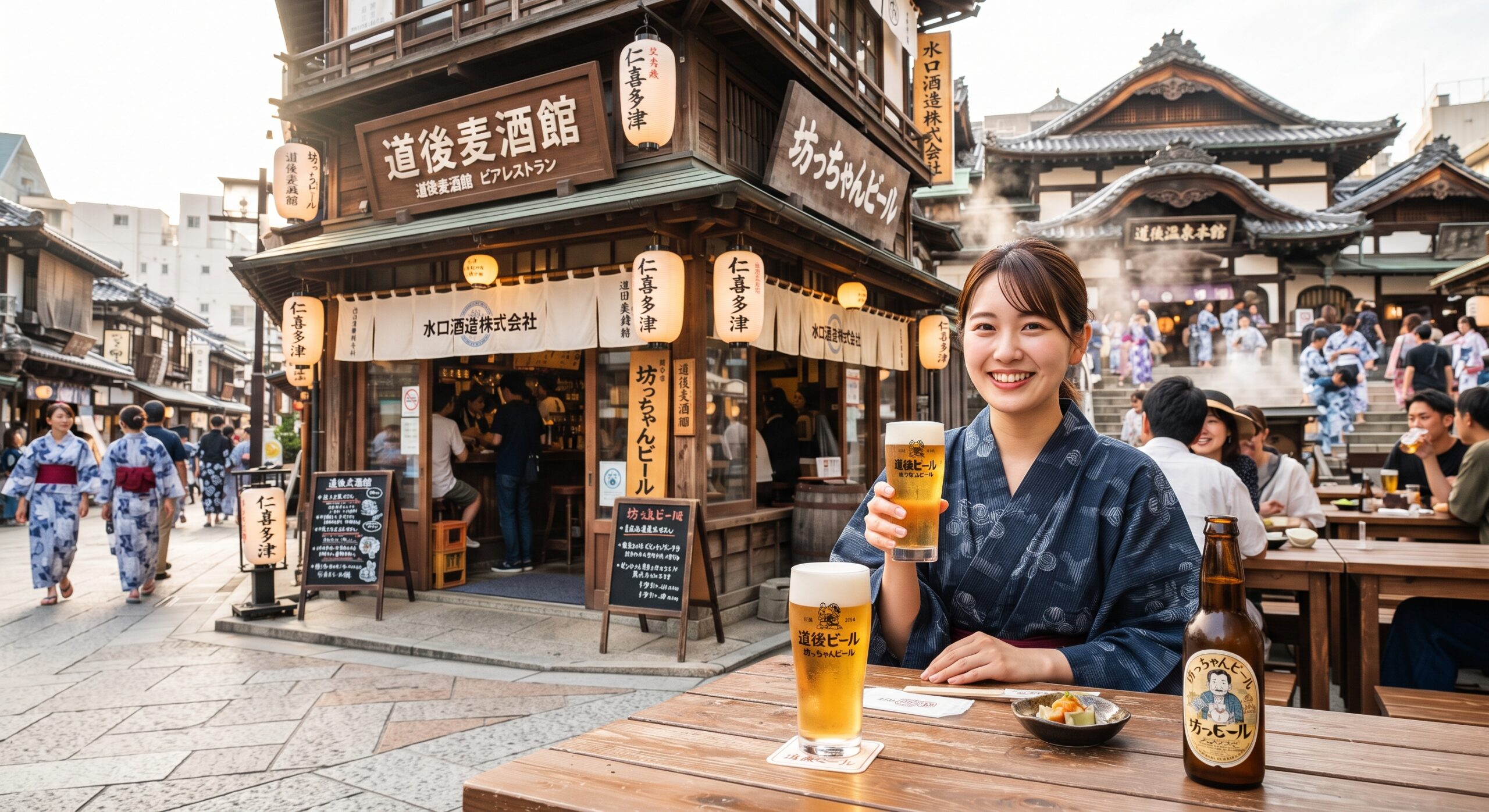
Dogo Beer is brewed by Minakuchi Shuzo, founded in 1895 and now the only sake brewery remaining in the Dogo Onsen district. Its sake, brewed since its founding, is called “Nikitatsu.” According to the brewery’s official site, the name refers to the ancient “Nikitatsu” poem in the Man’yōshū anthology, carrying the meaning “a harbor of benevolence and abundant joy.” On October 1, 2024, fifth-generation head Yoshitsugu Minakuchi stepped back to become chairman, and sixth-generation Kosuke Minakuchi took over as president (per the company’s press release).
The brewery obtained its beer manufacturing license in June 1996 and launched “Dogo Beer” that August. That November, it opened a brewery restaurant, “Dogo Bakushukan,” near Dogo Onsen Honkan (per the Japanese Wikipedia entry for Dogo Beer). Every beer in the line-up carries a nickname drawn from Natsume Soseki’s novel Botchan: the Kölsch is “Botchan Beer,” the Alt is “Madonna Beer,” the Stout is “Soseki Beer,” and the Weizen is “Nobosan Beer.” At the 2000 Japan Beer Grand Prix, the Stout won gold, the Alt silver, and the Kölsch bronze (same source).
The Kölsch featured here, according to the official product description, is brewed using the same fine water of Nikitatsu that gave rise to the sake “Nikitatsu,” drawing on the brewery’s long sake-making expertise in selecting malt and hops and in its brewing method. It uses a generous amount of quality malt and is unpasteurized, with live yeast still in the bottle. Kölsch is a style drunk mainly around Cologne, Germany; the official site describes it as “a mild, crisp beer known for its fruity aroma.”
The Story of the Land
According to the official Dogo Onsen site, the hot spring carries roughly 3,000 years of history and is said to be Japan’s oldest. The main bathhouse building, Dogo Onsen Honkan, became in December 1994 the first public bathhouse in Japan to be designated a National Important Cultural Property.
One of the most famous episodes in that history dates to 661 CE. Empress Saimei, travelling toward Kyushu, stopped at Dogo for over two months to wait for favourable tides, and Nukata no Ōkimi, who accompanied her, composed what is considered one of the representative early poems of the Man’yōshū: “At Nikitatsu, as we wait to set sail, the moon rises and the tide turns favourable — now, let us row out.” (Source: the official Dogo Onsen site.)
The name of Minakuchi Shuzo’s brewing water, “Nikitatsu,” comes directly from this poem. A poem about waiting for conditions to align — composed more than 1,300 years ago — still survives today as the name of the water in the glass. There’s a second coincidence. 1895, the year Minakuchi Shuzo was founded, is also the year Natsume Soseki arrived in Matsuyama to teach English at the prefectural middle school (April 1895 to April 1896, per the Japanese Wikipedia entry for Botchan). Ten years later, in 1906, Soseki published Botchan, based on that year’s experience. Exactly a century after that arrival, in 1996, a beer named after the novel’s characters was born in the very same town.
The Story of the Song
“Matsuwa” (“I Will Wait”) was the debut single of Amin, a duo made up of Takako Okamura and Haruko Kato, released July 21, 1982 on PHILIPS RECORDS / Nippon Phonogram (now Universal Music Japan). Okamura wrote and composed the song in full, with arrangement by Mitsuo Hagita. At the time of release, the pair were still undergraduates at Sugiyama Jogakuen University, and had debuted after winning the grand prize at the 23rd Yamaha Popular Song Contest.
“Matsuwa” reached No. 1 on the Oricon weekly chart and was the top single of 1982 on the year-end chart, with cumulative sales exceeding 1.2 million copies (per the Japanese Wikipedia entry for the song). True to its title, it is a single-minded song about waiting for a lover, unconditionally, for as long as it takes.
Why This Pairing
Nukata no Ōkimi’s Nikitatsu poem and Amin’s “Matsuwa” both sing about waiting, but the waiting itself means something different in each. In the Nikitatsu poem, what’s being waited for is a moment when conditions align — the moon risen, the tide turned. The waiting isn’t the point; it’s preparation for rowing out. In “Matsuwa,” waiting is the point: no condition, no guarantee, just the choice to keep waiting. The same word carries two opposite kinds of waiting, more than 1,300 years apart.
And this beer, too, is a drink you wait for. Dogo Beer is built around the idea of a “post-bath beer,” meant to be opened only after you’ve sat in the hot water a while — you wait, and only then reach for the glass. A beer whose brewing water is literally named after a poem about waiting for the right moment. The waiting in the song, and the waiting after the bath, both end the same way: with something that was building finally arriving, and starting to move.
Where to Find This Beer
The Rakuten Ichiba link below is an affiliate link.
- Brewery official site:https://minakuchi-shuzo.jp/
- Buy on Rakuten Ichiba: View the product page (330ml, ¥4,620)
These are Japanese storefronts. If you are visiting the brewery, drinking it fresh at their own taproom is by far the best option.
Pairing Dishes Worth Trying
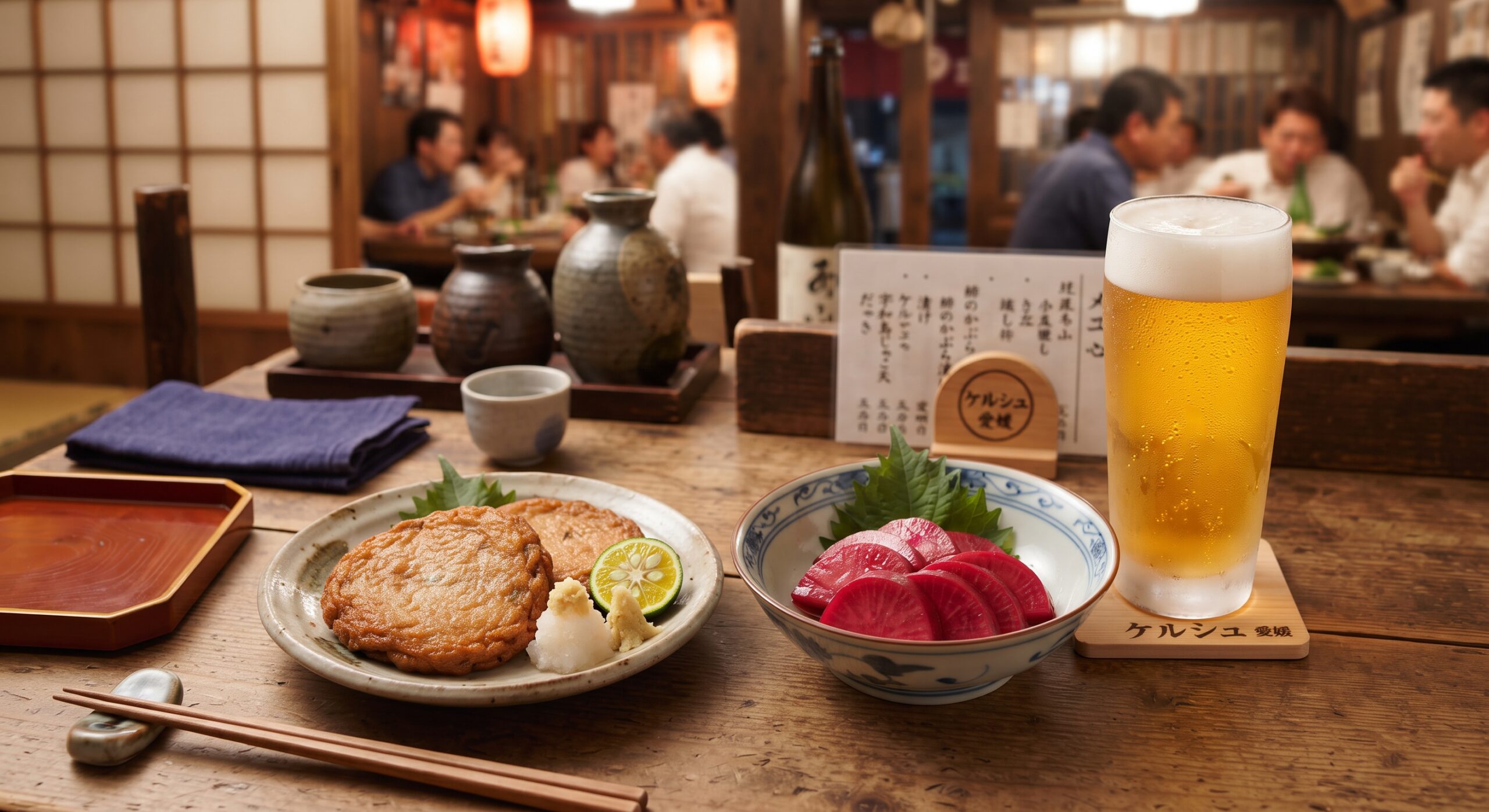
- Jako-ten
According to the Ministry of Agriculture, Forestry and Fisheries’ “Traditional Foods of Japan,” this is a fried fish cake from the Nan’yo region of Ehime (Uwajima, Yawatahama and nearby areas), made by grinding small fish caught in the Uwa Sea — skin, bones and all — into a paste. It’s said to date to 1615, when Date Munemune, first lord of the Uwajima domain, brought fish-cake craftsmen from his native Sendai to recreate a familiar taste. Because the bones are ground in too, it’s also a good source of calcium. Its fried, savoury crunch suits the Kölsch’s crisp finish. - Hi-no-kaburazuke (red turnip pickle)
The same MAFF source traces this Ehime heirloom vegetable pickle to roughly 300 years ago, when Gamo Tadatomo, lord of Matsuyama domain, transplanted turnips from his ancestral home of Hino in Ōmi Province (today’s Shiga Prefecture). It’s pickled in bitter-orange vinegar and sugar, and appears by name in Ehime’s folk song “Iyo-bushi.” Its sweet-and-sour brightness runs in the same direction as the Kölsch’s fruity aroma.
A note on the science: the vivid red of hi-no-kaburazuke comes from anthocyanin pigment in the turnip reacting with the acid in the bitter-orange vinegar — the same chemistry that turns pickled plums or vinegared red cabbage redder as acidity rises. Fried food like jako-ten, meanwhile, pairs well with a beer that has carbonation and a touch of bitterness, since both help rinse the oil coating off your palate so the next bite tastes fresh again.
Visiting the Brewery
Minakuchi Shuzo Co., Ltd. (Dogo Beer)
3-23 Dogo-Kitamachi, Matsuyama City, Ehime Prefecture 790-0848. Founded in 1895, it is the only sake brewery remaining in the Dogo district. It sits a short walk from Dogo Onsen Honkan, past the shopping arcade.
Sights Nearby
- Dogo Onsen Honkan / Dogo-Yunomachi, Matsuyama | a few minutes’ walk from the brewery (just past the shopping arcade)
A three-storey wooden bathhouse that became, in December 1994, the first public bathhouse in Japan to be designated a National Important Cultural Property. The official Dogo Onsen site describes it as carrying a history said to make it Japan’s oldest hot spring. The brewery’s own product page describes the walking route from the Honkan, past the arcade, to the brewery — it’s a distance you can cover on foot.
Hot Springs Nearby
- Dogo Onsen Honkan (Kami-no-yu, ground floor) / Dogo-Yunomachi, Matsuyama | a few minutes’ walk from the brewery
Day bathing in the same building listed above. The ground-floor Kami-no-yu course costs ¥700 for adults, open 6:00–23:00 (last entry 22:30), closed only for one annual cleaning day (confirmed on the City of Matsuyama’s official site). You can bathe, then walk the short distance to the brewery for a glass of Dogo Beer.
Opening hours, closing days and day-use bathing availability can change. Please check each facility’s official information before visiting.
A Quick Glossary of Beer Terms
- Craft beer: Beer made by small breweries that put the character of the maker front and centre, as opposed to the uniformity of mass production.
- Malt: Germinated barley. It forms the foundation of a beer’s sweetness, colour and body; how deeply it is roasted determines colour and toastiness.
- Hops: The cones of a climbing plant, which give beer its bitterness and aroma. Depending on the variety, that aroma can read as citrus, tropical fruit or open grassland.
- ABV: Alcohol By Volume. Beer typically runs around 5%; above 8% is considered a strong, heavier-drinking beer.
- Ji-biru: The name given to the beers that appeared across Japan after the 1994 liquor tax reform opened small-scale brewing. Today most of them are simply called craft beer.
Sources
- Dogo Beer Kölsch (Botchan Beer) 330ml – Minakuchi Shuzo Official Online Shop
- Minakuchi Shuzo Co., Ltd. – Company Profile
- Minakuchi Shuzo, the Only Sake Brewery Left in Matsuyama’s Dogo District, Announces New Management – PR TIMES
- Dogo Beer – Wikipedia (Japanese)
- Minakuchi Shuzo – Wikipedia (Japanese)
- Botchan – Wikipedia (Japanese)
- The Man’yōshū and Dogo Onsen – Dogo Onsen Official Site
- Dogo Onsen – Official Site
- Hours and Pricing – City of Matsuyama Official Site
- Matsuwa – Wikipedia (Japanese)
- Jako-ten, Ehime Prefecture – MAFF, “Traditional Foods of Japan”
- Hi-no-kaburazuke, Ehime Prefecture – MAFF, “Traditional Foods of Japan”
If you notice any errors in this article, please don’t hesitate to reach out at info@soundrecords.jp.
Read this article in Japanese: 満ちるまで、待つ