日本語で読む | This is the English version of a bilingual article.
Today’s Pairing
- Sake: Goninmusume Junmai (brewed by the kimoto method) — made with Nagano-grown Miyamanishiki sake rice, rice-polishing ratio (seimai buai) 70%, 14% alcohol / Terada Honke Co., Ltd. (1964 Kozaki-honjuku, Kozaki-machi, Katori-gun, Chiba Prefecture)
Official site: https://www.teradahonke.co.jp/ - Kayoukyoku (classic Japanese popular song): “Otone Tsukiyo” (“Moonlit Night on the Great Tone River”) by Tabata Yoshio, 1939
YouTube: https://www.youtube.com/watch?v=5-0j58U0M7o
▶ If the player above doesn’t play, open it on YouTube
The Story of the Brewery
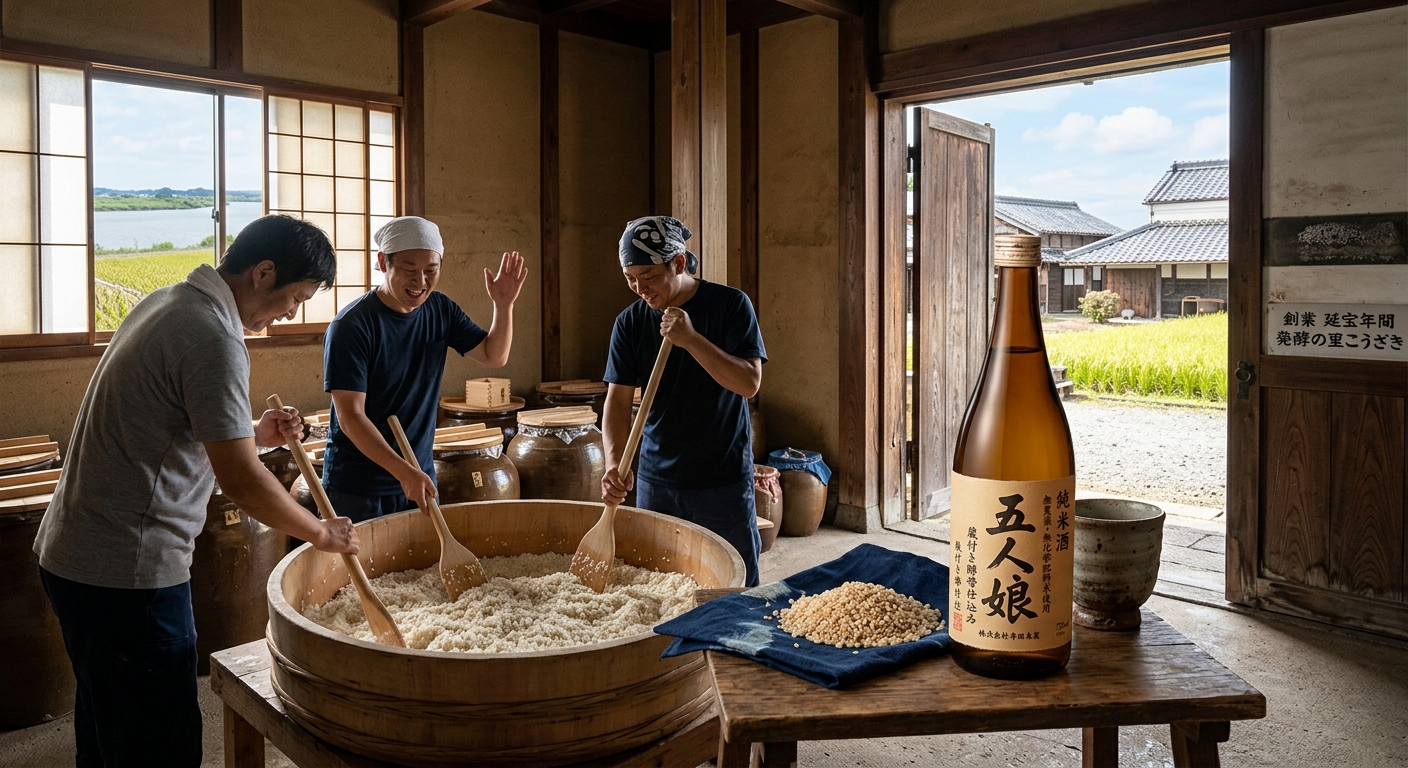
Terada Honke Co., Ltd. traces its founding to the Enpo era (1673–1681), giving it more than 350 years of history. Its current president is Terada Yu, the 24th generation. The brewery’s stated philosophy, on its official site, reads: “At Terada Honke, both the microbes and the people who work here get to work with energy. A wide variety of forces — microbes, people, materials, circumstances — all working together is what produces something delicious and good for you.”
The turning point toward this natural style of brewing came through the 23rd-generation owner, Terada Keisuke. Prompted by his own illness and a crisis in the brewery’s finances, he steered the brewery away from “brewing cheaply” and toward “brewing sake you can trust” — switching to pesticide- and chemical-fertilizer-free rice, relying on the brewery’s own naturally occurring yeast rather than additives, and favoring hand work and song over machinery. After Keisuke passed away, his son, the 24th-generation Terada Yu, carried that intention forward.
Among the brewery’s flagship Goninmusume (“Five Daughters”) line, the Junmai sake paired here is brewed with Nagano-grown Miyamanishiki rice polished to a seimai buai of 70%, at 14% alcohol. No yeast is added — it relies on the brewery’s own naturally occurring yeast in the traditional kimoto method — and it’s bottled unfiltered, straight from the press. In the brewery’s own words, it’s “a gentle sake where the rice’s soft sweetness and umami spread out, tightened by a sharp, bright acidity distinctive to kimoto brewing.”
The Story of the Land
Kozaki, in Katori District, Chiba, where Terada Honke stands, spreads along the banks of the Tone River as it flows toward the Pacific. The town is also home to another brewery with more than 300 years of history, Nabedana’s Kozaki Shuzogura. In April 2015, a roadside station built around these two breweries opened: Michi-no-Eki “Hakko no Sato Kozaki” (Fermentation Village Kozaki), themed entirely around fermentation and selling roughly 300 kinds of fermented foods from across Japan, from sake to miso, soy sauce, and pickles.
Nearby, in Sawara, Katori City, the former residence of Ino Tadataka — who produced Japan’s first map based on actual land surveys — still stands amid an old merchant townscape along the Ono River. A little further on sits Katori Jingu, the leading shrine of old Shimosa Province. All along this stretch of the Tone River, the memory of a land that once prospered on river trade still lingers.
The Story of the Song
“Otone Tsukiyo” was released in 1939, a single by Tabata Yoshio. The lyrics are by Fujita Masato, the music by Nagatsu Yoshiji. That same year, 1939, Tabata had debuted with “Shima no Funauta,” written by the up-and-coming composer Kurawaka Haruo, and went on to hit after hit — “Satokoi Toge,” this song, “Otone Tsukiyo,” then “Wakare-bune” and “Ume to Heitai” — building a reputation as a star vocalist alongside label-mates Shoji Taro and Uehara Bin.
The lyrics follow the feelings of a man gazing at the moon over the Tone River’s flow: “the moon I once watched while laughing — today, today, I see it through a face of tears.” The same river, the same moon — and yet how it looks depends entirely on what has changed in the heart of the one watching. Tabata Yoshio himself was born in 1919 in Matsusaka City, Mie Prefecture, and kept singing this song for decades, until his death in 2013 at the age of 94.
Why This Pairing
“Otone Tsukiyo” sings of a man who once watched the Tone River’s moon with laughter, and now watches the same moon through tears. At its core is that contrast: a river and a moon that stay the same, set against a heart that keeps changing.
Terada Honke, too, is a brewery that never feared change. The 23rd-generation owner, Keisuke, prompted by his own illness and the brewery’s financial crisis, let go of the old way of “brewing cheaply” and remade the brewery around pesticide-free rice and its own naturally occurring yeast — “sake you can trust.” And right beside that brewery, the Tone River still flows on, unchanged, to this day.
A moon that flows unchanged over the river’s surface, and a brewery that chose to keep changing. Along the banks of the Tone River, both have quietly been carried forward to the present day.
Where to Find This Bottle
The Rakuten Ichiba link below is an affiliate link.
- Brewery’s official site: https://www.teradahonke.co.jp/
- Buy on Rakuten Ichiba: View the product page (720ml, ¥1,822)
Note: the links above lead to Japan-based retailers. They’re most convenient for readers in Japan, or for those elsewhere who are able to arrange international shipping. Stock and availability change over time, so if you’re near a specialty sake shop, it’s well worth asking for this label by name.
Pairing Dishes Worth Trying
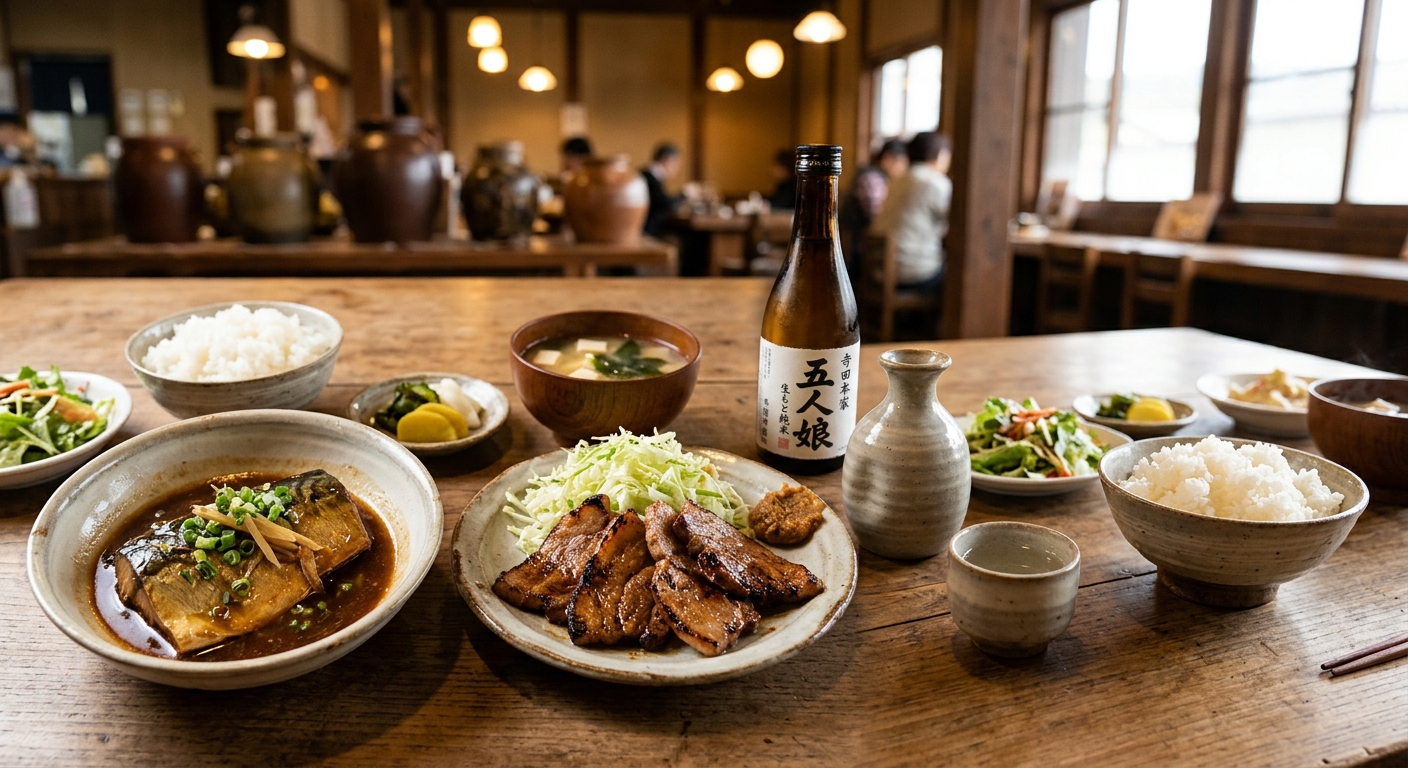
- Saba (mackerel) miso-ni
A dish familiar to this region, also served at the cafe & restaurant of Michi-no-Eki “Hakko no Sato Kozaki.” The umami of fermented miso meets the richness of fatty mackerel, while the bright acidity of this kimoto junmai sake cuts cleanly through the finish.
Recipe (in Japanese): Kurashiru, “Basic Saba Miso-ni” - Pork grilled in miso-koji marinade
Another dish on the same roadside station’s menu. The way koji’s enzymes work to tenderize the meat echoes Terada Honke’s own devotion to its brewery’s natural yeast and koji.
Recipe (in Japanese): Kurashiru, “Rice-Pairing Pork in Shio-koji Miso Marinade” (this recipe combines shio-koji and miso, but miso-koji alone works the same way).
A note on the science: the enzymes (proteases) in miso and koji break down proteins into umami compounds like glutamic acid. The gentle umami and acidity of this sake — itself born from rice koji — resonate with that same fermentation-derived umami, and help carry away the richness of fattier cuts in a clean finish.
Visiting the Brewery
Terada Honke
1964 Kozaki-honjuku, Kozaki-machi, Katori-gun, Chiba. About a 20-min walk from JR Narita Line’s Shimofusa-Kozaki Station; about 3 min by car from Kozaki IC on the Ken-O Expressway.
The Tone River flows right past the brewery, and next door stands another brewery with more than 300 years of history, Nabedana (Kozaki Shuzogura).
Sights Nearby
- Michi-no-Eki “Hakko no Sato Kozaki” (fermentation road station) / Kozaki-machi | ~3 min, ~2.5 km by car from Terada Honke
Opened in April 2015, this roadside station is built entirely around fermentation, selling sake from Terada Honke and Nabedana alongside roughly 300 kinds of fermented foods from across Japan. - Ino Tadataka’s Former Residence & the Sawara townscape / Sawara, Katori City | ~11 min, ~10 km by car from Terada Honke
The former home of Ino Tadataka, who surveyed and mapped Japan, still stands along the Ono River (free admission, 9:00–16:30, closed Dec 29–Jan 1), amid a townscape of old merchant houses. - Katori Jingu Shrine / Katori, Katori City | ~17 min, ~14 km by car from Terada Honke
The leading shrine (ichinomiya) of old Shimosa Province. Tradition holds it was founded in the 18th year of Emperor Jimmu’s reign; the current main hall and gate were built in 1700 under the fifth Tokugawa shogun, Tsunayoshi.
Opening hours and closing days can change. Please check each facility’s official information before visiting.
A Quick Glossary of Sake Terms
- Junmai: Sake made only from rice, rice koji, and water, with no added brewing alcohol. You taste the rice itself, straightforwardly.
- Kimoto: A traditional, labor-intensive method of building the sake starter (moto) by letting naturally occurring lactic acid bacteria establish themselves, rather than adding refined lactic acid.
- Seimai buai (rice-polishing ratio): The percentage of the original grain remaining after milling. The lower the number, the more the rice has been polished down.
Sources
- Terada Honke Co., Ltd. – Official Site
- Company Profile – Terada Honke Official Site
- Goninmusume Junmai 720ml – Terada Honke Official Site
- Tabata Yoshio – Wikipedia (Japanese)
- “Otone Tsukiyo” Lyrics – Uta-Net (Japanese)
- Michi-no-Eki Hakko no Sato Kozaki – Wikipedia (Japanese)
- Ino Tadataka’s Former Residence – Katori City Official Site
- Katori Jingu Shrine – Katori City Official Site
If you notice any errors in this article, please don’t hesitate to reach out at info@soundrecords.jp.
Read this article in Japanese: 利根川の月は、変わり続けるものだけを照らしてきた