日本語で読む | This is the English version of a bilingual article.
Today’s Pairing
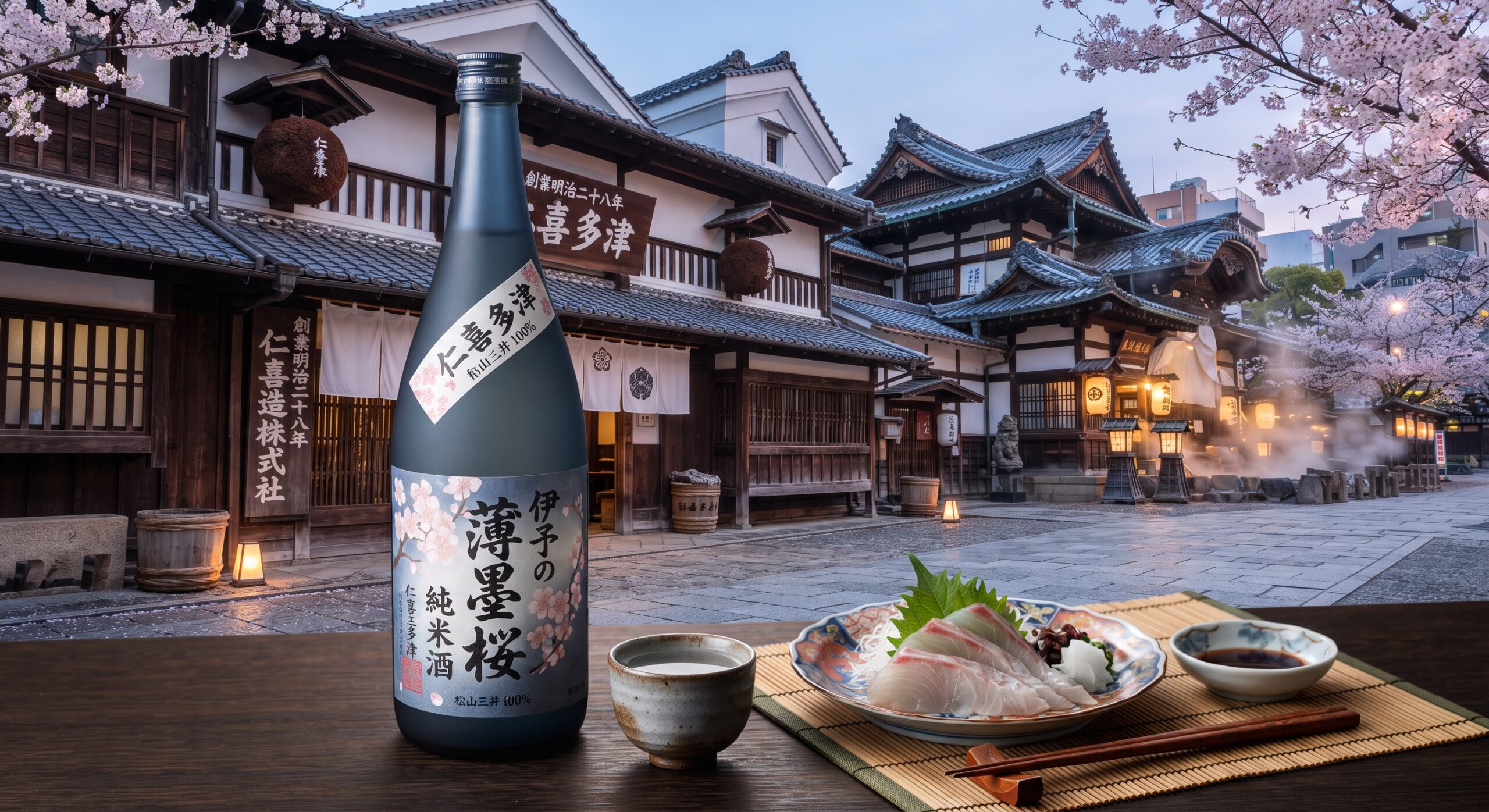
- Sake: Nikitatsu “Iyo no Usuzumizakura” Junmai — brewed 100% with Matsuyama Mii sake rice grown in Ehime, rice-polishing ratio (seimai buai) 70%, 15.5% alcohol, sake meter value (nihonshudo) +3 / Minakuchi Shuzo Co., Ltd. (3-23 Dogo Kita-machi, Matsuyama, Ehime Prefecture)
Official site: https://minakuchi-shuzo.jp/ - Kayoukyoku (classic Japanese popular song): “Iyo no Hito” (“A Woman of Iyo”) by Kitajima Saburo, 1968
YouTube: https://www.youtube.com/watch?v=vDk-CLnC3jU
▶ If the player above doesn’t play, open it on YouTube
The Story of the Brewery
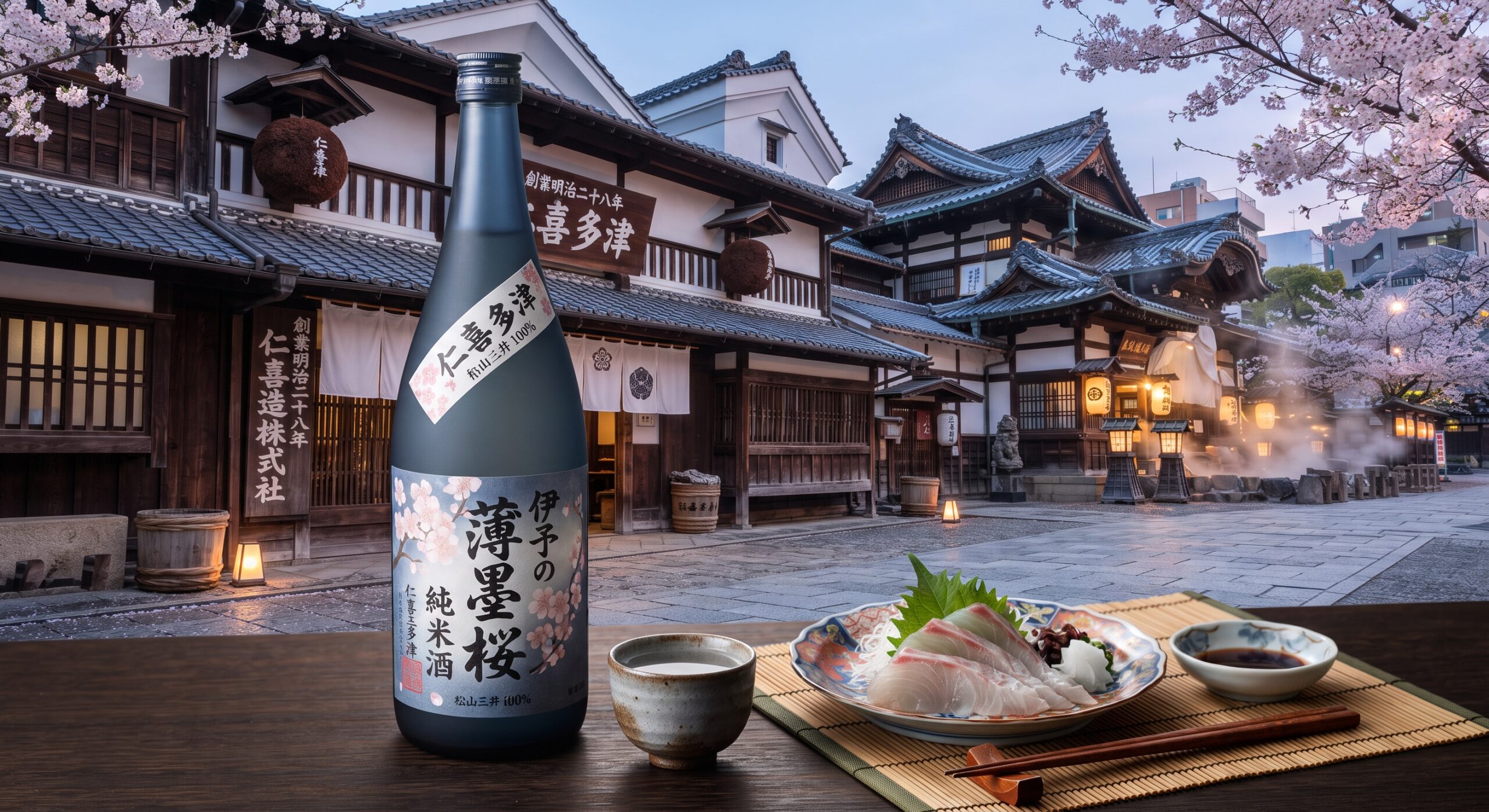
Minakuchi Shuzo Co., Ltd. was founded in 1895 by its first-generation owner, Minakuchi Daishichiro, right next to Dogo Onsen. It has been the only sake brewery in the Dogo district of Matsuyama ever since, supporting the area’s sake culture for over 120 years. Its shop-and-residence building, a wooden two-story structure built in 1917, is now a registered national Tangible Cultural Property. Since October 2024, Minakuchi Kosuke has served as the brewery’s sixth-generation president.
The brewery’s flagship brand, Nikitatsu, was born the same year the company was founded. According to the brewery, the name comes from Nikitatsu, an old name for the port of Dogo that appears in a poem by Nukata no Okimi in the Man’yoshu, Japan’s oldest surviving poetry anthology — chosen for its meaning, “a harbor of benevolence and abundant joy.” The bottle in this pairing, Iyo no Usuzumizakura Junmai — sake made only from rice, rice koji, and water — is brewed 100% with Matsuyama Mii rice grown in Ehime, polished to a seimai buai of 70%, at 15.5% alcohol with a nihonshudo (sake meter value) of +3. It’s a light, dry, clean-finishing sake, and the brewery itself recommends pairing it with sashimi of Ehime-caught tai (red sea bream).
The name itself comes from a single cherry tree at Saiho-ji Temple in Shimoidai-cho, Matsuyama. According to the legend, during the reign of Emperor Tenmu, an empress recovered from an eye ailment after praying to the temple’s principal Buddha while bathing at Dogo Onsen; in thanks, the emperor sent an imperial messenger bearing a pale-ink-colored (usuzumi) edict and a cherry tree as a gift, and the tree came to be called “Usuzumizakura” after the color of that edict. The tree is a Matsuyama City-designated natural monument, and it has been sung about since the Edo period in local folk songs such as “Iyo-bushi” and “Iyo Manzai.”
The Story of the Land
Dogo, where Minakuchi Shuzo stands, is centered on Dogo Onsen, said to be Japan’s oldest hot spring. The main bathhouse building, just steps from the brewery, is a nationally designated Important Cultural Property that still offers day-use bathing today — the brewery and the bathhouse have stood side by side in Dogo’s steam for well over a century.
The history of this place runs deeper still. The Man’yoshu includes a poem by Nukata no Okimi describing a departure by boat from Nikitatsu — believed to be Dogo’s ancient port — and the brand name “Nikitatsu” is a tribute to that very poem. Dogo, in other words, has been a place where people came and went for long enough that it was already being sung about in Japan’s oldest anthology of poetry.
The Story of the Song
“Iyo no Hito” was released on July 1, 1968, on the Nippon Crown label, sung by Kitajima Saburo. The lyrics are by Hoshino Tetsuro, with music and arrangement by Shimazu Nobuo. It’s one entry in Kitajima’s “Hito” (“Women”) series, set in Matsuyama, Ehime, and its lyrics weave in the place names Mitsuhama, Dogo, and the Ishite River.
Kitajima Saburo was born on October 4, 1936, in the village of Shirinai (now the town of Shirinai), Kamiiso District, Hokkaido. After his 1962 single “Namida Bune” sold a million copies, he went on to release hit after hit — “Hakodate no Onna,” “Kyodai Jingi,” “Yosaku,” “Matsuri” — and has appeared on NHK’s year-end Kohaku Uta Gassen since its 14th edition in 1963. “Iyo no Hito,” part of his “Women” series set across the country, is one of the songs that carries Matsuyama’s place names into Japanese popular song.
Why This Pairing
The sake’s name, Nikitatsu, was passed down from the name of Dogo’s ancient port as it appears in a Man’yoshu poem by Nukata no Okimi — a poem more than 1,300 years old, still living on today as the name on a bottle of sake. “Iyo no Hito,” meanwhile, is a Showa-era kayoukyoku that wove the real, still-mapped place names of Matsuyama — Dogo, Mitsuhama, the Ishite River — into its lyrics.
A sake name rooted in an ancient poem, and a place name carried by a modern song: both have looked at the same patch of land, Dogo, from very different centuries. And the cherry tree behind this particular bottle’s own name carries yet another “Dogo set to song” — a tree said to be a gift from an emperor, sung about in Edo-period folk songs ever since. As you lift your cup, it’s worth pausing on just how many centuries of Dogo are folded into it.
Where to Find This Bottle
The Rakuten Ichiba link below is an affiliate link.
- Brewery’s official site: https://minakuchi-shuzo.jp/
- Buy on Rakuten Ichiba: View the product page (720ml, ¥1,540)
Note: the links above lead to Japan-based retailers. They’re most convenient for readers in Japan, or for those elsewhere who are able to arrange international shipping. Stock and availability change over time, so if you’re near a specialty sake shop, it’s well worth asking for this label by name.
Pairing Dishes Worth Trying
- Tai (red sea bream) sashimi with salted kelp
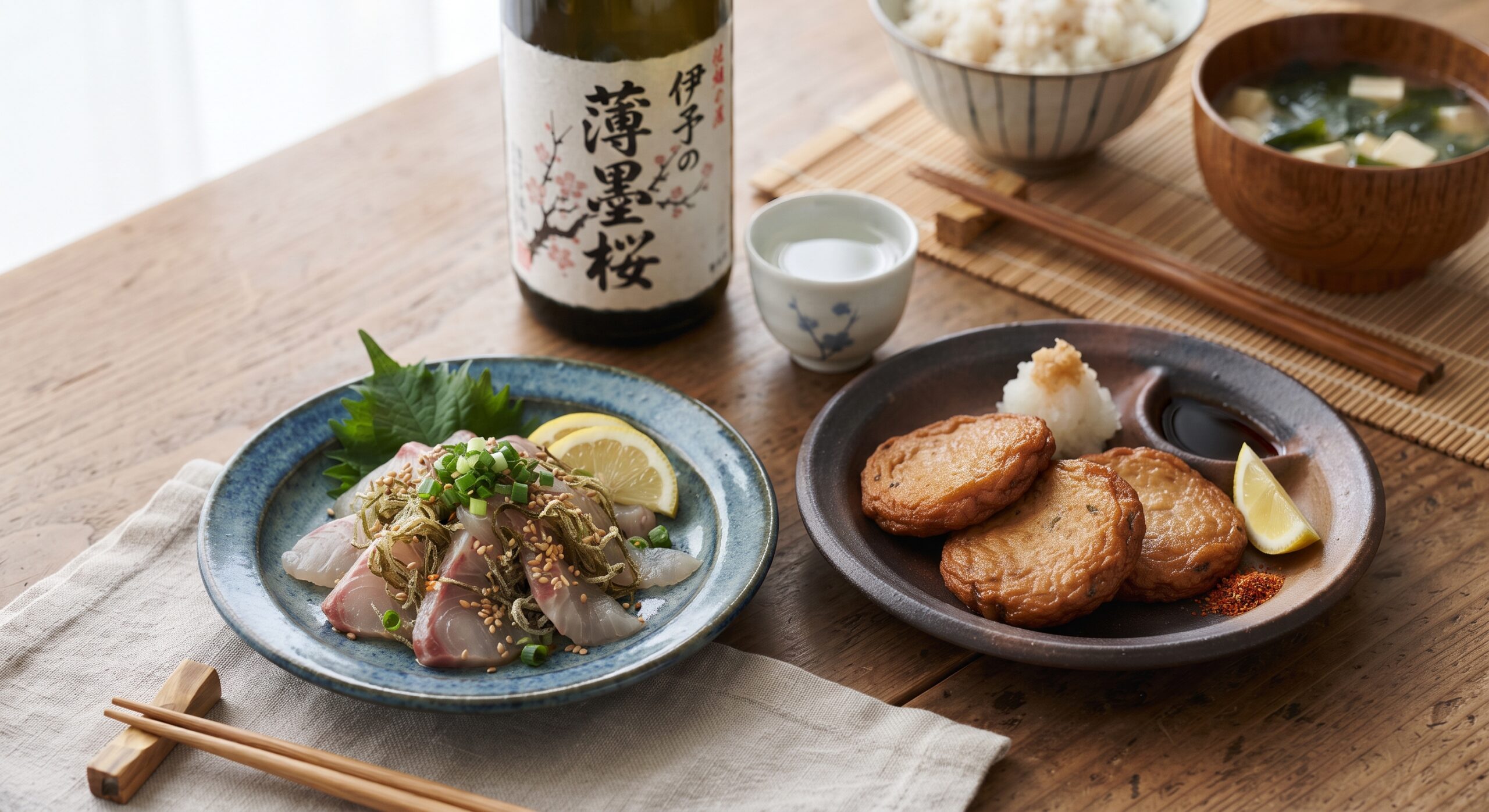
The brewery itself recommends pairing this sake with Ehime-caught tai sashimi. Tossed simply with shio-kombu (salted kelp) and a touch of sesame oil, the tai’s natural sweetness comes through, and the clean, crisp finish of this light, dry junmai lets the fish’s delicate flavor shine without competing.
Recipe (in Japanese): Kurashiru, “Tai Sashimi with Salted Kelp, Made Easy” - Jakoten
A local specialty of Ehime’s Nanyo region, made from deep-fried white fish paste. It’s a familiar bar snack in Matsuyama too. The toasty aroma of the freshly fried fish cake meets the rounded rice umami of a junmai sake.
Recipe (in Japanese): Cookpad, “Jakoten”
A note on the science: glutamic acid in salted kelp and inosinic acid in tai combine to create a synergistic boost in perceived umami, far stronger than either compound alone. Deep-frying, as with jakoten, produces toasty Maillard-reaction aromatic compounds that echo the gentle fragrance of a junmai sake, while the alcohol helps cut through and clear away the richness of the oil on the palate.
Visiting the Brewery
Minakuchi Shuzo (Dogo Brewery)
3-23 Dogo Kita-machi, Matsuyama, Ehime. About a 5-min walk from the Iyotetsu “Dogo Onsen” tram stop; about 28 min (8.6 km) by car from Matsuyama IC on the Matsuyama Expressway, per NAVITIME’s routing to the Dogo Onsen parking area.
Near the main approach to Dogo Onsen, the brewery’s wooden two-story shop-and-residence building, built in 1917, is a registered national Tangible Cultural Property, and it still brews sake, local beer, and more.
Sights Nearby
- Isaniwa Shrine / Dogo, Matsuyama | ~5 min on foot from Minakuchi Shuzo
Guardian shrine of Dogo Onsen, known for its hachiman-zukuri shrine hall — one of only three such examples in Japan, designated a national Important Cultural Property in 1967. A grand Momoyama-style hall sits atop a flight of 135 stone steps. - Ishite-ji Temple / Ishite, Matsuyama | ~5 min, ~1.6 km by car from Minakuchi Shuzo
Temple 51 of the Shikoku pilgrimage. Its Nio Gate is a National Treasure, and the three-story pagoda and bell tower are national Important Cultural Properties. Check opening hours before you visit. - Matsuyama Castle / Marunouchi, Matsuyama | ~9 min, ~2.4 km by car from Minakuchi Shuzo
One of Japan’s twelve surviving original castle keeps, a national Important Cultural Property. A ropeway and chairlift carry visitors up to the main enclosure.
Hot Springs Nearby
- Dogo Onsen Honkan / Dogo Yunomachi, Matsuyama | ~5 min on foot from Minakuchi Shuzo
Said to be Japan’s oldest hot spring; the main bathhouse building is a national Important Cultural Property. It resumed full operations in July 2024 and offers day-use bathing (from ¥700 for the ground-floor Kami-no-yu bath; open 6:00–23:00, last entry 22:30).
Opening hours, closing days and day-use bathing availability can change. Please check each facility’s official information before visiting.
A Quick Glossary of Sake Terms
- Junmai: Sake made only from rice, rice koji, and water, with no added brewing alcohol — letting the rice’s own umami come through directly.
- Seimai buai (rice-polishing ratio): The percentage of the original grain remaining after milling. The lower the number, the more the rice has been polished down.
Sources
- Minakuchi Shuzo Co., Ltd. – Official Site
- Nikitatsu “Iyo no Usuzumizakura” Junmai, 720ml – Minakuchi Shuzo Official Online Store
- “A Brewery Right Next to the Hot Spring: Minakuchi Shuzo” – Minakuchi Shuzo (note)
- Iyo no Hito – Wikipedia (Japanese)
- Kitajima Saburo – Wikipedia (Japanese)
- Hours & Rates – Dogo Onsen Honkan, Matsuyama City Official Site
- Iyo Usuzumi – Cherry Blossom Encyclopedia, Japan Cherry Blossom Association
If you notice any errors in this article, please don’t hesitate to reach out at info@soundrecords.jp.
Read this article in Japanese: 千三百年前の桜も、今日の盃も、道後の湯気の向こうに