日本語で読む | This is the English version of a bilingual article.
Today’s Pairing
- Sake: Seishu Taketsuru “Kimoto Junmai” — 100% Hiroshima-grown Hattannishiki No.1 rice, rice-polishing ratio (seimai buai) 70%, 15.6% alcohol / Taketsuru Shuzo Co., Ltd. (Honmachi 3-chome, Takehara City, Hiroshima Prefecture)
Official site: https://www.taketsuru-shuzou.co.jp/ - Kayoukyoku (classic Japanese popular song): “Tsugaru Kaikyo Fuyugeshiki” (“Winter Scenery of the Tsugaru Strait”) by Ishikawa Sayuri, 1977
YouTube: https://www.youtube.com/watch?v=QhGJQcN70gU
▶ If the player above doesn’t play, open it on YouTube
The Story of the Brewery
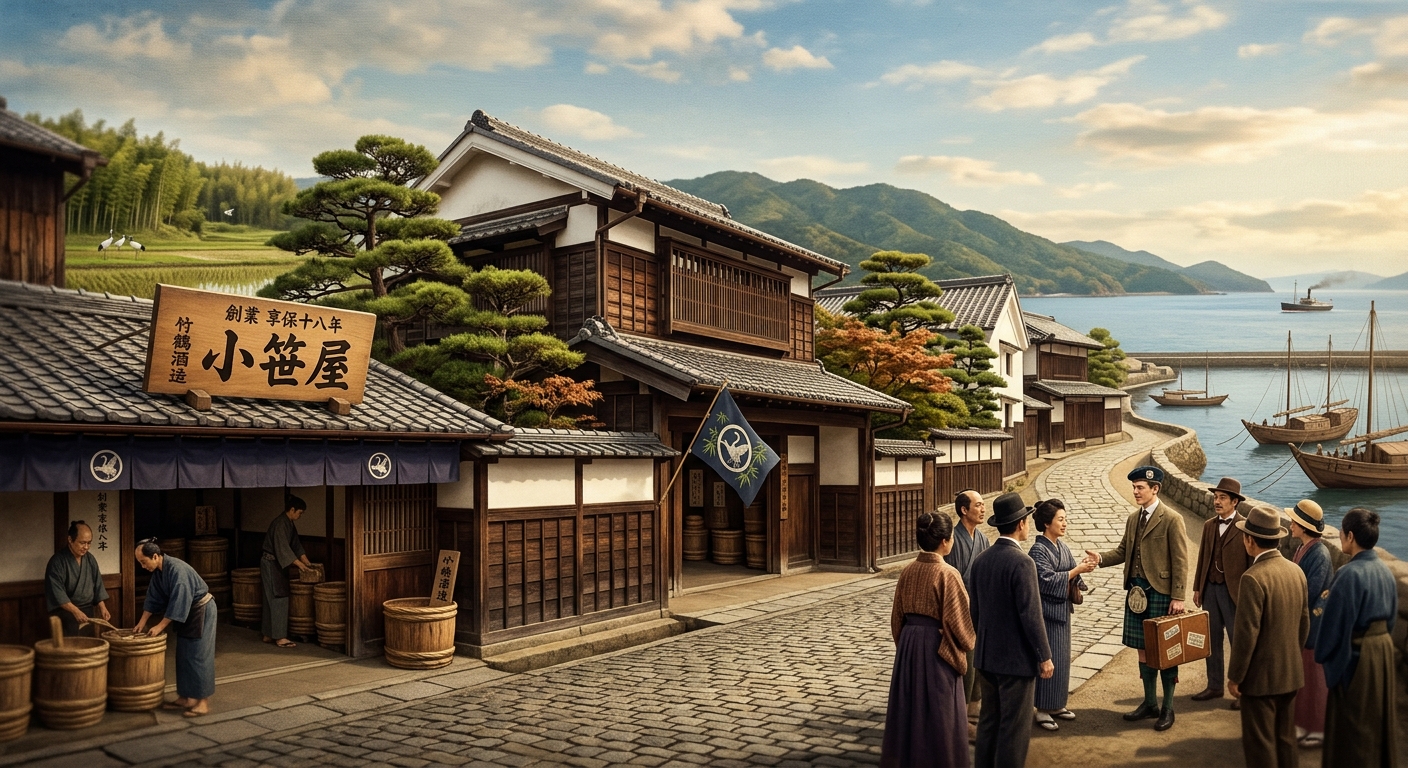
Taketsuru Shuzo’s history begins in the early 1600s, when a family that had moved from Wakayama settled in Takehara, a town on Hiroshima’s Seto Inland Sea coast, and took the name “Taketsuru” (bamboo crane) after a crane was said to have nested, as a good omen, in the bamboo grove behind their home. The family entered the salt-making business around 1650, then expanded into sake brewing in 1733, and adopted the trade name “Ozasaya” in the mid-1800s. In 1888 the brewery joined Hiroshima Prefecture’s first sake brewers’ association, in 1932 sake brewing became its core business, and in 1951 it was incorporated as a stock company. Today’s company president is Taketsuru Toshio.
The brewery is also known as the birthplace of Taketsuru Masataka, who later founded Nikka Whisky and came to be called “the father of Japanese whisky.” Born in Takehara in 1894, Masataka traveled to Scotland in 1918 to study applied chemistry and whisky-making at the University of Glasgow. After returning to Japan, he founded Dai Nippon Kaju Co., Ltd. (now Nikka Whisky) in 1934, in the distant town of Yoichi, Hokkaido. It’s the story of a young man, raised at this brewery, who crossed the sea to learn a craft abroad, then crossed the sea again to start a new kind of brewing in the far north. The brewery’s historic building later served as a filming location for the 2014 NHK morning drama “Massan,” based loosely on Masataka’s life.
The bottle in this pairing, Seishu Taketsuru “Kimoto Junmai,” is brewed from Hiroshima-grown Hattannishiki No.1 rice polished to 70%, using kimoto — a traditional method that cultivates the sake’s fermentation starter by drawing in naturally occurring lactic acid bacteria rather than adding it directly. At 15.6% alcohol and a sake meter value (nihonshu-do) of +19.0, it carries a full-bodied acidity and a crisp, notably dry character. All of the brewery’s core labels are junmai — made only from rice, rice koji, and water — and the brewery describes its sake as meant to be enjoyed alongside food, not on its own.
The Story of the Land
Takehara is a port town on the Seto Inland Sea. Its name appears as far back as the Heian period, in records of the “Aki no Kuni Takehara-sho” estate, land donated to Kyoto’s Kamo Shrine (today’s Shimogamo Shrine) — a history that has earned Takehara the nickname “the little Kyoto of Aki.” In the Edo period, the Hiroshima domain ordered land reclamation here, but the soil proved too salty for rice paddies. Engineers were brought in from Ako, in present-day Hyogo, and from the mid-1600s the town turned to salt production instead. The streets built by merchants who made their fortunes in the salt trade are preserved today as the Takehara Old Town Preservation District.
This port town, which prospered through salt, sake, and coastal shipping, sent no shortage of its people out across the sea. Masataka Taketsuru was one of them. The brewery where he was born and raised has stayed rooted in this same spot, still practicing kimoto, its old traditional method. A son who crossed the sea to create something new, and a brewery that stayed behind to keep its sake alive — two contrasting paths within the same family.
The Story of the Song
“Tsugaru Kaikyo Fuyugeshiki” was released on January 1, 1977, Ishikawa Sayuri’s 15th single. The lyrics are by Aku Yu, with music and arrangement by Miki Takashi. Originally one track on a concept album, “365-nichi Koi Moyou,” released the previous November, it drew wide attention once issued as a standalone single, going on to become a million-seller. That year it won the Japan Record Award for Best Vocal Performance, the Grand Prix and Best Vocal Performance awards at the ’77 FNS Music Festival, and the Popular Award at the 10th Japan Lyricists Award, sweeping many of the year’s major music honors.
The song follows the feelings of a woman boarding an overnight train from Ueno and crossing from Honshu to Hokkaido on the Seikan ferry. For Ishikawa Sayuri, who had until then worked as an idol singer, this song marked her turning point into a full-fledged enka singer, and it has remained her signature song, sung across generations ever since.
Why This Pairing
“Tsugaru Kaikyo Fuyugeshiki” portrays a woman leaving the place she knows, crossing the sea toward the northern land. Masataka Taketsuru, too, left this town on the Seto Inland Sea, crossing the sea twice — first to Scotland, then to Yoichi in Hokkaido — to forge his own path in whisky-making. The song’s protagonist and the young man who left this brewery follow strikingly similar routes, seen from a distance.
And yet the brewery where Masataka was born and raised never crossed the sea itself. It has stayed in Takehara, still cultivating its fermentation starter the old way, through kimoto, drawing on naturally occurring lactic acid bacteria. What crossed over, and what stayed behind — two contrasting choices within a single family. Keep that story in mind as you raise a glass of this full-bodied, acidic sake.
Where to Find This Bottle
The Rakuten Ichiba link below is an affiliate link.
- Brewery’s official site: https://www.taketsuru-shuzou.co.jp/
- Find a shop that carries it: The brewery’s list of stockists
- Buy on Rakuten Ichiba: View the product page (720ml, ¥2,930)
Note: the links above lead to Japan-based retailers. They’re most convenient for readers in Japan, or for those elsewhere who are able to arrange international shipping. Stock and availability change over time, so if you’re near a specialty sake shop, it’s well worth asking for this label by name.
Pairing Dishes Worth Trying
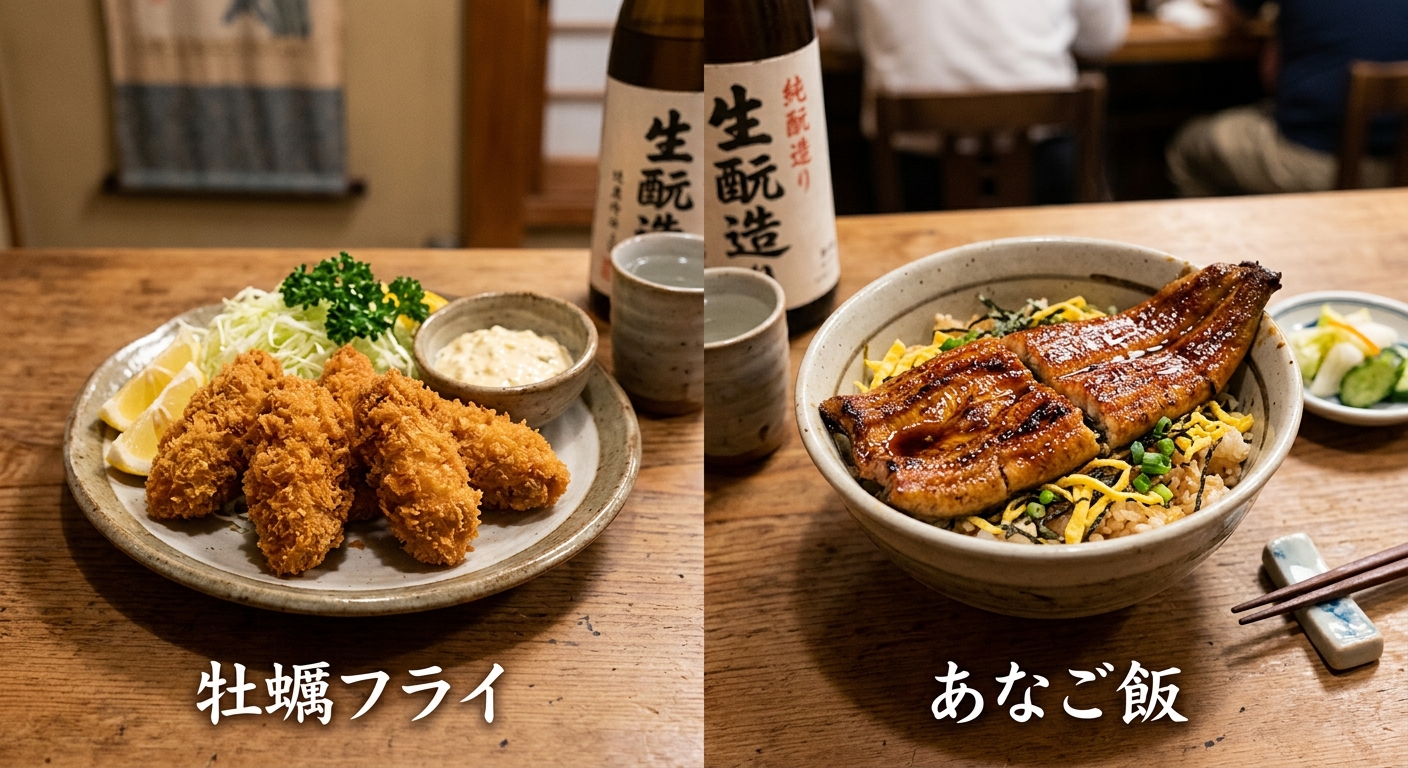
- Kaki fry (fried oysters)
A classic dish built on Hiroshima’s famous oysters. The savory crunch of the breading and the oyster’s deep umami are met by the kimoto sake’s full-bodied acidity, which keeps the finish clean and light.
Recipe (in Japanese): Kurashiru, “Crispy Kaki Fry” - Anago-meshi (grilled conger eel rice)
A local specialty around Hiroshima and Miyajima: rice topped with conger eel glazed in a sweet-savory sauce. Its gentle sweetness and toasted aroma echo quietly against the expanding umami of the sake once warmed.
Recipe (in Japanese): Cookpad, “Anago-meshi”
A note on the science: the glycogen and succinic acid that give oysters their umami harmonize well with the pronounced acidity of kimoto-brewed sake, which in turn cuts cleanly through richness and any briny edge. The caramelized, savory-sweet glaze on grilled conger eel develops aromatic compounds through heat, which resonate with the aromas that rise as the sake is warmed, stretching out the lingering finish on the palate.
Visiting the Brewery
Taketsuru Sake Brewery
3-10-29 Honmachi, Takehara City, Hiroshima. About a 12-min walk from Takehara Station (JR Kure Line).
The brewery stands within the preserved historic district, and is also the childhood home of Taketsuru Masataka, founder of Nikka Whisky.
Sights Nearby
- Takehara Preserved Historic District / Takehara City | the brewery is within this district
A district of merchant houses from the Edo period, when Takehara prospered on salt production; a nationally designated preservation district known as “Aki’s Little Kyoto.” - Okunoshima (Rabbit Island) / Takehara City | ~15 min, ~10 km by car to Tadanoumi port from the brewery, then a ~15-min ferry
An island home to some 900 feral rabbits. The ruins of a former Imperial Army poison-gas storehouse remain, with a museum on site.
Hot Springs Nearby
- Kamogawaso / Takehara City | ~10 min, ~5 km by car from the brewery
An inn in Takehara that accepts day-use bathers. ¥800 for adults; check the days and hours on its official calendar.
Opening hours, closing days and day-use bathing availability can change. Please check each facility’s official information before visiting.
A Quick Glossary of Sake Terms
- Junmai: Sake made only from rice, rice koji, and water, with no added brewing alcohol. Its flavor carries the straightforward umami of rice.
- Kimoto: A traditional, labor-intensive method of cultivating the fermentation starter (moto) by drawing in naturally occurring lactic acid bacteria, rather than adding lactic acid directly.
- Seimai buai (rice-polishing ratio): The percentage of the original grain remaining after milling. The lower the number, the more the rice has been polished down.
Sources
- Taketsuru Shuzo Co., Ltd. – Official Site
- Company Profile – Taketsuru Shuzo Official Site
- Product List – Taketsuru Shuzo Official Site
- Tsugaru Kaikyo Fuyugeshiki – Ishikawa Sayuri Official Site
- Tsugaru Kaikyo Fuyugeshiki – Wikipedia (Japanese)
- Taketsuru Masataka – Wikipedia (Japanese)
If you notice any errors in this article, please don’t hesitate to reach out at info@soundrecords.jp.
Read this article in Japanese: 海を渡っても、変わらぬ生家の酒