日本語で読む | This is the English version of a bilingual article.
Today’s Pairing
- Sake: Junmai Ginjo Kokuryu “Icchorai Junjin” / Kokuryu Shuzo Co., Ltd. (Eiheiji Town, Yoshida District, Fukui Prefecture)
Official site: https://www.kokuryu.co.jp/ - Kayoukyoku (classic Japanese popular song): “Echizen Misaki” (“Echizen Cape”), performed by Kawanaka Miyuki (1982)
YouTube: https://www.youtube.com/watch?v=WQ3HGxsa-rI
▶ If the player above doesn’t play, open it on YouTube
The Story of the Brewery
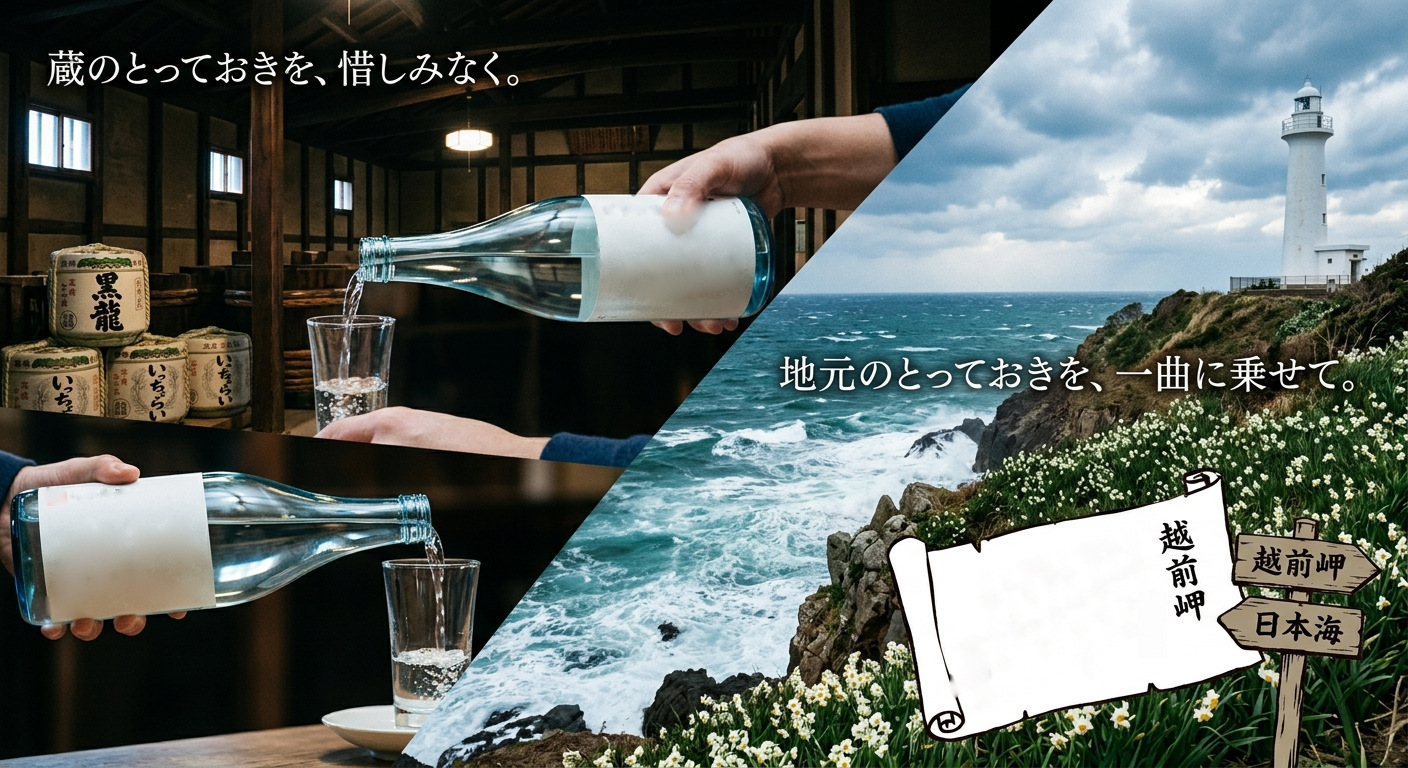
Kokuryu Shuzo was founded in 1804 by its first-generation owner, Ishidaya Nizaemon, in Matsuoka, Eiheiji Town, Fukui Prefecture — a place blessed with underground water flowing down from the Hakusan mountain range. The brewery’s guiding principle, “make good sake,” has been passed down through the generations, and it is now led by its eighth-generation owner, Mizuno Naoto.
A turning point for the brewery came under its seventh-generation owner, Mizuno Masato. Deeply interested in wine, he traveled to France at the age of 25, and after returning to Japan he experimented with applying wine-aging techniques to sake. At the time, daiginjo — sake brewed from rice polished to an especially high degree — was made almost exclusively for brewing competitions, a way for breweries to show off their technical skill rather than something sold to ordinary drinkers. Kokuryu’s decision to sell a daiginjo commercially was, by the brewery’s own account, a nationwide pioneering move, and in 1975 it released “Kokuryu Daiginjo Ryu.” That release spread the image of Kokuryu as synonymous with ginjo-style sake, and established the brewery’s reputation as a “ginjo brewery.”
The bottle in this pairing, Junmai Ginjo “Icchorai Junjin,” is brewed from Gohyakumangoku, a sake rice grown in Fukui Prefecture, polished to a seimai buai (rice-polishing ratio) of 55%. It comes in at 15–16% alcohol. “Icchorai” is a word in the Fukui dialect meaning one’s finest, best-kept outfit — the one saved for special occasions — and the name captures the brewery’s spirit of offering its finest work without holding back.
The Story of the Land
Eiheiji Town is known as the quiet, solemn approach to Eihei-ji, the head temple of the Soto school of Zen Buddhism. Fukui Prefecture also has another face: the Echizen Coast, where the rough waves of the Sea of Japan have carved a long line of sheer cliffs. The setting of this song, Echizen Misaki (Echizen Cape), sits in Echizen Town, Nyu District, facing the Sea of Japan at the eastern edge of Wakasa Bay. Here the steep slopes of the Nyu mountains drop straight into the sea, forming sea cliffs that reach 100 meters in height, dotted with sea caves and oddly shaped rock formations. The cape is also known for its fields of Echizen narcissus, which bloom in winter, and the Echizen Misaki Lighthouse, first lit in March 1940, still watches over the water today.
A quiet mountain town that guards the stillness of Zen, and a sea cape that is forever battered by rough waves — two contrasting faces exist side by side within the same prefecture.
The Story of the Song
“Echizen Misaki” was released as a single by Kawanaka Miyuki on August 5, 1982, with lyrics by Yoshioka Osamu and music by Kishimoto Kensuke. It reached a peak of number 20 on the weekly Oricon chart.
The song set the scenery of the Echizen Coast — its cliffs and its narcissus — to music, turning a wild landscape once known mainly to locals into scenery recognized across the country through the medium of a popular song.
Why This Pairing
Kokuryu’s seventh-generation owner took a daiginjo that, until then, could only be tasted in the closed world of brewing competitions, and boldly released it to the public. The name “Icchorai” — one’s finest, best-kept outfit — captures that same spirit: offering the brewery’s finest work without holding anything back.
“Echizen Misaki” did something similar. A wild stretch of coastline once known mainly to locals was turned, through a single popular song, into scenery recognized across the country. The cliffs and narcissus of Echizen — one of Fukui’s own finest, best-kept sights — were put on display for all to see.
A cup once tasted only within the brewery, and a view once known only to locals. Both share the same gesture: offering up something finest and best-kept, without reservation, so that its appeal can reach someone far away.
Where to Find This Bottle
The Rakuten Ichiba link below is an affiliate link.
- Brewery’s official site: https://www.kokuryu.co.jp/
- Search on Rakuten Ichiba: Kokuryu “Icchorai Junjin”
Note: both Rakuten and Amazon links above lead to Japan-based retailers. They’re most convenient for readers in Japan, or for those elsewhere who are able to arrange international shipping. Stock and availability change over time, so if you’re near a specialty sake shop, it’s well worth asking for this label by name.
Pairing Dishes Worth Trying
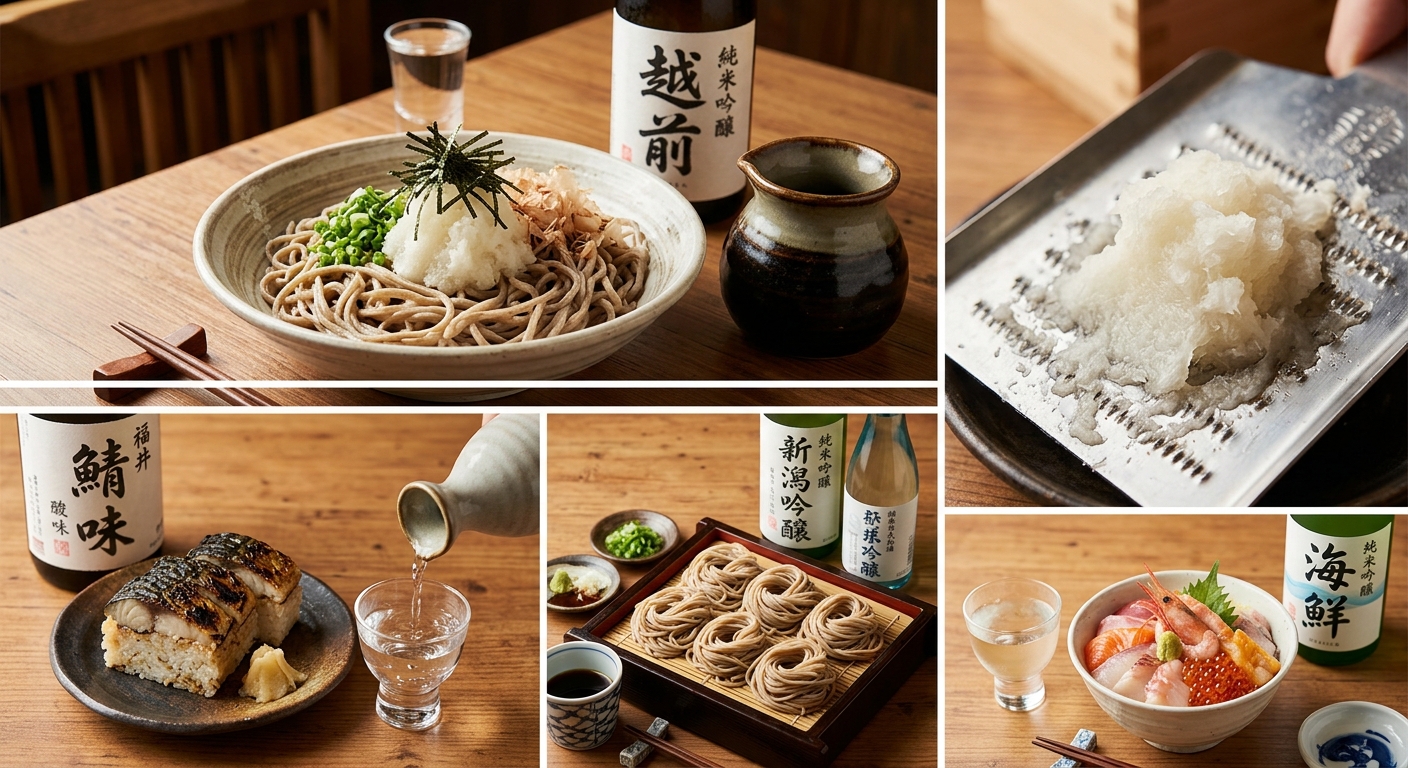
- Echizen oroshi soba (buckwheat noodles with grated daikon)
Fukui’s signature soba dish, topped with a generous mound of grated daikon radish. The bright bite of the daikon doesn’t fight the junmai ginjo’s gentle aroma but sets it off, while the umami in the noodle broth echoes the umami in the sake.
Recipe (in Japanese): Kurashiru, “Refreshing Echizen-Style Oroshi Soba” - Yaki-saba sushi (grilled mackerel sushi)
A staple of Fukui’s table: sushi made with mackerel grilled until fragrant. The rich fat of the mackerel is cut cleanly by the junmai ginjo’s crisp acidity, which also sits naturally alongside the vinegar in the sushi rice.
Recipe (in Japanese): Cookpad, “Easy and Delicious Yaki-Saba Sushi”
A note on the science: the pungent compounds in grated daikon are highly volatile, and overlap in the nose with the fragrant aromatic compounds of a ginjo-style sake, reinforcing the perceived aroma of both. With an oily blue fish like mackerel, the acidity in sake cuts through the fat, a “reset effect” that keeps the aftertaste light.
Visiting the Brewery
Kokuryu Sake Brewery
Matsuoka (the “Kanejojima sake-making village”), Eiheiji Town, Yoshida District, Fukui. About 20 min by car from Fukui Station.
Founded in 1804, the brewery brews with groundwater from the Kuzuryu River.
Sights Nearby
- Eiheiji Temple / Eiheiji Town | ~15 min, ~7 km by car from the brewery
The head temple of the Soto school of Zen, founded by Dogen in 1244. More than seventy halls stand among old cedars, open for visits (admission charged). - Ichijodani Asakura Family Historic Ruins / Fukui City | ~30 min, ~15 km by car from the brewery
The remains of the castle town of the warlord Asakura clan (a Special Historic Site and Special Place of Scenic Beauty), with a reconstructed townscape you can walk through.
Hot Springs Nearby
- Eiheiji Onsen Zen no Sato / Eiheiji Town | ~10 min, ~5 km by car from the brewery
A day-use natural hot spring next to the “Zen no Sato” roadside station, with water drawn from about 1,700 m underground, plus an open-air bath and sauna.
Opening hours, closing days and day-use bathing availability can change. Please check each facility’s official information before visiting.
A Quick Glossary of Sake Terms
- Junmai Ginjo: A junmai (pure rice) sake — made only from rice, rice koji, and water, with no added brewing alcohol — brewed from rice polished to 60% or less of its original size (a “ginjo” level of polish) and fermented slowly at low temperatures, giving it a fragrant aroma.
- Seimai buai (rice-polishing ratio): The percentage of the original brown rice grain remaining after polishing. The lower the number, the more the rice has been polished down.
Sources
- Kokuryu Shuzo – Official Site
- “Ryu” 50th Anniversary – Kokuryu Shuzo Official Site
- Kawanaka Miyuki – Wikipedia (Japanese)
- Echizen Misaki – Wikipedia (Japanese)
- Kokuryu Shuzo – Wikipedia (Japanese)
- Icchorai (Fukui dialect) – Wikipedia (Japanese)
If you notice any errors in this article, please don’t hesitate to reach out at info@soundrecords.jp.
Read this article in Japanese: 荒波の岬から、とっておきの一献を