日本語で読む | This is the English version of a bilingual article.
Today’s Pairing
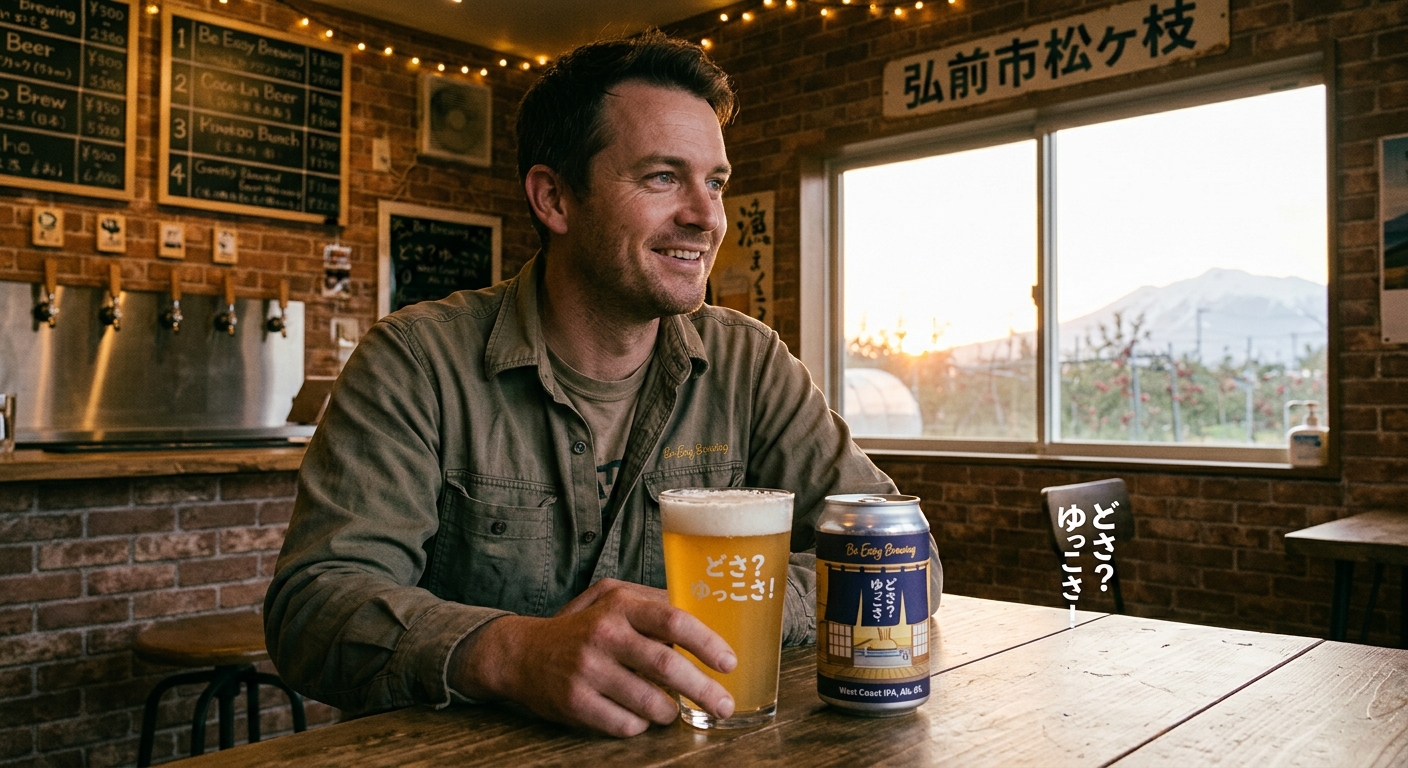
- Craft beer: Be Easy Brewing “Dosa?Yukkosa!” — West Coast IPA, ABV 6%, 350ml can. Malt: Pilsner, wheat, carapils. Hops: CTZ, Centennial, Comet, Motueka, Simcoe, Mosaic Cryo / Be Easy Brewing (Matsugae, Hirosaki, Aomori)
Official site: https://www.beeasybrewing.com/ - Music: “Ringo no Namida” (Tears of an Apple) by Ningen Isu, track 4 on their 1990 major-label debut album Ningen Shikkaku
YouTube: https://www.youtube.com/watch?v=mAO8mGuXbi8
▶ If the player above doesn’t play, open it on YouTube
The Story of the Brewery

Be Easy Brewing sits in the Matsugae district of Hirosaki, Aomori, and was founded in October 2016. Its president, Gareth Anson Burns, was born in Fort Collins, Colorado in 1984 and raised in Philadelphia, Pennsylvania.
After high school he joined the United States Air Force, serving on an explosive ordnance disposal team with deployments including the Middle East. At twenty he was posted to Misawa Air Base in Aomori Prefecture, and there he met Japanese culture and the people of Aomori. After leaving the service he moved to Hirosaki, opened an English conversation school, took up the Tsugaru shamisen, and began appearing on television as a performer who speaks the Tsugaru dialect. For one Aomori Asahi Broadcasting program he visited all forty municipalities in the prefecture.
In autumn 2016 he opened the brewery and its taproom, Gareth’s Hideout, in Hirosaki. In summer 2020 came Aomori Brew Pub in the city of Aomori, and the brewery now ships from Hirosaki to all forty-seven prefectures.
One decision was made on day one and never revisited: the beers would be named in Tsugaru dialect.
As the brewery tells it, the craft beer world of 2016 was full of English and stylish foreign lettering, and dialect was treated as something countrified, best avoided. Putting what is often called the hardest dialect in Japan on a premium beer was, by ordinary marketing logic, nothing but a risk. They did it anyway, because they “did not want a beautiful vocabulary, a history, a language of its own to vanish as a relic of the past.”
One of the first beers was Azumashi. Since then the lineup has carried names like Keyagu, Waiha, Hecho-pe, Nepute, Abe! Ikudo! and Ohayogosu. When someone anywhere in the world picks up one of these cans, the brewery writes, they wonder what the name means and go looking for the answer themselves — and that search, starting from a single glass rather than from a government campaign, is the best introduction to the dialect they can imagine.
“Dosa? Yukkosa!” belongs to that line. It takes an ordinary exchange — “Where are you off to?” “The bath!” — and makes it the name. The style is West Coast IPA at 6% ABV: grapefruit and pine resin on the nose, a firm bitterness, then a dry, clean finish. As the brewery puts it, this is a beer meant for after the bath.
The Story of the Land
Hirosaki grows roughly twenty percent of Japan’s apples, making it the country’s leading apple-producing city. More than 170,000 tons are harvested each year, and in 2020 the city ranked first among all Japanese municipalities in agricultural output from fruit, at 38.26 billion yen.
The Tsugaru dialect is the language of that same ground. Its speakers are dwindling, and younger generations use it less — the familiar path of dialects across Japan. Gareth Burns was born and raised in the United States, and he treated this language as something that must not disappear. That an outsider treated it that way is, to me, the most interesting part of the story.
The Story of the Song
Ningen Isu was formed in 1987 by Shinji Wajima and Ken-ichi Suzuki, both from Hirosaki. Wajima was born in the city on 25 December 1965. The band made its major-label debut on 21 July 1990 with the album Ningen Shikkaku, and “Ringo no Namida” is its fourth track.
A band name taken from a story by Edogawa Ranpo, a sound built on 1970s British hard rock, performances in traditional Japanese dress: every one of those choices ran against the fashion of the day. And in “Ringo no Namida,” the apples of Hirosaki and the sound of the Tsugaru tongue became a song.
The performance here comes from the live album Shippu Doto: Ningen Isu Live! Live!!
Why This Pairing
Both put the language of their own ground at the center, without embarrassment.
In 1990, Ningen Isu faced away from the fashion of the moment and made its debut singing about Hirosaki apples. In 2016, Gareth Burns took a dialect that was being avoided as countrified and put it on a premium beer. Two decisions, twenty-six years apart, setting out from the same city.
One was made by people born and raised on that ground. The other by someone born in America who fell for the place and stayed. Put the two side by side and you can see that a language can be kept from either direction, inside or out.
And “Dosa? Yukkosa!” is a beer for after the bath. When you crack the can, you will probably find yourself turning that little exchange over on your tongue once. Which is exactly what the brewery was after.
Where to Find This Beer
The Rakuten Ichiba link below is an affiliate link.
- Brewery official site:https://www.beeasybrewing.com/
- Buy on Rakuten Ichiba: View the product page (350ml, ¥850)
These are Japanese storefronts. If you are visiting the brewery, drinking it fresh at their own taproom is by far the best option.
Pairing Dishes Worth Trying

- Igamenchi
Squid tentacles and vegetables chopped fine and deep-fried — a local dish eaten mainly around Hirosaki. The firm bitterness and carbonation rinse the oil from the finish.
Recipe (in Japanese): Kurashiru, “Igamenchi, Aomori’s Soul Food, Loaded with Squid” - Karaage (Japanese fried chicken)
The brewery itself lists this among the food pairings for this beer, alongside gyoza and pizza. The toasty crust and the resinous side of the hops point in the same direction.
Recipe (in Japanese): Kurashiru, “Juicy Fried Chicken, the Basic Recipe”
A note on the science: hop bitter compounds (the isohumulones) and carbonation both make the film of oil left in the mouth harder to perceive. That is why fried food and IPA are so often paired, and a West Coast IPA — low in residual sugar, dry on the finish — resets the palate with every sip. The toasty aromatic compounds formed when batter is fried at high heat (products of the Maillard reaction) also run close to the resinous side of hop aroma, so the two do not fight.
Visiting the Brewery
Be Easy Brewing (Gareth’s Hideout)
5-7-9 Matsugae, Hirosaki, Aomori. About a 10-minute drive from JR Hirosaki Station.
The brewery occupies the ground floor; the taproom, Gareth’s Hideout, is upstairs. Beer to go is sold daily 9:00–18:00; the taproom opens Wednesday to Saturday, 17:00–22:00.
Sights Nearby
- Hirosaki Park (Hirosaki Castle) / Hirosaki | ~6 min, ~4 km by car from the brewery
The grounds of the Tsugaru clan’s castle, now a public park. In August 2026, roughly ten years after being moved aside for stonework repairs, the castle keep was hauled back onto its original stone base. The event was called “Hippare! Keppare! Hirosaki Castle” — keppare, meaning “keep at it,” is Tsugaru dialect. - Saishoin Five-Story Pagoda / Hirosaki | ~5 min, ~3 km by car from the brewery
A nationally designated Important Cultural Property. It was commissioned to hold memorial services for those who died during the unification of Tsugaru — on both sides, without distinction. Construction began in 1656 and was completed in 1667.
Hot Springs Nearby
- Owani Community Center Wanicome / Owani Town | ~15 min, ~13 km by car from the brewery
Its day-use bath, Wani-no-Yu, is open 9:00–22:00. This is, in effect, the answer the beer’s name is waiting for: asked “Dosa?” — where are you off to? — you can reply “Yukkosa,” to the bath.
Opening hours, closing days and day-use bathing availability can change. Please check each facility’s official information before visiting.
A Quick Glossary of Beer Terms
- Craft beer: Beer made by small breweries that put the character of the maker front and centre, as opposed to the uniformity of mass production.
- IPA: India Pale Ale. A pale ale with hops pushed much further, so bitterness and aroma both come forward.
- Malt: Germinated barley. It forms the foundation of a beer’s sweetness, colour and body; how deeply it is roasted determines colour and toastiness.
- Hops: The cones of a climbing plant, which give beer its bitterness and aroma. Depending on the variety, that aroma can read as citrus, tropical fruit or open grassland.
- ABV: Alcohol By Volume. Beer typically runs around 5%; above 8% is considered a strong, heavier-drinking beer.
- Ale: Beer made by top fermentation, with the yeast working near the surface at close to room temperature. It tends toward fruity aromas and a fuller body.
Sources
- Be Easy Brewing — official site
- Be Easy Brewing — “Dosa?Yukkosa! – West Coast IPA”
- Be Easy Brewing — “Carrying the Tsugaru dialect forward through beer”
- City of Hirosaki — “Apple Kingdom”
- Hirosaki Park official information (City of Hirosaki)
- Aomori Prefectural Board of Education — Saishoin Five-Story Pagoda
- Owani Community Center Wanicome — official site
- Ningen Isu (band) — Wikipedia (Japanese)
- Ningen Isu — official site
If you notice any errors in this article, please don’t hesitate to reach out at info@soundrecords.jp.
Read this article in Japanese: 消えそうな言葉を、名前にして残す