日本語で読む | This is the English version of a bilingual article.
Today’s Pairing
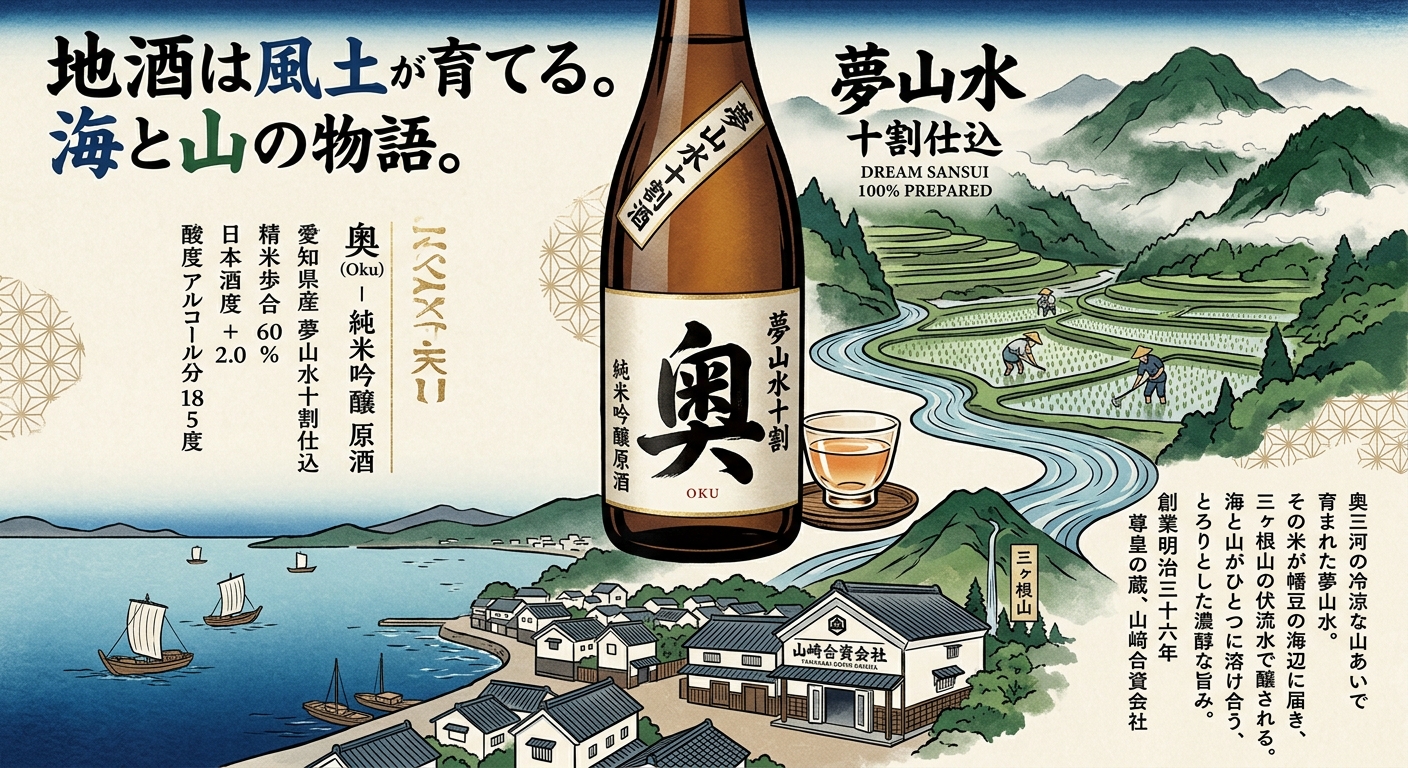
- Sake: Oku “Yumesansui Juwari” Junmai Ginjo Genshu — Aichi-grown Yumesansui rice 100%, rice-polishing ratio (seimai buai) 60%, 18.5% alcohol / Yamazaki Gohshi Kaisha, Sonnoh Brewery (Hazu, Nishio City, Aichi Prefecture)
Official site: https://www.sonnoh.co.jp/ - Kayoukyoku: “Funauta” (Boatman’s Song) by Yashiro Aki, 1979
YouTube: https://www.youtube.com/watch?v=yGI0QZ4Gk34
▶ If the player above doesn’t play, open it on YouTube
The Story of the Brewery
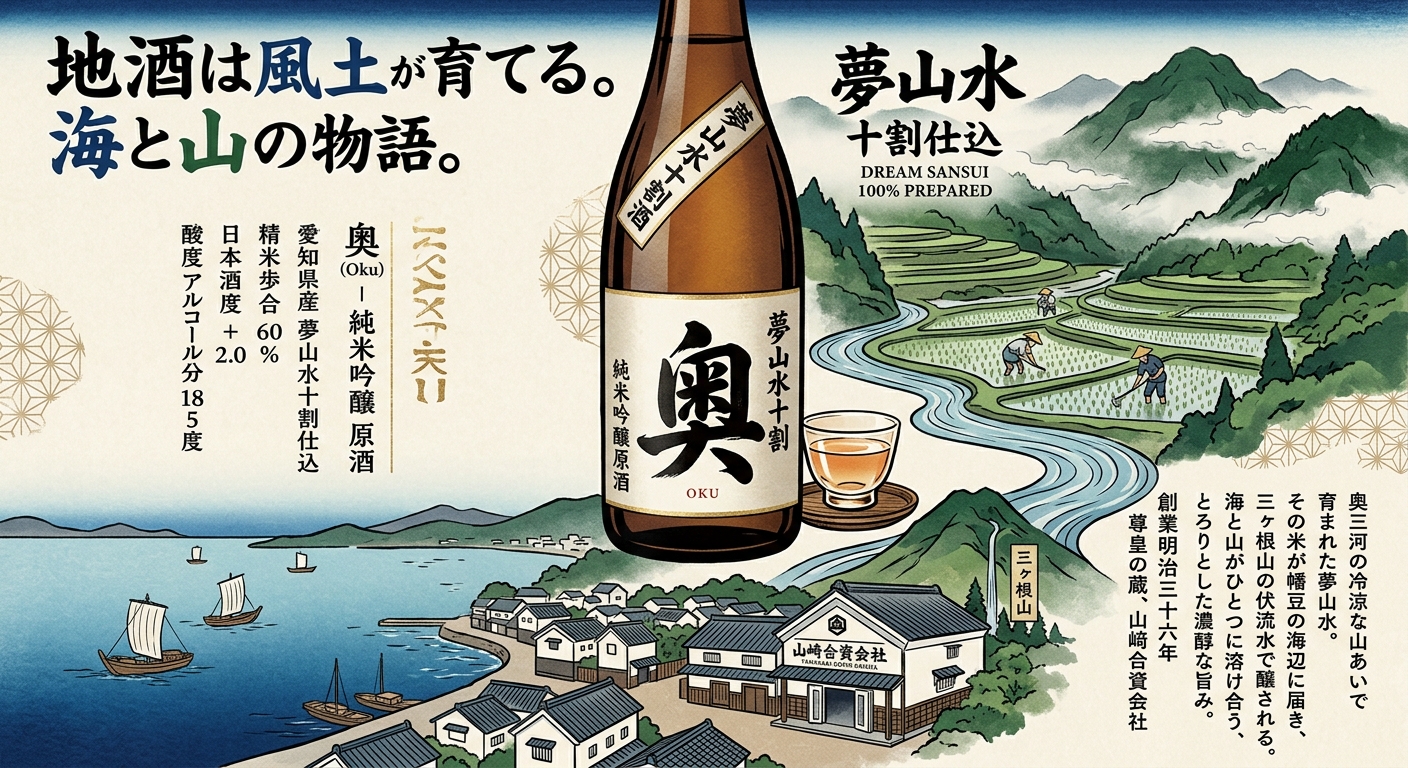
Yamazaki Gohshi Kaisha set up its brewery in Hazu, in what is now Nishio City, Aichi Prefecture, in 1903. Sonnoh, the flagship label launched in 1920, has been the face of the house for more than a century. The brewing water comes from springs at the foot of Mount Sangane, and more than 95% of the rice is grown in Aichi. “Local sake is raised by local land” is the brewery’s stated creed, and it holds to it all the way back to where the grain comes from.
Oku is a label this brewery developed for a deliberately narrow distribution — a bottle meant for specialist sake shops rather than the mass market. The name means “the interior,” and it points to Okumikawa, the mountainous northeast of Aichi, where the rice is grown under contract. The variety is Yumesansui, a relatively new sake rice whose cultivation in Aichi began in 1996, raised in the cool air of the hills. Oku is brewed from Yumesansui and nothing else, which is what the phrase “Yumesansui Juwari” — one hundred percent Yumesansui — on the label declares.
The rice is milled to 60%, with a sake meter value of +2.0 and acidity of 1.8. The number that stands out is the alcohol: because no water is added after pressing, this genshu reaches 18.5%. That is high for sake, and you feel it as density on the palate, almost a viscosity. Yet it is not merely heavy — the aroma lifts with the refinement you expect from a junmai ginjo. Richness and poise, in the same glass.
The Story of the Land
Hazu, where the brewery stands, faces Mikawa Bay. Designated part of a quasi-national park, this is a calm inland sea dotted with small islands, gentle enough that people sometimes call it “the Seto Inland Sea of the Tokai region.” Mount Sangane rises behind the town. Sea and mountain are both within easy reach.
Okumikawa, where the rice grows, is the same prefecture wearing a completely different face: a highland region in the northeast, near the borders with Nagano and Shizuoka, where the nights turn cold even in summer. That coolness lets the grain fill out slowly, which suits sake rice well.
A quiet seaside town and a cold mountain valley. Rice raised in Okumikawa comes down out of the hills to a brewery beside the bay, and becomes sake within sight of the water. The distance between those two places is built into the name Oku.
The Story of the Song
“Funauta” was released on 25 May 1979 as a single by Yashiro Aki, with words by Aku Yu and music by Hama Keisuke. It took a Gold Prize at that year’s Japan Record Awards.
It was the first song Yashiro Aki sang in a man’s voice. A singer who had until then given shape to women’s feelings steps instead into the perspective of a man drinking alone in a bar. The opening lines set out, one by one, the temperature of the sake, the food beside it, how brightly the lamp should burn, even what kind of company he would want — and each time the answer is that this, as it is, will do. He asks for little. The song makes that modesty sound like a luxury. There is no soaring climax, and yet it has been sung for more than forty years, which suggests there is real strength in its quietness.
And then the sea. In the later verses a boat moves offshore and gulls cross above it. A small lamp inside, dark water outside: it is that double frame that gives the song its depth.
Why This Pairing
Oku is not a bottle you drink quickly. Eighteen and a half percent alcohol slows the hand on its own. You take a small mouthful and wait while the density unwinds across the tongue. The sake asks to be drunk that way.
“Funauta” is about exactly that kind of hour. Not sake for a crowded room, but sake for a dim lamp and a long silence — the song of someone in no hurry with a single cup.
Both of them, too, sit beside the sea. The Hazu brewery works within sight of Mikawa Bay; the song looks out at a boat on the water. The difference is that this sake came down from the mountains first. Grain that ripened in the cold air of Okumikawa is brewed beside the bay and drunk facing the sea. For a sake that ties mountain and coast together in one cup, the stillness of this song makes a fitting vessel.
Where to Find This Bottle
The Rakuten Ichiba link below is an affiliate link.
The Rakuten Ichiba link below is an affiliate link.
- The brewery’s official site: https://www.sonnoh.co.jp/
- Search on Rakuten Ichiba: Oku “Yumesansui Juwari” Junmai Ginjo Genshu
Note: The Rakuten Ichiba link above is an affiliate link. Rakuten Ichiba and Amazon.co.jp are Japan-based retailers, so these links are most useful for readers in Japan or those who can arrange international shipping. Stock and availability change over time, and a local sake shop may also be able to source this bottle by name.
Pairing Dishes Worth Trying
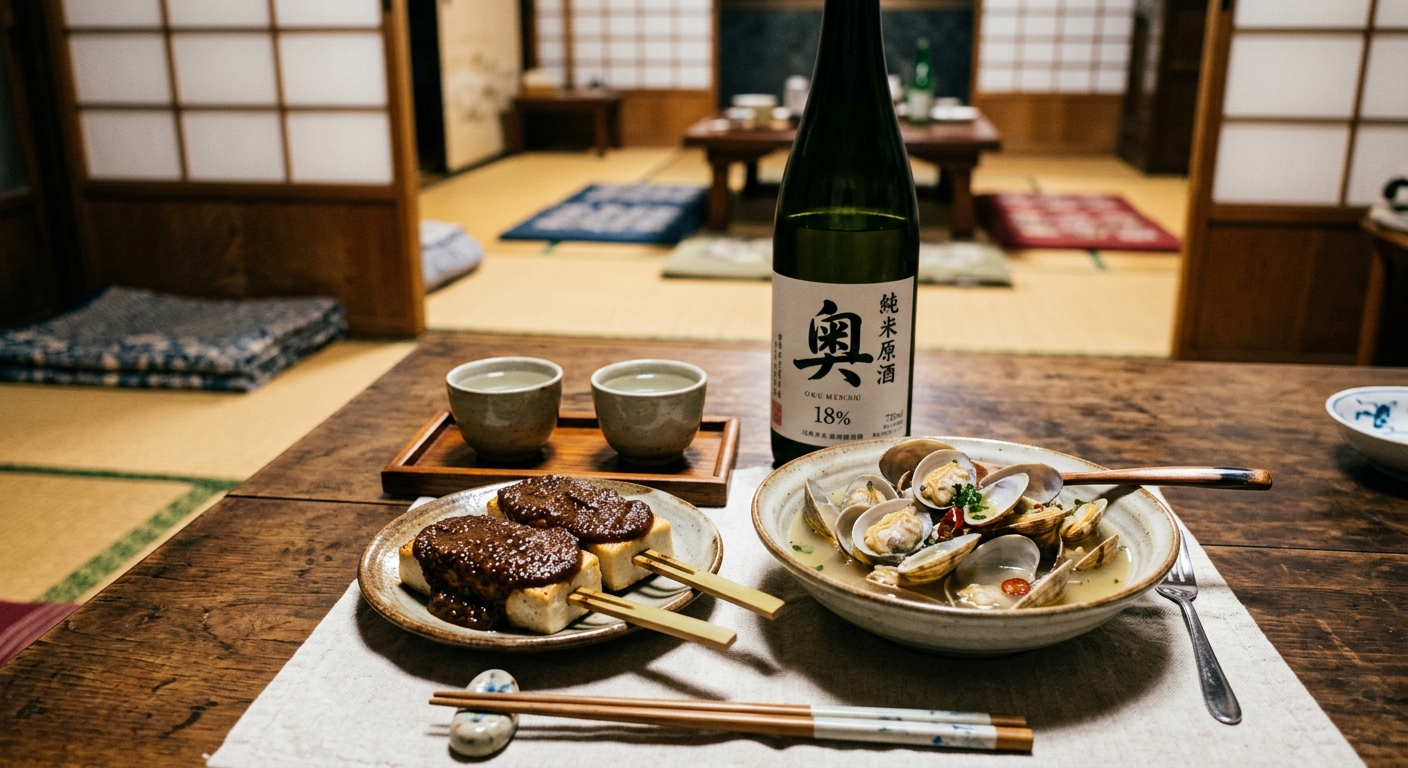
- Miso dengaku with Hatcho miso
The defining strong flavor of the Aichi table. The weight of salt and umami in this dark soybean miso will simply overpower a light sake. At over 18% alcohol, Oku meets it head-on and leaves the sweetness of the rice behind the miso.
Recipe (in Japanese): Kurashiru, “Easy dengaku miso” - Asari clams steamed in sake
Mikawa Bay is prime ground for asari clams, and Aichi is one of Japan’s leading producers. The clean savory depth of the shellfish broth rounds off the edges of a genshu this concentrated — the sea in front of the brewery, met by the sake brewed beside it.
Recipe (in Japanese): Kurashiru, “Asari steamed with butter and soy sauce”
A quick scientific note: soybean misos like Hatcho are high in both salt and umami compounds, and a lighter sake gets pushed aside by them. A genshu carries enough alcohol and umami density to hold its ground, so neither the dish nor the sake loses its outline. Asari are rich in succinic acid, which layers with the rice-derived amino acids in sake to create a synergistic lift in umami — the clam broth stretches the sake’s finish out longer.
Visiting the Brewery
Sonno Brewery — Yamazaki Goshi Kaisha (Oku, Sonno)
57 Kakita, Nishi-hazu-cho, Nishio City, Aichi. About an 8-min walk from Nishi-hazu Station (Meitetsu Gamagori Line).
The brewery faces Mikawa Bay in the Hazu district (it has a shop; ask the brewery about visits).
Sights Nearby
- Aichi Children’s Land / Nishio City | ~7 min, ~4 km by car from the brewery
A large children’s park across two hills, “Asahi-ga-oka” and “Yuhi-ga-oka.” 9:00-17:00, free entry, with a steam locomotive, big play structures and views of Mikawa Bay. - Sangane-san Skyline / Nishio City to Gamagori City | ~10 min by car to the toll gate from the brewery
A 5.1 km toll road along a ridge about 350 m high (¥420 for a standard car; toll gate open 8:00-20:00), known for early-summer hydrangeas and views over Mikawa Bay.
Hot Springs Nearby
- Kira Onsen / Nishio City | ~15 min, ~8 km by car from the brewery
A seaside hot spring looking out over Mikawa Bay (a chloride spring). Inns such as Miyajimakan and Ryugu Hotel accept day-use bathers; check each one’s hours.
Opening hours, closing days and day-use bathing availability can change. Please check each facility’s official information before visiting.
A Quick Glossary of Sake Terms
- Junmai Ginjo: A junmai sake made from rice milled down to 60% or less of its original size and fermented slowly at low temperatures. Known for its fragrant, floral aroma.
- Genshu: Sake bottled without adding water after pressing, so the alcohol stays where fermentation left it — usually higher, with a denser flavor.
- Seimai buai: The percentage of the grain remaining after milling. The lower the number, the more of the rice has been polished away.
Sources
- Sonnoh Brewery, Yamazaki Gohshi Kaisha official site
- NIHONMONO: Yamazaki Gohshi Kaisha, the brewery behind Sonnoh
- Funauta – Wikipedia (Japanese)
- Yashiro Aki – Wikipedia (Japanese)
If you notice any errors in this article, please don’t hesitate to reach out at info@soundrecords.jp.
Read this article in Japanese: 山の米を、海の蔵が受け止める