日本語で読む | This is the English version of a bilingual article.
Today’s Pairing
- Craft beer: Kinshachi Beer Pilsner — German-style pilsner, 5% ABV, 40 IBU, 330ml bottle / Morita Kinshachi Beer Co., Ltd. (Haguro-Shinden, Inuyama City, Aichi)
Official site: https://www.kinshachibeer.co.jp/beers-others/kinshachi/%E9%87%91%E3%81%97%E3%82%83%E3%81%A1%E3%83%93%E3%83%BC%E3%83%AB-%E3%83%94%E3%83%AB%E3%82%B9%E3%83%8A%E3%83%BC/ - Music: “Zenryoku Shounen” (“All-Out Boy”) by Sukima Switch (2005)
YouTube: https://www.youtube.com/watch?v=IvDTkTKi5pA
▶ If the player above doesn’t play, open it on YouTube
The Story of the Brewery
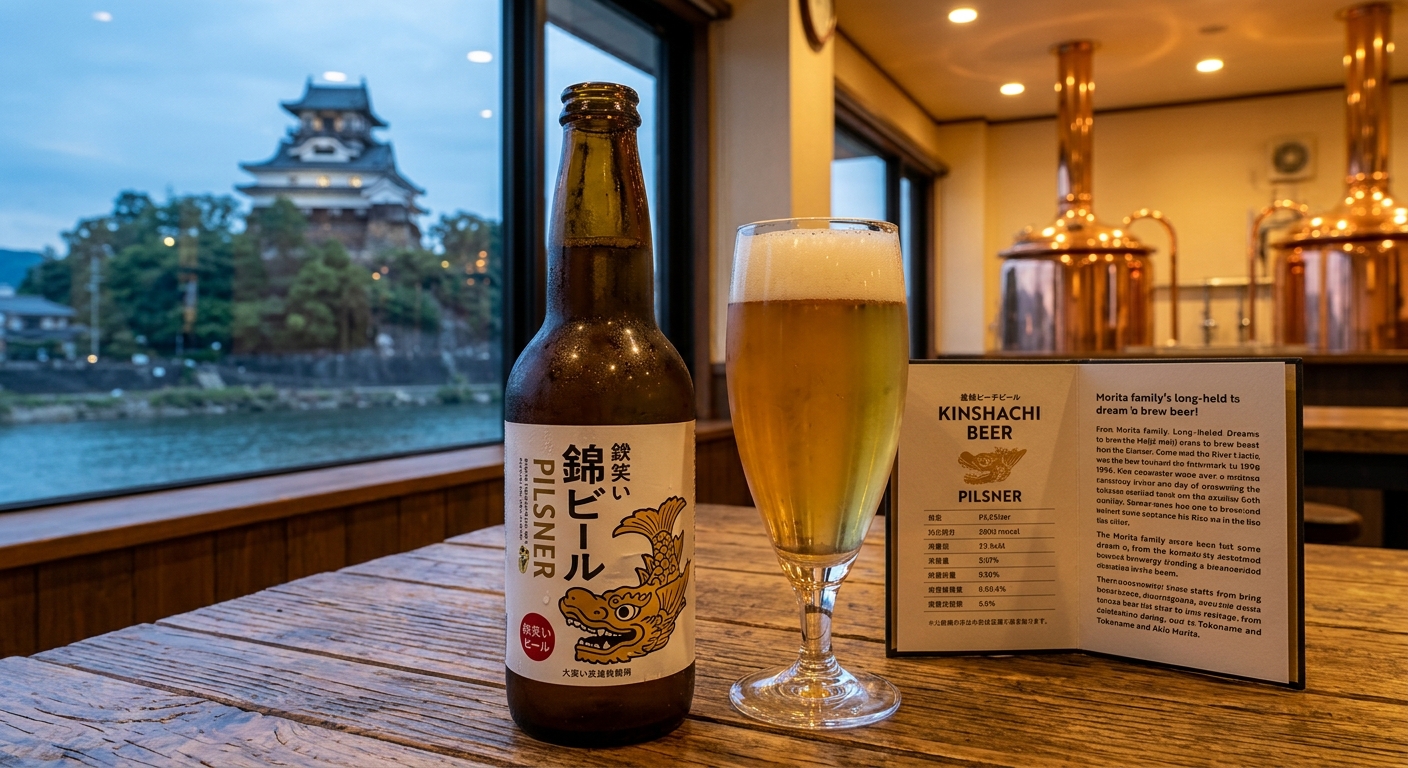
Morita Kinshachi Beer was launched in 1996, riding the wave of deregulation that followed a change to Japan’s liquor tax law. But the company’s own history page frames that year less as a founding than a restart. This was not the Morita family’s first attempt at brewing beer.
The record goes back to the late 1880s, when the Morita family had already succeeded in trial-brewing a beer called “Mitsuboshi Beer” (“Three-Star Beer”), at a time when beer itself was still a new drink in Japan. The company’s official site describes the 1996 venture as “not a one-off ‘local beer,’ but a business that carries on what is, in effect, a hundred-year dream of brewing quality beer that customers would enjoy.” Roughly a hundred and ten years after that first trial brew, the dream took shape again.
The Morita family itself is an old sake-brewing family rooted in Tokoname, on the Chita Peninsula of Aichi. Among those born into this family is Akio Morita, the co-founder of Sony. Akio himself was born in the city of Nagoya, but the family trade was sake brewing in Tokoname. The same family that sent a major corporation into the world had also been carrying, for generations, an unfinished dream of brewing beer.
The Pilsner featured here follows German brewing tradition: 5% ABV, 40 IBU. The staff who developed it describe its bitterness as among the highest of any pilsner made in Japan, pairing a crisp malt finish with hops that assert themselves clearly. In 2021, it won silver in the German-style pilsner category at the International Beer Cup.
The Story of the Land
The brewery sits in the Haguro district of Inuyama City, served by Haguro Station on the Meitetsu Komaki Line, a quiet area a short distance from the castle town that draws most of Inuyama’s visitors. The brewing water is groundwater from the Kiso River system — the same river that has carried water across the Nobi Plain and down to this ground.
Inuyama Castle is said to have been built around 1537 by Oda Nobuyasu, an uncle of the warlord Oda Nobunaga, and the castle’s own official site calls it the oldest surviving tenshu keep in Japan. It stands on a bluff above the Kiso River — the same water system, in a different form, that fills the beer.
The Story of the Song
Sukima Switch is a duo made up of Ohashi Takuya and Tokita Shintaro. Ohashi is from Tokai City, Aichi; Tokita is from Midori Ward in Nagoya — both of them born and raised in Aichi Prefecture. The duo came together in 1999, after Ohashi asked Tokita to arrange one of his songs.
“Zenryoku Shounen” was released on April 20, 2005, as the duo’s fifth single, written and composed by Sukima Switch themselves. It spread through a string of tie-ins — a TV commercial for NTT DoCoMo Kansai, the April 2005 opening theme for Nippon TV’s “Music Fighter,” an insert song for the film “Rough,” and the Japanese-version ending song for the Disney/Pixar film “Onward” — and reached as high as third place on the Oricon weekly singles chart.
The song is about not letting go of the reckless, all-out energy of childhood as adulthood pulls you away from it — about chasing a dream with everything you have, the same way you did as a kid. The title, “Zenryoku Shounen” (“All-Out Boy”), is a plain statement of exactly that stance.
Why This Pairing
Morita Kinshachi Beer calls its own business “a business that carries on a hundred-year dream.” A dream that took shape once in the Meiji era, then appeared to break off, was picked up again by the same family a hundred and ten years later and finally made real. That is a story about a dream chased across a very long stretch of time, without ever being given up on.
“Zenryoku Shounen” is also a song about an all-out energy that time doesn’t erase — about heading toward a dream as an adult with the same feeling you had as a boy. The beer’s hundred-year dream and the song’s unchanging, all-out spirit work on very different scales, but they point in the same direction.
The flavor doesn’t hold back either. At 40 IBU, this is a bitterness the brewer itself is proud to name. It is a glass with a clear, assertive voice of its own — fitting, for a beer paired with a song called “All-Out Boy.”
Where to Find This Beer
The Rakuten Ichiba link below is an affiliate link.
- Brewery official site:https://www.kinshachibeer.co.jp/beers-others/kinshachi/%E9%87%91%E3%81%97%E3%82%83%E3%81%A1%E3%83%93%E3%83%BC%E3%83%AB-%E3%83%94%E3%83%AB%E3%82%B9%E3%83%8A%E3%83%BC/
- Buy on Rakuten Ichiba: View the product page (330ml, ¥420)
These are Japanese storefronts. If you are visiting the brewery, drinking it fresh at their own taproom is by far the best option.
Pairing Dishes Worth Trying
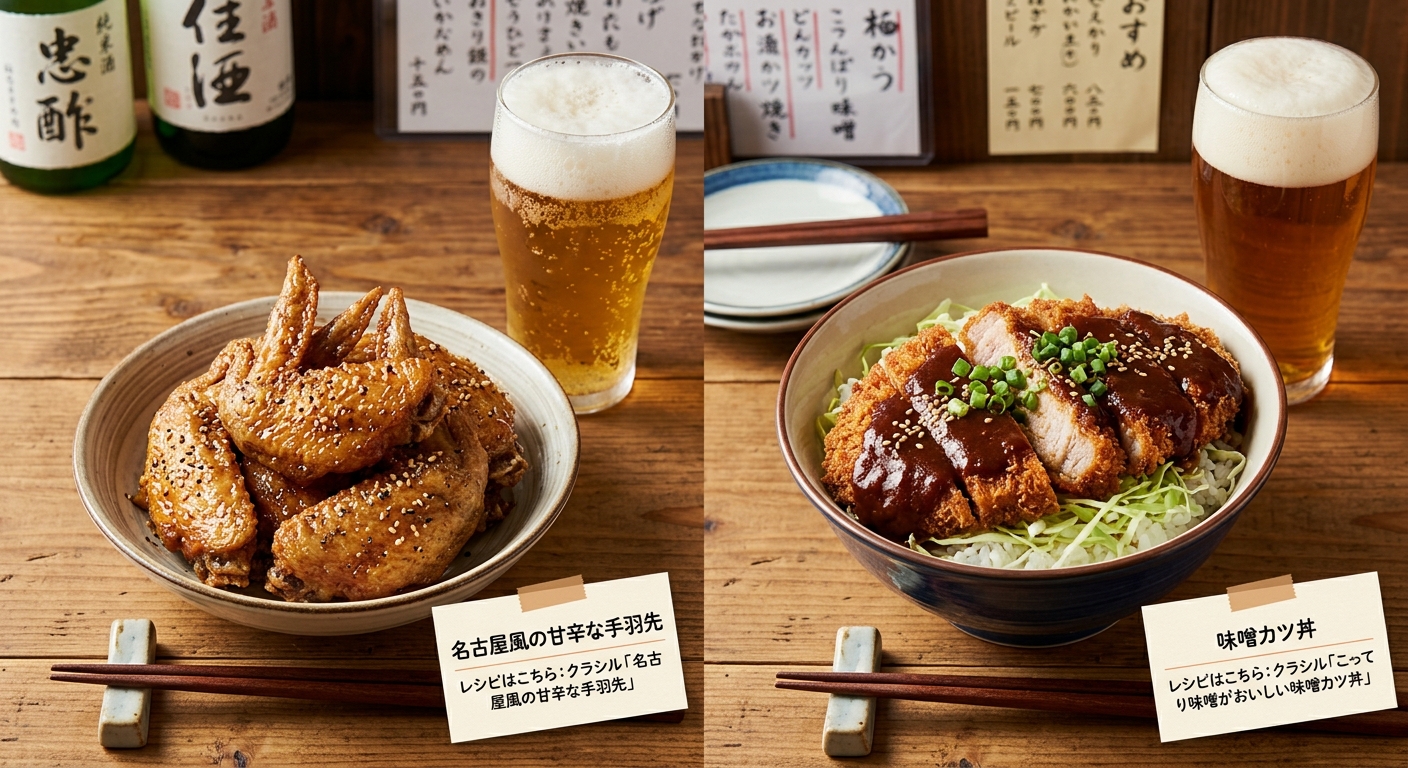
- Nagoya-style sweet-and-spicy tebasaki (chicken wings)
Chicken wings glazed with a soy-and-mirin sweet-spicy sauce, a Nagoya specialty. The pilsner’s assertive bitterness and carbonation wash away the frying oil together. - Miso katsu don (pork cutlet with red miso sauce over rice)
A dish that represents Aichi: a fried pork cutlet under a sweet, rich red-miso sauce. The deep umami and richness of the miso stand up well against the beer’s firm 40 IBU bitterness.
A note on the science: the iso-alpha acids that carry hop bitterness, together with the pressure of carbonation, strip away the film of oil that fried food leaves in the mouth, resetting the palate. Glutamic acid and other umami compounds abundant in red miso amplify richness when layered against a beer’s bitterness, so the richer the sauce, the better it pairs with a firmly bitter beer.
Visiting the Brewery
Morita Kinshachi Beer Co., Ltd.
1-4 Takami, Haguro-Shinden, Inuyama City, Aichi. About a 5-min drive from Haguro Station (Meitetsu Komaki Line).
The brewing water is groundwater from the Kiso River system.
Sights Nearby
- Inuyama Castle (National Treasure) / Inuyama City | ~10 min, ~5 km by car from the brewery
Said to have been built around 1537 by Oda Nobuyasu, an uncle of Oda Nobunaga. The castle’s official site calls it the oldest surviving tenshu keep in Japan, standing on a bluff over the Kiso River. - Museum Meiji-Mura / Inuyama City | ~20 min, ~9 km by car from the brewery
An open-air museum of more than 60 relocated Meiji-era buildings, including 11 Important Cultural Properties, with rides on a preserved steam locomotive and a Kyoto city tram.
Hot Springs Nearby
- Inuyama Citizens’ Health Center “Sara Sakura no Yu” / Inuyama City | ~10 min, ~4 km by car from the brewery
A city-run day-bathing facility with indoor and open-air baths and a sauna. ¥520 for adults, 10:00-20:30 (last entry 20:00), closed Mondays (or the following day if Monday is a holiday).
Opening hours, closing days and day-use bathing availability can change. Please check each facility’s official information before visiting.
A Quick Glossary of Beer Terms
- Craft beer: Beer made by small breweries that put the character of the maker front and centre, as opposed to the uniformity of mass production.
- Pilsner: A pale lager born in Pilsen, Czechia, known for its clear golden colour and refined hop bitterness. The most widely drunk style in the world.
- Malt: Germinated barley. It forms the foundation of a beer’s sweetness, colour and body; how deeply it is roasted determines colour and toastiness.
- Hops: The cones of a climbing plant, which give beer its bitterness and aroma. Depending on the variety, that aroma can read as citrus, tropical fruit or open grassland.
- IBU: International Bitterness Units, a scale for how bitter a beer tastes. Around 10 is barely noticeable bitterness; above 60 lands in clearly bitter IPA territory.
Sources
- Morita Kinshachi Beer official site — company profile and history
- Morita Kinshachi Beer official site — Kinshachi Beer Pilsner
- Morita Kinshachi Beer official site — Awards
- Akio Morita — Wikipedia (Japanese)
- “Zenryoku Shounen” — Wikipedia (Japanese)
- Inuyama Castle official site
If you notice any errors in this article, please don’t hesitate to reach out at info@soundrecords.jp.
Read this article in Japanese: 百年前の夢を、まだ追いかけている