日本語で読む | This is the English version of a bilingual article.
Today’s Pairing
- Craft beer: Gassan Beer “Alt” — 5% ABV; 330 ml; brewed from malt, hops, yeast and water / Nishikawa Town Comprehensive Development Co., Ltd. (2304 Mizusawa, Nishikawa Town, Nishimurayama District, Yamagata Prefecture)
Official site: https://www.gassan.co.jp/facility/01_nishikawa/ - Music: “Jinsei no Tobira” (“The Door of Life”) by Mariya Takeuchi, 2007 / Words and music by Mariya Takeuchi, produced by Tatsuro Yamashita
YouTube: https://www.youtube.com/watch?v=Qt8y0KsngAc
▶ If the player above doesn’t play, open it on YouTube
The Story of the Brewery
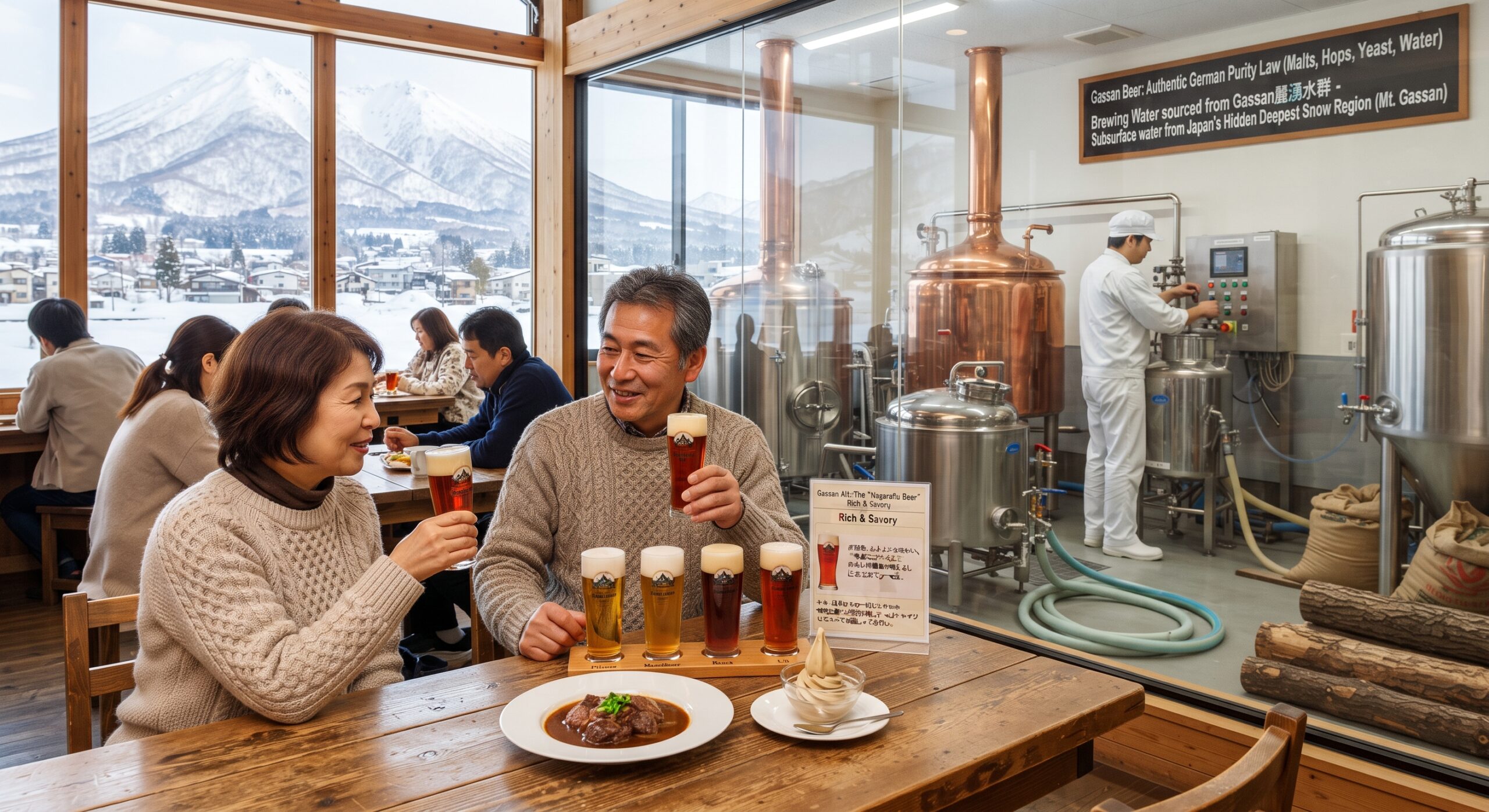
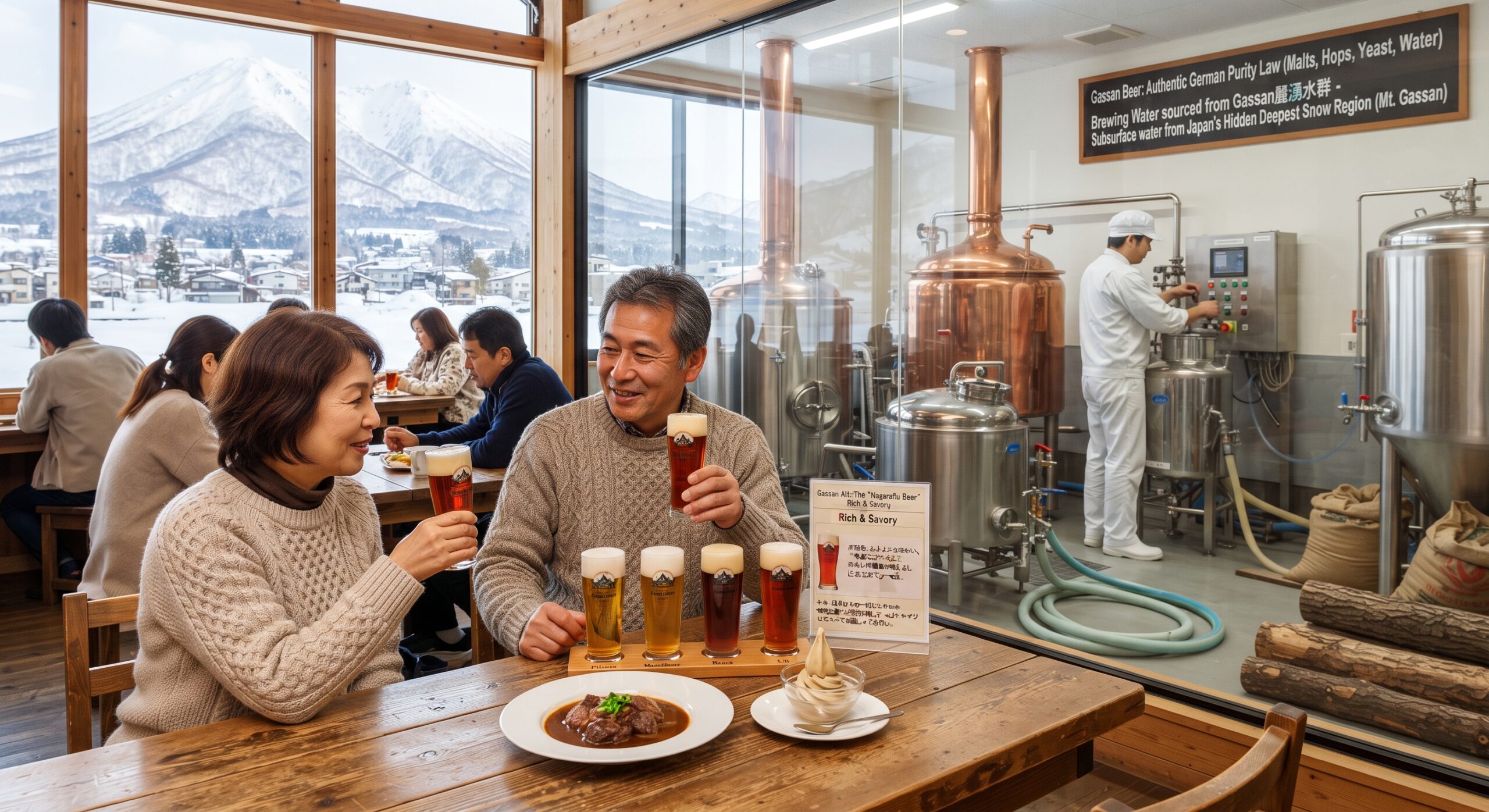
Gassan Beer is brewed by Nishikawa Town Comprehensive Development Co., Ltd., inside the roadside station “Michi-no-Eki Nishikawa” in Yamagata Prefecture — the only craft beer factory in the prefecture. Brewing began in 1998 under the name “Ji-biru Gassan” (“Local Beer Gassan”). The attached restaurant has the brewing kettles visible through glass at the back, so you can drink the beer fresh while watching it being made. The signature dish is beef simmered in the local beer; the shop also sells beer-flavoured soft-serve ice cream.
The brewing water comes from a group of springs at the foot of Mount Gassan, designated one of Japan’s “100 Famous Waters” by the Environment Agency (as it then was) in 1985. According to the town’s official site, snow falls here in a heavy-snow region where 10 metres of accumulation is not unusual, and that snow is said to take centuries, filtering through the ground, to emerge as spring water. The water is local, but the malt, hops and yeast come from Germany and the Czech Republic, brewed under the German Beer Purity Law (ingredients limited to malt, hops and water). The brewing equipment is from Germany’s Kaspar Schulz, and the brewer trained in Germany.
The regular line-up includes Pilsner, Münchner and Rauch, among others, with Alt as one of the beers in that range. A product description for a furusato nōzei (hometown tax donation) gift box calls this Alt a reddish-brown, full-bodied “sipping beer,” saying the amount of flavour it gives off increases as it approaches room temperature, and recommends comparing the first sip right after pouring with a later sip once it has warmed. That is the opposite of a Pilsner, which is meant to be drunk cold and fast.
The Story of the Land
Nishikawa Town sits roughly in the middle of Yamagata Prefecture, about 32 km west of Yamagata City. Its symbol is Mount Gassan, the main peak of the Dewa Sanzan (Three Mountains of Dewa). The population is 4,269 (as of September 1, 2026), and most of the town’s area is forest — a small town tucked into the mountains.
In December 2019, the town declared itself “Japan’s number one snow country.” The Ubazawa area, at the foot of Mount Gassan, records some of the heaviest snowfall in the country, and among inhabited areas, the Shizu district has recorded a maximum snow depth of 720 cm. Because Shizu has no official Japan Meteorological Agency observation station, this depth is not widely known. The town itself has described this on its official social media account as a “hidden number one” in snowfall, and a local TV station has reported on it.
The water used to brew Gassan Beer is this snow — snow that fell on a quietly record-breaking snow country and took centuries, moving through the ground, to emerge as spring water. It is not this year’s snow; it is snow that fell generations ago, only now arriving as water. The mountain in front of the brewery works as a kind of reservoir for time itself.
The Story of the Song
“Jinsei no Tobira” (“The Door of Life”) appeared on Mariya Takeuchi’s album Denim, released May 23, 2007. Words and music are by Takeuchi herself, produced by Tatsuro Yamashita. Fan demand for a single release was strong enough that it was issued on August 8 that year as a double A-side with “Chance no Maegami,” her 35th single, on MOON RECORDS. It was also used as a TV commercial song for Kyowa Hakko (now Kyowa Hakko Kirin) and as the theme song for the TV Tokyo New Year drama special Musume no Kekkon (“A Daughter’s Marriage”). According to Wikipedia, the single “Chance no Maegami / Jinsei no Tobira” peaked at No. 23 on Oricon’s weekly chart and appeared on it 30 times in total.
The lyric has a clear structure. It opens with the passing of years — “spring comes again, the same bloom as last year, the same view, a slightly different me” — and in the chorus it moves through one’s twenties, thirties, forties and on, affirming each decade in turn: wanting to fall in love no matter how old you get, days you want to cry but keep going anyway. Takeuchi was in her fifties when it was released. True to its title, the song is built so that each year you age opens a new door.
Why This Pairing
Gassan Beer’s Alt is not a beer meant to be drunk cold and fast. As the official description says, the amount of flavour it gives off increases as it nears room temperature. The same glass shows a different face right after pouring than it does after sitting a while. This is the opposite of a beer built for quick consumption.
“Jinsei no Tobira” has the same structure. It sings through one’s twenties, thirties, forties, and each decade adds a new verse. The lyric frames the simple passage of years — “no matter how old,” “this age is good too” — as flavour that accumulates rather than fades. It doesn’t treat youth as the only good thing; it puts value in what grows with time. That lines up exactly with how you’re meant to drink the Alt.
And one more thing. The water for this Alt is snow that fell on Mount Gassan’s quietly record-breaking snow country and took centuries, moving through the ground, to come out as spring water. What’s in tonight’s glass is snow that fell generations ago. A song about accumulating years, and water that reaches the glass only after centuries of time. Both point to the same thing: not “right now,” but “more, the longer it takes.” Pour it, don’t drink it straight down, and let it warm a little before the next sip. The song suits the same kind of patience — worth hearing through the whole album, or at least as far as the B-side, “Chance no Maegami.”
Where to Find This Beer
The Rakuten Ichiba link below is an affiliate link.
- Brewery official site:https://www.gassan.co.jp/facility/01_nishikawa/
- Search on Rakuten Ichiba:see results for “月山ビール アルト”
These are Japanese storefronts. If you are visiting the brewery, drinking it fresh at their own taproom is by far the best option.
Pairing Dishes Worth Trying
- Imoni (inland-style taro stew)
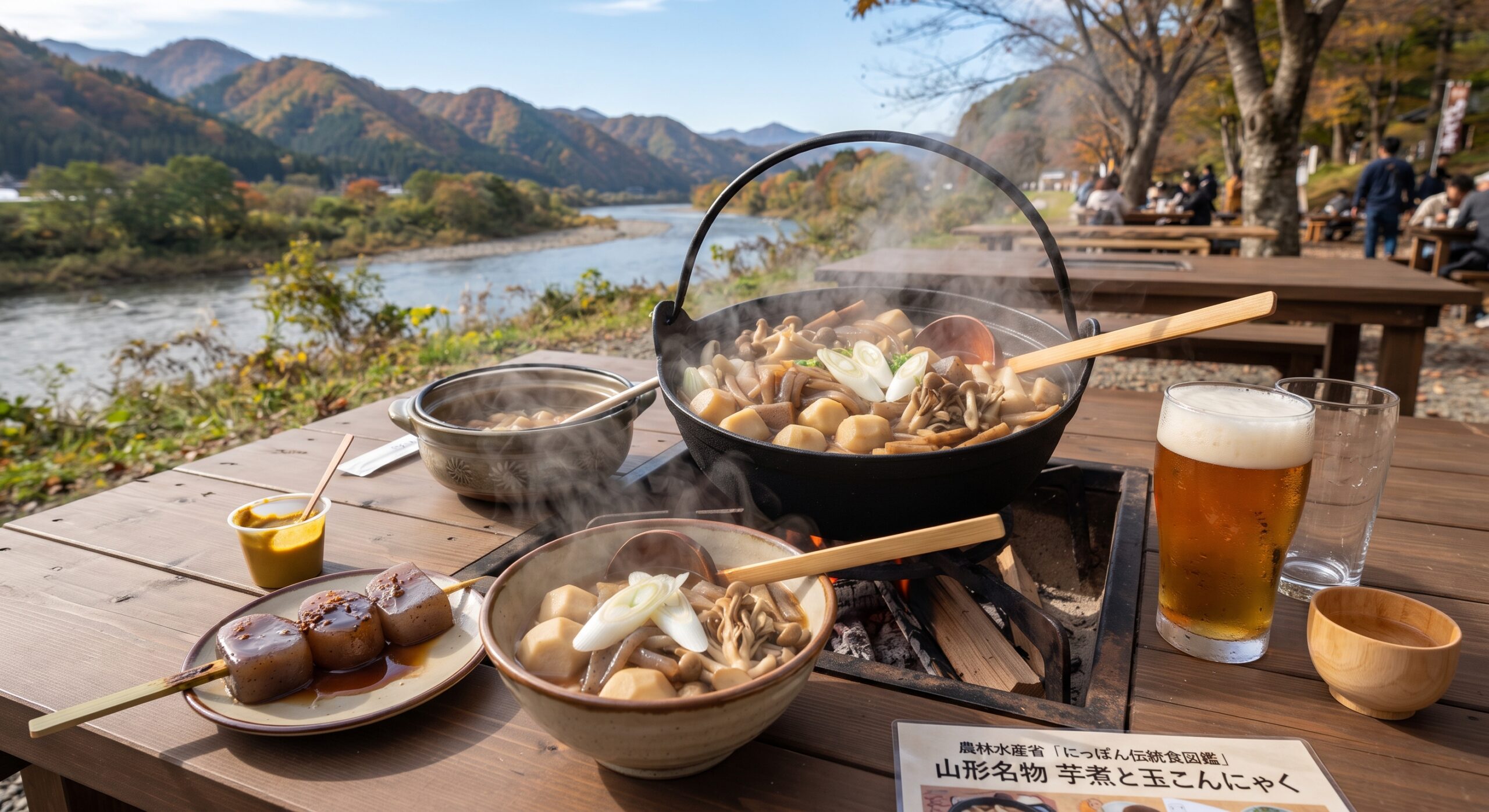
According to the Ministry of Agriculture, Forestry and Fisheries’ “Traditional Foods of Japan,” this is a soy-sauce-based hotpot found across Yamagata Prefecture, eaten in autumn and winter, built on taro, beef (in the inland style), konnyaku, green onion and mushrooms. Its origin is traced to the mid-1600s, when boatmen at the terminus of the Mogami River shipping route simmered taro and dried cod in a pot. The sweet-savoury beef and soy sauce meet the Alt’s malt sweetness and body from the same direction. - Tama-konnyaku (ball-shaped konnyaku)
The same MAFF source describes this as a food culture unique to Yamagata: konnyaku rolled into balls about 3 cm across, simmered in a soy-sauce-and-dried-squid broth. It’s sold skewered at tourist spots and festival stalls, and is something of a soul food for the prefecture. It suits being nibbled alongside a beer, which fits the Alt’s character as a beer for sipping slowly rather than draining fast.
A note on the science: the reddish-brown malt used for an Alt is roasted darker than Pilsner malt, giving it more caramel- and nut-like aromatic compounds. These sit close to the toasty aromas (from the Maillard reaction) in the soy-based broths of imoni and tama-konnyaku, so the flavours add to each other rather than compete. And since the Alt’s malt sweetness comes through more clearly as it nears room temperature, it also picks up the deeper sweetness in the soy broth that a cold beer would wash past.
Visiting the Brewery
Gassan Beer (Nishikawa Town Comprehensive Development Co., Ltd.)
2304 Mizusawa, Nishikawa Town, Nishimurayama District, Yamagata Prefecture. The brewery sits inside the roadside station “Michi-no-Eki Nishikawa” — the only craft beer factory in Yamagata Prefecture. From the attached restaurant you can watch the brewing kettles through glass while drinking the beer fresh.
Opening hours: the direct-sales shop and restaurant are both open 8:30–18:00 (lunch service 11:00–15:00). Closed December 31 and January 1.
Sights Nearby
- Mizusawa Onsen-kan / attached to Michi-no-Eki Nishikawa | ~1 min, ~70 m on foot from the brewery
A day-use hot spring in the same building complex as the brewery. Open 7:00–21:00 Sunday–Thursday and 7:00–22:00 Friday–Saturday from April to November; 8:00–21:00 and 8:00–22:00 respectively from December to March. Closed on the second Tuesday of the month (the following day if that is a public holiday). Admission is ¥350 for adults, ¥850 if you use the sauna. The water is a sodium chloride spring. You can have a beer, then wash it off at the hot spring on the same grounds. - Gassan-ko Water Culture Hall / Sunagoseki, Nishikawa Town | ~10 min by car toward Tsuruoka from the brewery
A water-themed exhibition hall on Route 112, beside the Sagae Dam (known locally as Lake Gassan). Open 10:00–16:00, closed every Wednesday, free admission. It explains how meltwater flowing down from Mount Gassan supports life in the town.
Hot Springs Nearby
- Mizusawa Onsen-kan / attached to Michi-no-Eki Nishikawa | ~1 min, ~70 m on foot from the brewery
The same facility listed above. A natural, day-use hot spring; hours and prices as above. The closest side trip from the brewery happens to also be the hot spring.
Opening hours, closing days and day-use bathing availability can change. Please check each facility’s official information before visiting.
A Quick Glossary of Beer Terms
- Craft beer: Beer made by small breweries that put the character of the maker front and centre, as opposed to the uniformity of mass production.
- Ale: Beer made by top fermentation, with the yeast working near the surface at close to room temperature. It tends toward fruity aromas and a fuller body.
- Malt: Germinated barley. It forms the foundation of a beer’s sweetness, colour and body; how deeply it is roasted determines colour and toastiness.
- Hops: The cones of a climbing plant, which give beer its bitterness and aroma. Depending on the variety, that aroma can read as citrus, tropical fruit or open grassland.
- ABV: Alcohol By Volume. Beer typically runs around 5%; above 8% is considered a strong, heavier-drinking beer.
- Ji-biru: The name given to the beers that appeared across Japan after the 1994 liquor tax reform opened small-scale brewing. Today most of them are simply called craft beer.
Sources
- Michi-no-Eki Nishikawa – Nishikawa Town Comprehensive Development Co., Ltd. Official Site
- Nishikawa Town Comprehensive Development Co., Ltd. – Official Site
- Tsukiyama Shikisai Honpo (Gassan Beer Online Shop)
- Gassan Craft Beer 3-Variety 14-Bottle Set (Alt / Pilsner / Rauch) – Furusato Choice
- “100 Famous Waters” Card for the Gassan Foothills Springs – Nishikawa Town Official Site
- Mizusawa Onsen-kan (Michi-no-Eki Nishikawa) – Nishikawa Town Official Site
- Gassan-ko Water Culture Hall – Nishikawa Town Official Site
- Mariya Takeuchi – Official Web Site
- Chance no Maegami / Jinsei no Tobira – Wikipedia (Japanese)
- Imoni – MAFF, “Traditional Foods of Japan”
- Tama-konnyaku – MAFF, “Traditional Foods of Japan”
If you notice any errors in this article, please don’t hesitate to reach out at info@soundrecords.jp.
Read this article in Japanese: 常温に近づくほど、増えていくもの