日本語で読む | This is the English version of a bilingual article.
Today’s Pairing
- Sake: Shichihonyari Low-Polish Junmai — brewed with Shiga-grown Tamasakae sake rice, rice-polishing ratio (seimai buai) 80%, 15% alcohol / Tomita Shuzo Co., Ltd. (1107 Kinomoto, Kinomoto-cho, Nagahama City, Shiga Prefecture)
Official site: https://7yari.co.jp/ - Kayoukyoku (classic Japanese popular song): “Biwako Shuko no Uta” (“Song of Sailing Round Lake Biwa”) by Tokiko Kato, 1971
YouTube: https://www.youtube.com/watch?v=NmOJC7RfKPU
▶ If the player above doesn’t play, open it on YouTube
The Story of the Brewery
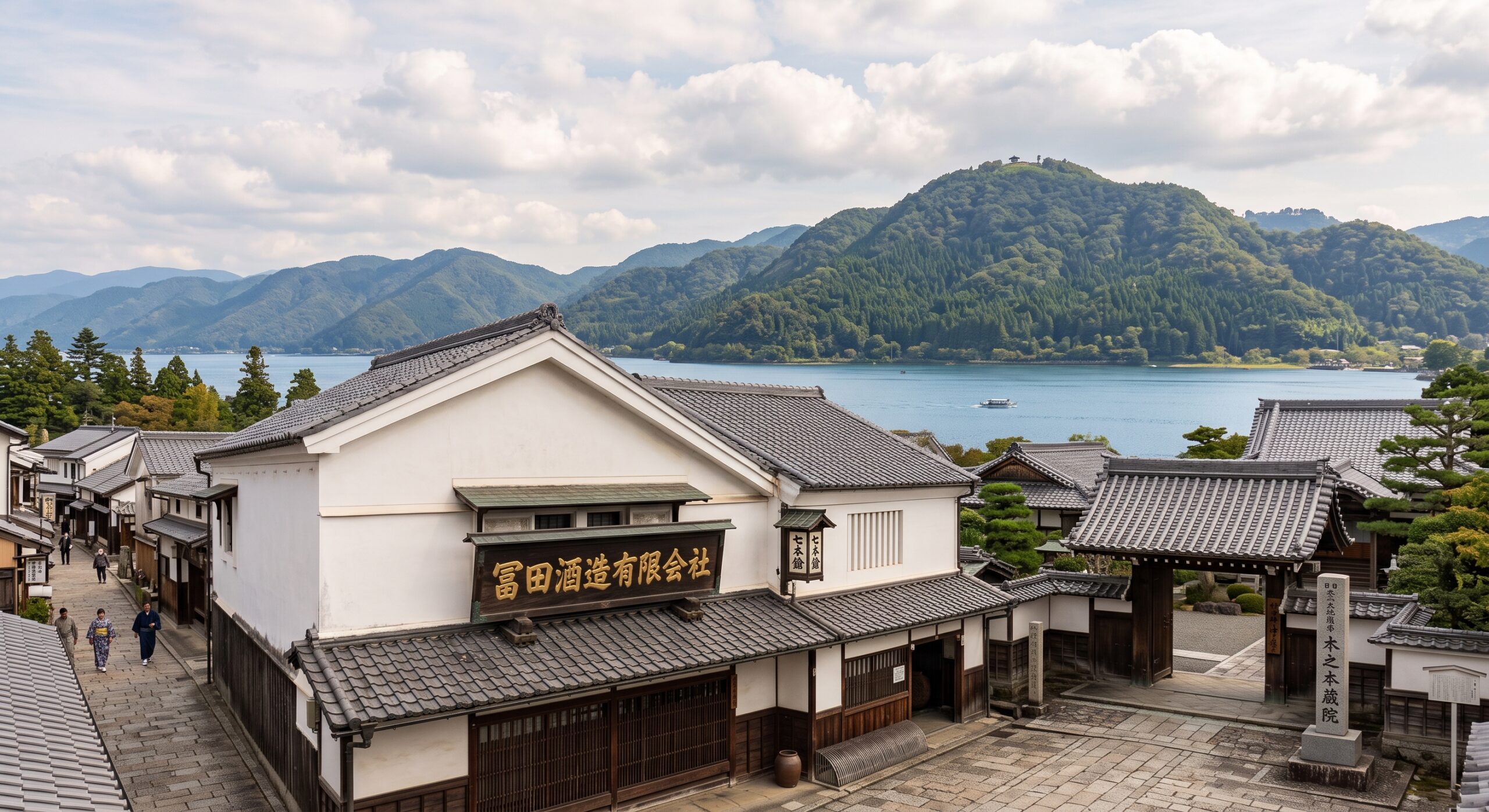
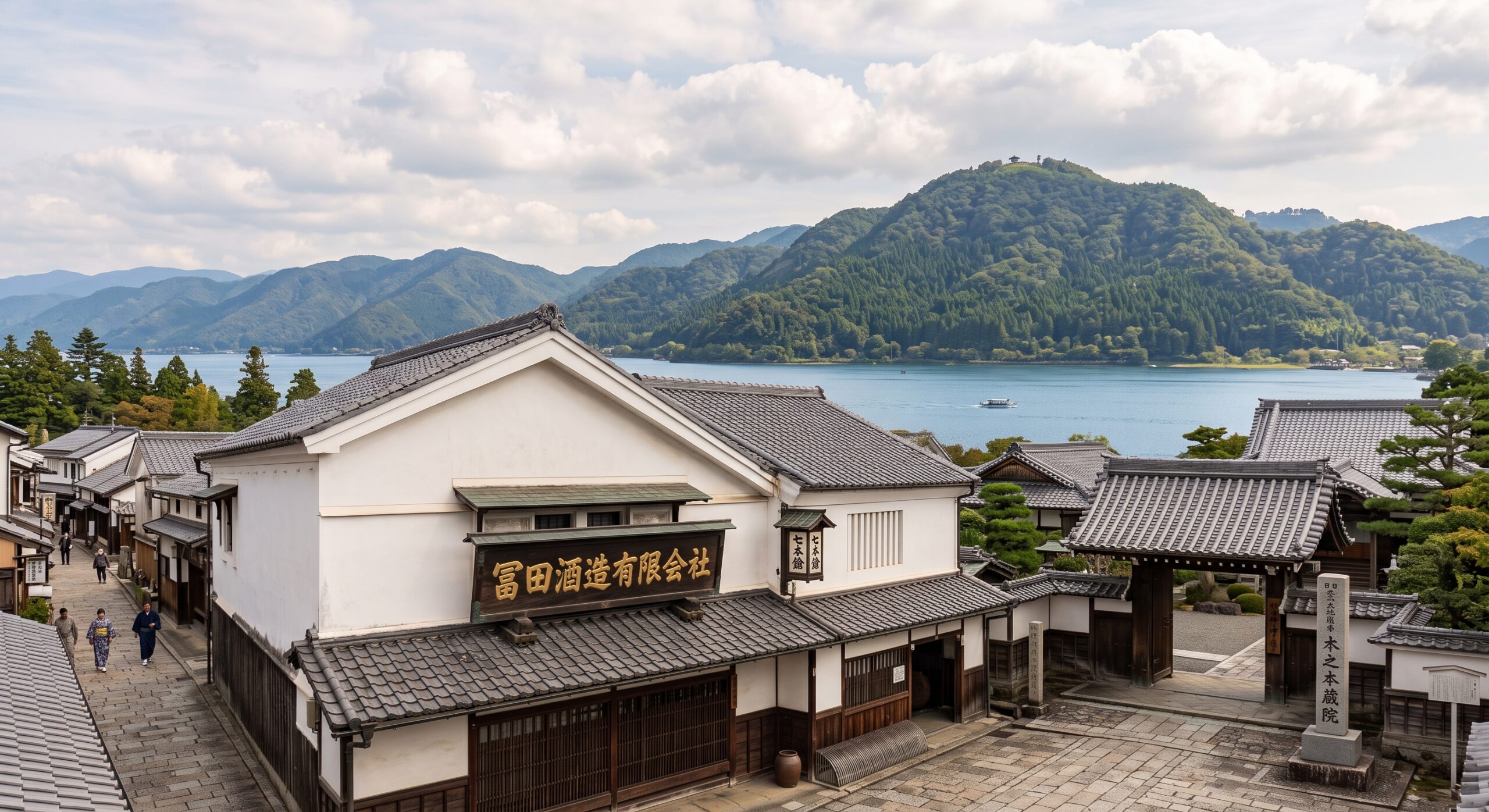
Tomita Shuzo Co., Ltd. is based in Kinomoto-juku, an old post town on the Hokkoku Kaido road near the northern tip of Lake Biwa. The brewery is said to have been founded in the early Tenmon era (1532–1555), when its first-generation founder, Takayasu, moved to Kinomoto relying on his mother’s family connections and left his samurai status behind to become a sake brewer. The brand name Shichihonyari (“Seven Spears”) comes from the “Seven Spears of Shizugatake,” seven young warriors who distinguished themselves at the Battle of Shizugatake (1583); the characters on the label were carved by the artist Rosanjin Kitaoji, who stayed at the brewery for an extended period in the Taisho era.
In the late Showa era the brewery came close to a hiatus, a crisis that was carried through by the mother of Tomita Yasunobu, the 15th-generation owner, until Yasunobu himself took over in the Heisei era. After joining the brewery in 2002, he moved away from the previous arrangement of hiring a Noto toji (a brewmaster from the Noto region) and shifted to a structure in which the owner himself also brews the sake. The brewery’s guiding idea is “walking the local path, opening the local path” — treating tradition not as something that “must be preserved,” but as something “one wants to keep,” so that the character of the Kohoku region comes through directly in the sake itself.
The bottle in this pairing, Shichihonyari Low-Polish Junmai, is where that philosophy shows most clearly. It’s brewed with Tamasakae, a sake-rice variety grown in Shiga. Most sake is made by polishing away a large portion of the rice grain’s outer layer, which is a source of off-flavors, but this sake is deliberately polished to only 80% of the original grain — a seimai buai of 80%. Rather than polishing the rice down further, the brewery keeps the grain’s inherent, full-bodied umami and depth intact in the finished sake. It comes in at 15% alcohol: a bottle that values a clear, solid backbone over showiness, very much in keeping with Tomita Shuzo’s approach.
The Story of the Land
Kinomoto-juku prospered as a post town where the Hokkoku Kaido, connecting the Hokuriku region to Omi (present-day Shiga), met the Hokkoku Wakiokan road running along the eastern shore of Lake Biwa. Tomita Shuzo’s brewery still stands today among the row of white-plastered old townhouses along that former highway, and just next door is Kinomoto Jizo-in (Joshin-ji Temple). Its principal image, a statue of the bodhisattva Jizo said to be one of Japan’s three great Jizo images, has long been revered by travelers as “the Jizo of the eyes.” Travelers passing along the highway would pray here for a safe journey and then go on to buy sake — a memory of the old post town that’s still written into the brewery’s very location.
A short drive from the brewery brings you to Mt. Shizugatake, which juts out toward the northern tip of Lake Biwa, and beyond it to Lake Yogo. Sitting between these two lakes, one large and one small, this area has long been a crossing point for both water transport and overland roads, supporting the trade and faith of the Omi region for centuries.
The Story of the Song
“Biwako Shuko no Uta” traces back to June 28, 1917. During a rowing trip around Lake Biwa, members of the boat club at the Third Higher School (now Kyoto University) are said to have first sung it, setting lyrics written by club member Oguchi Taro to the melody of a popular song of the day, “Hitsujigusa” (composed by Yoshida Chiaki). The full lyrics, running to six verses as sung today, are said to have been completed by the summer of 1918. This song, first hummed among a group of students, has been passed down and covered by more than 60 different singers since, without anyone significantly rewriting it.
The major turning point came in 1971, when Tokiko Kato included the song on her album “Nihon Aika-shu” (“Collection of Japanese Elegies”). The record became a major hit, selling 700,000 copies, and lifted a song that had belonged to a university boat club into one known across the whole country. Kato was born in 1943 in Harbin, in what was then Manchuria; while a student at the University of Tokyo, she won the Japan Amateur Chanson Competition in 1965 and made her record debut the following year, later becoming known for hits including “Shiretoko Ryojo” and “Hyakuman-bon no Bara” (“A Million Roses”). Having grown up in Manchuria with no single place she could call a hometown, Kato has said that this song about Lake Biwa — tied to her through her father’s connection to Shiga — became her own “hometown song.”
Why This Pairing
Shichihonyari Low-Polish Junmai is a sake that doesn’t polish away much of the rice at all, keeping the grain’s naturally full-bodied umami intact. Rather than polishing something up into something showier, it lets the material keep its own form — and that’s exactly the idea behind Tomita Shuzo’s guiding principle of “walking the local path.”
“Biwako Shuko no Uta,” too, has been carried down for more than a hundred years in essentially the same form the students first sang it in, without anyone significantly reworking it. Tokiko Kato found her own sense of “hometown” not in the place she was born, but in this song about Lake Biwa, which she came to know through her father’s ties to the region.
A sake that isn’t polished too far, and a song that was never polished up. Both are stories that reached distant places and later eras precisely by staying true to the form they were given. As you raise a glass of this sake, brewed in Kinomoto, take a moment to listen to the song that made its own way across Lake Biwa.
Where to Find This Bottle
The Rakuten Ichiba link below is an affiliate link.
- Brewery’s official site: https://7yari.co.jp/
- Search on Rakuten Ichiba: See search results for “Shichihonyari Junmai Tamasakae 80”
Note: the links above lead to Japan-based retailers. They’re most convenient for readers in Japan, or for those elsewhere who are able to arrange international shipping. Stock and availability change over time, so if you’re near a specialty sake shop, it’s well worth asking for this label by name.
Pairing Dishes Worth Trying
- Funa-zushi
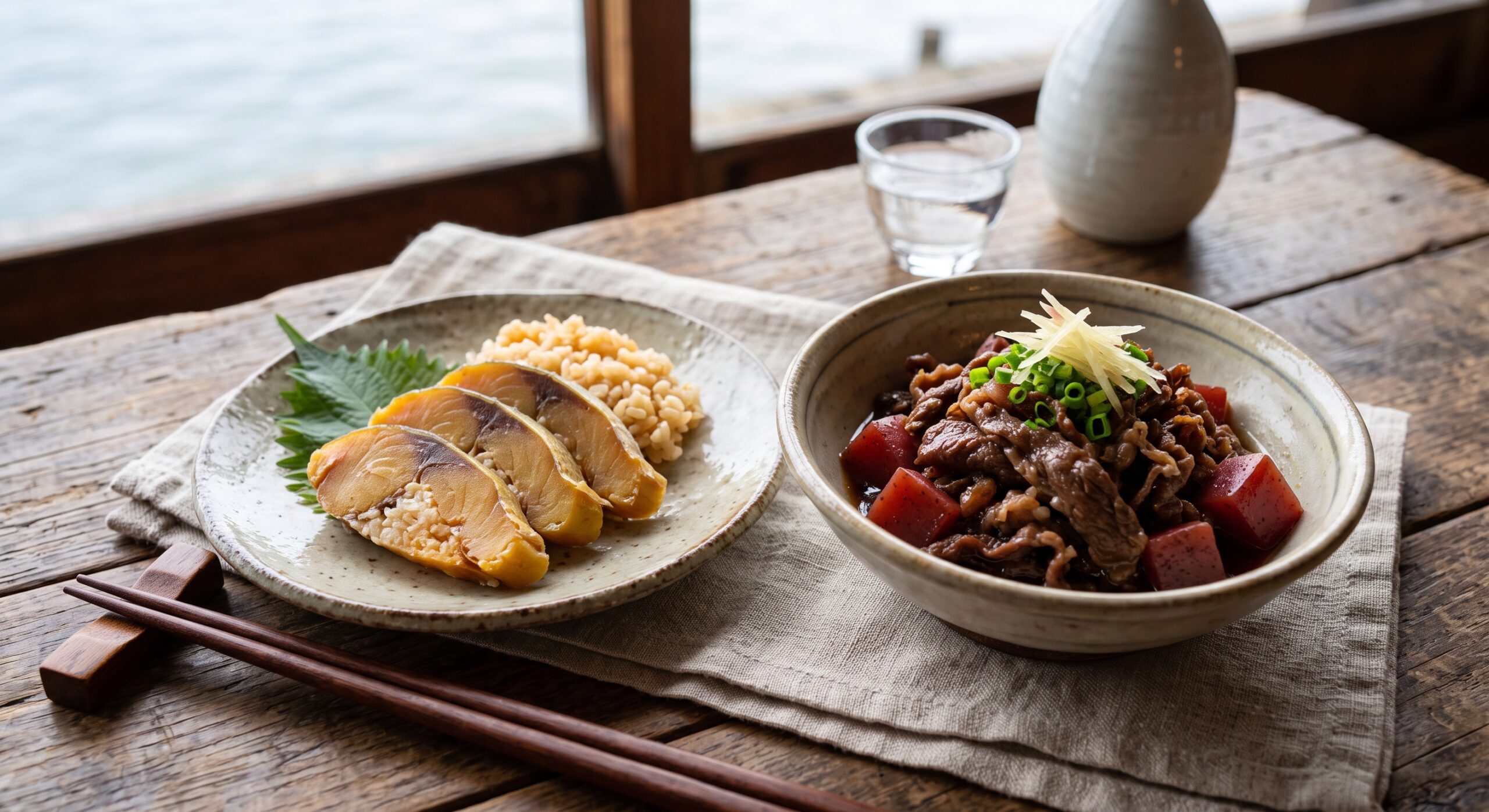
A fermented dish (narezushi) representative of Shiga, made by salting and fermenting nigorobuna, a crucian carp caught in Lake Biwa, with rice over a long period. Records of it appear on wooden tablets from the Nara period, and it’s considered one of the roots of Japan’s sushi culture. Its strong acidity and concentrated umami stand up directly to this sake’s own full-bodied acidity. - Omi beef shigure-ni
Omi beef simmered sweet-and-savory together with red konnyaku, another Shiga specialty — a dish that goes straight through a bowl of rice. The acidity and clean finish (kire) of this low-polish junmai cut cleanly through the richness of the beef fat.
Recipe (in Japanese): Cookpad, “Discovery! Food Heritage” official account, “Omi Beef Shigure-ni”
A note on the science: the strong acidity and umami compounds (glutamic acid and inosinic acid) produced by funa-zushi’s lactic fermentation meet this sake’s own full-bodied acidity and umami head-on, since it too is brewed from rice that hasn’t been polished down very far. With a rich dish like Omi beef shigure-ni, the acidity and clean finish of a low-polish junmai wash through the fat and keep the aftertaste light.
Visiting the Brewery
Tomita Shuzo (1107 Kinomoto, Kinomoto-cho, Nagahama City, Shiga)
About a 7-min walk from JR Kinomoto Station; about 5 min by car from Kinomoto IC on the Hokuriku Expressway. The brewery sits along the old Hokkoku Kaido post road in the town of Kinomoto-juku. The brewery itself is not open for tours, but the townscape and the neighboring temple are worth a visit.
Sights Nearby
- Kinomoto Jizo-in (Joshin-ji Temple) / Nagahama City | about a 5-min walk from Tomita Shuzo
An old temple whose principal image, a statue of the bodhisattva Jizo, is said to be one of Japan’s three great Jizo images, long revered by travelers as “the Jizo of the eyes.” The grounds are free to enter (a separate 300-yen fee applies to walk the dark passage beneath the Jizo hall). Visiting hours are roughly 8:00–17:00; please check ahead of your visit. - Shizugatake Lift and the Shizugatake battlefield / Nagahama City | about a 5-min drive from Tomita Shuzo
A chairlift carries visitors to the summit, with views over both Lake Biwa and Lake Yogo from the site of the Battle of Shizugatake. The lift usually operates from mid-April through around November and is closed in winter; please check current operating status before visiting. - Lake Yogo / Nagahama City | about a 12-min drive (~5.6 km) from Tomita Shuzo
A quiet lake about 6 km around, tied to a local celestial-robe legend, offering mountain-lake scenery quite different from Lake Biwa itself.
Opening hours and closing days can change. Please check each facility’s official information before visiting.
A Quick Glossary of Sake Terms
- Junmai: Sake made only from rice, rice koji, and water, with no added brewing alcohol, allowing the umami of the rice to come through directly.
- Seimai buai (rice-polishing ratio): The percentage of the original grain remaining after milling. The lower the number, the more the rice has been polished down; this sake is deliberately polished only lightly, to 80%.
Sources
- Tomita Shuzo Co., Ltd. – Official Site
- Shichihonyari Low-Polish Junmai 80% – Tomita Shuzo Official Site
- Tomita Shuzo – Wikipedia (Japanese)
- Biwako Shuko no Uta – Wikipedia (Japanese)
- Tokiko Kato – Wikipedia (Japanese)
- “Biwako Shuko no Uta Is My Hometown,” Says Singer Tokiko Kato – Nikkei
- Kinomoto Jizo-in – Wikipedia (Japanese)
- Hokkoku Wakiokan Road – Wikipedia (Japanese)
- Funa-zushi – Wikipedia (Japanese)
If you notice any errors in this article, please don’t hesitate to reach out at info@soundrecords.jp.
Read this article in Japanese: 削らずに残した旨みは、琵琶湖を渡ってゆく