日本語で読む | This is the English version of a bilingual article.
Today’s Pairing
- Craft beer: Baird Beer Rising Sun Pale Ale — Pale Ale, built on floor-malted Maris Otter with Caramel malt and Roast Barley, dry-hopped with whole-cone hops from the Pacific Northwest (no pellets or extracts), 5.5% ABV, 34 IBU / Baird Brewing (Oodaira, Izu City, Shizuoka; Brewery Gardens Shuzenji)
Official site: https://bairdbeer.com/products/rising-sun-pale-ale - Music: “Ue wo Muite Arukou” (“I Look Up as I Walk”) by Kyu Sakamoto (1961; released in the US as “SUKIYAKI,” it reached No. 1 on the Billboard Hot 100 in 1963)
YouTube: https://www.youtube.com/watch?v=F284iB65-QU
▶ If the player above doesn’t play, open it on YouTube
The Story of the Brewery
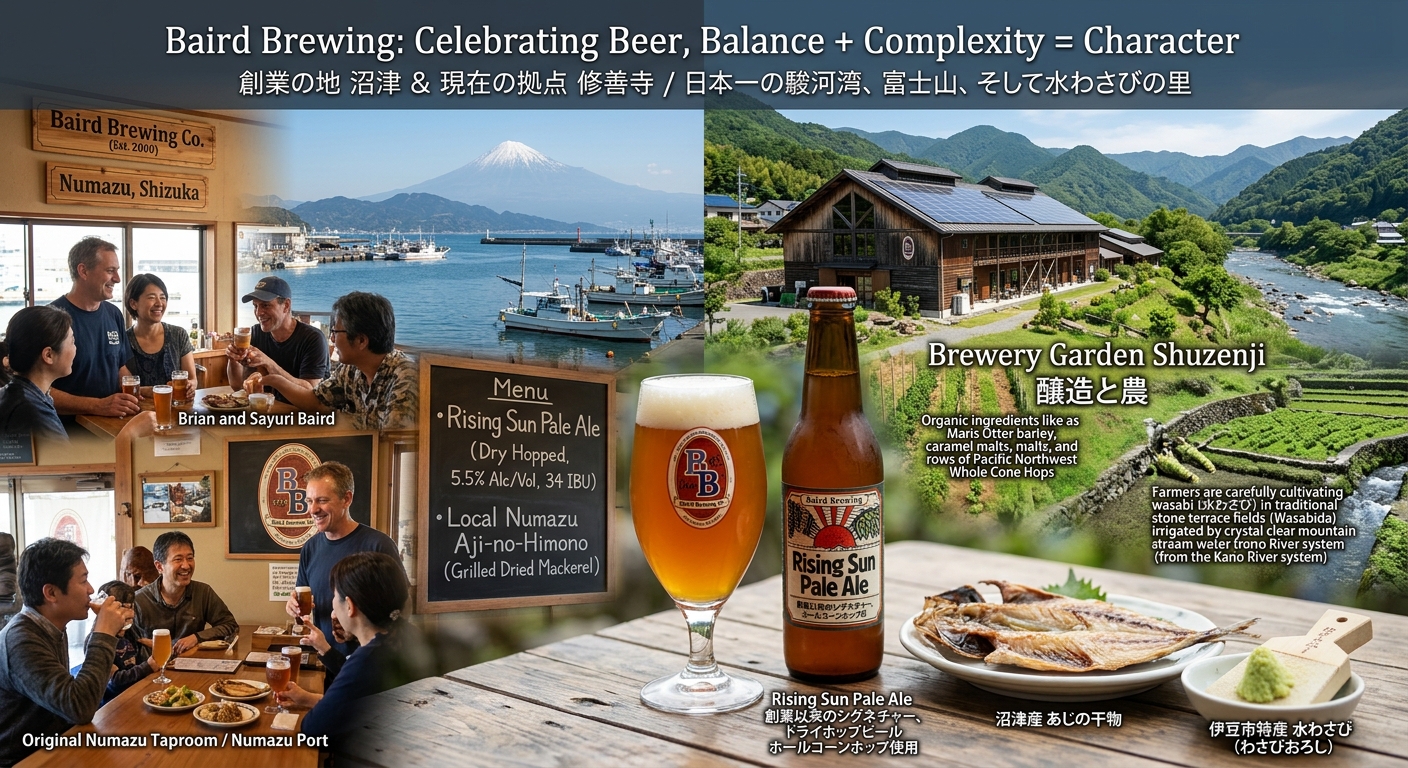
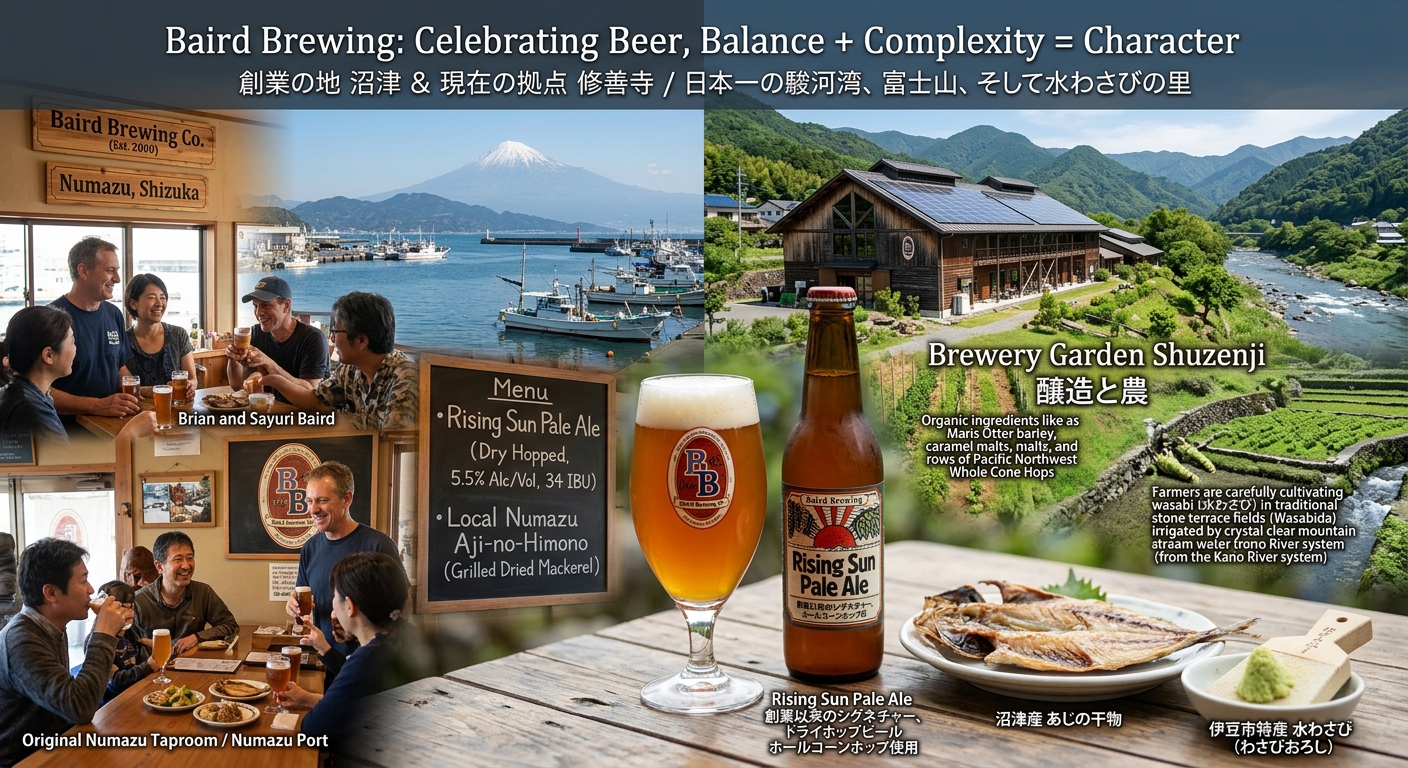
Baird Brewing was founded in 2000 by the husband-and-wife team of Bryan and Sayuri Baird in Numazu, Shizuoka. After graduating college in 1989, Bryan spent three years teaching English in Osaka. He then went on to Johns Hopkins University for graduate school, studying international political economy, and during those years became a regular at the legendary Brickskeller beer bar in Washington, D.C. — a place that once held a Guinness World Record for stocking over a thousand different beers. Japan was in the middle of a wave of deregulation at the time, and Bryan has said what drew him back was not just craft beer itself, but the shokunin, or artisan, culture Japan is known for.
Asked why he chose Numazu, Bryan has explained that the water quality was good, the proximity to Tokyo made distribution easier, and costs were lower. The brewery’s motto is “Celebrating Beer,” and its guiding philosophy is summed up in a simple formula: “Balance + Complexity = Character.” It remains a family company built around restoring the flavor, character and dignity that mass production leaves behind.
In the spring of 2014, the brewery moved its main production to the banks of the Kano River in Shuzenji, Izu City. Brewery Gardens Shuzenji sits on three hectares of land and combines brewing with farming on the same site. The official site describes the goal this way: by brewing and farming here, the aim is to highlight the intricate connection that exists between land and beer.
Rising Sun Pale Ale, featured here, has been the brewery’s signature dry-hopped beer since its early days. It’s built on floor-malted Maris Otter, an English malting tradition, with Caramel malt and Roast Barley added, and dry-hopped exclusively with whole-cone hops from the Pacific Northwest — no pellets or extracts — for a citrus and pine character. 5.5% ABV, 34 IBU.
The Story of the Land
Numazu, where the brewery began, sits on Suruga Bay, known as Japan’s deepest bay. Baird Brewing’s first taproom opened near Numazu’s fish port, serving beer alongside the day’s catch from the bay. Numazu is also one of Japan’s leading producers of aji himono — dried, salted horse mackerel — to this day.
The brewery’s current home, Oodaira in Izu City, sits along the Kano River in the middle of the Izu Peninsula. Izu City happens to hold the top spot in another field, too: mizuwasabi, water-grown wasabi. Shizuoka Prefecture leads Japan in both the yield and the value of its wasabi rhizome harvest, and roughly 70% of the prefecture’s cultivated area is concentrated in Izu City. The clear spring water drawn from the surrounding mountain forests to grow that wasabi, and the search for good water that led this brewery here, share the same root.
The Story of the Song
Kyu Sakamoto was born on December 10, 1941, in Kawasaki, Kanagawa. He debuted in 1959, and “Ue wo Muite Arukou” was released on October 15, 1961, with lyrics by Rokusuke Ei and music by Hachidai Nakamura.
In 1963, the song caught the attention of Pye Records in the UK. Company president Louis Benjamin heard it during a trip to Japan, liked it, and decided to release it back home — but couldn’t read the Japanese title. The solution was a new name for English-speaking markets: “SUKIYAKI,” a word that never appears in the lyrics and has nothing to do with the song’s content. It was chosen simply because it was short, easy to remember, and unmistakably Japanese. Released across the US by Capitol Records on May 3 of that year, it entered the Billboard Hot 100 at No. 79 on the May 11 chart, climbed steadily, and reached No. 1 on the chart dated June 15 — holding the top spot for three weeks.
The lyrics describe looking up as you walk, so the tears won’t fall — someone carrying sorrow while still trying to move forward. Kyu Sakamoto himself died on August 12, 1985, in the crash of Japan Airlines Flight 123, at the age of 43. The song is still sung today.
Why This Pairing
Both of these look up. The beer’s name, Rising Sun, points straight at the sun climbing into the sky, and hops themselves are a climbing plant, a bine that reaches upward through the summer months. “Ue wo Muite Arukou” is, quite literally, a song about walking with your face turned up. What they’re each looking toward differs, but the direction is the same.
There’s another thing they share: both crossed the Pacific, in opposite directions. Bryan Baird crossed from America to Japan and built a beer that brews English malting tradition and American hops together in Izu’s water. “Ue wo Muite Arukou” crossed from Japan to America, picking up a new name along the way — “SUKIYAKI,” a word with no connection to its lyrics — and still climbed to the top of the chart with its melody intact. Something changes shape when it crosses the ocean, but whatever was at its core seems to survive the crossing. This may be one more example of that.
The flavors share that same light, upward quality. Balanced between a citrus-and-pine hop aroma and malt sweetness, this beer drinks easy, and the glass empties quickly. That’s not so far from the rhythm of a song that stays bright even while its lyrics carry sorrow.
Where to Find This Beer
The Rakuten Ichiba link below is an affiliate link.
- Brewery official site:https://bairdbeer.com/products/rising-sun-pale-ale
- Buy on Rakuten Ichiba: View the product page (¥590)
These are Japanese storefronts. If you are visiting the brewery, drinking it fresh at their own taproom is by far the best option.
Pairing Dishes Worth Trying
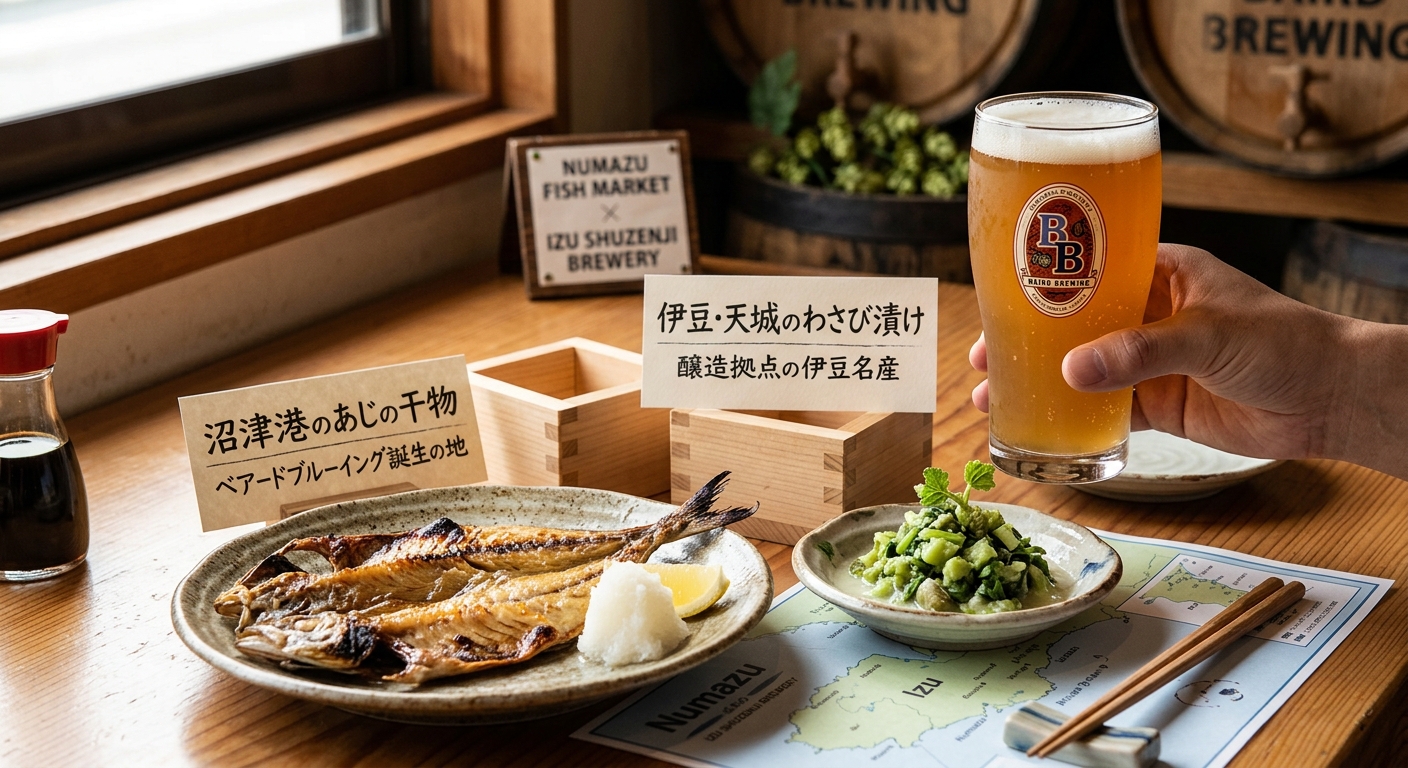
- Aji himono (dried horse mackerel) from Numazu port
The specialty of the town where Baird Brewing was born. Its concentrated umami and salt soften the beer’s hop bitterness while bringing the malt sweetness forward. - Wasabizuke from Amagi, Izu
A specialty of the area where the brewery now stands — wasabi root and leaves pickled in sake lees. Its sharp, sinus-clearing heat cuts through fat and layers neatly over the beer’s citrus and pine hop aroma.
A note on the science: wasabi’s pungent compounds, including allyl isothiocyanate, are highly volatile and register as aroma as much as taste. Hop aroma compounds are volatile in a similar way, perceived through much the same pathway, so rather than competing, the two aromas tend to layer into one impression. Salt, meanwhile, is known to soften the perception of bitterness, letting the malt sweetness in the beer come through more clearly against the dried fish.
Visiting the Brewery
Baird Brewing (Brewery Gardens Shuzenji)
1052-1 Odaira, Izu City, Shizuoka. About 10 min by car from Shuzenji Station (Izuhakone Railway).
A farm-style brewery on the bank of the Kano River. The third-floor taproom looks out over the river and the mountains of Izu.
Sights Nearby
- Shuzenji Onsen town / Izu City | ~8 min, ~3 km by car from the brewery
One of the oldest hot-spring towns in Izu, said to have been opened by Kobo Daishi. It has a bamboo-lined path along the Katsura River and the Tokko-no-yu spring welling up in the riverbed. - Shuzen-ji Temple / Izu City | ~8 min, ~3 km by car from the brewery
A temple at the heart of the hot-spring town, said to have been founded in 807, and connected to the story of Minamoto no Yoriie.
Hot Springs Nearby
- Shuzenji Onsen public bath “Hakoyu” / Izu City | ~8 min, ~3 km by car from the brewery
A day-use bath with a cypress-wood tub. Some inns in the hot-spring town also accept day-use bathers; check each one’s hours.
Opening hours, closing days and day-use bathing availability can change. Please check each facility’s official information before visiting.
A Quick Glossary of Beer Terms
- Craft beer: Beer made by small breweries that put the character of the maker front and centre, as opposed to the uniformity of mass production.
- Pale Ale: A lightly coloured ale that balances malt sweetness against hop aroma — often the entry point into the world of ale styles.
- Malt: Germinated barley. It forms the foundation of a beer’s sweetness, colour and body; how deeply it is roasted determines colour and toastiness.
- Hops: The cones of a climbing plant, which give beer its bitterness and aroma. Depending on the variety, that aroma can read as citrus, tropical fruit or open grassland.
- Dry hopping: Steeping hops in beer after fermentation rather than boiling them. Because nothing is boiled, bitterness barely increases, while aroma is pushed dramatically forward.
- IBU: An international measure of bitterness. Around 10 you barely notice it; above 60 you are in clearly bitter IPA territory.
Sources
- Baird Beer official site — Rising Sun Pale Ale product page
- Baird Beer official site — The Baird Beer Way
- Baird Beer official site — Brewery Gardens Shuzenji
- Japan Beer Times — Baird Brewing interview
- Billboard JAPAN — Kyu Sakamoto’s “SUKIYAKI” reaches No. 1 on the Hot 100, chart dated June 15, 1963
- “Ue wo Muite Arukou” — Wikipedia (Japanese)
- Kyu Sakamoto — Wikipedia (Japanese)
- Wasabi in Izu City — official Izu City portal
- Wasabizuke (Shizuoka) — “Our Local Cuisine,” Ministry of Agriculture, Forestry and Fisheries
- Numazu’s traditional himono industry — Shizuoka Gastronomy Tourism
If you notice any errors in this article, please don’t hesitate to reach out at info@soundrecords.jp.
Read this article in Japanese: のぼる方へ