日本語で読む | This is the English version of a bilingual article.
Today’s Pairing
- Sake: Hiokizakura Junmai Daiginjo “Goriki” — made with 100% Tottori-grown Goriki sake rice, rice-polishing ratio (seimai buai) 45%, 15% alcohol / Yamane Shuzojo Co., Ltd. (Aoya-cho Otsubo, Tottori City, Tottori Prefecture; founded 1887)
Official site: https://hiokizakura.jp/ - Kayoukyoku (classic Japanese popular song): “Tottori Sakyu” (“Tottori Sand Dunes”) by Mizumori Kaori, 2003
YouTube: https://www.youtube.com/watch?v=i0_Bk66TCnE
▶ If the player above doesn’t play, open it on YouTube
The Story of the Brewery
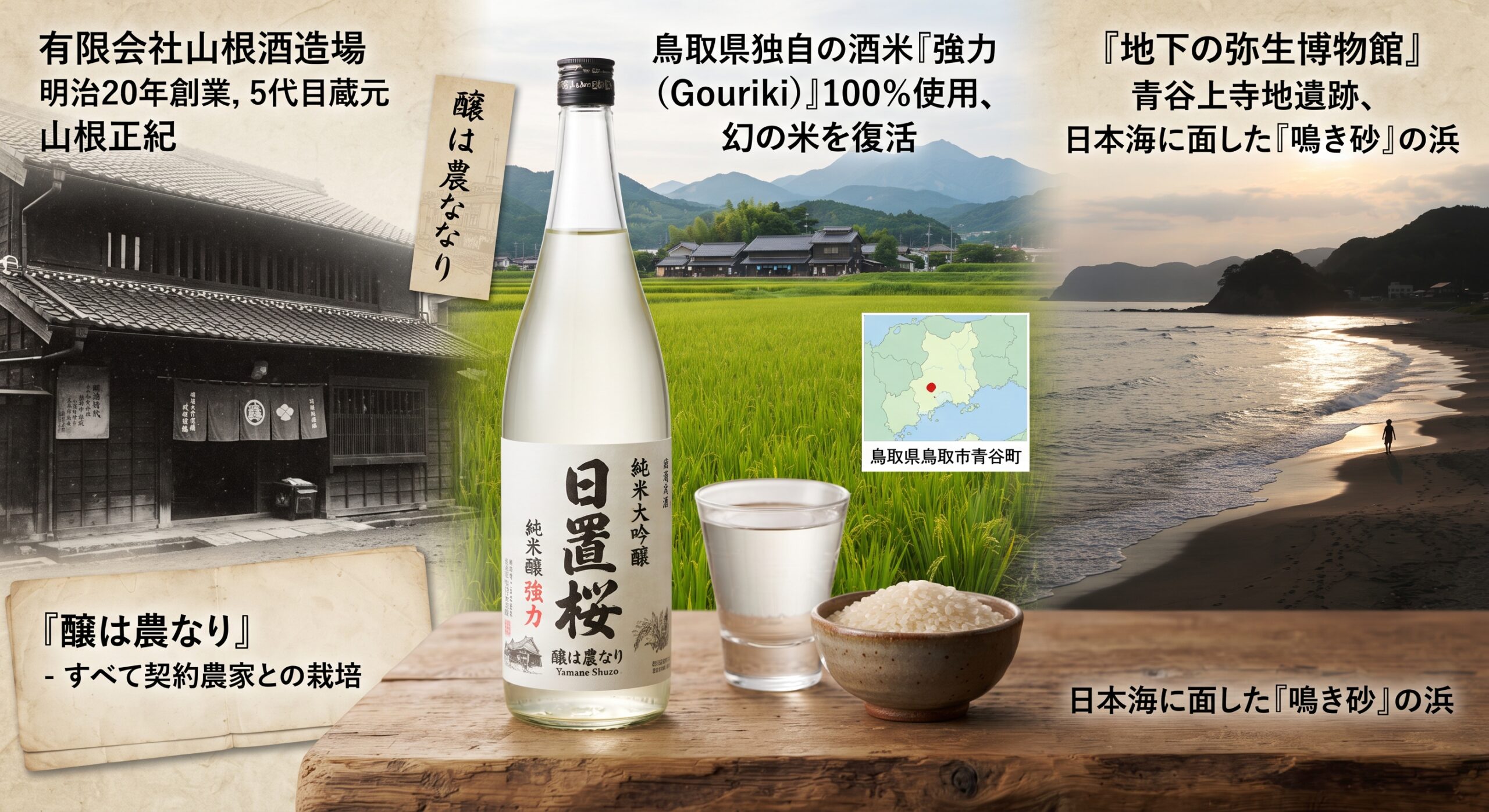
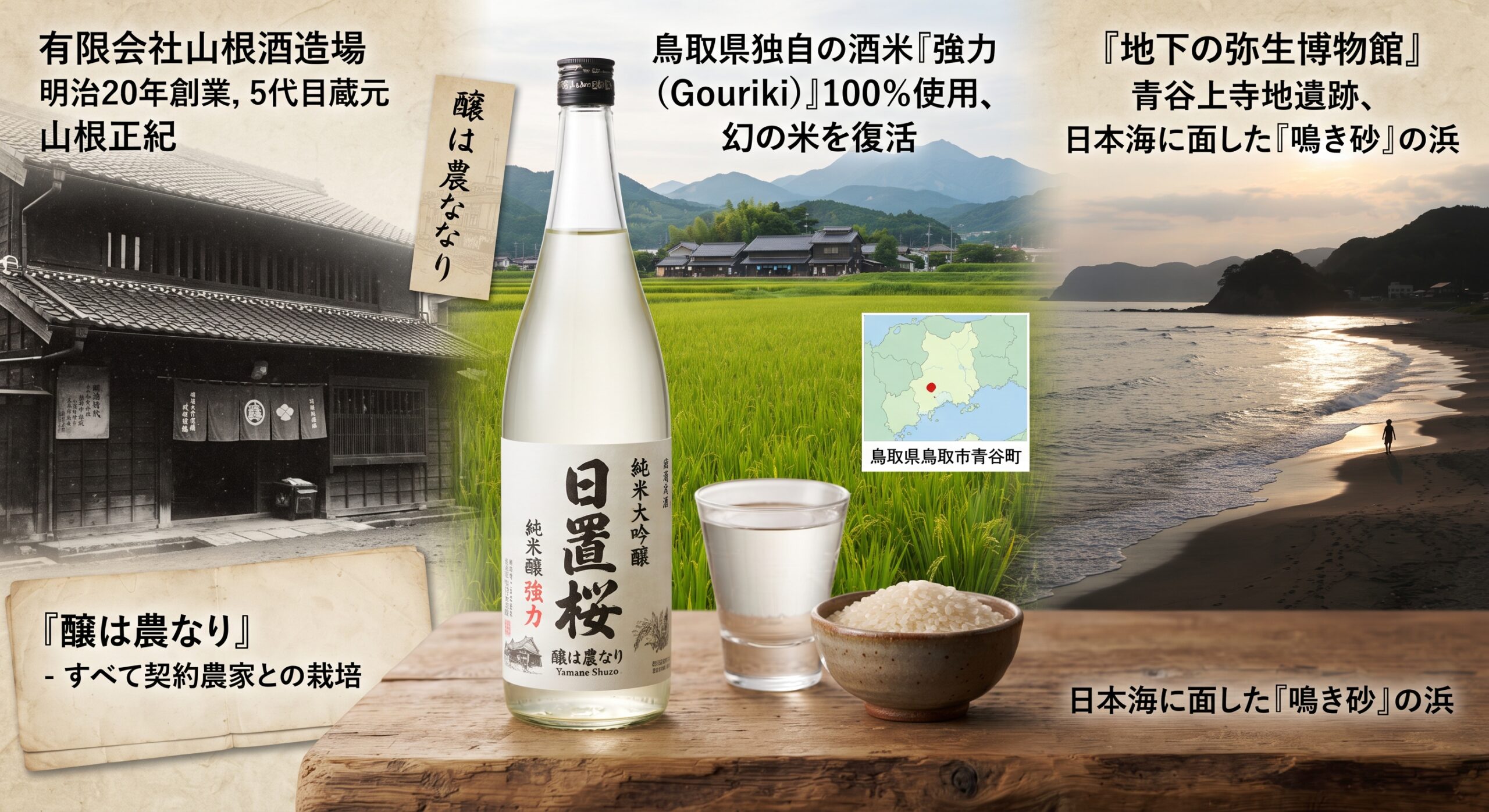
Yamane Shuzojo Co., Ltd. was founded in 1887 in the Hioki valley of Aoya-cho, Tottori City. It’s now led by fifth-generation brewery owner Yamane Masaki, under the motto “brewing is farming.” Every grain of rice behind the brewery’s single label, Hiokizakura, is grown under contract with local farmers. Guided by the belief that “sake should keep purifying itself — that is its evolution, and what should be passed on to the future,” the brewery aims for complete fermentation, letting the yeast consume the sugars fully. Its sake tends to carry some bitterness and astringency when young, then grows richer in umami the longer it’s left to rest.
The bottle in this pairing, Junmai Daiginjo “Goriki,” is brewed with 100% Goriki, a sake rice variety unique to Tottori, polished to a seimai buai of 45%. It has a broad, assertive acidity and deep richness — a style built less around aroma and more around the kind of sturdy, full-bodied flavor reminiscent of ginjo sake from the Showa era.
Goriki was selected and bred from a local rice variety by Watanabe Shinpei of what was then Shimonakayama village in Tohaku District, Tottori (now Daisen Town). Widely grown as one of Tottori’s recommended rice varieties from the Taisho era into the Showa era, it was dropped from that list in 1945 because its tall, easily lodged stalks made it difficult to cultivate, and by around 1954 it had disappeared from the prefecture entirely. Nakagawa Sake Brewery and Yamane Shuzojo later led the effort to revive it, working from a small reserve of seed stock kept at Tottori University’s Faculty of Agriculture, and in 1990 brought it back to life as a junmai daiginjo sake. In 1998, at Nakagawa Sake Brewery’s call, growers and brewers formed the “Association for Nurturing Goriki” to preserve the original strain and manage its seed stock. Hiokizakura is one of the breweries that brought this rice, once vanished from Tottori altogether, back to life with its own hands.
The Story of the Land
Aoya-cho, the quiet town on the Sea of Japan where the brewery stands, holds something remarkable underground: a site nicknamed “an underground Yayoi museum.” The Aoya Kamijichi archaeological site, discovered during the construction of the San’in Expressway, is the remains of a Yayoi-period settlement dating from roughly 2,400 to 1,700 years ago. Protected by the oxygen-poor conditions of a wetland, it has yielded wooden tools, human bones bearing cut marks, and even a fragment of Yayoi-era human brain tissue, all in remarkable condition — items that rarely survive at most archaeological sites. Tottori Prefecture itself describes the discovery as “a find of global significance.” As many as 1,353 items from the site have been designated Important Cultural Properties, and visitors can see them today at the adjoining Aoya Kamijichi Archaeological Park.
The same town is also home to Idegahama, also known as Aoya Coast, known for its “singing sand” — a rare beach where the sand squeaks underfoot, once rated among the lowest and most beautiful-sounding in Japan. Local residents and surfers keep the sand clean enough through ongoing cleanup efforts to preserve that sound. In this unassuming seaside town, more than one thing that once sank beneath the passage of time has resurfaced into the light — that is Aoya-cho.
The Story of the Song
Mizumori Kaori debuted on September 25, 1995, with “Oshiroi Bana,” entering the Oricon enka/kayoukyoku ranking at a striking No. 3. But no major hit followed for years. A first sign of a turning point came in 2002 with her tenth single, “Toujinbo,” which caught on with karaoke fans and gave her a foothold as a major-label artist. Then, on April 2, 2003, came her eleventh single, “Tottori Sakyu.” The lyrics are by Kinoshita Ryutaro, the music by Tsuru Tetsuya, and the arrangement by Maeda Toshiaki. It peaked at only 16 on Oricon’s weekly chart — not a flashy number — but it became a long-running hit, earned a platinum certification from the Recording Industry Association of Japan, and won the Gold Prize at the 45th Japan Record Awards. That same year, Mizumori made her first appearance on NHK’s year-end Kohaku Uta Gassen.
After the breakout success of “Tottori Sakyu,” Mizumori went on to release one “go-to-chi song” (a song dedicated to a specific place in Japan) after another, becoming known as “the queen of go-to-chi songs.” The turning point that finally arrived with her eleventh single, nearly eight years into her career, became the foundation for everything that followed.
Why This Pairing
Goriki, the sake rice, was once widely grown across Tottori as one of its recommended varieties, only to vanish from the prefecture completely. Brewers — including Hiokizakura’s own — and farmers brought it back, and now it can be tasted again, right here in this cup. The wooden artifacts and brain tissue that lay buried deep underground at Aoya Kamijichi, and the singing sand of Idegahama, are likewise things that nearly sank beneath the passage of time before resurfacing into the present.
Mizumori Kaori, too, spent nearly eight quiet years after her 1995 debut without much recognition, before her eleventh single found its audience. Once “Tottori Sakyu” finally reached people widely, she went on to become “the queen of go-to-chi songs,” spending her career shining a light on one unassuming corner of Japan after another. Something once overlooked catching the light again — that’s a story you can find both in Tottori’s sake rice and in the song that first turned Tottori into something sung about nationwide.
Where to Find This Bottle
The Rakuten Ichiba link below is an affiliate link.
- Brewery’s official site: https://hiokizakura.jp/
- Buy on Rakuten Ichiba: View the product page (720ml, ¥4,048)
Note: the links above lead to Japan-based retailers. They’re most convenient for readers in Japan, or for those elsewhere who are able to arrange international shipping. Stock and availability change over time, so if you’re near a specialty sake shop, it’s well worth asking for this label by name.
Pairing Dishes Worth Trying
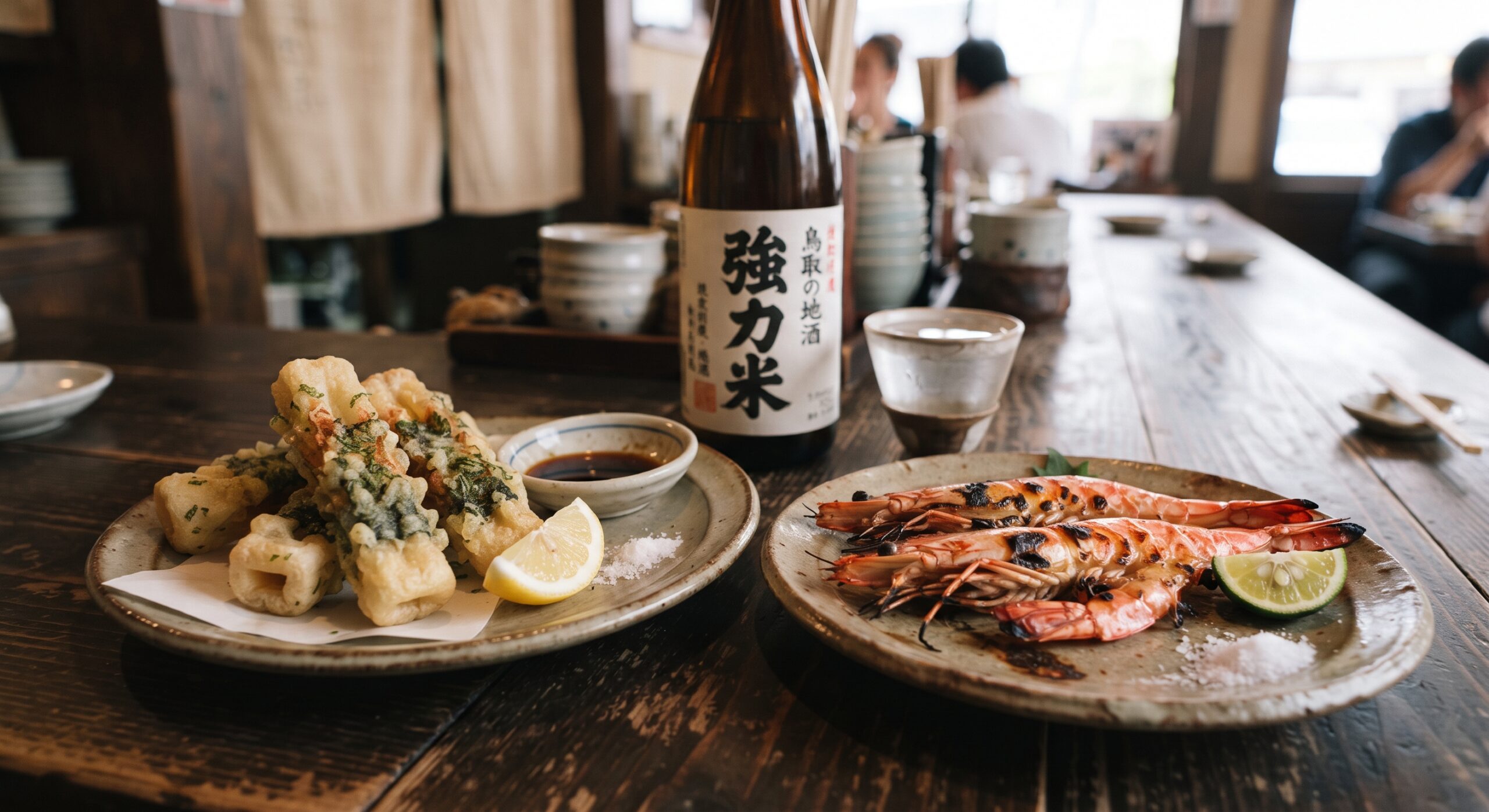
- Tofu chikuwa, isobe-age style
A soul food of eastern Tottori Prefecture: fish surimi kneaded together with tofu, giving it a distinctively light, fluffy texture. Deep-frying it in a seaweed-flecked batter (isobe-age) adds a toasty aroma that stands up well to the broad acidity and richness of Goriki rice sake.
Recipe (in Japanese): Kurashiru, “Chikuwa Isobe-age, Simple and Good” (the same method works with tofu chikuwa) - Salt-grilled mosa ebi
Known locally as kurozako-ebi, this shrimp is so perishable that it rarely travels beyond Tottori, earning it a reputation as a “phantom shrimp.” Grilling it whole, shell and all, with a dusting of salt brings out a sweetness said to rival that of sweet shrimp (amaebi).
Recipe (in Japanese): Cookpad, “Salt-Grilled Mosa Ebi” by Battoman
A note on the science: the acidity in sake cuts through the oil of fried food, cleansing the palate — which is why freshly fried tofu chikuwa pairs so naturally here. Ingredients rich in sweetness and umami, like mosa ebi, resonate with the amino-acid umami of a junmai daiginjo, so the umami from both sides layers together into a fuller, deeper flavor.
Visiting the Brewery
Hiokizakura (Yamane Shuzojo)
Aoya-cho Otsubo, Tottori City, Tottori Prefecture. Within walking distance of JR Aoya Station on the San’in Main Line, and just off the Aoya Interchange on the San’in Expressway.
Founded in 1887, the brewery works under the motto “brewing is farming,” growing every grain of rice it uses under contract with local farmers.
Sights Nearby
- Aoya Kamijichi Archaeological Park / Yoshikawa, Aoya-cho, Tottori City | ~5 min by car from the brewery
The remains of a Yayoi-period settlement dating from about 2,400 to 1,700 years ago. Preserved in an oxygen-poor wetland, the site has yielded a fragment of Yayoi-era human brain tissue along with finely made wooden tools in remarkable condition — earning it the nickname “an underground Yayoi museum.” Open 9:00–17:00, closed the 4th Monday of each month and over New Year’s; admission is free except for the building housing Important Cultural Properties. - Idegahama / Aoya Coast / Ide, Aoya-cho, Tottori City | ~10 min by car from the brewery
A coastline within the Nishi-Inaba Prefectural Natural Park, known for its “singing sand.” Open as a swimming beach in summer, and popular with surfers year-round. Local residents and surfers keep the sand clean enough to preserve its sound.
Opening hours and closing days can change. Please check each facility’s official information before visiting.
A Quick Glossary of Sake Terms
- Junmai Daiginjo: Junmai sake (made only from rice, rice koji, and water, with no added brewing alcohol) polished to a seimai buai of 50% or less — the most refined, fragrant tier of junmai sake.
- Seimai buai (rice-polishing ratio): The percentage of the original grain remaining after milling. The lower the number, the more the rice has been polished down.
Sources
- Yamane Shuzojo – Official Site
- Message from the Brewery Owner – Yamane Shuzojo Official Site
- Product List – Yamane Shuzojo Official Site
- Yamane Shuzojo – “Torinet” Tottori Prefecture Official Site
- What Is Goriki, the “Wild Horse” of Sake Rice? – SAKE Street (Japanese)
- Goriki (rice) – Wikipedia (Japanese)
- Tottori Sakyu (Mizumori Kaori song) – Wikipedia (Japanese)
- Mizumori Kaori – Wikipedia (Japanese)
- Mizumori Kaori Profile – Tokuma Japan Communications (Japanese)
- Feature: The Revived Yayoi Kingdom – Aoya Kamijichi Site – “Torinet” Tottori Prefecture Official Site (Japanese)
- Aoya Kamijichi Archaeological Park – Official Site, Access (Japanese)
- Idegahama & Aoya Coast – Aoya Town Tourism Association (Japanese)
- Cookpad, “Salt-Grilled Mosa Ebi” by Battoman (Japanese)
If you notice any errors in this article, please don’t hesitate to reach out at info@soundrecords.jp.
Read this article in Japanese: 消えてしまった米も、ようやく光を浴びる