今日のペアリング
▶ 上のプレーヤーで再生できない場合は、YouTubeで開く
酒蔵の話
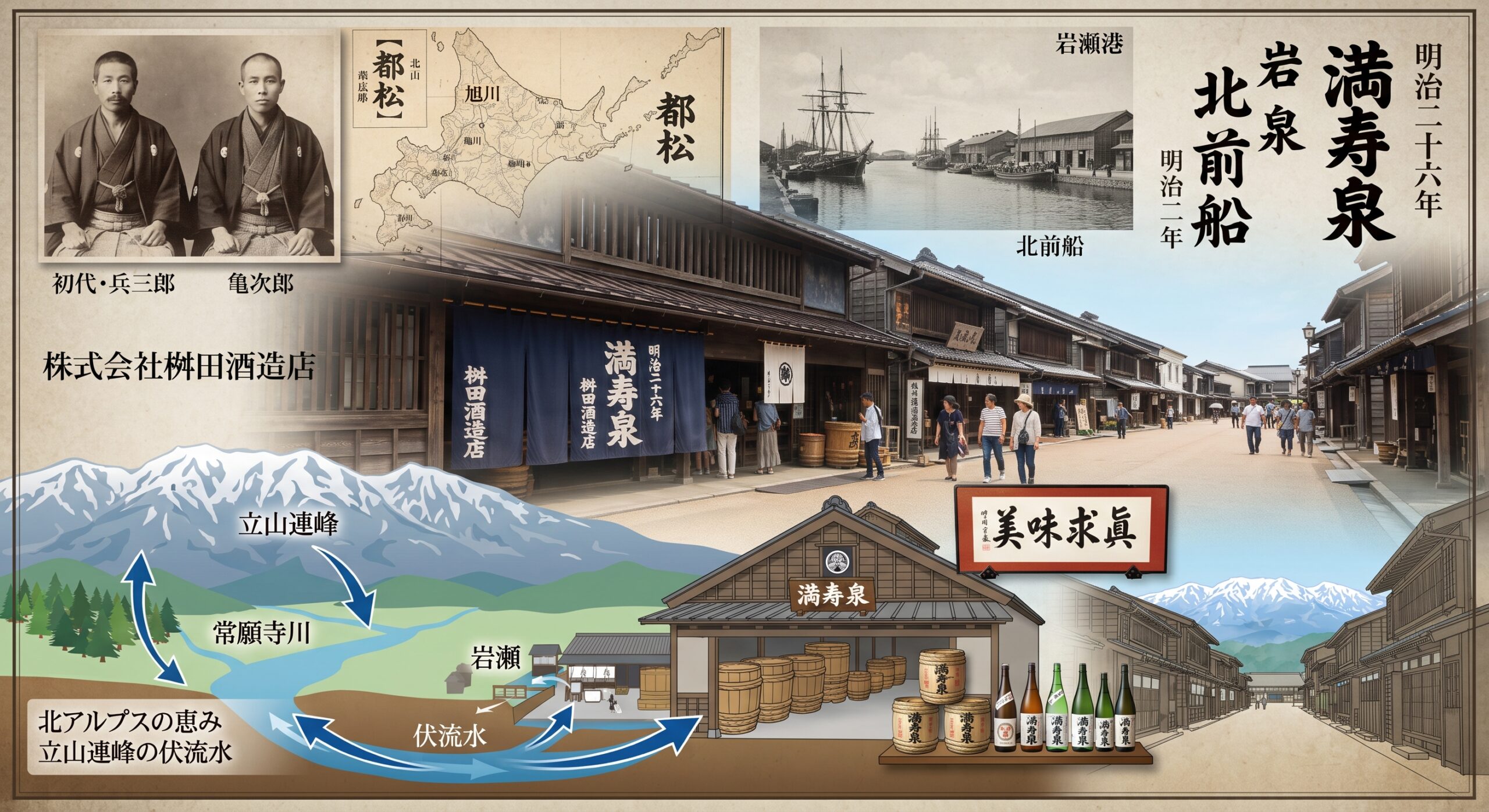
株式会社桝田酒造店の歴史は、明治26年(1893年)にさかのぼります。初代・兵三郎は長男の亀次郎とともに、富山の港町・岩瀬を離れて北海道旭川に渡り、「都松」の商標で酒造業を始めました。明治30年(1897年)頃には1,500石という、当時としては日本でも屈指の規模まで成長しましたが、明治35年(1902年)の厳しい寒さに、亀次郎の妻フデが故郷への帰郷を望むようになります。明治38年(1905年)、亀次郎は岩瀬に戻り、「岩泉」の銘柄で酒造りを再開しました。昭和初期、港町の芸者衆にも喜ばれる目出度い名前として、苗字の「桝田」にちなみ「満寿泉」と名付けた酒が大当たりし、これが蔵の主力ブランドとなりました。
4代目当主・桝田敬二郎氏は、のちに「能登杜氏四天王」の一人と称されるようになる杜氏・三盃幸一氏とともに、吟醸酒がまだ広く知られていなかった時代から、その市販に取り組んできました。蔵の理念は「美味求眞(びみきゅうしん)」。おいしいものを食べて舌を鍛えた人にしか、本物の日本酒は造れない、という考え方だといいます。現在の5代目当主・桝田隆一郎氏は「酒は文化とともにある」と語り、蔵のある岩瀬の町づくりにも力を注いでいます。
土地の話
桝田酒造店のある富山市岩瀬は、神通川の河口に位置する港町です。蔵元の公式サイトによれば、岩瀬は平安時代の法典「延喜式」に駅(うまや)として登場し、室町時代の海運のルールをまとめた「廻船式目」では、日本有数の港をまとめた「三津七湊」の一つに「越中岩瀬湊」として名を連ねています。江戸後期から明治にかけては北前船の寄港地として栄え、「岩瀬五大家」と呼ばれる廻船問屋が軒を連ねました。明治6年(1873年)の大火でかつての町並みは焼失しましたが、その後に建て直された家々が、今も岩瀬の歴史的な街並みとして残っています。
満寿泉を仕込む水は、北アルプスの立山連峰を源とする常願寺川の伏流水です。立山に降った雪や雨が地中にしみ込み、長い時間をかけて川をくだり、この岩瀬の蔵のもとへ届く――蔵元の公式サイトは、そんな水の巡りをこの一言で伝えています。
音楽の話
「川の流れのように」は1989年1月11日発売、美空ひばりのシングル。作詞は秋元康、作曲は見岳章、編曲は竜崎孝路、レコード会社は日本コロムビアです。オリコン週間チャートでは最高8位でしたが、第31回日本レコード大賞で金賞と作曲賞、第20回日本歌謡大賞で特別栄誉賞を受けています。
美空ひばりは1937年5月29日、神奈川県横浜市生まれ。1989年6月24日、52歳で逝去しました。「川の流れのように」は、彼女が生前最後に発表したシングルとなり、没後に売り上げが伸びて、彼女の生涯最大のヒット曲となりました。同年7月2日、美空ひばりには国民栄誉賞が贈られています。女性としては初めての受賞でした。
なぜこの組み合わせなのか
満寿泉を仕込む水は、立山連峰に降った雪や雨が常願寺川をくだり、長い時間をかけて岩瀬の蔵のもとへ届いたものです。そしてその岩瀬こそ、かつて日本中からやってきた北前船が立ち寄り、海の向こうへと再び旅立っていった港町でした。山に始まり、川をくだり、海へ出ていく――この土地には、そういう水と人の流れが、昔からずっと重なってきました。
「川の流れのように」は、これから先どこに行き着くのか分からないまま、ただ流れに身を任せて生きていくことを歌った曲です。美空ひばりが世を去る半年前に発表した、生涯最後のシングルだと知ると、この歌はいっそう重みを増して聞こえてきます。立山の雪どけから始まり、川をくだって海へ出ていく水の道のりと、一人の歌手が歌い残した人生の歌。どちらも、山から海まで、ゆっくりと時間をかけて流れていくものとして、重なって見えてきます。
この一本を、探すなら
※楽天市場へのリンクは広告(アフィリエイト)です。在庫・取扱いは変動します。お近くの酒販店でも、ぜひ銘柄名を伝えて探してみてください。
🌡️ おすすめの飲み方:常温、または40℃前後のぬる燗で。米・米麹・水だけで仕込んだ純米酒らしい、米の旨みをまっすぐ感じられる一本です。燗にすると、その旨みがふわりと広がります。
合わせたい「アテ」
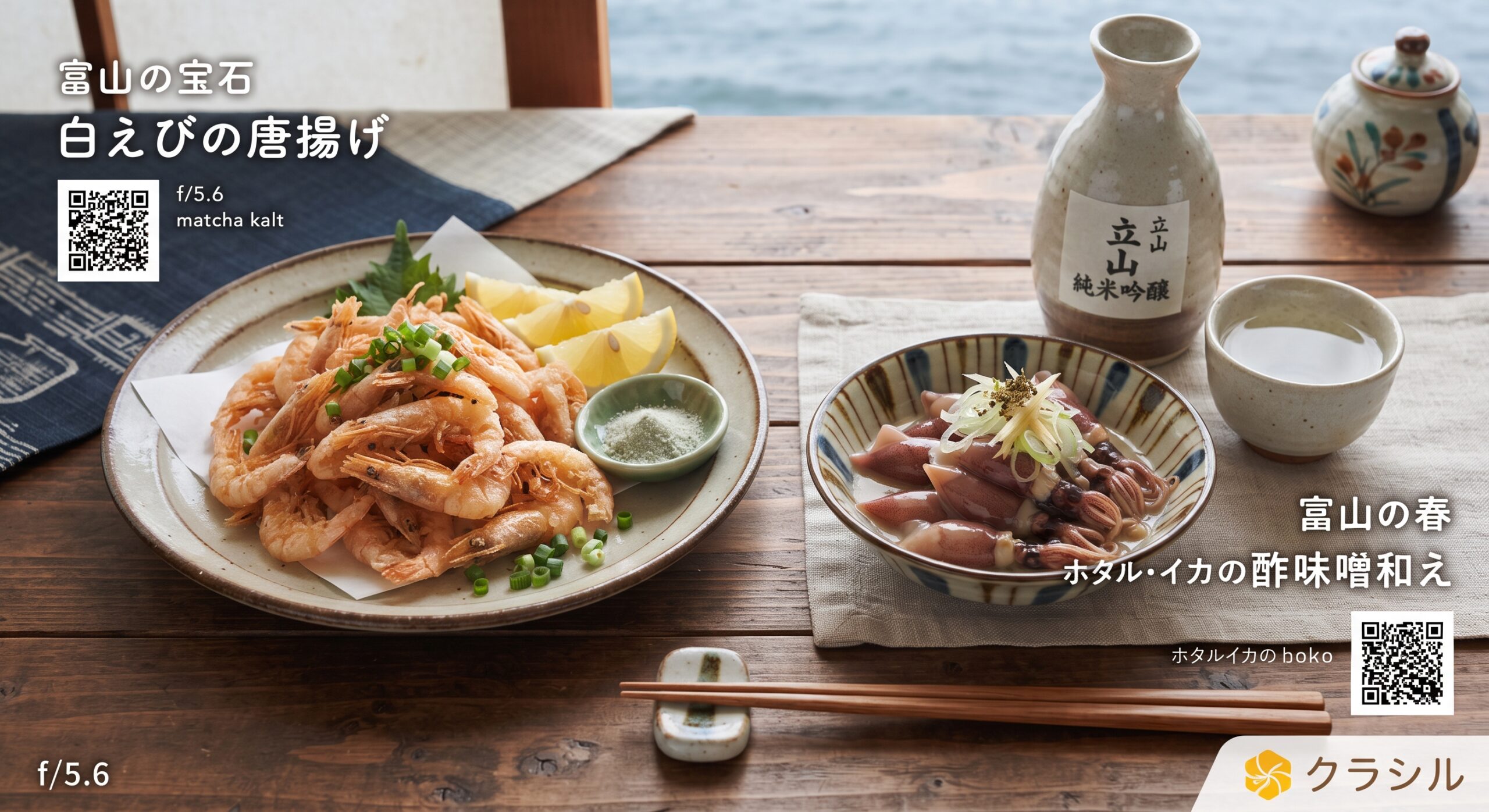
- 白えびの唐揚げ
富山湾でしか、まとまった量が水揚げされない白えび。体長5〜8cmほどの小さなエビで、水揚げ直後は透き通るような淡いピンク色をしていることから「富山湾の宝石」と呼ばれています。上品な甘みのある白えびをサクッと揚げた一品に、純米酒の米の旨みがすっと寄り添います。
レシピはこちら:クラシル「サクサク白エビの唐揚げ」
- ホタルイカの酢味噌和え
富山湾では毎年3月から5月にかけて、産卵のためにホタルイカの大群がやってきます。常願寺川の河口から魚津市にかけての海面は、昭和27年(1952年)に国の特別天然記念物「ホタルイカ群遊海面」に指定されています。プリプリとした身に酢味噌の酸味がよく合う、富山の春を告げる一品です。
レシピはこちら:クラシル「ホタルイカの酢味噌和え」
科学的にひとこと:白えびの唐揚げのように油で揚げた料理は、日本酒の酸味と軽い発泡感(炭酸ガス)が口の中の脂をすっきりと洗い流し、次の一口をより美味しく感じさせてくれます。ホタルイカの持つ独特の旨味は、酢味噌の発酵由来のグルタミン酸と重なり合うことで、旨味の相乗効果を生み出します。
この蔵をたずねるなら
桝田酒造店
富山県富山市東岩瀬町269/富山ライトレール「東岩瀬駅」から徒歩約5分。
蔵のある岩瀬地区は、かつて北前船の寄港地として栄えた港町で、古い街並みが今も残っています。
近くの観光スポット
- 旧馬場家住宅/富山市岩瀬地区|蔵から徒歩約3分(約0.2km)
北前船廻船問屋として栄えた「岩瀬五大家」筆頭の旧家。国登録有形文化財。2024年5月1日に再開館。9:00〜17:00(入館は16:30まで)、年末年始(12/28〜1/4)休館、入館料大人100円。
- 岩瀬カナル会館/富山市岩瀬地区|蔵から徒歩約8分(約0.6km)
富岩水上ラインの発着地にある観光案内施設。物産販売や展示ラウンジがあり、レンタサイクルの受付も行っています(営業時間は窓口ごとに異なるため、訪問前にご確認ください)。
近くの温泉
- 萩の湯/富山市岩瀬地区|蔵から徒歩圏
岩瀬の港町に根付く鉱泉銭湯(泉温42.0℃)。14:00〜21:00営業、火曜定休。日帰り入浴ができます(詳細は富山県公衆浴場業生活衛生同業組合『とやせん』のサイトでご確認ください)。
※営業時間・定休日・日帰り入浴の可否は変わることがあります。おでかけ前に各施設の公式情報をご確認ください。
ひとことメモ(日本酒の用語)
- 純米酒:米・米麹・水だけで造られ、醸造アルコールを添加していない日本酒。米の旨みをまっすぐ感じられるのが特徴です。
参考
内容に誤りがございましたら、お手数ですが info@soundrecords.jp までご連絡いただけますと幸いです。
Today’s Pairing
- Sake: Masuizumi Junmai “Shirahagi” — a Junmai sake (made only from rice, rice koji, and water) / Masuizumi Shuzoten Co., Ltd. (269 Higashi-Iwase-cho, Toyama City, Toyama Prefecture)
Official site: https://www.masuizumi.co.jp/
- Kayoukyoku (classic Japanese popular song): “Kawa no Nagare no You ni” (“Like the Flow of a River”) by Hibari Misora, 1989
YouTube: https://www.youtube.com/watch?v=p4kt1rhDR6Y
▶ If the player above doesn’t play, open it on YouTube
The Story of the Brewery
The history of Masuizumi Shuzoten goes back to 1893. Hyozaburo, the brewery’s founder, left the port town of Iwase in Toyama together with his eldest son Kamejiro and moved to Asahikawa, Hokkaido, where they began brewing sake under the brand name “Tomatsu.” By around 1897 their output had grown to 1,500 koku (roughly 270,000 liters), a scale that ranked among the largest in Japan at the time. But the bitter cold of 1902 made Kamejiro’s wife Fude long for home, and in 1905 Kamejiro returned to Iwase, restarting the brewery under the name “Iwaizumi.” In the early Showa era, a sake named “Masuizumi” — an auspicious name chosen to please the geisha of the port town, playing on the family name Masuda — became a hit, and it has been the brewery’s main brand ever since.
The brewery’s fourth-generation owner, Masuda Keijiro, worked together with toji (master brewer) Sanbai Koichi — later known as one of the “Four Heavenly Kings of Noto Toji” — to bring ginjo sake to market at a time when it was still largely unknown. The brewery’s guiding philosophy is “bimikyushin” (美味求眞, “seeking truth through delicious taste”): the idea that only someone whose palate has been trained by truly delicious food can brew real sake. The current, fifth-generation owner, Masuda Ryuichiro, has said that “sake exists together with culture,” and has put real energy into the revitalization of Iwase, the town where the brewery stands.
The Story of the Land
Masuizumi Shuzoten stands in Iwase, a port town at the mouth of the Jinzu River in Toyama City. According to the brewery’s own website, Iwase appears as a post station in the Heian-era legal code Engishiki, and in the Muromachi-era shipping code Kaisen Shikimoku it’s named, as “Etchu Iwase Harbor,” among the “three ports and seven harbors” (santsu-shichiso) ranked as Japan’s leading ports of the time. From the late Edo period into the Meiji era, Iwase thrived as a port of call for Kitamaebune trading ships, and the shipping merchants known as the “Five Great Families of Iwase” lined its streets. A great fire in 1873 destroyed the old townscape, but the houses rebuilt afterward still stand today as Iwase’s historic streetscape.
The water used to brew Masuizumi is spring water drawn from the Joganji River system, whose source lies in the Tateyama mountain range of the Northern Japan Alps. Snow and rain that fall on Mt. Tateyama seep into the ground and, over a long stretch of time, travel down the river to reach the brewery here in Iwase — a journey the brewery’s own website describes in just those words.
The Story of the Song
“Kawa no Nagare no You ni” was released on January 11, 1989, a single by Hibari Misora. The lyrics are by Akimoto Yasushi, the music by Mitake Shoichi, the arrangement by Tatsuzaki Koji, and it was released on Nippon Columbia. It peaked at number 8 on Oricon’s weekly singles chart, and went on to win the Gold Prize and the Composition Award at the 31st Japan Record Awards, as well as a Special Honor Award at the 20th Japan Music Awards (Nihon Kayo Taisho).
Hibari Misora was born on May 29, 1937, in Yokohama, Kanagawa Prefecture, and passed away on June 24, 1989, at the age of 52. “Kawa no Nagare no You ni” became the last single she released during her lifetime; its sales grew after her death, and it went on to become the best-selling single of her career. On July 2 of that year, Misora was awarded the People’s Honor Award (Kokumin Eiyo-sho) — the first woman ever to receive it.
Why This Pairing
The water used to brew Masuizumi begins as snow and rain on the Tateyama mountains, travels down the Joganji River, and arrives, after a long journey, at the brewery here in Iwase. And Iwase itself was once a port where Kitamaebune ships from all across Japan would call, before setting out again across the sea. Starting in the mountains, running down the river, and heading out to sea — this pattern of water, and of people, has repeated itself here for a very long time.
“Kawa no Nagare no You ni” is a song about living by simply letting yourself go with the flow, without knowing where you’ll eventually end up. Knowing that it was released just six months before Hibari Misora’s death, as the last single of her life, gives the song an added weight. The long journey of water that begins as snowmelt on Mt. Tateyama and flows, by way of a river, out to sea, and the song a single singer left behind at the end of her life — both come to look, in the end, like things that take their time, flowing slowly from the mountains to the sea.
Where to Find This Bottle
The Rakuten Ichiba link below is an affiliate link.
Note: the links above lead to Japan-based retailers. They’re most convenient for readers in Japan, or for those elsewhere who are able to arrange international shipping. Stock and availability change over time, so if you’re near a specialty sake shop, it’s well worth asking for this label by name.
🌡️ Recommended way to drink it: At room temperature, or gently warmed (nurukan) to around 40°C. As a junmai sake — made only from rice, rice koji, and water — its straightforward rice umami comes through clearly, and warming it lets that umami unfold a little further.
Pairing Dishes Worth Trying
- Shiroebi (white shrimp) karaage
Toyama Bay is the only place in Japan where shiroebi, a tiny shrimp just 5–8 cm long, is caught in commercially meaningful quantities. Freshly landed, it’s a translucent, pale pink, which is why it’s known as “the jewel of Toyama Bay.” Its refined sweetness, fried up crisp, sits naturally alongside the straightforward rice umami of a junmai sake.
Recipe (in Japanese): Kurashiru, “Crispy Shiroebi Karaage”
- Hotaru-ika (firefly squid) with vinegar miso
Every year between March and May, huge schools of firefly squid come to Toyama Bay to spawn. The waters stretching from the mouth of the Joganji River to Uozu City were designated a Special Natural Monument of Japan in 1952 as the “Hotaruika Gunyu Kaimen” (Firefly Squid Mass Appearance Sea Surface). The squid’s plump texture pairs naturally with the tang of vinegar miso, in a dish that announces spring in Toyama.
Recipe (in Japanese): Kurashiru, “Hotaru-ika with Vinegar Miso”
A note on the science: fried dishes like shiroebi karaage leave oil on the palate, and sake’s acidity and light carbonation help rinse that richness away, so the next bite tastes just as good as the first. The distinctive umami of hotaru-ika resonates with the glutamic acid produced by the fermentation in vinegar miso, creating a synergistic boost of savoriness.
Visiting the Brewery
Masuizumi Shuzoten (Masuda Sake Brewing)
269 Higashi-Iwase-cho, Toyama City, Toyama Prefecture. About a 5-minute walk from Toyama Light Rail’s Higashi-Iwase Station.
The brewery sits in Iwase, a port district that once thrived as a Kitamaebune (coastal trading ship) port, and still keeps much of its old townscape today.
Sights Nearby
- Former Baba Residence / Iwase, Toyama City | ~3 min on foot (~0.2 km) from the brewery
The grandest of the “Five Great Families of Iwase,” former owners who prospered as Kitamaebune shipping merchants. A nationally registered tangible cultural property. Reopened May 1, 2024. Open 9:00–17:00 (last entry 16:30), closed over New Year’s (Dec 28–Jan 4), ¥100 for adults.
- Iwase Canal Hall / Iwase, Toyama City | ~8 min on foot (~0.6 km) from the brewery
A visitor center at the dock for the Fugan Suijo Line canal cruise, with a local-goods shop, an exhibit lounge, and bicycle rentals (hours vary by counter, so check before you go).
Hot Springs Nearby
- Hagi no Yu / Iwase, Toyama City | walking distance from the brewery
A small neighborhood mineral-spring bathhouse (42.0°C) rooted in the port town of Iwase. Open 14:00–21:00, closed Tuesdays. Day-use bathing is available (check the Toyama public-bath association’s site, Toyasen, for the latest details).
Opening hours, closing days and day-use bathing availability can change. Please check each facility’s official information before visiting.
A Quick Glossary of Sake Terms
- Junmai: Sake made only from rice, rice koji, and water, with no added brewing alcohol. Its character lets the straightforward umami of rice come through clearly.
Sources
If you notice any errors in this article, please don’t hesitate to reach out at info@soundrecords.jp.
コメントを残す