Nishida Shuzoten Co., Ltd. was founded in 1878 (Meiji 11) and is the only sake brewery in Aomori City, based in the Aburakawa district. Its flagship label, Denshu (田酒), literally means “sake made only from rice harvested in the paddies.” The brewery’s very name is a declaration: this is a junmai sake (pure rice sake), brewed from nothing but rice and rice koji, with no added brewing alcohol or sugars.
The brewery began pursuing this style of brewing in earnest in 1970 (Showa 45). Driven by a wish to “return to the roots of sake and craft something with real character and integrity,” they took on the challenge of old-fashioned, entirely handmade junmai brewing. After years of trial and error, they released “Junmai Sake Denshu” on October 1, 1974. The response at launch was modest, but seven years later, after being named the best sake in the country in the magazine Tokusengai’s “Delicious Sake Contest,” its quality became widely known.
The Tokubetsu Junmai we’re pairing today is brewed from Hanafubuki, a sake rice variety native to Aomori, polished down to a rice-polishing ratio (seimai buai) of 55%. It’s rich and full-bodied with a satisfying umami sweetness, yet finishes clean enough that you never tire of it. Nearly half a century after its debut, it remains a long-selling favorite that still accounts for half of the brewery’s total production.
The Story of the Land
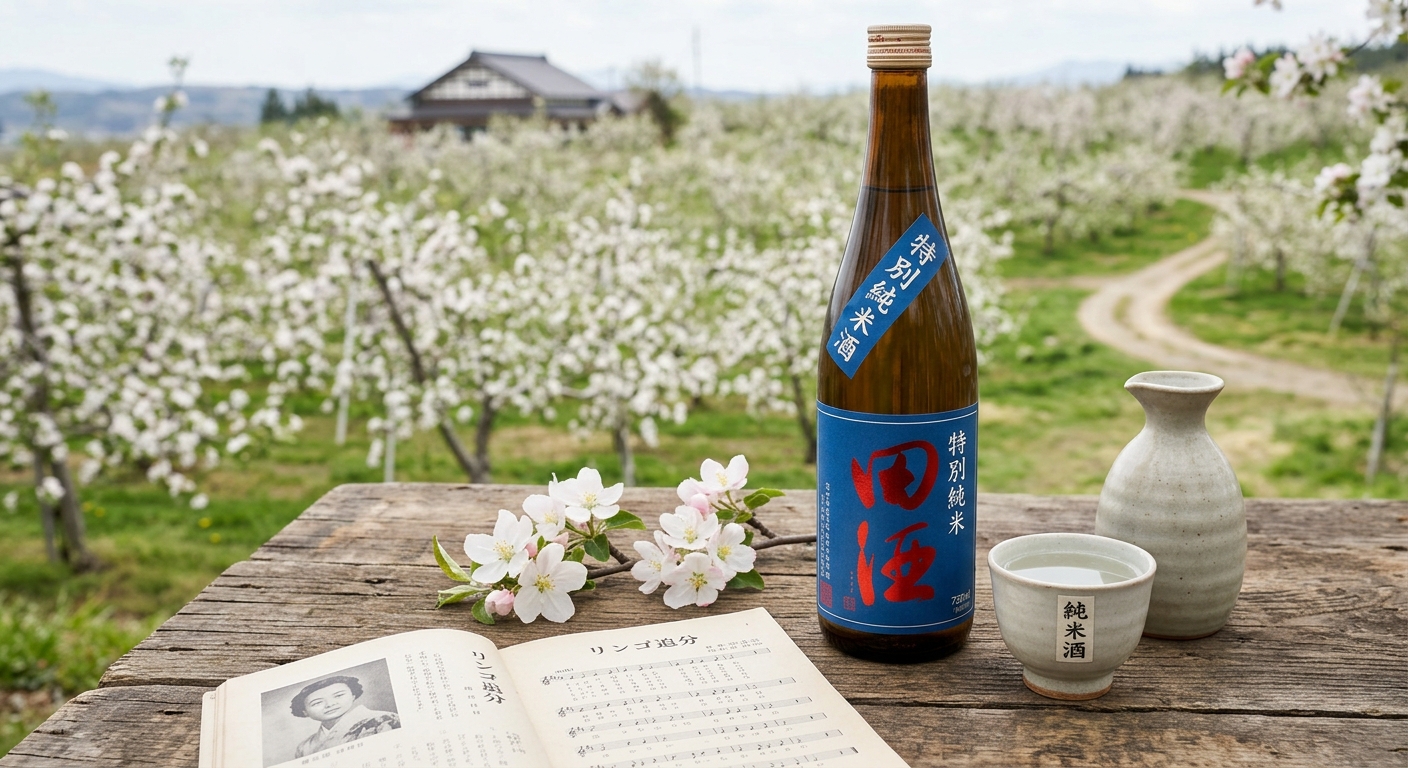
Just next to Aomori City, where the brewery stands, the Tsugaru Plain is known as one of Japan’s finest apple-growing regions. Come spring, the fields turn white with apple blossoms — a sight that is, in many ways, the very essence of life in Tsugaru. At Hirosaki’s Apple Park, the setting of “Ringo Oiwake,” a monument inscribed with the song’s lyrics still stands today, and every May the “All-Japan Ringo Oiwake Contest” is held there — a reminder that this song is still sung as part of the land’s living memory.
An unadorned sake made from nothing but rice, and the apple blossoms of Tsugaru in spring: neither owes anything to showy embellishment. Both are simply the blessings of the land, given form.
The Story of the Song
“Ringo Oiwake” was released on May 1, 1952. It was originally written as an insert song for the radio drama “Ringoen no Shoujo” (The Girl of the Apple Orchard), created to commemorate the launch of Radio Tokyo (now TBS Radio), with lyrics by Fujio Ozawa and music by Masao Yoneyama. The composer had actually poured his real effort into the drama’s main theme song — “Ringo Oiwake” was, by comparison, something of an afterthought, with Ozawa reportedly writing the lyrics in just fifteen minutes. Yet when the story was made into a film that November, starring a then 15-year-old Misora Hibari, the song caught fire, selling 700,000 copies — one of the biggest hits of the postwar era — and eventually surpassing 1.3 million copies to become a certified million-seller.
Why This Pairing
Denshu is a sake born of an aesthetic of subtraction: no added brewing alcohol, no added sugar, just rice standing entirely on its own. “Ringo Oiwake,” too, was an unadorned little song, dashed off in fifteen minutes in the shadow of a more “serious” theme tune. And yet both, precisely because of that lack of adornment, captured people’s hearts and have endured across the decades.
The clean, straightforward flavor of this Tokubetsu Junmai, which reflects the umami of rice with no detours, echoes the plain, unaffected voice of a Tsugaru girl singing of longing for home. What we hope to capture in this pairing is a shared truth: that in the end, it’s substance — not technique or ornamentation — that endures longest.
Where to Find This Bottle
The Rakuten Ichiba link below is an affiliate link.
Stock and availability change from time to time, so it’s worth checking directly — and feel free to ask for it by name at your local sake shop, too. Note: the Rakuten and Amazon links above are Japan-based retailers, so they’re most useful for readers in Japan or those who can arrange international shipping.
🌡️ Recommended way to drink it: Best enjoyed at room temperature or gently warmed (nurukan) — warming it brings out even more of the rice’s umami and richness. That said, it’s every bit as refreshing served chilled.
A Pairing Dish to Enjoy Alongside
Kayaki Miso
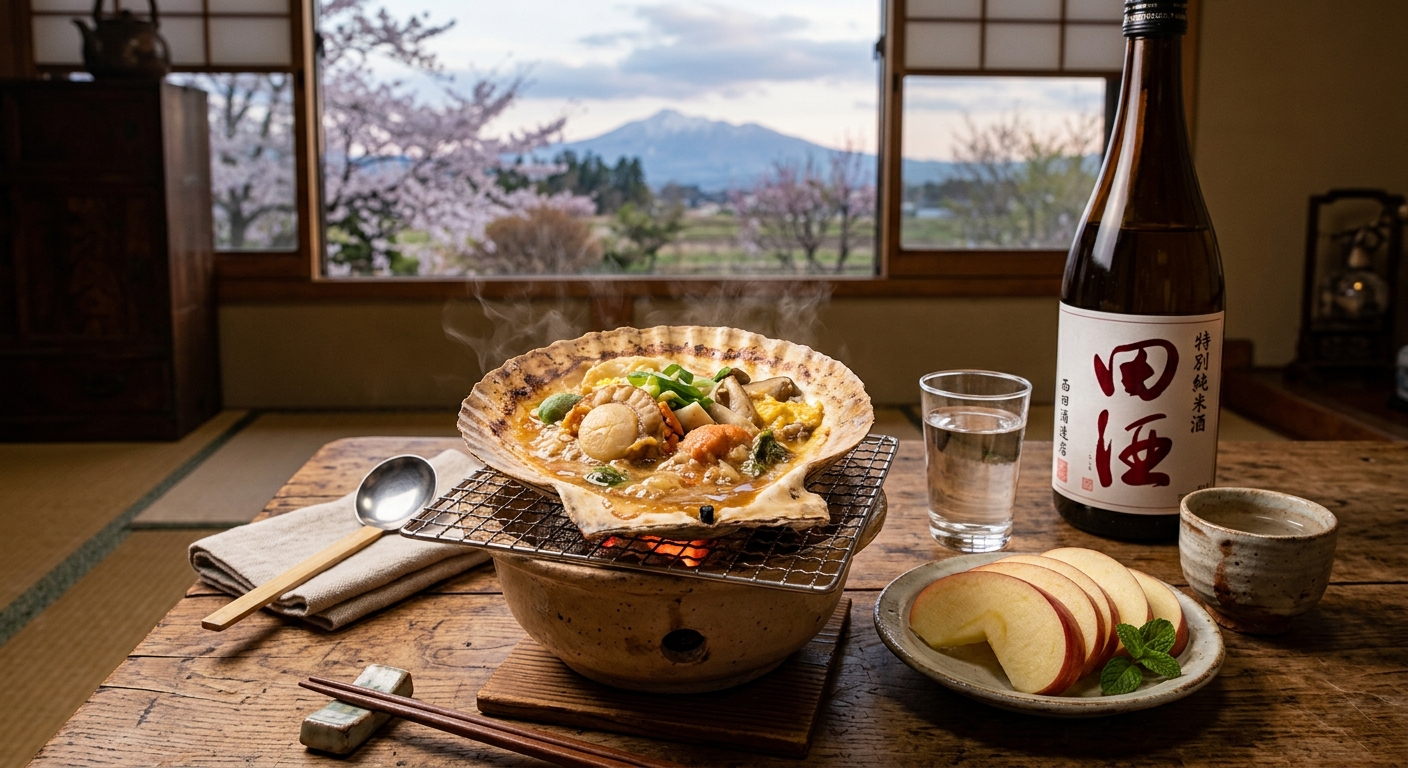
A local Aomori dish in which scallop meat and egg are simmered in miso, using the scallop’s own shell in place of a pot. The deep umami of the miso resonates beautifully with the rice-forward sweetness of Denshu, each bringing out the best in the other.
Recipe (in Japanese): Kurashiru “Kayaki Miso”
Fresh Aomori Apples
If you want to put the very scene of the song onto a plate, nothing does it better. The apple’s bright acidity and sweetness layer over Denshu’s clean finish, leaving an aftertaste like a breeze blowing through Tsugaru in spring.
A little science: the richness of miso and the umami of rice share the same amino-acid-driven flavor profile, so the two reinforce one another, while the apple’s acidity tightens the sake’s rounded sweetness and keeps the finish light.
Visiting the Brewery
Nishida Sake Brewery (Denshu, Kikuizumi) 46 Aburakawa, Aomori City, Aomori. About a 10-min walk from Aburakawa Station (JR Tsugaru Line), or 15 min by car from Aomori-chuo IC. The brewery sits in the Aburakawa district, close to Mutsu Bay.
Sights Nearby
Sannai-Maruyama Site / Aomori City | ~15 min, ~7 km by car from the brewery A large Jomon-period settlement site and part of the UNESCO World Heritage “Jomon Prehistoric Sites in Northern Japan.” Large reconstructed timber structures stand on the grounds (admission ¥500 for adults; free for high-school age and younger).
Aomori Museum of Art / Aomori City (next to the Sannai-Maruyama Site) | ~15 min, ~7 km by car from the brewery Home to Chagall’s stage backdrops and works by Munakata Shiko and Nara Yoshitomo, and known for the outdoor “Aomori-ken” dog sculpture (occasional closures for exhibition changes).
Hot Springs Nearby
Aomori Aburakawa Yuttara Onsen / Aomori City | ~5 min, ~2 km by car from the brewery A day-use hot spring in the same Aburakawa district as the brewery. A sodium-chloride spring with an open-air bath, sauna and stone-sauna. ¥420 for adults, open year-round, from early morning until late at night.
Opening hours, closing days and day-use bathing availability can change. Please check each facility’s official information before visiting.
A Quick Glossary of Sake Terms
Junmai (pure rice sake): Sake made only from rice, rice koji, and water, with no added brewing alcohol. It lets the umami of rice come through directly.
Tokubetsu Junmai: A junmai sake brewed using a special method or special rice, with those details disclosed on the label.
Rice-polishing ratio (seimai buai): The percentage of the original grain remaining after the outer layers of brown rice have been polished away. The lower the number, the more the rice has been polished.
コメントを残す