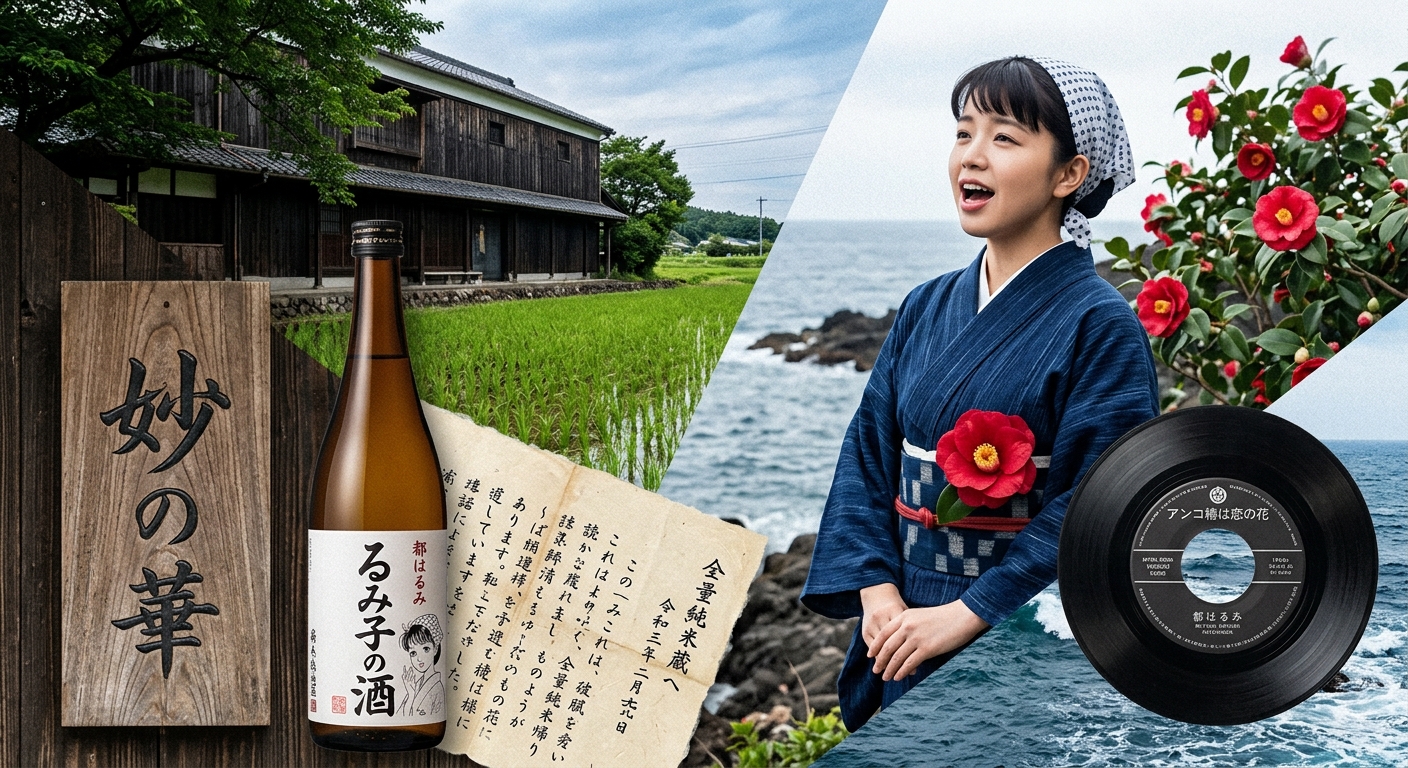
Sake: Rumiko no Sake, Tokubetsu Junmai, No.9 Yeast (25% Yamada Nishiki from Tokushima and 75% Ise Nishiki from Mie, 60% polish, 15% alcohol, Association No.9 yeast, sake meter value +7, acidity 1.7) / Morikishuzo Sake Brewery Co., Ltd. (Chitose, Iga City, Mie Prefecture) Official site: https://morikishuzo.co.jp/
Kayoukyoku (classic Japanese popular song): “Anko Tsubaki wa Koi no Hana” (“The Camellia of Love”), performed by Miyako Harumi (1964) YouTube: https://www.youtube.com/watch?v=EnlyOZn3Ago
Morikishuzo Sake Brewery was founded in 1893. It sits in Chitose, in Iga City, Mie Prefecture — just north of Iga-Ueno, a region famed as the historical home of the ninja. The brewery’s first owner, Keiichiro Morikishu, named his inaugural label “Myo no Hana” (“Flower of the Wondrous”), a name drawn from the Lotus Sutra in tribute to the monk who had a well dug on the brewery grounds.
The brewery’s great turning point came when its female owner, Rumiko Morikishu, encountered a manga. Moved by “Natsuko no Sake,” a story depicting the daily life of a toji (master brewer) and his sake brewery, Rumiko wrote a letter to the author, Akira Oze. The correspondence that followed set the brewery on a new course: in 1999, it committed fully to junmai brewing, adding no distilled brewing alcohol to any of its sake. It was Oze who named the resulting label “Rumiko no Sake” and even designed its package illustration himself. A single letter changed the direction of the entire brewery.
The bottle we pair today is the brewery’s year-round Tokubetsu Junmai, “Rumiko no Sake No.9 Yeast.” It is brewed from 25% Yamada Nishiki grown in Tokushima and 75% Ise Nishiki grown in Mie, polished to a rice-polishing ratio (seimai buai) of 60%, fermented with Association No.9 yeast, and bottled at 15% alcohol, with a sake meter value of +7 and an acidity of 1.7. It was created to be clean yet firmly built, and it can be drunk chilled, at room temperature, gently warmed or hot. And the label itself was drawn by Ozé Akira — the correspondence that began with a single letter still shows on the face of every bottle.
The Story of the Land
Iga City sits in a basin ringed by mountains on every side. Known widely as ninja country, the Chitose district where the brewery stands is, even today, a quiet farming landscape surrounded by rice paddies. The sharp temperature swings characteristic of a basin, together with the clear water flowing down from the surrounding mountains, have long nurtured this area’s identity as fine rice-growing country.
It’s a quiet land, rarely in the spotlight. And yet a single letter sent from here reached across the distance to move the heart of a manga artist, and in doing so reshaped the brewery’s entire fate. Even from an unassuming place, a single-minded devotion can travel far — that story still lives in this land.
The Story of the Song
“Anko Tsubaki wa Koi no Hana” was released on October 5, 1964. It was Miyako Harumi’s third single, and her first major hit. The lyrics were written by Tetsuro Hoshino, with music composed by Shosuke Ichikawa. The song became a million-seller and won the New Artist Award at the 6th Japan Record Awards that same year, launching the singing career of Miyako Harumi, then just sixteen years old.
The song is set on Izu Oshima, an island famous for its camellias. Built around the word “anko,” a local term for the island’s young women, it likens a single-minded, devoted love to the camellia blossom. Rather than relying on vocal technique, it was a voice that threw raw youth straight at the listener, and that honesty is what won so many hearts. It’s the quintessential “starting song” — a debut singer climbing to the top on nothing but unguarded, wholehearted sincerity.
Why This Pairing
Just as Rumiko Morikishu changed her brewery’s future because of a single letter, Miyako Harumi charted her own path as a singer through a single song, “Anko Tsubaki wa Koi no Hana.” Both stories share the same thread: an unguarded, straightforward devotion that opened the door to a defining turning point.
The crisp, dry outline of a sake meter value of +7 echoes the unguarded directness of a sixteen-year-old Miyako Harumi, singing of a devotion likened to a camellia. And the firm backbone beneath the clean texture that Ise Nishiki and Yamada Nishiki give this sake is the very strength of will that let Rumiko Morikishu change her brewery’s course with a single letter.
Where to Find This Bottle
The Rakuten Ichiba link below is an affiliate link.
Note: both Rakuten and Amazon links above lead to Japan-based retailers. They’re most convenient for readers in Japan, or for those elsewhere who are able to arrange international shipping. Stock and availability change over time, so if you’re near a specialty sake shop, it’s well worth asking for this label by name.
🌡️ Recommended way to drink it:This is a sake that takes any temperature, from chilled to hot. Start it cold for the crisp, dry outline of its +7 sake meter value, then try it gently warmed (nurukan, around 40°C), where the savoury depth of Ise Nishiki opens up and the sake seems to become something else entirely. It is made to sit beside everyday food, so drink it with a meal rathes. At 18% alcohol this is an undiluted genshu, so pour small and drink it alongside food.
A Pairing Dish Worth Trying
Iga Beef Hot-Plate Grill Iga’s celebrated brand of beef. Its sweet fat and deep, savory richness are met head-on by the crisp dryness of a +7 sake meter value, and the finish pulls taut. Warm the sake and the match with beef gets better still. Recipe (in Japanese): クックパッド「黒毛和牛の陶板焼き風」
Sea Bream and Citrus Carpaccio A dish where citrus brightens the delicate flavor of white fish. It echoes the sake’s own citrus notes, bringing out on the plate the same vivid, single-minded intensity found in a camellia blossom. Recipe (in Japanese): クラシル「みかんと鯛の爽やかカルパッチョ」
A note on the science: the clean, dry finish of a +7 sake meter value works like a “reset,” cleanly cutting through the richness of Iga beef’s fat, while the citrus accompanying the sea bream carpaccio echoes the sake’s own citrus aromatic compounds, uniting the two in one seamless bouquet.
Visiting the Brewery
Moriki Shuzojo (“Rumiko no Sake”) 41-2 Chitose, Iga City, Mie. About 5 min by car from Inodamichi Station (Iga Railway), or 10 min from Nakase IC on the Meihan Expressway. A small brewery that makes only junmai sake — please contact it directly about visits.
Sights Nearby
Iga-Ueno Castle (Ueno Park) / Iga City | ~15 min, ~7 km by car from the brewery Known for its keep, rebuilt in 1935, and one of Japan’s tallest castle stone walls. Ueno Park also gathers sites connected to the poet Matsuo Basho.
Iga-ryu Ninja Museum / Ueno Park, Iga City | ~15 min, ~7 km by car from the brewery Live demonstrations of a trick-filled ninja house and a ninjutsu show (weekdays 10:00-16:00, weekends & holidays 10:00-16:30; last entry 30 min before closing).
Hot Springs Nearby
Hill Hotel Sunpia Iga, “Basho no Yu” natural hot spring / Iga City | ~15 min, ~8 km by car from the brewery Day-use bathing 6:00-22:00, open year-round, ¥770 for adults. A smooth alkaline simple spring.
Opening hours, closing days and day-use bathing availability can change. Please check each facility’s official information before visiting.
A Quick Glossary of Sake Terms
Tokubetsu Junmai: A junmai sake — made only from rice, koji and water — that is either polished to 60% or below, or made by a special method, with that method stated on the label.
Sake meter value (nihonshu-do): A figure showing how much sugar remains. The higher the plus number, the drier the sake; negative figures lean sweet.
Seimai buai (rice-polishing ratio): The percentage of the original brown rice grain remaining after polishing. The lower the number, the more the rice has been polished down.

コメントを残す