日本語で読む | This is the English version of a bilingual article.
Today’s Pairing
- Craft beer: Kyoto Brewing Co. “Ichigo Ichie” — saison; hops: Cascade and Motueka (New Zealand); 5.0% ABV; IBU 20 / Kyoto Brewing Co., Ltd. (25-1 Nishikujo Takahata-cho, Minami-ku, Kyoto City, Kyoto Prefecture)
Official site: https://kyotobrewing.com/ - Music: “Bara no Hana” (“The Rose”) by Quruli, 2001 / Words and music by Shigeru Kishida
YouTube: https://www.youtube.com/watch?v=baNgL0jFkAs
▶ If the player above doesn’t play, open it on YouTube
The Story of the Brewery
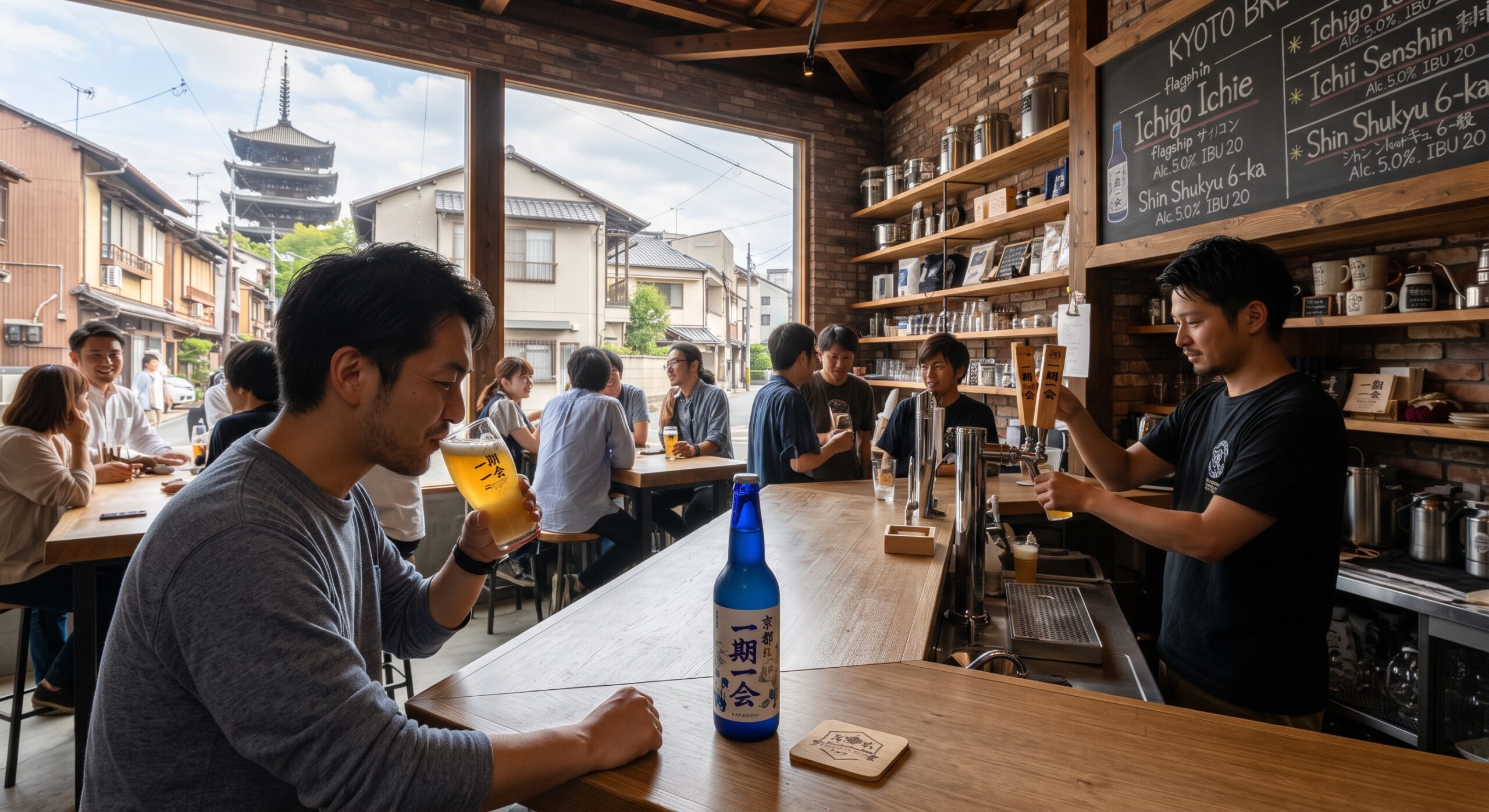
Kyoto Brewing Co. began in 2015, in a quiet residential pocket of Minami-ku, Kyoto, just south of Toji temple. Three people started it. According to an interview on the City of Kyoto’s official site, Chris, who handles brewing, is from the United States; Paul, who handles finance and IT, is from Canada; and Benjamin Falck, who handles sales, is from Wales. This is not the story of a Kyoto-born brewer taking over a family business. Three people from three different countries chose this city and started making beer in it — that is where this brewery starts.
The tools they chose sit slightly off to one side of the Japanese craft-beer mainstream, too. The official site lists three year-round beers — Ichigo Ichie, Ichii Senshin, and New 6-Day Weekend — all of them brewed with Belgian yeast. Belgian yeast throws aromatic compounds during fermentation (esters and phenols) that suggest fruit and spice, and it builds flavor in layers. It creates complexity from a different direction than pilsners and IPAs, which lean on hops to do that work.
Ichigo Ichie, the beer in this pairing, is the first of those three. According to its official product page, the style is saison, a Belgian original; 5.0% ABV, IBU 20. The hops are Cascade and carefully selected Motueka from New Zealand. The official description: “a gentle bitterness and a clean, soft mouthfeel, with the vivid fruit aroma of carefully chosen New Zealand hops.” The brewer’s notes add that the Belgian yeast gives a layered variety of flavor, an extremely dry finish, and the same easy drinkability as a lager.
IBU 20 is a notably low number in the craft beer world. Rather than asserting itself through bitterness, this beer lifts its aroma and then dries the palate as it leaves. That is the design.
The Story of the Land
The brewery’s address is 25-1 Nishikujo Takahata-cho, Minami-ku, Kyoto. It is walkable from Toji and Jujo stations on the Kintetsu Kyoto Line, and about 1.5 km north stands Toji, with its National Treasure five-storied pagoda. This is a part of town slightly south of the “Kyoto” visitors picture. Not a district of temples and machiya townhouses, but a street where ordinary houses and small factories sit side by side — and in among them, a brewery and its taproom.
That taproom, per the official site, opens on Friday evenings and weekend afternoons: the standard hours are Friday 17:00–21:00 (last order 20:30) and Saturday and Sunday 12:00–18:00 (last order 17:30). The bar counter and an outdoor drinking area are on the first floor, with seating upstairs. The official site publishes the actual opening days as a calendar, though, and the taproom occasionally closes on weekends when the brewery is out at an event. It is not open every day, and not a place where turning up guarantees you a pint — check the calendar before you go.
Which makes it a good moment to remember what the beer’s name means. “Ichigo ichie” comes from the tea ceremony: this meeting happens once, and you will never have this same time with these same people again. A way of thinking that this city spent centuries putting into words — and three people from other countries put it on their flagship beer.
The Story of the Song
According to the profile on their official site, Quruli formed around September 1996 in the music club “Rock Commune” at Ritsumeikan University in Kita-ku, Kyoto. The current members are Shigeru Kishida (vocals, guitar) and Masashi Sato (bass, vocals). A band that began in a university club room in Kyoto.
“Bara no Hana” was released as a single on January 24, 2001, written and composed by Shigeru Kishida and issued by Victor Entertainment. It appears on the original album TEAM ROCK, and peaked at No. 20 on Oricon’s weekly chart. It was later used as an insert song in the 2004 TBS drama Orange Days, and is included in a Japanese high school music textbook. The music video was directed by Kishida together with the photographer Masafumi Sanai, and shot at Usuiso Beach and Shioyazaki Lighthouse in Iwaki City, Fukushima Prefecture. According to the band’s official site, YouTube carried only a short edit of it for years; the full-size version was released on Quruli’s official YouTube channel on January 24, 2023 — the same date, 22 years on.
The song itself has nothing showy about it. A level tempo, a voice that never pushes, scenery simply set down. And partway through, the narrator buys a ginger ale and drinks it. For a love song, the most concrete thing in it is that one glass of something to drink.
Why This Pairing
First, both of them start in Kyoto. A band that came out of a university club room at Ritsumeikan, and a brewery that came out of a residential street south of Toji. The Kyoto that sits outside the image of temples and sightseeing.
Second, both are dry. The official description of Ichigo Ichie names its extremely dry finish as a virtue: with bitterness as low as IBU 20, it leaves the aroma behind, dries the palate and withdraws. “Bara no Hana” likewise never raises its voice, never reaches for tears, and simply ends. It doesn’t pile on emotion; it sets things down without saying them. “Dry” doesn’t mean quite the same thing in beer and in music, but in the sense that what remains afterward is never forced on you, I think the two words point at the same thing.
Third, there is a drink in the song: a ginger ale. A hand holding a glass, carbonation, and time continuing without anything being resolved — it is hard to imagine a line better suited to a beer article. Drink a dry, lively glass while this song plays, and you are sitting in the same posture as the song’s narrator.
And last, the name. “Ichigo ichie” says that this meeting happens only once. The taproom is not open every day, and what is on tap is not always the same. The music video for “Bara no Hana” was something you could not watch in full for 22 years. Receiving a once-only thing as a once-only thing — that is a fitting way to drink this beer.
Where to Find This Beer
The Rakuten Ichiba link below is an affiliate link.
- Brewery official site:https://kyotobrewing.com/
- Buy on Rakuten Ichiba: View the product page (350ml×6本, ¥3,816)
These are Japanese storefronts. If you are visiting the brewery, drinking it fresh at their own taproom is by far the best option.
Pairing Dishes Worth Trying
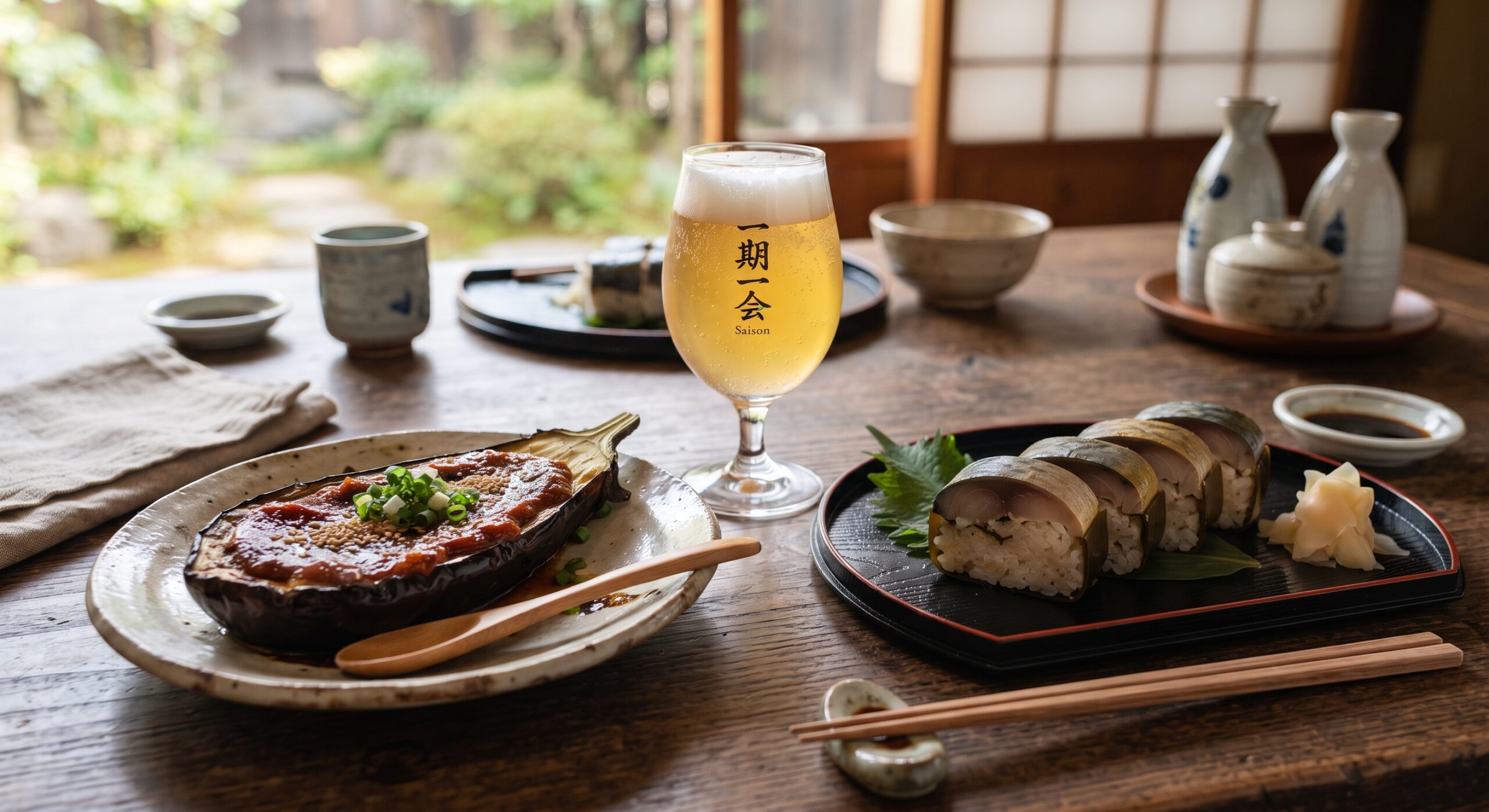
- Kamo nasu dengaku (grilled eggplant with sweet miso)
Kamo nasu, a traditional Kyoto eggplant, grilled and topped with a sweetened miso. The oil in the eggplant and the richness of the miso would linger on their own, but Ichigo Ichie’s extremely dry finish and carbonation clear it away. The fruity saison aroma doesn’t fight the toasted smell of the grilled miso either. - Saba-zushi (mackerel sushi)
Kyoto’s saba-zushi is vinegar-cured mackerel and vinegared rice wrapped in kelp — a dish for festivals and celebrations. Low bitterness (IBU 20) and a dry finish pair well with the combination of oily fish and vinegar: the fat gets reset without the acidity being trampled.
A note on the science: hop bitter compounds and carbonation reset a palate weighed down by fat. Bitterness that is too strong collides with the flavors of oily fish and miso, but at IBU 20 it clears the fat without getting in the food’s way. And the esters Belgian yeast produces during fermentation — the fruity aromas — run in the same direction as the toasted miso and the vinegar, so they add to the dish’s aroma rather than crowding it out.
Visiting the Brewery
Kyoto Brewing Co.
25-1 Nishikujo Takahata-cho, Minami-ku, Kyoto City, Kyoto. Within walking distance of Toji and Jujo stations on the Kintetsu Kyoto Line, in a quiet residential area just south of Toji temple.
The taproom attached to the brewery is open Friday 17:00–21:00 (last order 20:30) and Saturday and Sunday 12:00–18:00 (last order 17:30). The bar counter and an outdoor drinking area are on the first floor, with indoor seating upstairs. It occasionally closes on weekends when the brewery is out at an event, so check the official site before you go.
Sights Nearby
- Toji Temple (Kyoogokoku-ji) / Kujo-cho, Minami-ku, Kyoto | ~6 min, ~1.5 km by car from Kyoto Brewing
A World Heritage site and the head temple of Shingon Buddhism. Its National Treasure five-storied pagoda stands tall enough to serve as a landmark from anywhere in the city. The Kondo and Kodo halls are open 8:00–17:00 (reception until 16:30); year-round admission is ¥800 for adults, ¥400 for high school students and ¥300 for junior high students and younger (prices differ during special exhibition periods). Kyoto Brewing sits in the residential streets just south of Toji — close enough to walk from the taproom. - Kyoto Railway Museum / Kankiji-cho, Shimogyo-ku, Kyoto | ~13 min, ~4 km by car from Kyoto Brewing
A railway museum next to Umekoji Park. Open 10:00–17:00 (last entry 16:30); admission ¥1,500 general, ¥1,300 university and high school students, ¥500 junior high and elementary students, ¥200 children aged 3 and over. Closed Wednesdays (open on public holidays and during school vacation periods) and over the New Year. Check the official site before visiting.
Hot Springs Nearby
- Kyoto Katsura Onsen Nizaemon no Yu / Katagihara Bonzan, Nishikyo-ku, Kyoto | ~25 min, ~9 km by car from Kyoto Brewing
A day-use hot spring with two free-flowing sources: Jin no Yu (46.6°C) and Ichi no Yu (26.2°C), both weakly alkaline. Open 10:00 to 1:00 the following morning (from 8:00 on Sundays and public holidays; last reception 0:30). Bathing is ¥900 on weekdays and ¥1,050 on weekends and holidays for junior high students and above. Please confirm prices and hours before visiting.
Opening hours, closing days and day-use bathing availability can change. Please check each facility’s official information before visiting.
A Quick Glossary of Beer Terms
- Craft beer: Beer made by small breweries that put the character of the maker front and centre, as opposed to the uniformity of mass production.
- Ale: Beer made by top fermentation, with the yeast working near the surface at close to room temperature. It tends toward fruity aromas and a fuller body.
- Hops: The cones of a climbing plant, which give beer its bitterness and aroma. Depending on the variety, that aroma can read as citrus, tropical fruit or open grassland.
- Malt: Germinated barley. It forms the foundation of a beer’s sweetness, colour and body; how deeply it is roasted determines colour and toastiness.
- ABV: Alcohol By Volume. Beer typically runs around 5%; above 8% is considered a strong, heavier-drinking beer.
- IBU: International Bitterness Units, a scale for how bitter a beer tastes. Around 10 is barely noticeable bitterness; above 60 lands in clearly bitter IPA territory.
Sources
- Kyoto Brewing Co. – Official Site
- Ichigo Ichie – Kyoto Brewing Co. Official Online Store
- Taproom – Kyoto Brewing Co. Official Site
- Kyoto Brewing Co. – City of Kyoto, KYO-WORKING (Official)
- Profile – Quruli Official Site
- Full-size “Bara no Hana” Music Video on YouTube – Quruli Official Site
- Bara no Hana – Wikipedia (Japanese)
- Visitor Information – Toji Temple Official Site
- Visitor Information – Kyoto Railway Museum Official Site
- Kyoto Katsura Onsen Nizaemon no Yu – Kyoto City Tourism Association
If you notice any errors in this article, please don’t hesitate to reach out at info@soundrecords.jp.
Read this article in Japanese: 乾いた一杯が、いちばん残る