日本語で読む | This is the English version of a bilingual article.
Today’s Pairing
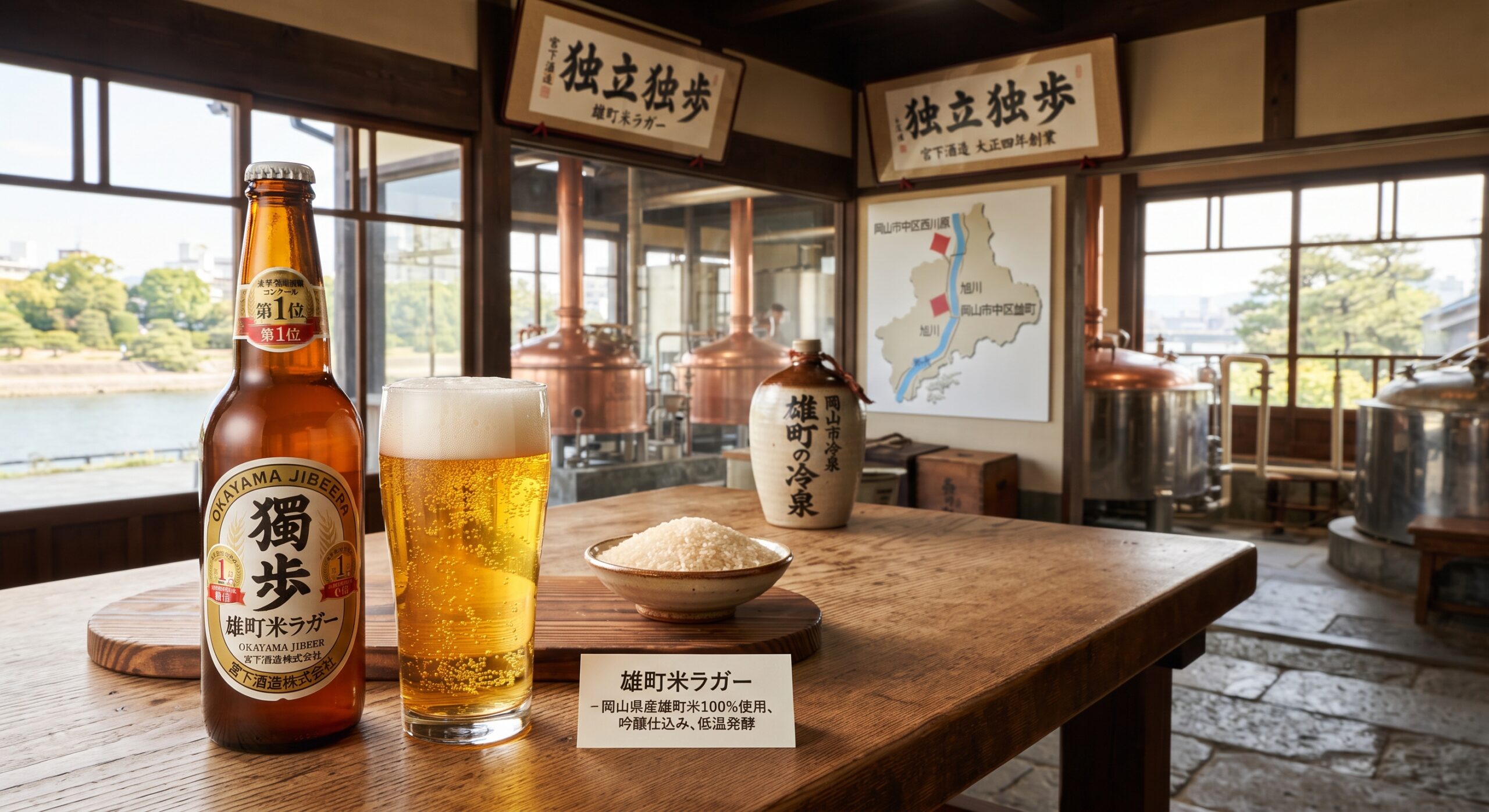
- Craft beer: Doppo Omachi Rice Lager — bottom-fermented lager, 5% ABV, made with malt, rice (Okayama-grown “Omachi” sake rice, polished to 60%, as in ginjo-grade sake), and hops / Miyashita Sake Brewing Co., Ltd. (Naka Ward, Okayama City)
Official site: https://www.msb.co.jp/doppo/ - Music: “Tabiji” (“The Journey”) by Fujii Kaze (2021), written and composed by Fujii Kaze himself, produced by Yaffle
YouTube: https://www.youtube.com/watch?v=29p8FvT_puU
▶ If the player above doesn’t play, open it on YouTube
The Story of the Brewery
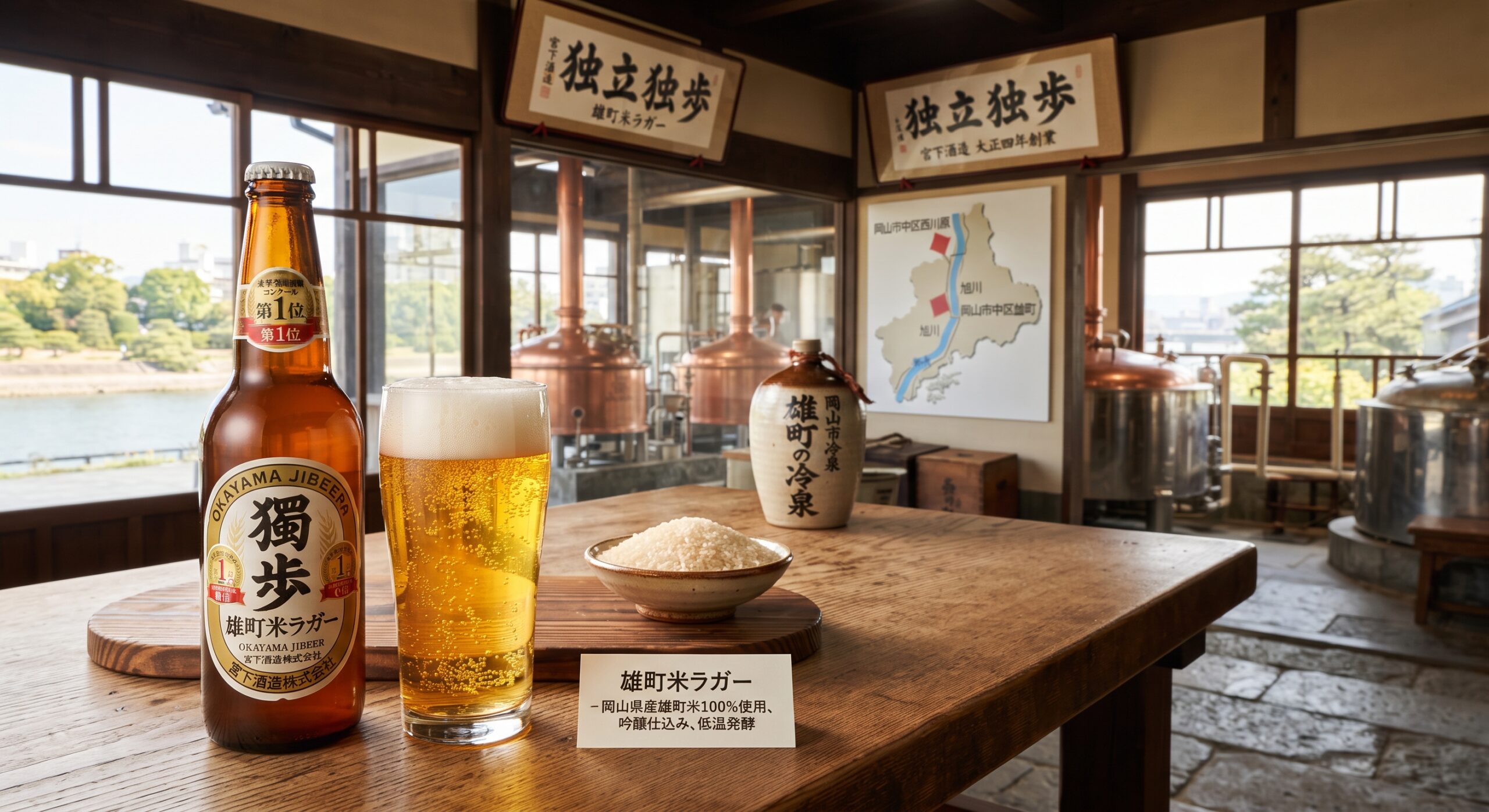
Miyashita Sake Brewing traces back to 1915, when brothers Kamezo and Motosaburo Miyashita began brewing sake in Tamano City, Okayama. In 1967 the brewery moved to its current site in Nishikawahara, Naka Ward, Okayama City — about a kilometer north of Korakuen, one of Japan’s three great gardens — where it has long drawn its brewing water from groundwater of the Asahi River, one of Okayama’s three major rivers, pumped up from 100 meters underground.
The move into beer came after a 1994 revision to Japan’s liquor tax law that made it possible for small companies to brew beer for the first time. As sake consumption was declining while beer’s easy, ready-to-drink appeal was growing, the company decided to enter beer brewing, launching its craft beer “Doppo” in July 1995 — the first in the Chugoku region and the ninth in Japan. At the time, almost no information about beer brewing was publicly available in Japan, so Miyashita traveled to Germany three times to source ingredients, invited a German brewmaster, and trained in the US as well, learning from scratch how to make a beer meant to be savored rather than gulped down.
The name “Doppo” was chosen from roughly 3,000 entries in a public naming contest. Beyond the fact that “Doku” (独) evokes Germany, it also carries the spirit of the phrase “dokuritsu doppo” — standing on one’s own two feet — reflecting the small brewery’s resolve to brew with its own convictions. Because Okayama’s soft water suits pale lagers well, the brewery initially built its lineup around Pilsner, which won first place in the local beer category of the 2009 Spring National Liquor Contest.
The beer featured here, Omachi Rice Lager, takes that a step further. It uses Okayama’s own “Omachi” sake rice, polished to 60% as in ginjo-grade sake, as a secondary ingredient, fermented and aged slowly at lower temperatures in a nod to sake-brewing methods. The result is a beer that’s light and clear, carrying the fullness and umami that malt and Omachi rice bring together. It has won first place in the local beer category of the Spring National Liquor Contest three times — in 2010, 2014, and 2019 — and also received an award at the 2019 National Local Beer Quality Review.
The Story of the Land
The name “Omachi” comes from a place: Omachi, in Naka Ward, Okayama City. According to tradition, in 1859 a farmer named Jinzo Kishimoto, from what was then Takashima Village, Omachi, in Bizen Province’s Joto District, brought home an unfamiliar rice plant on his way back from a pilgrimage to Mount Daisen in Hoki Province. The rice came to be known by the name of the place where it was found — Omachi. Prized for sake brewing, it was used as breeding stock across the country, and roughly two-thirds of Japan’s existing sake rice varieties are said to trace their lineage back to Omachi, earning it the nickname “the root of sake rice.” Even today, about 90% of Japan’s Omachi rice is grown in Okayama Prefecture.
In that same area of Omachi, a spring called “Omachi no Reisen” still flows, designated one of Japan’s Top 100 Waters in 1985 by what was then the Environment Agency (predecessor to today’s Ministry of the Environment). Tradition holds that it was developed in 1686, during the rule of the Okayama domain’s lord Tsunamasa Ikeda, and it is groundwater from the Asahi River surfacing at ground level. The water Miyashita Sake Brewing draws for its brewing is groundwater from that same Asahi River. The place where the rice was born and the river that feeds the brewery’s water share the same watershed.
The Story of the Song
Fujii Kaze was born on June 14, 1997, in Satosho, Asakuchi District, Okayama Prefecture. His family ran a coffee shop, and he grew up teaching himself piano, posting videos of his own performances on YouTube. In the summer of 2018, a staff member from a talent agency saw those videos and visited the family’s coffee shop to offer him a contract, leading to his major-label debut on January 24, 2020. Since debuting, he has kept using the local word “washi” as his first-person pronoun in lyrics, mixing standard Japanese with Okayama dialect.
“Tabiji” was released digitally on March 1, 2021, through HEHN RECORDS/Universal Music. Fujii Kaze wrote and composed it himself, with production by Yaffle, and it was used as the theme song for the TV Asahi Thursday drama Nijiiro Karte. Fujii wrote it after visiting the drama’s set and reading through the script. On release day, March 1, he appeared live on TV Asahi’s news program Hodo Station and performed it solo at the piano as a gift to that year’s graduates, whose ceremonies had been disrupted by the COVID-19 pandemic. The music video, released March 11, 2021 and directed by filmmaker Kento Yamada, was shot in Fujii’s hometown of Satosho and at his old school.
Why This Pairing
The name “Doppo” itself means “dokuritsu doppo” — standing and walking on your own two feet. At a time when only five major companies made beer in Japan, it was the name a small brewery gave itself as it set out, relying only on local water and local ingredients and its own convictions. Fujii Kaze, too, is someone who was discovered starting from a family coffee shop in Satosho, through self-taught piano and videos he filmed himself. Even after his major debut, he has kept his dialect in his lyrics rather than hiding it, and went out of his way to film the “Tabiji” video back in his hometown and at his old school.
There’s a second thread running underneath, in the Omachi rice itself. In the 160-plus years since its discovery, Omachi rice has passed its lineage down into sake rice varieties across the country, to the point that roughly two-thirds of today’s sake rice is said to descend from it. And yet its source is still right there, in Omachi, Naka Ward, Okayama City, within the same Asahi River watershed. Something — or someone — can travel far and still stay connected to where it began. The title “Tabiji,” a journey, and the name “Doppo,” walking alone, meet at the same starting point.
Where to Find This Beer
The Rakuten Ichiba link below is an affiliate link.
- Brewery official site:https://www.msb.co.jp/doppo/
- Buy on Rakuten Ichiba: View the product page (¥3,960)
These are Japanese storefronts. If you are visiting the brewery, drinking it fresh at their own taproom is by far the best option.
Pairing Dishes Worth Trying
- Mamakari vinegar pickle
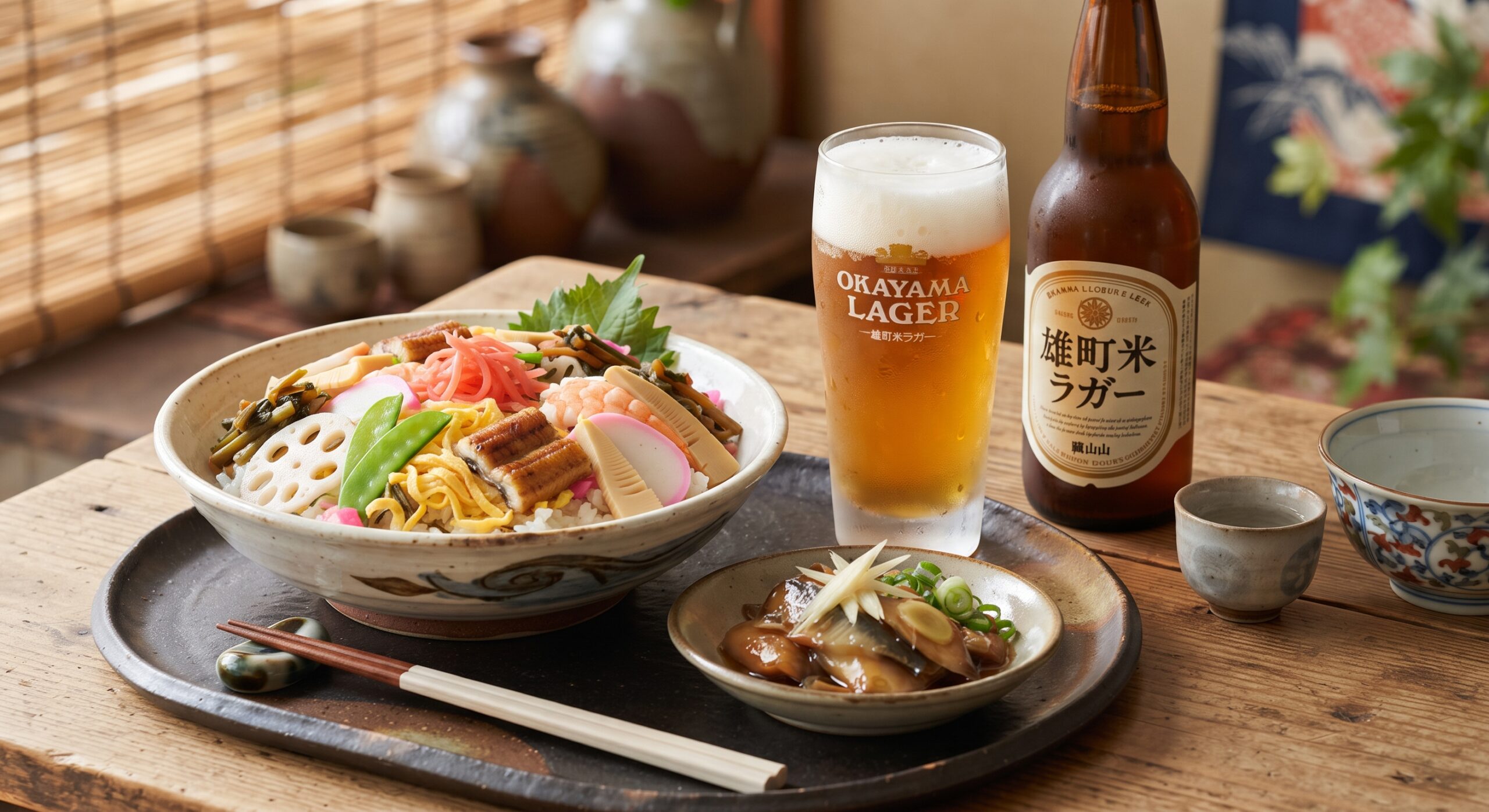
An Okayama specialty: a small herring-family fish called “sappa,” salted and then marinated in sweet vinegar. It’s said to taste so good people would go “borrow rice” (mama-kari) from a neighbor to eat with it. The lager’s light bitterness and carbonation clean up the sweet vinegar’s tang. - Okayama barazushi
Also called “matsuri-zushi” (festival sushi), this Okayama specialty mixes seafood and vegetables from the Seto Inland Sea straight into vinegared rice for a festive, celebratory dish. The rounded umami that malt and Omachi rice bring to the lager echoes the umami in the sushi rice’s many ingredients.
A note on the science: a lager’s carbonation and mild hop bitterness are known to reset a palate tightened by vinegar or salt. The tang of mamakari’s sweet vinegar and the vinegared rice in barazushi both come through cleanly against the Omachi lager’s crisp finish, letting the rice-derived umami in both the beer and the dish stand out together.
A Quick Glossary of Beer Terms
- Craft beer: Beer made by small breweries that put the character of the maker front and centre, as opposed to the uniformity of mass production.
- Lager: Beer made by “bottom fermentation,” in which the yeast works slowly at a low temperature and settles toward the bottom of the tank. It tends to come out clean and crisp — the style behind most major Japanese beers.
- Hops: The cones of a climbing plant, which give beer its bitterness and aroma.
- Malt: Germinated barley. It forms the foundation of a beer’s sweetness, colour and body.
- ABV: Alcohol By Volume. Around 5% is standard for beer; anything above 8% is considered a stronger, more full-bodied style.
- Local beer (ji-biiru): The term used for beers from Japan’s small breweries after the 1994 liquor tax reform made small-scale brewing legal. Today these are more often called “craft beer.”
Sources
- “Omachi Rice Lager,” Miyashita Sake Brewing Co., Ltd. (official)
- “Our History,” Miyashita Sake Brewing Co., Ltd. (official)
- “Okayama’s Local Beer ‘Doppo’: 15 Years and What’s Next” by Koichi Miyashita (Miyashita Sake Brewing Co., Ltd.), Seibutsu-kogaku (Journal of the Society for Biotechnology, Japan), Vol. 88, No. 11
- “Omachi” — Wikipedia (Japanese)
- “Omachi no Reisen,” City of Okayama (official)
- “Tabiji (Fujii Kaze song)” — Wikipedia (Japanese)
- “Fujii Kaze” — Wikipedia (Japanese)
If you notice any errors in this article, please don’t hesitate to reach out at info@soundrecords.jp.
Read this article in Japanese: 自分の足で、どこまでも