今日のペアリング
▶ 上のプレーヤーで再生できない場合は、YouTubeで開く
醸造所の話
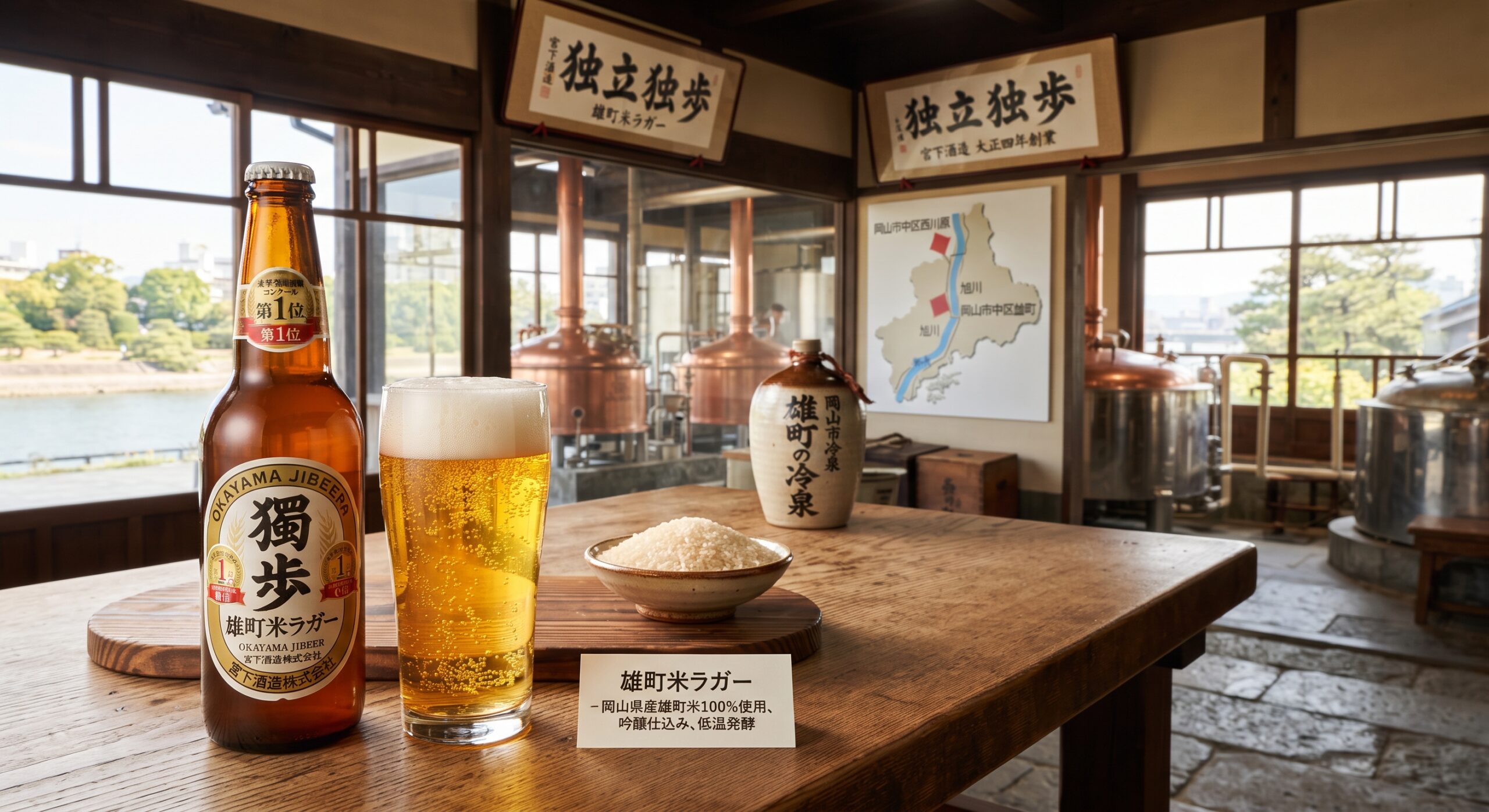
宮下酒造は大正4年(1915年)、宮下亀蔵・元三郎の兄弟が岡山県玉野市で清酒の醸造を始めたのがはじまりです。昭和42年(1967年)に現在地の岡山市中区西川原へ蔵を移転し、日本三大名園のひとつ・岡山後楽園の北およそ1kmという立地で、岡山三大河川のひとつ旭川の伏流水を地下100mから汲み上げて仕込み水に使ってきました。
ビールへ乗り出したのは、1994年の酒税法改正がきっかけです。日本酒の消費量が減っていく一方で手軽なビールの消費が伸びていた時代、小さな会社でもビールを造れるようになったことを受けて事業化を決意し、1995年7月に地ビール「独歩」の製造・販売を開始しました。中国地方では初めて、全国でも9番目という早さでした。当時の日本にはビールの造り方に関する情報がほとんど公開されておらず、宮下酒造はドイツへ3度渡って原料を買い付け、ドイツ人のブラウマイスター(醸造技師)を招き、アメリカでも研修を受けながら、日本になかったタイプの、じっくり味わうビール造りを一から学びました。
「独歩」という名前は、約3000通の応募が寄せられた一般公募の中から選ばれたものです。「独」の字がドイツを連想させることに加え、「独立独歩」という言葉のとおり、日本の小さなマイクロブルワリーとして、自分たちの信念で特色あるビールを醸造しようという心意気が込められています。岡山の軟水は淡色ビールに向いていることから、当初はピルスナーを主力に据え、2009年の春季全国酒類コンクール地ビール部門では第1位も受賞しました。
今回選んだ「雄町米ラガー」は、そこからさらに一歩踏み出した一本です。地元・岡山の酒米「雄町米」を、吟醸酒と同じ精米歩合60%まで磨いて副原料に使い、日本酒の造り方を意識して通常より低温でじっくりと発酵・熟成させています。この製法により、軽やかで透明感のある味わいに、麦芽と雄町米がおりなすふくらみと旨味が重なった一本に仕上がりました。春季全国酒類コンクール地ビール部門では2010年・2014年・2019年と3度にわたり第1位を受賞し、2019年には全国地ビール品質審査会でも入賞しています。
土地の話
「雄町米」という名前は、岡山市中区雄町という土地に由来します。安政6年(1859年)、備前国上道郡高島村字雄町(現在の岡山市中区雄町)の農家・岸本甚造が、伯耆大山への参拝の帰り道で見慣れない稲を持ち帰ったのが始まりと伝わり、その米はやがて発見地の名をとって「雄町米」と呼ばれるようになりました。酒造りに適したその特性から各地で交配のもとに使われ、現存する酒造好適米のおよそ3分の2が雄町の系統を引くとされることから、「酒米のルーツ」とも呼ばれています。今も日本の雄町米の生産量の9割は岡山県産が占めています。
その雄町の地には、昭和60年(1985年)に当時の環境庁が選んだ「名水百選」にも選ばれた「雄町の冷泉」が今も湧いています。江戸時代の貞享3年(1686年)、岡山藩主・池田綱政の代に整備されたと伝わる湧き水で、旭川の伏流水が地表に出てきたものです。宮下酒造が仕込み水として汲み上げているのも、同じ旭川の伏流水です。酒米が生まれた場所と、ビールの仕込み水がもとをたどる川は、同じ水系でつながっています。
音楽の話
藤井風は1997年6月14日、岡山県浅口郡里庄町の生まれです。実家は喫茶店を営んでおり、幼いころからピアノに親しみ、独学で腕を磨きながら自身の演奏動画をYouTubeに投稿していました。2018年夏、その動画を見た音楽事務所のスタッフが実家の喫茶店を訪ね、契約を提案したことがきっかけとなり、2020年1月24日にメジャーデビューを果たします。デビュー後も、歌詞の一人称に地元の言葉「ワシ」を使うなど、標準語と岡山弁を使い分けたスタイルを貫いています。
「旅路」は2021年3月1日、HEHN RECORDS/ユニバーサルミュージックからデジタル配信された楽曲です。作詞・作曲は藤井風自身、プロデュースをYaffleが手がけ、テレビ朝日系木曜ドラマ『にじいろカルテ』の主題歌に起用されました。藤井はドラマの撮影現場を訪ね、台本を読み込んだうえでこの曲を書いたといいます。配信当日の3月1日には『報道ステーション』に生出演し、コロナ禍で例年通りの卒業式を迎えられなかった卒業生たちへ、この曲をピアノの弾き語りで贈りました。同年3月11日に公開されたミュージックビデオは、映像作家・山田健人の監督のもと、藤井の出身地である里庄町と、母校で撮影されました。
なぜこの組み合わせなのか
「独歩」という名前そのものが「独立独歩」、自分の足で立って歩くという意味です。大手5社しかビール会社がなかった時代に、地元の水と地元の原料だけを頼りに、小さな醸造所が自分たちの信念で歩き出した名前でした。藤井風もまた、里庄町の実家の喫茶店から、独学のピアノと自分で撮った動画だけで見出された人です。デビュー後も方言を隠さず歌詞に織り込み、「旅路」のミュージックビデオもわざわざ地元・里庄町と母校まで戻って撮影しています。
そしてもうひとつ、雄町米という副原料そのものが、この組み合わせを後押ししてくれます。雄町米は発見から160年余りをかけて日本各地の酒米に血を分け、いまの酒米のおよそ3分の2がその系統を引くと言われるまでに広がりました。それでも、その源流は今も岡山市中区雄町の、同じ旭川の水系のなかにあります。遠くまで届いていく人や物が、それでも生まれた場所とつながり続けている。「旅路」というタイトルと、「独歩」というビールの名前が、同じ場所で重なります。
この一杯を、探すなら
※楽天市場へのリンクは広告(アフィリエイト)です。醸造所がタップルームや直営店を持っている場合は、できたてを現地で味わうのが一番のおすすめです。
🌡️ おすすめの飲み方(温度とグラス):5〜8℃程度によく冷やして、口がすぼまったピルスナーグラスや、背の高いタンブラーへ。雄町米由来の透明感のある淡い色と、立ちのぼる細かな泡が映えます。
合わせたい「アテ」
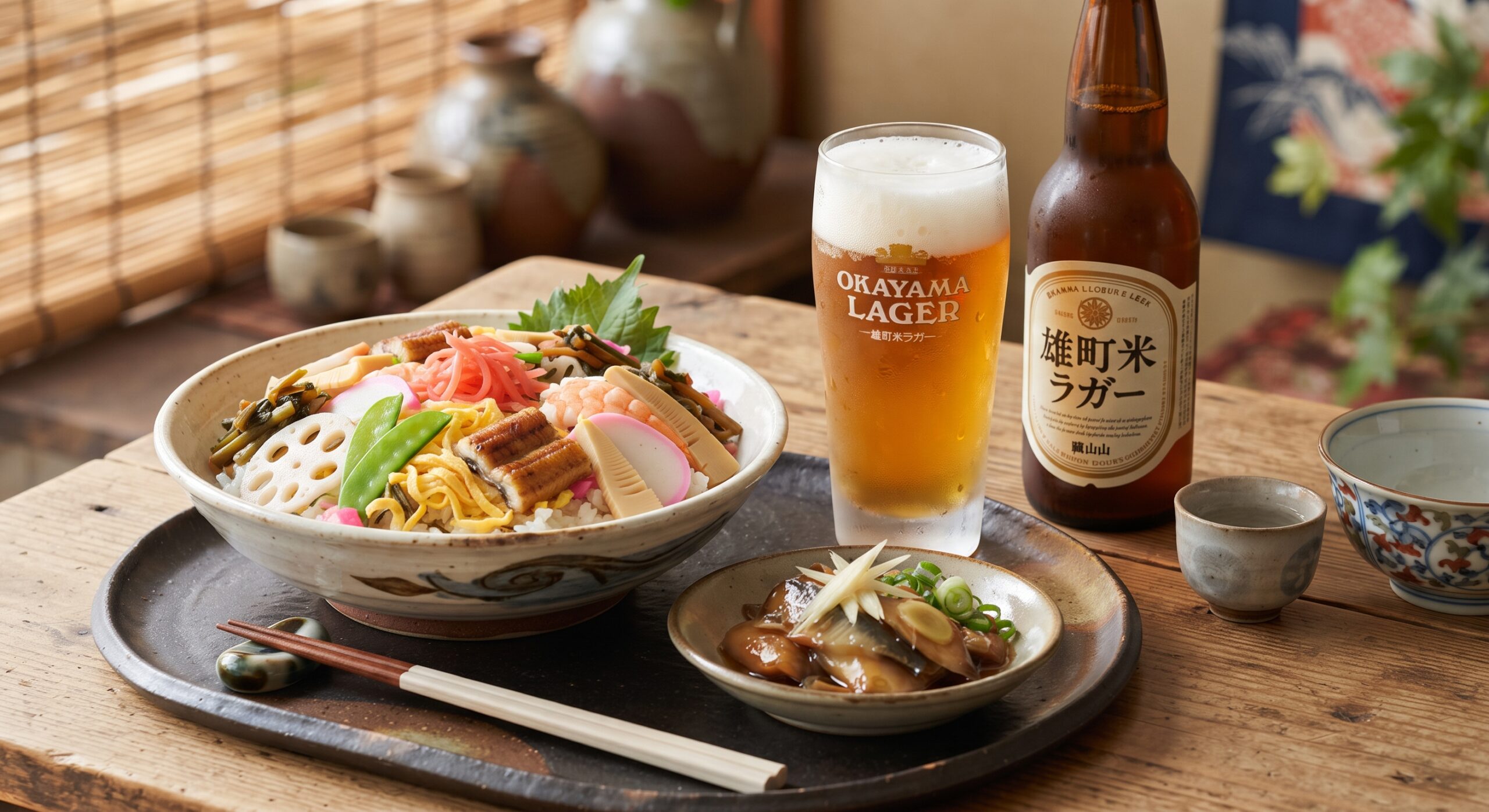
- ままかりの酢漬け
岡山県の郷土料理。「サッパ」という小魚を塩でしめてから甘酢に漬け込んだもので、あまりの美味しさに「ご飯(まま)を借りに行くほど」という名前の由来を持ちます。ラガーの軽やかな苦みと炭酸が、甘酢の酸味を後味すっきりとまとめてくれます。
- 岡山ばらずし
「祭り寿司」とも呼ばれる岡山の郷土料理で、瀬戸内の魚介や野菜を酢飯に混ぜ込んだハレの日のごちそうです。雄町米ラガーの麦芽と米由来のふくらみのある旨味が、具だくさんの寿司飯の旨味と重なります。
科学的にひとこと:ラガーの炭酸とホップの穏やかな苦みには、酢や塩気で引き締まった口の中をリセットする働きがあります。ままかりの甘酢の酸味やばらずしの酢飯は、雄町米ラガーのすっきりとした喉ごしによって後味が重くならず、米由来の旨味同士が響き合って感じられやすくなります。
ひとことメモ(ビールの用語)
- クラフトビール:小規模な醸造所が、造り手の個性を前面に出して仕込むビールの総称。大量生産の均一な味とは別の方向を目指しています。
- ラガー:低温で、酵母が下に沈みながら働く「下面発酵」で造るビール。すっきりと澄んだ切れ味になり、日本の大手ビールの多くがこの系統です。
- ホップ:ビールに苦みと香りを与えるつる性植物の毬花(まりばな)。品種によって、柑橘・トロピカルフルーツ・草原のように香りが変わります。
- モルト:発芽させた大麦(麦芽)のこと。ビールの甘み・色・コクの土台になり、焙煎の深さで色と香ばしさが決まります。
- ABV:アルコール度数(Alcohol By Volume)のこと。ビールでは5%前後が標準で、8%を超えると飲みごたえのある「強め」の部類になります。
- 地ビール:1994年の酒税法改正で小規模醸造が解禁された後、各地で生まれたビールの呼び名。現在は「クラフトビール」と呼ばれることが多くなっています。
参考
内容に誤りがございましたら、お手数ですが info@soundrecords.jp までご連絡いただけますと幸いです。
Today’s Pairing
- Craft beer: Doppo Omachi Rice Lager — bottom-fermented lager, 5% ABV, made with malt, rice (Okayama-grown “Omachi” sake rice, polished to 60%, as in ginjo-grade sake), and hops / Miyashita Sake Brewing Co., Ltd. (Naka Ward, Okayama City)
Official site: https://www.msb.co.jp/doppo/
- Music: “Tabiji” (“The Journey”) by Fujii Kaze (2021), written and composed by Fujii Kaze himself, produced by Yaffle
YouTube: https://www.youtube.com/watch?v=29p8FvT_puU
▶ If the player above doesn’t play, open it on YouTube
The Story of the Brewery
Miyashita Sake Brewing traces back to 1915, when brothers Kamezo and Motosaburo Miyashita began brewing sake in Tamano City, Okayama. In 1967 the brewery moved to its current site in Nishikawahara, Naka Ward, Okayama City — about a kilometer north of Korakuen, one of Japan’s three great gardens — where it has long drawn its brewing water from groundwater of the Asahi River, one of Okayama’s three major rivers, pumped up from 100 meters underground.
The move into beer came after a 1994 revision to Japan’s liquor tax law that made it possible for small companies to brew beer for the first time. As sake consumption was declining while beer’s easy, ready-to-drink appeal was growing, the company decided to enter beer brewing, launching its craft beer “Doppo” in July 1995 — the first in the Chugoku region and the ninth in Japan. At the time, almost no information about beer brewing was publicly available in Japan, so Miyashita traveled to Germany three times to source ingredients, invited a German brewmaster, and trained in the US as well, learning from scratch how to make a beer meant to be savored rather than gulped down.
The name “Doppo” was chosen from roughly 3,000 entries in a public naming contest. Beyond the fact that “Doku” (独) evokes Germany, it also carries the spirit of the phrase “dokuritsu doppo” — standing on one’s own two feet — reflecting the small brewery’s resolve to brew with its own convictions. Because Okayama’s soft water suits pale lagers well, the brewery initially built its lineup around Pilsner, which won first place in the local beer category of the 2009 Spring National Liquor Contest.
The beer featured here, Omachi Rice Lager, takes that a step further. It uses Okayama’s own “Omachi” sake rice, polished to 60% as in ginjo-grade sake, as a secondary ingredient, fermented and aged slowly at lower temperatures in a nod to sake-brewing methods. The result is a beer that’s light and clear, carrying the fullness and umami that malt and Omachi rice bring together. It has won first place in the local beer category of the Spring National Liquor Contest three times — in 2010, 2014, and 2019 — and also received an award at the 2019 National Local Beer Quality Review.
The Story of the Land
The name “Omachi” comes from a place: Omachi, in Naka Ward, Okayama City. According to tradition, in 1859 a farmer named Jinzo Kishimoto, from what was then Takashima Village, Omachi, in Bizen Province’s Joto District, brought home an unfamiliar rice plant on his way back from a pilgrimage to Mount Daisen in Hoki Province. The rice came to be known by the name of the place where it was found — Omachi. Prized for sake brewing, it was used as breeding stock across the country, and roughly two-thirds of Japan’s existing sake rice varieties are said to trace their lineage back to Omachi, earning it the nickname “the root of sake rice.” Even today, about 90% of Japan’s Omachi rice is grown in Okayama Prefecture.
In that same area of Omachi, a spring called “Omachi no Reisen” still flows, designated one of Japan’s Top 100 Waters in 1985 by what was then the Environment Agency (predecessor to today’s Ministry of the Environment). Tradition holds that it was developed in 1686, during the rule of the Okayama domain’s lord Tsunamasa Ikeda, and it is groundwater from the Asahi River surfacing at ground level. The water Miyashita Sake Brewing draws for its brewing is groundwater from that same Asahi River. The place where the rice was born and the river that feeds the brewery’s water share the same watershed.
The Story of the Song
Fujii Kaze was born on June 14, 1997, in Satosho, Asakuchi District, Okayama Prefecture. His family ran a coffee shop, and he grew up teaching himself piano, posting videos of his own performances on YouTube. In the summer of 2018, a staff member from a talent agency saw those videos and visited the family’s coffee shop to offer him a contract, leading to his major-label debut on January 24, 2020. Since debuting, he has kept using the local word “washi” as his first-person pronoun in lyrics, mixing standard Japanese with Okayama dialect.
“Tabiji” was released digitally on March 1, 2021, through HEHN RECORDS/Universal Music. Fujii Kaze wrote and composed it himself, with production by Yaffle, and it was used as the theme song for the TV Asahi Thursday drama Nijiiro Karte. Fujii wrote it after visiting the drama’s set and reading through the script. On release day, March 1, he appeared live on TV Asahi’s news program Hodo Station and performed it solo at the piano as a gift to that year’s graduates, whose ceremonies had been disrupted by the COVID-19 pandemic. The music video, released March 11, 2021 and directed by filmmaker Kento Yamada, was shot in Fujii’s hometown of Satosho and at his old school.
Why This Pairing
The name “Doppo” itself means “dokuritsu doppo” — standing and walking on your own two feet. At a time when only five major companies made beer in Japan, it was the name a small brewery gave itself as it set out, relying only on local water and local ingredients and its own convictions. Fujii Kaze, too, is someone who was discovered starting from a family coffee shop in Satosho, through self-taught piano and videos he filmed himself. Even after his major debut, he has kept his dialect in his lyrics rather than hiding it, and went out of his way to film the “Tabiji” video back in his hometown and at his old school.
There’s a second thread running underneath, in the Omachi rice itself. In the 160-plus years since its discovery, Omachi rice has passed its lineage down into sake rice varieties across the country, to the point that roughly two-thirds of today’s sake rice is said to descend from it. And yet its source is still right there, in Omachi, Naka Ward, Okayama City, within the same Asahi River watershed. Something — or someone — can travel far and still stay connected to where it began. The title “Tabiji,” a journey, and the name “Doppo,” walking alone, meet at the same starting point.
Where to Find This Beer
The Rakuten Ichiba link below is an affiliate link.
These are Japanese storefronts. If you are visiting the brewery, drinking it fresh at their own taproom is by far the best option.
🌡️ How to serve it:Chilled to about 5–8°C, in a narrow-mouthed Pilsner glass or a tall tumbler. That shows off the clear, pale color that comes from the Omachi rice and the fine bubbles rising through the glass.
Pairing Dishes Worth Trying
- Mamakari vinegar pickle
An Okayama specialty: a small herring-family fish called “sappa,” salted and then marinated in sweet vinegar. It’s said to taste so good people would go “borrow rice” (mama-kari) from a neighbor to eat with it. The lager’s light bitterness and carbonation clean up the sweet vinegar’s tang.
- Okayama barazushi
Also called “matsuri-zushi” (festival sushi), this Okayama specialty mixes seafood and vegetables from the Seto Inland Sea straight into vinegared rice for a festive, celebratory dish. The rounded umami that malt and Omachi rice bring to the lager echoes the umami in the sushi rice’s many ingredients.
A note on the science: a lager’s carbonation and mild hop bitterness are known to reset a palate tightened by vinegar or salt. The tang of mamakari’s sweet vinegar and the vinegared rice in barazushi both come through cleanly against the Omachi lager’s crisp finish, letting the rice-derived umami in both the beer and the dish stand out together.
A Quick Glossary of Beer Terms
- Craft beer: Beer made by small breweries that put the character of the maker front and centre, as opposed to the uniformity of mass production.
- Lager: Beer made by “bottom fermentation,” in which the yeast works slowly at a low temperature and settles toward the bottom of the tank. It tends to come out clean and crisp — the style behind most major Japanese beers.
- Hops: The cones of a climbing plant, which give beer its bitterness and aroma.
- Malt: Germinated barley. It forms the foundation of a beer’s sweetness, colour and body.
- ABV: Alcohol By Volume. Around 5% is standard for beer; anything above 8% is considered a stronger, more full-bodied style.
- Local beer (ji-biiru): The term used for beers from Japan’s small breweries after the 1994 liquor tax reform made small-scale brewing legal. Today these are more often called “craft beer.”
Sources
- “Omachi Rice Lager,” Miyashita Sake Brewing Co., Ltd. (official)
- “Our History,” Miyashita Sake Brewing Co., Ltd. (official)
- “Okayama’s Local Beer ‘Doppo’: 15 Years and What’s Next” by Koichi Miyashita (Miyashita Sake Brewing Co., Ltd.), Seibutsu-kogaku (Journal of the Society for Biotechnology, Japan), Vol. 88, No. 11
- “Omachi” — Wikipedia (Japanese)
- “Omachi no Reisen,” City of Okayama (official)
- “Tabiji (Fujii Kaze song)” — Wikipedia (Japanese)
- “Fujii Kaze” — Wikipedia (Japanese)
If you notice any errors in this article, please don’t hesitate to reach out at info@soundrecords.jp.
コメントを残す