日本語で読む | This is the English version of a bilingual article.
Today’s Pairing
- Sake: Isojiman Daiginjo “Itteki Nyukon” — brewed with 100% Yamada Nishiki sake rice from the special-grade Tojo-Akitsu district of Hyogo, rice-polishing ratio (seimai buai) 45% / Isojiman Shuzo Co., Ltd. (307 Iwashigashima, Yaizu, Shizuoka Prefecture)
Official site: http://www.isojiman-sake.jp/ - Kayoukyoku (classic Japanese popular song): “Minato-machi Blues” (“Port Town Blues”) by Mori Shinichi, 1969
YouTube: https://www.youtube.com/watch?v=Hn0qv9vsBb0
▶ If the player above doesn’t play, open it on YouTube
The Story of the Brewery
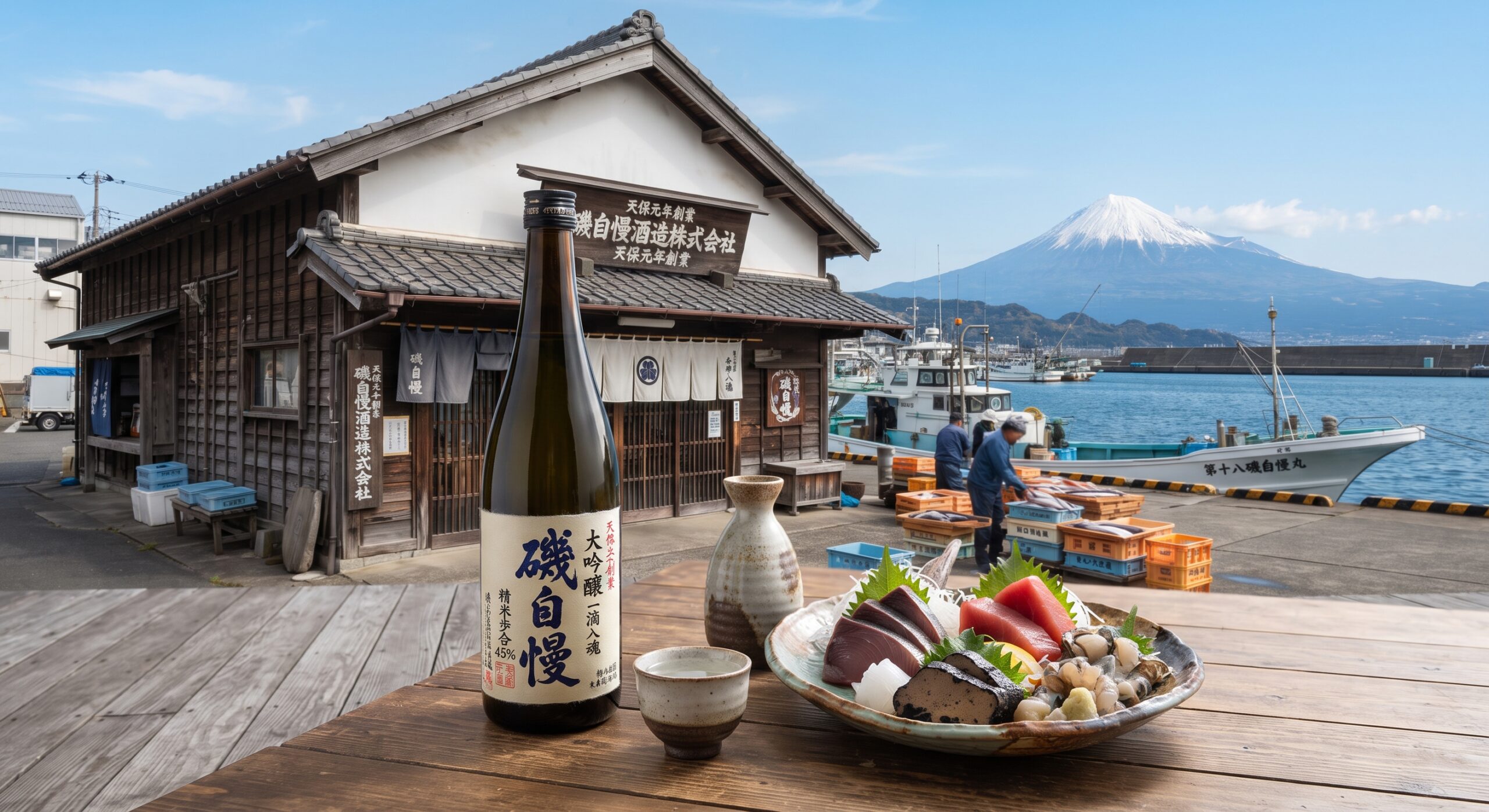
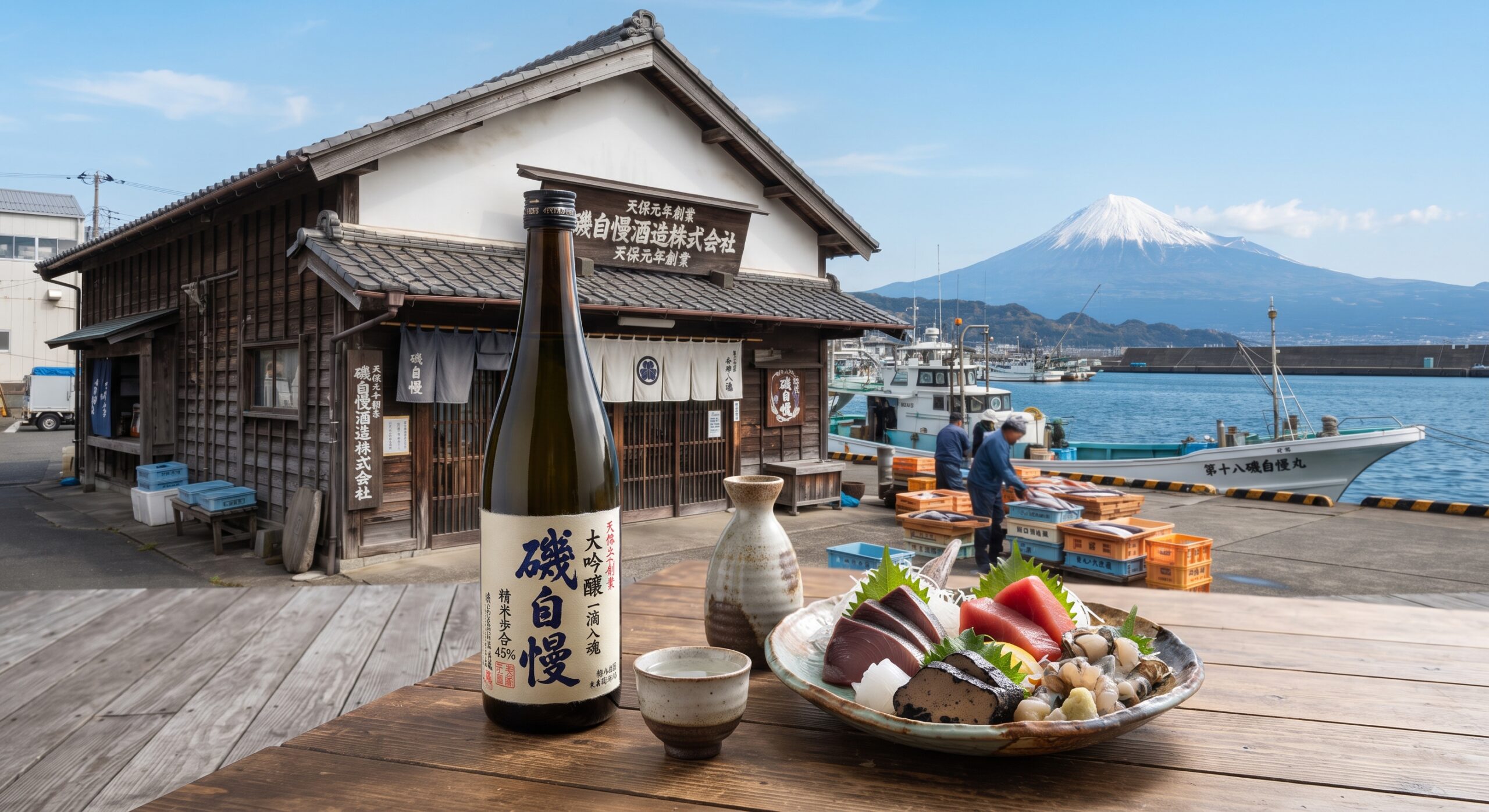
Isojiman Shuzo Co., Ltd. was founded in 1830. The family were originally landowners and village headmen in Yaizu, and are said to have begun brewing sake using surplus rice during the slow winter farming season. Its current president is Teraoka Yoji, and its toji (master brewer) is Tada Nobuo, trained in the Nanbu brewing tradition. Most of its sake rice is Yamada Nishiki from the special-grade Tojo district of Hyogo Prefecture; about 65% of all the rice it uses is a registered strain called “Tojo Yamada Nishiki,” grown by contracted local farmers, and the brewery also takes part in “Frontier Tojo 21,” a group of eleven like-minded breweries nationwide that supports farmers in that growing region. Its brewing water is groundwater carried into the Shida Plain by the Oi River, which rises at Mt. Ainodake in the Southern Alps.
The bottle that has carried the Isojiman name at home and abroad is this pairing’s “Daiginjo Itteki Nyukon” (“One Drop, Whole Soul”). Brewed with Tojo-Akitsu Yamada Nishiki rice polished to a seimai buai of 45%, it sits at the core of the Isojiman lineup; the brewery describes it as the bottle that “most directly conveys the Isojiman style and philosophy, whether paired with seafood or simply enjoyed with a meal.” In 1987, Isojiman Shuzo was the first brewery in Japan to build an all-stainless refrigerated brewing room, a step that greatly improved the quality of its slow, low-temperature ginjo brewing. The brewery’s own website explains that when it set up refrigerated facilities for pressing the sake, it drew on the ultra-cold (-60°C) freezing technology developed in “Yaizu, the town of fish.”
The Story of the Land
Yaizu, where Isojiman Shuzo is based, is a port town on Suruga Bay in central Shizuoka Prefecture. To the east lie the Izu Peninsula and Mt. Fuji, and the brewery’s own water comes from the same source: groundwater carried by the Oi River, which rises at Mt. Ainodake in the Southern Alps. The name “Yaizu” is said to come from Japanese mythology — the legendary prince Yamato Takeru, attacked with a brushfire by enemies here during his eastern campaign, is said to have used his sword, Kusanagi, to cut down the surrounding reeds and set a backfire to escape, an episode said to have given the place its name (yaizu, roughly “burnt inlet”).
Yaizu remains one of Japan’s leading fishing towns today. Building on a tradition of bonito fishing that flourished here since the Edo period, it has grown into a major base for offshore tuna and bonito fishing, and recorded the highest fishing catch value of any city in Japan in 2020. Local dishes that make full use of the catch, such as kurohanpen (a dark, fish-based cake made from bonito and sardine), are still very much part of daily life here.
The Story of the Song
“Minato-machi Blues” was released on April 15, 1969, Mori Shinichi’s twelfth single. The lyrics are by Fukatsu Takeshi, with additional lyrics by Nakanishi Rei, the music by Inomata Kimiaki, and the arrangement by Morioka Kenichiro. Within about two weeks of release it entered Oricon’s weekly top ten, then held the number-one spot for five consecutive weeks, becoming a million-seller. That same year it won Best Vocal Performance at the 11th Japan Record Awards and the Grand Prix at the 2nd Japan Cable Broadcasting Awards.
Mori Shinichi was born in Kofu, Yamanashi Prefecture, in 1947, and raised in Kagoshima City. He debuted as a singer in 1966 with “Onna no Tameiki” (“A Woman’s Sigh”), and won a following for his distinctively raspy voice singing of women’s hearts. “Minato-machi Blues,” one of his signature songs, names one port town after another in its lyrics, running from Hakodate in the north down to Kagoshima in the south. Among the names it sings are Yaizu and Omaezaki — both port towns in Shizuoka Prefecture, the same prefecture where Isojiman is brewed.
Why This Pairing
The Yaizu that appears in “Minato-machi Blues” is not just one name among many in a list of port towns. A town that has thrived on bonito fishing since the Edo period and remains one of Japan’s top fishing bases today, it’s also the very town that shaped Isojiman itself.
Behind Isojiman Shuzo’s pioneering refrigerated brewing room, and the slow, low-temperature ginjo brewing it made possible, lay the -60°C freezing technology developed in “Yaizu, the town of fish.” Knowledge built up by people working the port, in other words, eventually became the technique that polishes a single drop of sake. Seen that way, this brewery’s sake belongs, through and through, to the port town of Yaizu.
“Minato-machi Blues” has, for decades, sung of port towns that send countless ships out and welcome them back in. As you pour a glass of “Itteki Nyukon,” polished in the sea breeze of Yaizu, let your thoughts settle for a moment on one of the port towns this song sings of.
Where to Find This Bottle
The Rakuten Ichiba link below is an affiliate link.
- Brewery’s official site: http://www.isojiman-sake.jp/
- Buy on Rakuten Ichiba: View the product page (720ml, ¥5,500)
Note: the links above lead to Japan-based retailers. They’re most convenient for readers in Japan, or for those elsewhere who are able to arrange international shipping. Stock and availability change over time, so if you’re near a specialty sake shop, it’s well worth asking for this label by name.
Pairing Dishes Worth Trying
- Kurohanpen with plum and shiso, deep-fried
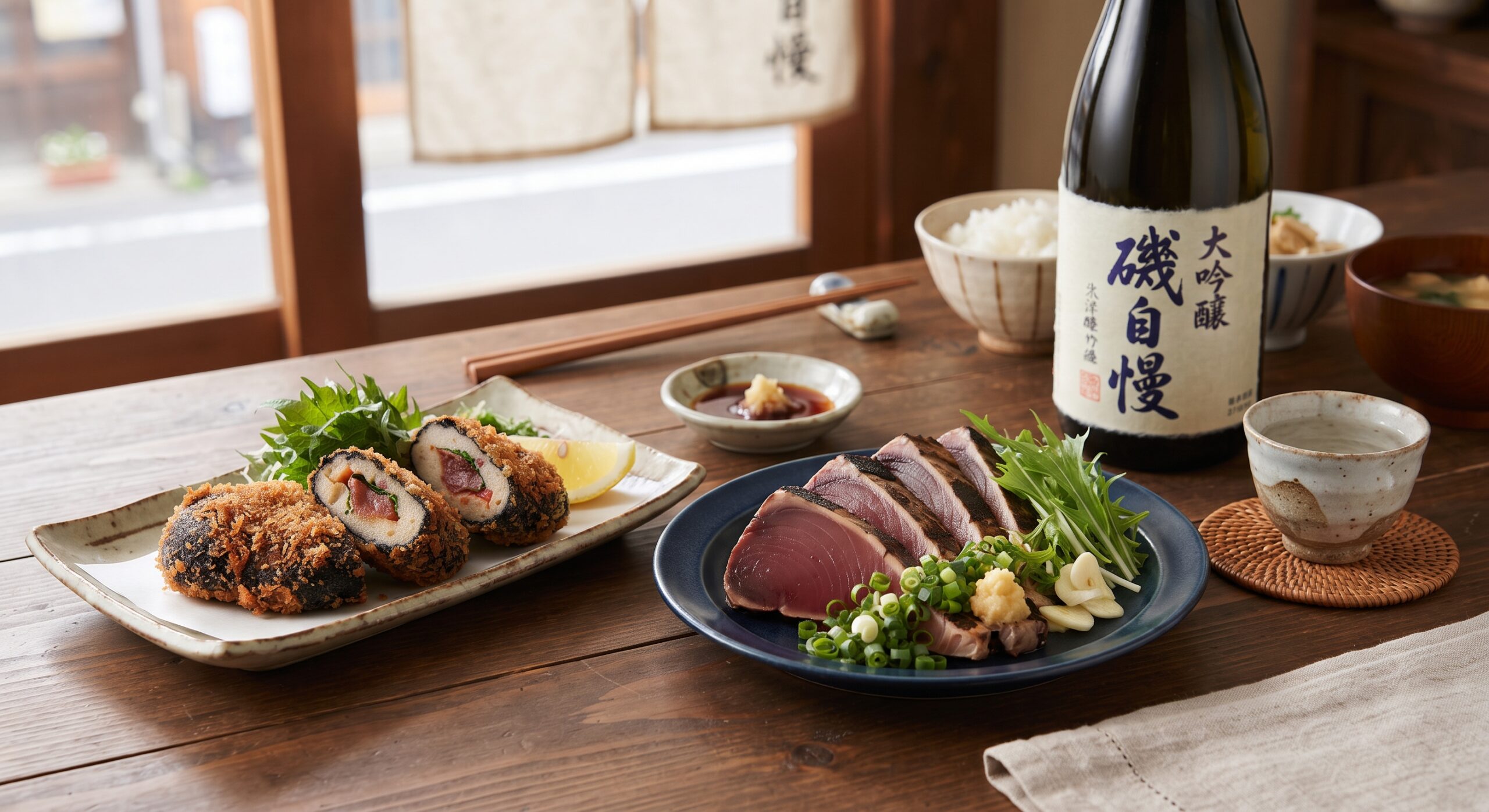
Kurohanpen, a dark fish cake made from bonito and sardine, is Shizuoka and Yaizu’s soul food; here it’s rolled with pickled plum and shiso leaf before frying. The crisp, fragrant batter pairs naturally with the showy ginjo aroma of a daiginjo.
Recipe (in Japanese): Kurashiru, “Kurohanpen with Plum and Shiso, Deep-Fried” - Bonito tataki with a homemade ginger-soy sauce
Bonito landed in Yaizu, seared and served with a homemade sauce of ginger, garlic, and soy. The umami of this red-fleshed fish pairs naturally with Isojiman’s gentle acidity and deep, layered flavor.
Recipe (in Japanese): Kurashiru, “Bonito Tataki with a Homemade Sauce”
A note on the science: the oil in fried food is cut through by sake’s gentle acidity and by the ester compounds — such as isoamyl acetate — that make up a ginjo aroma, refreshing the palate for the next bite. The inosinic acid abundant in red-fleshed fish like bonito resonates with the amino-acid umami in sake, creating a synergistic boost of savoriness.
Visiting the Brewery
Isojiman Shuzo Co., Ltd. (307 Iwashigashima, Yaizu, Shizuoka)
About a 21-minute walk from JR Yaizu Station. To the east, the brewery looks out over Suruga Bay toward the Izu Peninsula and Mt. Fuji. Its brewing water is groundwater from the Oi River, which rises at Mt. Ainodake in the Southern Alps.
Sights Nearby
- Yaizu Shrine / Yaizu, Yaizu City | ~5 min, ~2 km by car from the brewery
An old shrine said to have been founded about 1,600 years ago, enshrining the legendary prince Yamato Takeru. Tradition holds that when Yamato Takeru landed here, he placed the “fire stone” and “water stone” he carried in a small shrine and enshrined Ichikishima-hime, a goddess of the sea — the origin of the shrine. Its August festival is known as one of the wildest mikoshi festivals in the Tokai region. Visiting hours vary by day, so check before you go. - Yaizu Sakana Center / Yaizu City | ~10 min, ~3 km by car from the brewery
A seafood market with roughly 60 shops. Yaizu is today a major base for offshore tuna and bonito fishing, and recorded the highest fishing catch value in Japan in 2020. Open 9:00–17:00 (the food court keeps separate hours); closed January 1 and other days. Check the official site for details. - Hanazawa-no-Sato / Hanazawa, Yaizu City | ~20 min, ~8.5 km by car from the brewery
A mountain hamlet with a townscape dating back to the Edo period, designated in 2014 as Shizuoka Prefecture’s first Important Preservation District for Groups of Traditional Buildings. The free visitor center is open 9:00–16:00, closed Mondays and in rain.
Hot Springs Nearby
- Yaizu Kuroshio Onsen, Yaizu Grand Hotel / Hamatoume, Yaizu City | ~12 min, ~4.5 km by car from the brewery
A hot spring hotel facing Suruga Bay, with two baths, “Umioto” and “Shiokaze.” Day-use bathing is possible through the “Yuttari Restaurant Plan,” which pairs a 13:00–14:30 bath (¥1,500 for middle schoolers and up) with lunch — bathing alone isn’t offered. The hotel can also close day-use bathing on certain dates, so check its official site before visiting.
Opening hours, closing days and day-use bathing availability can change. Please check each facility’s official information before visiting.
A Quick Glossary of Sake Terms
- Ginjo: Sake brewed from rice polished to a seimai buai of 60% or less and fermented slowly at low temperatures for a fragrant aroma; unlike junmai ginjo, a small amount of brewing alcohol is added to shape its aroma and flavor.
- Seimai buai (rice-polishing ratio): The percentage of the original grain remaining after milling. The lower the number, the more the rice has been polished down.
Sources
- Isojiman Shuzo Co., Ltd. – Official Site (Company Profile)
- Isojiman Shuzo Co., Ltd. – Official Site (Products)
- Isojiman Shuzo Co., Ltd. – Official Site (A Message from the Brewery)
- Minato-machi Blues – Wikipedia (Japanese)
- Mori Shinichi – Wikipedia (Japanese)
- Yaizu City – Wikipedia (Japanese)
- Yaizu Shrine – Official Site (Japanese)
If you notice any errors in this article, please don’t hesitate to reach out at info@soundrecords.jp.
Read this article in Japanese: 凍える港が磨いた、一滴の魂