今日のペアリング
▶ 上のプレーヤーで再生できない場合は、YouTubeで開く
酒蔵の話
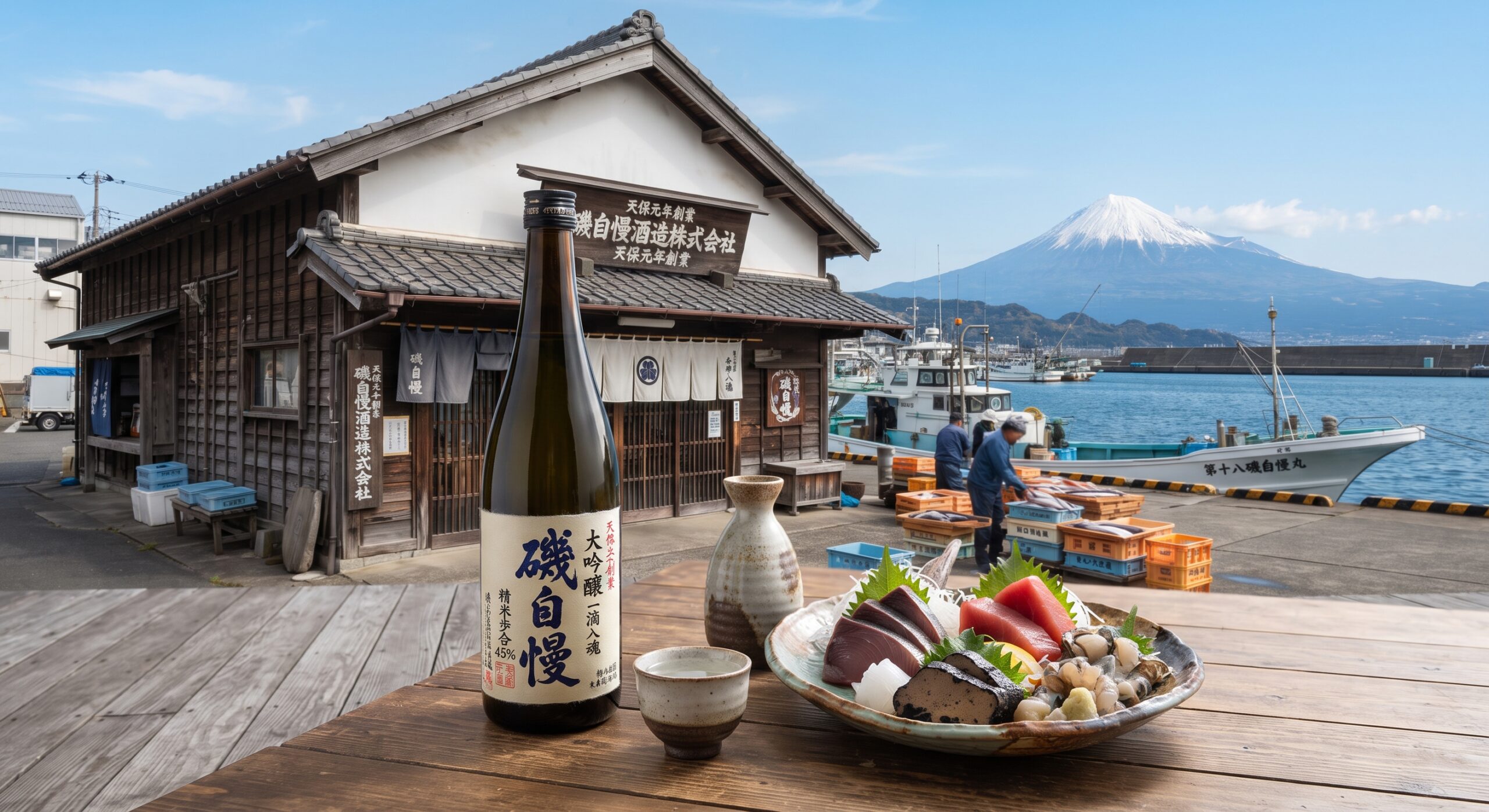
磯自慢酒造株式会社の創業は天保元年(1830年)。もとは焼津の地主・庄屋で、冬の農閑期に余った年貢米を使って酒造りを始めたと伝えられています。現在の代表取締役は寺岡洋司氏、杜氏は南部流の多田信男氏。酒米は兵庫県の特A地区・東条地区産の山田錦を中心に、現地の契約農家に栽培してもらう「東条山田錦」(商標登録)を使用米全体の約65%に用い、志を同じくする全国11の蔵元と結んだ「フロンティア東条21」を通じて、産地の農家を支える取り組みも続けています。仕込み水は、南アルプス・間ノ岳を水源とする大井川が志太平野にもたらす伏流水です。
磯自慢の名を国内外に知らしめてきた一本が、今回合わせる「大吟醸 一滴入魂」です。特A地区東条秋津産の山田錦を精米歩合45%まで磨き上げた、磯自慢ラインナップの中核をなす酒で、蔵元は「魚介のお料理とのマリアージュ、あるいは食中酒として、磯自慢のスタイルや考え方を最も端的にお伝えできるお酒」と紹介しています。昭和62年(1987年)、磯自慢酒造は全国に先駆けてオールステンレス製の冷蔵仕込み室を導入し、低温でじっくり醸す吟醸造りの品質を大きく引き上げました。搾りの工程を冷蔵設備の中で行うようにした際には、「魚の町・焼津」で培われてきた-60℃の冷凍技術を酒造りに応用したのだと、蔵元自身が公式サイトで語っています。
土地の話
磯自慢酒造が蔵を構える焼津市は、駿河湾に面した静岡県中部の港町です。東には伊豆半島と富士山を望み、蔵の仕込み水も、南アルプス・間ノ岳を水源とする大井川が運んでくる伏流水を使っています。「焼津」という地名は日本神話に由来すると伝えられ、日本武尊が東征の折にこの地で賊に野火を放たれた際、草薙剣で周囲の葦を薙ぎ倒し、迎え火を放って難を逃れたという言い伝えから名づけられたとされています。
焼津は今も「全国有数の水産文化都市」で、江戸時代から盛んだったカツオ漁の伝統の上に、現在はカツオ・マグロを中心とする遠洋漁業の一大基地として発展してきました。2020年の漁業水揚げ額は全国一位を記録しています。水揚げされた魚を余すところなく生かす「黒はんぺん」など、港町ならではの魚食文化も、この土地には豊かに息づいています。
音楽の話
「港町ブルース」は1969年4月15日発売、森進一の12枚目のシングルです。作詞は深津武志、補作はなかにし礼、作曲は猪俣公章、編曲は森岡賢一郎。発売から2週間あまりでオリコンチャートのベストテンに入り、5週にわたって1位を記録するミリオンセラーとなりました。同年の第11回日本レコード大賞では最優秀歌唱賞を、第2回日本有線大賞ではグランプリを受賞しています。
森進一は1947年、山梨県甲府市生まれ、鹿児島市育ち。1966年、「女のためいき」で歌手デビューし、かすれた声で女心を歌うスタイルで人気を集めました。「港町ブルース」はその代表曲のひとつで、歌詞には北は函館から南は鹿児島まで、日本各地の港町の名が次々と歌い込まれています。その中に登場するのが、焼津と御前崎――どちらも磯自慢の蔵元と同じ静岡県の港町です。
なぜこの組み合わせなのか
「港町ブルース」が歌う焼津は、歌詞に並ぶ数ある港町のひとつというだけではありません。江戸時代からカツオ漁で栄え、今も遠洋漁業の基地として日本有数の水揚げを誇るこの港町は、磯自慢という酒そのものを育ててきた土地でもあります。
磯自慢酒造が全国に先駆けて冷蔵仕込み室を整え、低温でじっくり醸す吟醸造りを磨き上げてこられた背景には、「魚の町・焼津」で培われた-60℃の冷凍技術がありました。港で働く人々が積み重ねてきた知恵が、巡りめぐって一滴の酒を磨く技術になった――そう思うと、この蔵の酒はどこまでも焼津という港町のものだとわかります。
多くの船を送り出し、また迎え入れてきた港町の情景を、「港町ブルース」は歌い継いできました。焼津の海風の中で磨かれた「一滴入魂」を傾けながら、この歌に歌われた港町のひとつに、静かに思いを馳せてみてください。
この一本を、探すなら
※楽天市場へのリンクは広告(アフィリエイト)です。在庫・取扱いは変動します。お近くの酒販店でも、ぜひ銘柄名を伝えて探してみてください。
🌡️ おすすめの飲み方:よく冷やして。大吟醸ならではの白桃やマスクメロン、完熟バナナを思わせる華やかな香りは、冷やすことでいちばん美しく引き立ちます。
合わせたい「アテ」
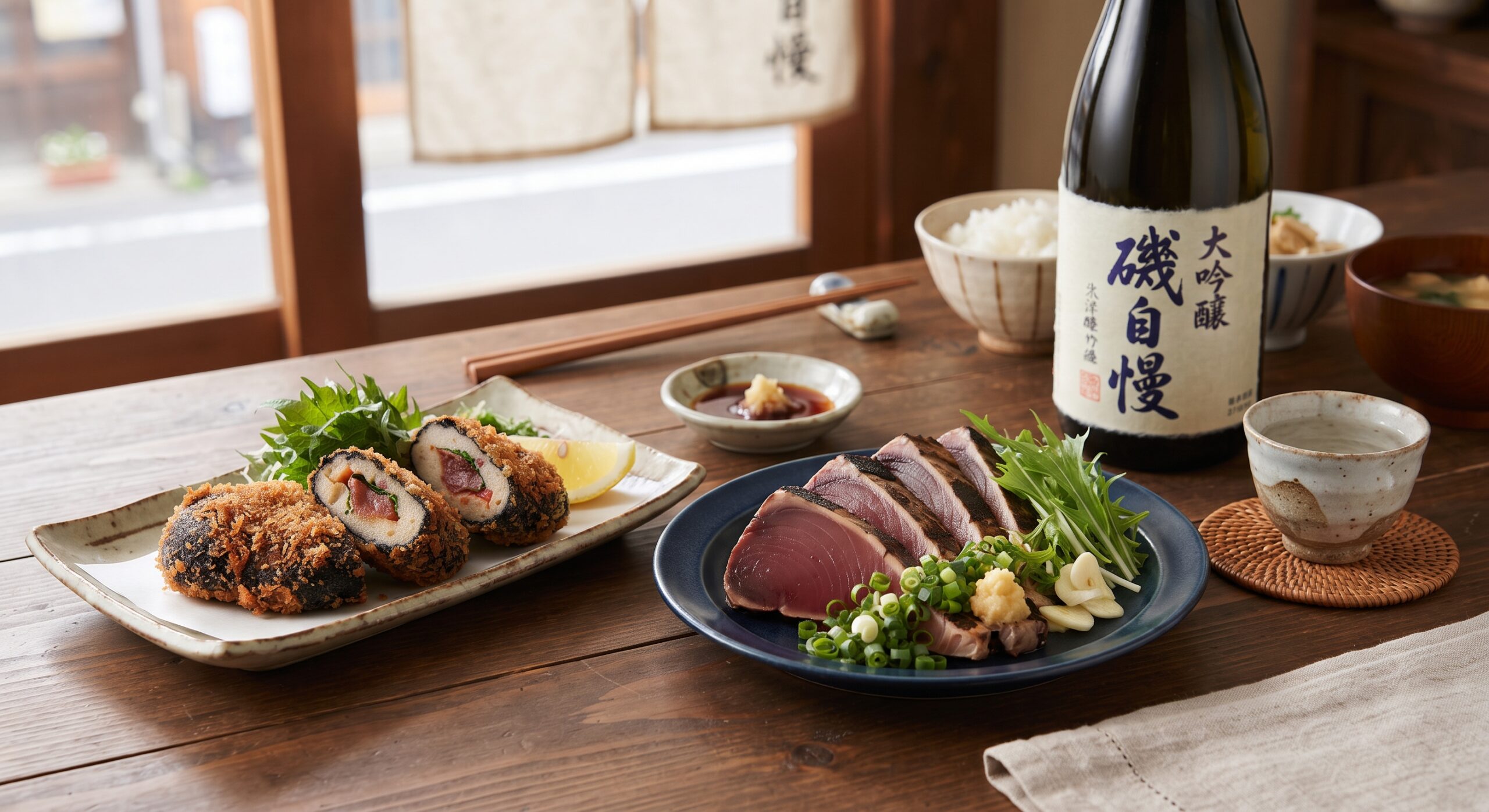
- 黒はんぺんの梅しそフライ
静岡・焼津のソウルフード「黒はんぺん」を、梅肉と大葉で巻いて揚げた一品。サクッとした衣の香ばしさに、大吟醸らしい華やかな吟醸香が寄り添います。
レシピはこちら:クラシル「黒はんぺんの梅しそフライ」
- 手作りダレで食べるカツオのたたき
焼津に水揚げされるカツオを、生姜と醤油の手作りダレでさっぱりと。赤身魚の旨味に、磯自慢の穏やかな酸と奥深い味わいがよく寄り添います。
レシピはこちら:クラシル「手作りダレで食べるカツオのたたき」
科学的にひとこと:揚げ物の油分は、日本酒の穏やかな酸と、吟醸香を形づくる酢酸イソアミルなどのエステル類によって口の中で洗い流され、次のひと口をさっぱりと感じさせてくれます。カツオなど赤身魚に多いイノシン酸の旨味は、日本酒に含まれるアミノ酸由来の旨味と重なり合い、相乗効果でいっそう深い味わいを生み出します。
この蔵をたずねるなら
磯自慢酒造株式会社(静岡県焼津市鰯ヶ島307)
JR焼津駅から徒歩約21分。蔵の東には駿河湾越しに伊豆半島と富士山を望みます。仕込み水は、南アルプス・間ノ岳を水源とする大井川の伏流水です。
近くの観光スポット
- 焼津神社/焼津市焼津|蔵から車で約5分・約2km
日本武尊を祭神とする、約1,600年前の創建と伝わる古社。日本武尊がこの地に上陸した際、携えていた「火石」「水石」を祠に納め、海の神・市杵島姫命を祀ったのが始まりと伝えられています。8月の例大祭は「東海一の荒祭」として知られます。参拝できる時間は日によって変わるため、訪問前にご確認ください。
- 焼津さかなセンター/焼津市|蔵から車で約10分・約3km
水産物を中心に約60店舗が集まる観光市場。焼津は現在、カツオ・マグロを中心とする遠洋漁業の基地で、2020年の漁業水揚げ額は全国一位を記録しました。営業時間は9:00〜17:00(食堂は別時間)、休業日は1月1日ほか。詳しくは公式サイトでご確認ください。
- 花沢の里/焼津市花沢|蔵から車で約20分・約8.5km
江戸期以来の家並みが残る山あいの集落で、2014年に静岡県で初めて国の重要伝統的建造物群保存地区に選定されました。花沢地区ビジターセンターは見学無料、9:00〜16:00、月曜と雨天時は休館です。
近くの温泉
- やいづ黒潮温泉 焼津グランドホテル/焼津市浜当目|蔵から車で約12分・約4.5km
駿河湾に面した「海音」「汐風」2つの大浴場を持つ温泉ホテル。日帰り入浴は、ランチとセットの「湯ったりレストランプラン」(利用時間13:00〜14:30、入浴料は中学生以上1,500円)で可能ですが、日帰り入浴のみの利用はできません。特定日に休業することもあるため、訪問前に公式サイトでご確認ください。
※営業時間・定休日・日帰り入浴の可否は変わることがあります。おでかけ前に各施設の公式情報をご確認ください。
ひとことメモ(日本酒の用語)
- 吟醸酒:精米歩合60%以下まで磨いた米を低温でじっくり発酵させた日本酒。純米吟醸酒と違い、香味を整えるための醸造アルコールが加えられています。華やかな香りが特徴です。
- 精米歩合:玄米を削り、残った部分の割合。数値が低いほど、米を多く磨いていることを示します。
参考
内容に誤りがございましたら、お手数ですが info@soundrecords.jp までご連絡いただけますと幸いです。
Today’s Pairing
- Sake: Isojiman Daiginjo “Itteki Nyukon” — brewed with 100% Yamada Nishiki sake rice from the special-grade Tojo-Akitsu district of Hyogo, rice-polishing ratio (seimai buai) 45% / Isojiman Shuzo Co., Ltd. (307 Iwashigashima, Yaizu, Shizuoka Prefecture)
Official site: http://www.isojiman-sake.jp/
- Kayoukyoku (classic Japanese popular song): “Minato-machi Blues” (“Port Town Blues”) by Mori Shinichi, 1969
YouTube: https://www.youtube.com/watch?v=Hn0qv9vsBb0
▶ If the player above doesn’t play, open it on YouTube
The Story of the Brewery
Isojiman Shuzo Co., Ltd. was founded in 1830. The family were originally landowners and village headmen in Yaizu, and are said to have begun brewing sake using surplus rice during the slow winter farming season. Its current president is Teraoka Yoji, and its toji (master brewer) is Tada Nobuo, trained in the Nanbu brewing tradition. Most of its sake rice is Yamada Nishiki from the special-grade Tojo district of Hyogo Prefecture; about 65% of all the rice it uses is a registered strain called “Tojo Yamada Nishiki,” grown by contracted local farmers, and the brewery also takes part in “Frontier Tojo 21,” a group of eleven like-minded breweries nationwide that supports farmers in that growing region. Its brewing water is groundwater carried into the Shida Plain by the Oi River, which rises at Mt. Ainodake in the Southern Alps.
The bottle that has carried the Isojiman name at home and abroad is this pairing’s “Daiginjo Itteki Nyukon” (“One Drop, Whole Soul”). Brewed with Tojo-Akitsu Yamada Nishiki rice polished to a seimai buai of 45%, it sits at the core of the Isojiman lineup; the brewery describes it as the bottle that “most directly conveys the Isojiman style and philosophy, whether paired with seafood or simply enjoyed with a meal.” In 1987, Isojiman Shuzo was the first brewery in Japan to build an all-stainless refrigerated brewing room, a step that greatly improved the quality of its slow, low-temperature ginjo brewing. The brewery’s own website explains that when it set up refrigerated facilities for pressing the sake, it drew on the ultra-cold (-60°C) freezing technology developed in “Yaizu, the town of fish.”
The Story of the Land
Yaizu, where Isojiman Shuzo is based, is a port town on Suruga Bay in central Shizuoka Prefecture. To the east lie the Izu Peninsula and Mt. Fuji, and the brewery’s own water comes from the same source: groundwater carried by the Oi River, which rises at Mt. Ainodake in the Southern Alps. The name “Yaizu” is said to come from Japanese mythology — the legendary prince Yamato Takeru, attacked with a brushfire by enemies here during his eastern campaign, is said to have used his sword, Kusanagi, to cut down the surrounding reeds and set a backfire to escape, an episode said to have given the place its name (yaizu, roughly “burnt inlet”).
Yaizu remains one of Japan’s leading fishing towns today. Building on a tradition of bonito fishing that flourished here since the Edo period, it has grown into a major base for offshore tuna and bonito fishing, and recorded the highest fishing catch value of any city in Japan in 2020. Local dishes that make full use of the catch, such as kurohanpen (a dark, fish-based cake made from bonito and sardine), are still very much part of daily life here.
The Story of the Song
“Minato-machi Blues” was released on April 15, 1969, Mori Shinichi’s twelfth single. The lyrics are by Fukatsu Takeshi, with additional lyrics by Nakanishi Rei, the music by Inomata Kimiaki, and the arrangement by Morioka Kenichiro. Within about two weeks of release it entered Oricon’s weekly top ten, then held the number-one spot for five consecutive weeks, becoming a million-seller. That same year it won Best Vocal Performance at the 11th Japan Record Awards and the Grand Prix at the 2nd Japan Cable Broadcasting Awards.
Mori Shinichi was born in Kofu, Yamanashi Prefecture, in 1947, and raised in Kagoshima City. He debuted as a singer in 1966 with “Onna no Tameiki” (“A Woman’s Sigh”), and won a following for his distinctively raspy voice singing of women’s hearts. “Minato-machi Blues,” one of his signature songs, names one port town after another in its lyrics, running from Hakodate in the north down to Kagoshima in the south. Among the names it sings are Yaizu and Omaezaki — both port towns in Shizuoka Prefecture, the same prefecture where Isojiman is brewed.
Why This Pairing
The Yaizu that appears in “Minato-machi Blues” is not just one name among many in a list of port towns. A town that has thrived on bonito fishing since the Edo period and remains one of Japan’s top fishing bases today, it’s also the very town that shaped Isojiman itself.
Behind Isojiman Shuzo’s pioneering refrigerated brewing room, and the slow, low-temperature ginjo brewing it made possible, lay the -60°C freezing technology developed in “Yaizu, the town of fish.” Knowledge built up by people working the port, in other words, eventually became the technique that polishes a single drop of sake. Seen that way, this brewery’s sake belongs, through and through, to the port town of Yaizu.
“Minato-machi Blues” has, for decades, sung of port towns that send countless ships out and welcome them back in. As you pour a glass of “Itteki Nyukon,” polished in the sea breeze of Yaizu, let your thoughts settle for a moment on one of the port towns this song sings of.
Where to Find This Bottle
The Rakuten Ichiba link below is an affiliate link.
Note: the links above lead to Japan-based retailers. They’re most convenient for readers in Japan, or for those elsewhere who are able to arrange international shipping. Stock and availability change over time, so if you’re near a specialty sake shop, it’s well worth asking for this label by name.
🌡️ Recommended way to drink it: Well chilled. The showy aroma of this daiginjo — white peach, muskmelon, ripe banana — comes through most beautifully when served cold.
Pairing Dishes Worth Trying
- Kurohanpen with plum and shiso, deep-fried
Kurohanpen, a dark fish cake made from bonito and sardine, is Shizuoka and Yaizu’s soul food; here it’s rolled with pickled plum and shiso leaf before frying. The crisp, fragrant batter pairs naturally with the showy ginjo aroma of a daiginjo.
Recipe (in Japanese): Kurashiru, “Kurohanpen with Plum and Shiso, Deep-Fried”
- Bonito tataki with a homemade ginger-soy sauce
Bonito landed in Yaizu, seared and served with a homemade sauce of ginger, garlic, and soy. The umami of this red-fleshed fish pairs naturally with Isojiman’s gentle acidity and deep, layered flavor.
Recipe (in Japanese): Kurashiru, “Bonito Tataki with a Homemade Sauce”
A note on the science: the oil in fried food is cut through by sake’s gentle acidity and by the ester compounds — such as isoamyl acetate — that make up a ginjo aroma, refreshing the palate for the next bite. The inosinic acid abundant in red-fleshed fish like bonito resonates with the amino-acid umami in sake, creating a synergistic boost of savoriness.
Visiting the Brewery
Isojiman Shuzo Co., Ltd. (307 Iwashigashima, Yaizu, Shizuoka)
About a 21-minute walk from JR Yaizu Station. To the east, the brewery looks out over Suruga Bay toward the Izu Peninsula and Mt. Fuji. Its brewing water is groundwater from the Oi River, which rises at Mt. Ainodake in the Southern Alps.
Sights Nearby
- Yaizu Shrine / Yaizu, Yaizu City | ~5 min, ~2 km by car from the brewery
An old shrine said to have been founded about 1,600 years ago, enshrining the legendary prince Yamato Takeru. Tradition holds that when Yamato Takeru landed here, he placed the “fire stone” and “water stone” he carried in a small shrine and enshrined Ichikishima-hime, a goddess of the sea — the origin of the shrine. Its August festival is known as one of the wildest mikoshi festivals in the Tokai region. Visiting hours vary by day, so check before you go.
- Yaizu Sakana Center / Yaizu City | ~10 min, ~3 km by car from the brewery
A seafood market with roughly 60 shops. Yaizu is today a major base for offshore tuna and bonito fishing, and recorded the highest fishing catch value in Japan in 2020. Open 9:00–17:00 (the food court keeps separate hours); closed January 1 and other days. Check the official site for details.
- Hanazawa-no-Sato / Hanazawa, Yaizu City | ~20 min, ~8.5 km by car from the brewery
A mountain hamlet with a townscape dating back to the Edo period, designated in 2014 as Shizuoka Prefecture’s first Important Preservation District for Groups of Traditional Buildings. The free visitor center is open 9:00–16:00, closed Mondays and in rain.
Hot Springs Nearby
- Yaizu Kuroshio Onsen, Yaizu Grand Hotel / Hamatoume, Yaizu City | ~12 min, ~4.5 km by car from the brewery
A hot spring hotel facing Suruga Bay, with two baths, “Umioto” and “Shiokaze.” Day-use bathing is possible through the “Yuttari Restaurant Plan,” which pairs a 13:00–14:30 bath (¥1,500 for middle schoolers and up) with lunch — bathing alone isn’t offered. The hotel can also close day-use bathing on certain dates, so check its official site before visiting.
Opening hours, closing days and day-use bathing availability can change. Please check each facility’s official information before visiting.
A Quick Glossary of Sake Terms
- Ginjo: Sake brewed from rice polished to a seimai buai of 60% or less and fermented slowly at low temperatures for a fragrant aroma; unlike junmai ginjo, a small amount of brewing alcohol is added to shape its aroma and flavor.
- Seimai buai (rice-polishing ratio): The percentage of the original grain remaining after milling. The lower the number, the more the rice has been polished down.
Sources
If you notice any errors in this article, please don’t hesitate to reach out at info@soundrecords.jp.
コメントを残す