今日のペアリング
▶ 上のプレーヤーで再生できない場合は、YouTubeで開く
醸造所の話
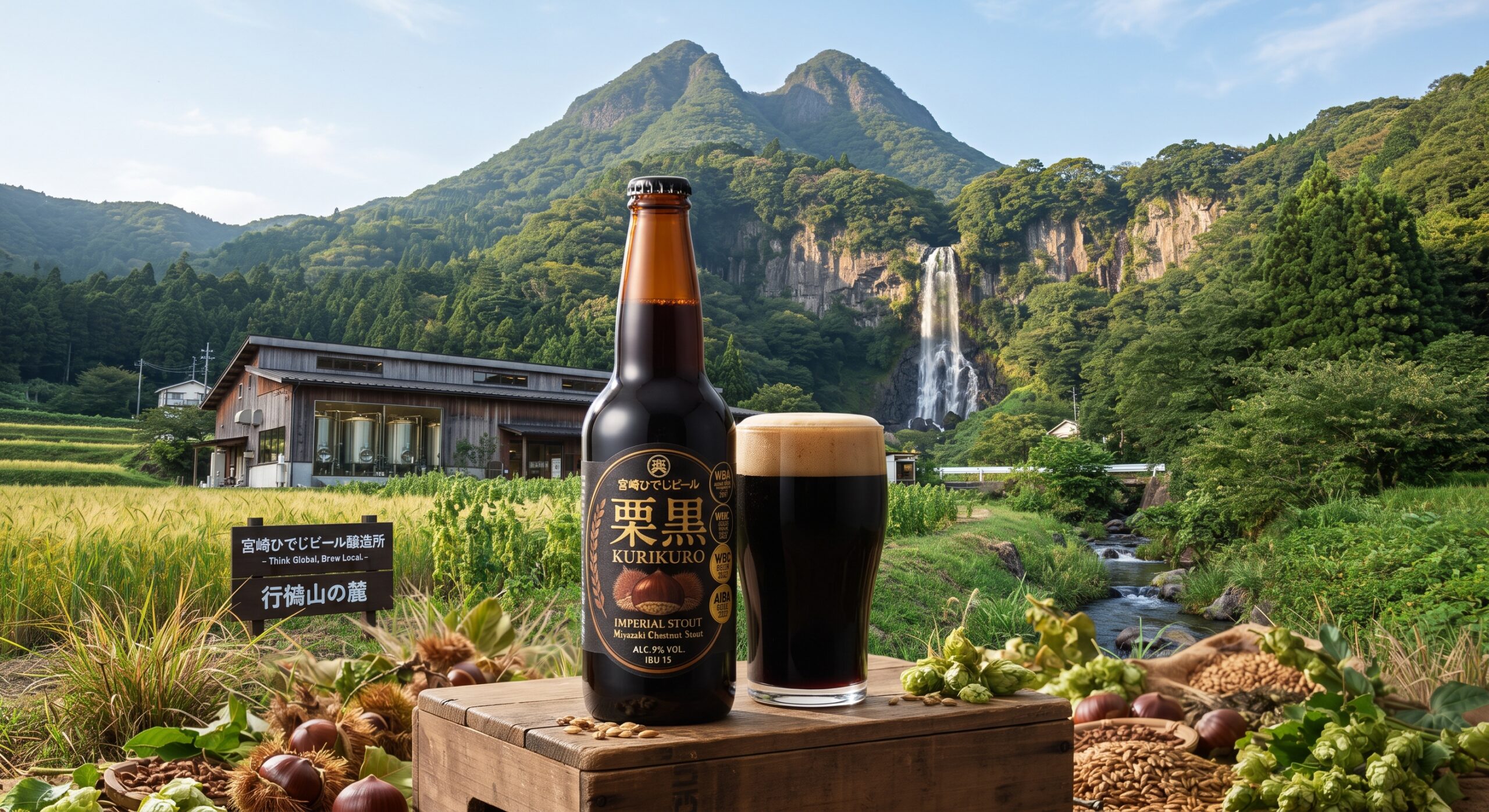
ブランド名の「ひでじ」は、人の名前です。1996年6月、酒税法の改正で小規模な醸造が解禁された「地ビール解禁」の時期に、すでに高齢だった西田英次(にしだ・ひでじ)氏が、宮崎県延岡市の行縢山(むかばきやま)の麓を切り開いて、醸造所とブルワリーレストランを立ち上げました。
ところが、その地ビールブームは数年で終わります。全国で撤退が相次いだ時期に、ひでじビールは品質を安定させるために工場をいったん解体し、配管の細部まで磨き上げ、指導者を招いてビール造りを一から見直すところから立て直しにかかりました。酵母ラボを設け、酵母の自家培養の技術まで自分たちのものにしています。
それでも、前社長の西田英敏氏を不慮の事故で失ったのち、「半年後に、ビール事業部を廃止する」という通告が届きます。当時ビール事業部を統括していた永野氏が選んだのは、従業員による買収(EBO)でした。2010年7月15日に宮崎ひでじビール株式会社を設立し、同年11月に株式会社ニシダからビール製造・販売部門を取得。ここから新生ひでじビールが始まります。
独立した直後、宮崎県は口蹄疫に見舞われました。公式サイトには、県東部の5町ですべての牛と豚がいなくなったと書かれています。翌2011年には新燃岳が噴火し、同じ年に鳥インフルエンザも発生しました。
その後に立ち上げたのが「宮崎農援プロジェクト」です。宮崎の農畜海産物を積極的に使った商品を企画・開発・ブランド化することで、県内の一次産業そのものを活気づけようという取り組みです。2006年から代表の永野氏がつぶやいていた「いつか宮崎県産だけで、ビールを造りたいね」という言葉から、宮崎ではほぼ0トンだった二条大麦の栽培を農家と一緒に始め、浸麦槽・乾燥機・脱根機といった製麦の機械まで地元で作って、自家製麦芽にたどり着きました。県産麦芽100%の「YAHAZU」は2023年、ワールド・ビア・アワードの日本大会で日本一に選ばれています。2016年からはホップの自社栽培にも取りかかり、国内の産地やドイツの専門家から「無理」と言われながら、2017年7月初旬に初収穫、その夏に初醸造までこぎつけました。
今回の「栗黒」は、その流れのなかから出てきた一本です。高温で乾燥させて黒くなるまで焙煎したローストバーレイに、宮崎県産の栗のペーストを仕込み原料として加えたインペリアルスタウト。アルコール分9%、IBUは15。コーヒーのような香ばしさと、栗の上品な香り、そして重厚なコクが同時に来ます。苦みの数値は意外なほど低く、黒ビールらしい香ばしさは焙煎から、飲みごたえはアルコールとコクから出ている造りです。
2017年、イギリスで開かれたワールド・ビア・アワードのスタウト&ポーター部門で、スタイル別・カテゴリー別の二つの世界一を受賞しました。RateBeerでは2018年・2019年・2020年と3年続けて日本最高評価、2022年にはアメリカ・ミネアポリスで開かれたワールドビアカップのスペシャリティビール部門で金賞、同じ年のオーストラリア・インターナショナル・ビア・アワードでも金賞を得ています。
そして、この一本はアルコール度数が高いぶん、数か月から数年の瓶熟成に耐えます。公式サイトには、熟成させると香り・旨み・アルコール分がビール全体になじみ、舌触りがよくなってまろやかな味わいへ変わっていくと書かれています。
土地の話
醸造所があるのは、行縢山の麓です。行縢山は標高831m。雄岳と雌岳という二つの岩峰を持ち、そのあいだに落差77mの行縢の滝がかかっています。日本の滝100選に選ばれた名瀑です。麓に鎮座する行縢神社は御鎮座1300年をこえる古社で、この滝そのものを御神体の一つとしています。ひでじビールが使うのは、この山の上質な天然水です。
延岡はまた、旭化成の企業城下町でもあります。ひでじビールがビールを仕込むタンクを地元で作れたのは、その延岡の中小企業が持つ高い技術に支えられてのことだと、公式サイトは書いています。山から湧く水と、街に積み上がった金属加工の技術。その両方が、同じ一杯の中に入っています。
会社の基本姿勢として掲げられているのは「Think Global, Brew Local.」という一文です。地球規模の視野で考え、地域の視点で動く。県産の大麦も、県産のホップも、県産の栗も、その姿勢の具体的な形として出てきたものでした。
音楽の話
「時代」は1975年12月21日、キャニオン・レコードから発売された中島みゆきのシングルです。作詞・作曲は中島みゆき本人、編曲は船山基紀。
中島みゆきは1952年2月23日、北海道札幌市生まれ。1975年9月に「アザミ嬢のララバイ」でレコードデビューしたばかりの、23歳でした。その年の10月、第10回ポピュラーソングコンテストのつま恋本選会で「時代」がグランプリを受賞。続く11月16日、日本武道館で開かれた第6回世界歌謡祭でも、同じ曲でグランプリに選ばれます。デビューから数か月のうちに、この曲は二つのコンテストの頂点に立ちました。シングルは20万枚のヒットとなり、のちに「日本の歌百選」にも選ばれています。
歌っているのは、めぐる時間のことです。別れと出逢いをくりかえしながら時代はまわっていくのだから、いま倒れて泣いている日も、めぐりめぐって、いつかは語れる過去に変わる――そういう歌です。1975年のコンテストの曲として消えるのではなく、半世紀たったいまも歌われ続けている理由は、たぶんそこにあります。
なぜこの組み合わせなのか
一度「終わり」を告げられた、というところが重なります。
ひでじビールは、半年後に事業部を廃止すると通告されました。それでも、造っている人たち自身が会社を買い取り、独立した直後に口蹄疫、翌年に噴火と鳥インフルエンザ、のちにはコロナ禍で6,000Lの「太陽のラガー」を捨てることになりながら、宮崎県産の栗を使った黒ビールで世界一まで行きました。造り続けた側が、結果として残っています。
「時代」も、まわって戻ってくることを歌った曲です。そして、この曲自体がまわり続けました。1975年のコンテストのための曲として終わらず、半世紀たったいまも歌われ続け、「日本の歌百選」にも選ばれました。
もう一つ重なるのは、時間が味方につく点です。栗黒は数か月から数年置くと、香りと旨みとアルコールが互いになじんで、角が取れてまろやかになります。造りたてがいちばんおいしい、という飲み物ではありません。「時代」が言っているのも、痛みそのものが消えるという話ではなく、時間が経てばそれが語れるものに変わっていくという話です。
どちらも、めぐりながらまろやかになるものです。9%ある黒ビールを小さなグラスでゆっくり飲みながらこの曲を聴くと、急がなくてよいのだと思えてきます。
この一杯を、探すなら
※楽天市場へのリンクは広告(アフィリエイト)です。醸造所がタップルームや直営店を持っている場合は、できたてを現地で味わうのが一番のおすすめです。
🌡️ おすすめの飲み方(温度とグラス):冷蔵庫から出して少し置き、10〜13℃で飲むのがおすすめです。冷やしすぎると、栗とローストの香りが閉じてしまいます。グラスは口がやや狭まる脚付きのチューリップ型(スニフター)に、一度に注ぎきらず少しずつ。アルコール分が9%あるので、小さなグラスで時間をかけるのがちょうどいい一本です。
合わせたい「アテ」
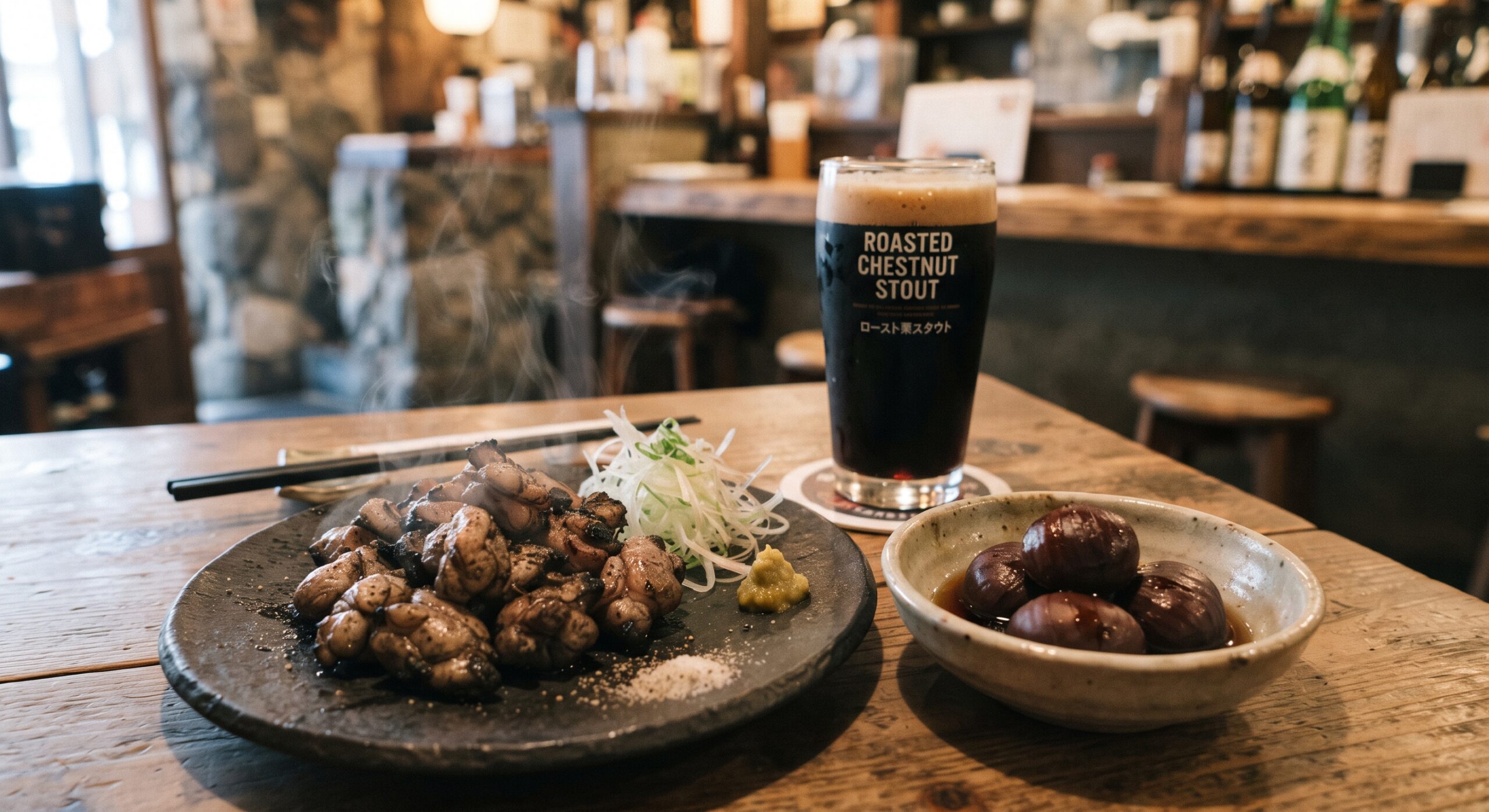
- みやざき地頭鶏の炭火焼
宮崎の定番の一皿。炭で一気に焼いた鶏の香ばしさが、ローストバーレイの焙煎香と同じ方向に響きます。タレより、塩だけで焼いたものの方がビールの栗の香りを邪魔しません。
- 栗の渋皮煮
栗に栗を重ねる形。渋皮に残るほのかな渋みが、深く焙煎した麦芽の渋みとつながるので、甘さだけが前に出ません。
科学的にひとこと:ローストバーレイの香ばしさは、麦を高温で焙煎するときに糖とアミノ酸が結びつく「メイラード反応」と、糖そのものが色づく「カラメル化」から生まれます。炭火で焼いた鶏の皮の焦げ目に出ているのも同じ反応なので、香りの系統がそろって厚みが増します。栗黒はIBU15と苦みが低いぶん、脂を流す役目は苦みではなく、炭酸とアルコール分9%が担います。渋皮煮の渋みはタンニンによるもので、深く焙煎した麦芽が持つ渋みと同じ方向に働くため、栗の甘さだけが浮かずに落ち着きます。
この醸造所をたずねるなら
醸造所は宮崎県延岡市むかばき町747-58、行縢山(むかばきやま)の麓にあります。JR延岡駅から車で約30分、東九州自動車道・延岡インターチェンジからは約20分。公共交通機関の場合は、宮崎交通バス「行縢山登山口」停留所から徒歩約7分です。
近くの観光スポット
- 行縢山・行縢の滝/延岡市|醸造所から車で約2分・約0.5km(歩いても約7分)
標高831mの行縢山。雄岳と雌岳という二つの岩峰のあいだに落差77mの行縢の滝がかかり、日本の滝100選に選ばれています。登山口から滝までは約60分。醸造所の最寄りバス停の名前が、そのまま「行縢山登山口」です。
- 行縢神社/延岡市行縢町|醸造所から車で約2分・約0.5km
行縢山の麓に鎮座する、御鎮座1300年をこえる古社。行縢の滝そのものを御神体の一つとしています。参拝時間は午前7時30分〜午後4時30分、参拝者用の駐車場は10台ほど。登山や滝を目指す場合は、その奥にある登山口の駐車場が案内されています。
※営業時間・定休日は変わることがあります。おでかけ前に各施設の公式情報をご確認ください。
ひとことメモ(ビールの用語)
- クラフトビール:小規模な醸造所が、造り手の個性を前面に出して仕込むビールの総称。大量生産の均一な味とは別の方向を目指しています。
- エール:常温に近い温度で、酵母が液面近くで働く「上面発酵」で造るビール。果実のような香りと厚みのある味わいが出やすいのが特徴です。
- スタウト:焙煎した大麦を使う黒いエール。コーヒーやチョコレートのような香ばしさと、なめらかな口当たりが特徴です。
- モルト:発芽させた大麦(麦芽)のこと。ビールの甘み・色・コクの土台になり、焙煎の深さで色と香ばしさが決まります。
- ABV:アルコール度数(Alcohol By Volume)のこと。ビールでは5%前後が標準で、8%を超えると飲みごたえのある「強め」の部類になります。
- IBU:苦みの強さを表す国際的な数値。10前後だとほとんど苦みを感じず、60を超えるとはっきり苦いIPAの領域です。
参考
内容に誤りがございましたら、お手数ですが info@soundrecords.jp までご連絡いただけますと幸いです。
Today’s Pairing
- Craft beer: Miyazaki Hideji Beer “Kuri Kuro” — Imperial Stout, brewed with roasted barley kiln-dried at high temperature until black, plus a paste of chestnuts grown in Miyazaki Prefecture added to the mash, 9% ABV, 15 IBU, 330ml / Miyazaki Hideji Beer Co., Ltd. (747-58 Mukabaki-cho, Nobeoka, Miyazaki)
Official site: https://hideji-beer.jp/
- Music: “Jidai” (“The Times”) by Miyuki Nakajima (1975)
YouTube: https://www.youtube.com/watch?v=aOOpDfmy7mw
▶ If the player above doesn’t play, open it on YouTube
The Story of the Brewery
The brand name “Hideji” is a person’s name. In June 1996, when a revision of the liquor tax law opened the door to small-scale brewing in Japan, Eiji “Hideji” Nishida — already an elderly man — cleared a patch of ground at the foot of Mt. Mukabaki in Nobeoka, Miyazaki, and set up a brewery and a brewpub restaurant.
That first local-beer boom, however, ended within a few years. As breweries pulled out across the country, Hideji Beer dismantled its own plant to stabilise quality, polished every last stretch of pipework, brought in an adviser and rebuilt its brewing from the ground up. It set up a yeast lab and made in-house yeast propagation part of its own skill set.
Even so, after losing its previous president, Eitoshi Nishida, in an accident, the company received notice that the beer division would be shut down in six months. Nagano, who headed that division at the time, chose an employee buy-out. Miyazaki Hideji Beer Co., Ltd. was founded on 15 July 2010, and in November of the same year it acquired the beer production and sales business from Nishida Co., Ltd. That is where the new Hideji Beer begins.
Right after becoming independent, Miyazaki was hit by foot-and-mouth disease. The brewery’s own site records that every cow and pig disappeared from five towns in the eastern part of the prefecture. The following year, 2011, Mt. Shinmoedake erupted, and avian influenza broke out in the same year.
What came next was the “Miyazaki Agricultural Support Project” — planning, developing and branding products that make active use of Miyazaki’s farm, livestock and seafood produce, in order to energise the prefecture’s primary industries themselves. From a remark company president Nagano had been repeating since 2006 — “one day I’d like to brew a beer entirely from Miyazaki ingredients” — the brewery started growing two-row barley with local farmers, in a prefecture where production had been close to zero tonnes, and even had the malting equipment (steeping tanks, kilns, de-rooting machines) built locally until it reached its own house malt. “YAHAZU,” made with 100% Miyazaki malt, was named the best in Japan at the World Beer Awards’ Japanese round in 2023. From 2016 the brewery also took on growing its own hops; told it was impossible by experts both in Japan’s hop regions and in Germany, it got to a first harvest in early July 2017 and a first brew that same summer.
“Kuri Kuro” came out of that current. It is an imperial stout built on roasted barley kiln-dried at high temperature until black, with a paste of Miyazaki-grown chestnuts added to the mash: 9% ABV, 15 IBU. Coffee-like toastiness, the refined aroma of chestnut and a heavy, deep body all arrive together. The bitterness number is surprisingly low — the dark-beer toastiness comes from the roast, and the drinking heft comes from alcohol and body.
In 2017 it took two world titles at the World Beer Awards in the UK, winning both the style and the category in Stout & Porter. It was rated the best in Japan on RateBeer three years running, in 2018, 2019 and 2020; in 2022 it won gold in the speciality beer category at the World Beer Cup in Minneapolis, and gold at the Australian International Beer Awards the same year.
Because the alcohol runs high, this bottle also stands up to months or even years of ageing. The official site notes that with age the aroma, flavour and alcohol settle into the beer as a whole, the mouthfeel smooths out, and the taste turns mellower.
The Story of the Land
The brewery sits at the foot of Mt. Mukabaki, 831 meters high, with two rock peaks — Odake and Medake — and Mukabaki Falls dropping 77 meters between them. The falls are one of Japan’s “100 Best Waterfalls.” Mukabaki Shrine, at its foot, has been enshrined here for more than 1,300 years and treats the waterfall itself as one of its sacred bodies. The water Hideji brews with is this mountain’s natural water.
Nobeoka is also a company town built around Asahi Kasei. The brewery’s own site says the reason it could have its brewing tanks made locally was the high level of skill held by Nobeoka’s small and mid-sized manufacturers. Water welling out of the mountain, and metalworking expertise accumulated in the town: both of them end up inside the same glass.
The company’s stated stance is a single line — “Think Global, Brew Local.” Think on a global scale, act from a local point of view. The prefecture’s barley, the prefecture’s hops and the prefecture’s chestnuts are all concrete shapes that stance has taken.
The Story of the Song
“Jidai” was released on 21 December 1975 by Canyon Records, a single by Miyuki Nakajima. She wrote both the words and the music; Motoki Funayama arranged it.
Nakajima was born on 23 February 1952 in Sapporo, Hokkaido. She had only just made her recording debut in September 1975 with “Azami Jo no Lullaby,” and she was 23. That October, “Jidai” won the grand prize at the 10th Popular Song Contest finals at Tsumagoi. Then on 16 November, at the 6th World Popular Song Festival held at Nippon Budokan, the same song won the grand prize again. Within a few months of her debut, this one song had taken the top of two contests. The single sold 200,000 copies, and it was later chosen for Japan’s “100 Songs of Japan” list.
What it sings about is circling time. The times keep turning through partings and meetings, so even a day when you have fallen down and are crying will, in time, come around into something you can talk about. That is the song. The reason it didn’t end as a newcomer’s contest piece from 50 years ago, and is still sung today, probably lies right there.
Why This Pairing
What overlaps is that both were once told they were finished.
Hideji Beer was given notice that its division would be closed in six months. The people actually making the beer bought the company instead — and then met foot-and-mouth disease right after going independent, an eruption and avian influenza the next year, and later a pandemic that forced them to dump 6,000 litres of their “Taiyo no Lager.” They kept brewing, and they are the ones still here, having gone all the way to a world title with a dark beer made from Miyazaki chestnuts.
“Jidai” is a song about things coming back around, and the song itself kept coming around. It did not end as a piece written for a 1975 contest; half a century on, it is still being sung.
The other overlap is that time works in their favour. Left for months or years, Kuri Kuro lets its aroma, flavour and alcohol settle into one another, and the edges come off. This is not a drink that is at its best the day it is made. What “Jidai” says isn’t that the pain disappears either — it is that, given time, it turns into something you can speak of.
Both mellow as they come around. Drinking a 9% stout slowly from a small glass while this song plays, you start to feel there is no need to hurry.
Where to Find This Beer
The Rakuten Ichiba link below is an affiliate link.
These are Japanese storefronts. If you are visiting the brewery, drinking it fresh at their own taproom is by far the best option.
🌡️ How to serve it:Take it out of the fridge and let it sit a moment — around 10–13°C is ideal. Too cold and the chestnut and roast aromas close up. Use a stemmed tulip glass or snifter that narrows slightly at the rim, and pour a little at a time rather than emptying the bottle at once. At 9% ABV, this is a bottle to take slowly from a small glass.
Pairing Dishes Worth Trying
- Charcoal-grilled Miyazaki jitokko chicken
A Miyazaki staple. The toastiness of chicken seared fast over charcoal runs in the same direction as the roasted barley’s aroma. Grilled with just salt, rather than a sweet sauce, it stays out of the way of the beer’s chestnut note.
- Chestnuts simmered in their inner skins (shibukawa-ni)
Chestnut on chestnut. The faint astringency left in the inner skin links up with the astringency of deeply roasted malt, so the sweetness never dominates.
A note on the science: roasted barley’s toastiness comes from the Maillard reaction, where sugars and amino acids bond as the grain is kilned at high temperature, and from caramelisation, where the sugars themselves colour. The char on charcoal-grilled chicken skin is the product of the same reactions, so the aroma families line up and gain depth. At 15 IBU, Kuri Kuro is low in bitterness, so the job of cutting through fat falls not to bitterness but to carbonation and 9% alcohol. The astringency in shibukawa-ni comes from tannins, working in the same direction as the astringency of heavily roasted malt, which keeps the chestnut sweetness from floating off on its own.
Visiting the Brewery
The brewery sits at 747-58 Mukabaki-cho, Nobeoka, Miyazaki, at the foot of Mt. Mukabaki. It is about 30 minutes by car from JR Nobeoka Station and about 20 minutes from the Nobeoka interchange on the Higashi-Kyushu Expressway. By public transport, it is a seven-minute walk from the Miyazaki Kotsu bus stop named “Mukabaki-zan Tozanguchi” (Mt. Mukabaki trailhead).
Sights Nearby
- Mt. Mukabaki and Mukabaki Falls / Nobeoka | about 2 min by car, about 0.5 km from the brewery (about a 7-minute walk)
Mt. Mukabaki rises 831 meters, and between its two rock peaks — Odake and Medake — Mukabaki Falls drops 77 meters, one of Japan’s “100 Best Waterfalls.” The falls are about 60 minutes on foot from the trailhead. The brewery’s nearest bus stop is literally named after that trailhead.
- Mukabaki Shrine / Mukabaki-cho, Nobeoka | about 2 min by car, about 0.5 km from the brewery
An old shrine at the foot of Mt. Mukabaki, enshrined here for more than 1,300 years. Mukabaki Falls itself is treated as one of its sacred bodies. Open for worship from 7:30 a.m. to 4:30 p.m., with parking for about ten cars; hikers and those heading for the falls are directed to the trailhead car park further up.
Opening hours and closing days can change. Please check each facility’s official information before visiting.
A Quick Glossary of Beer Terms
- Craft beer: Beer made by small breweries that put the character of the maker front and centre, as opposed to the uniformity of mass production.
- Ale: Beer made by top fermentation, where the yeast works near the surface at temperatures closer to room temperature. It tends to show fruity aromas and a fuller body.
- Stout: A dark ale made with roasted barley, marked by coffee- or chocolate-like toastiness and a smooth mouthfeel.
- Malt: Germinated barley (or wheat). It forms the foundation of a beer’s sweetness, colour and body; how deeply it is roasted determines colour and toastiness.
- ABV: Alcohol By Volume. Beer typically runs around 5%; above 8% is considered strong.
- IBU: An international measure of bitterness. Around 10 you barely notice it; above 60 you are in clearly bitter IPA territory.
Sources
If you notice any errors in this article, please don’t hesitate to reach out at info@soundrecords.jp.
コメントを残す