今日のペアリング
▶ 上のプレーヤーで再生できない場合は、YouTubeで開く
酒蔵の話
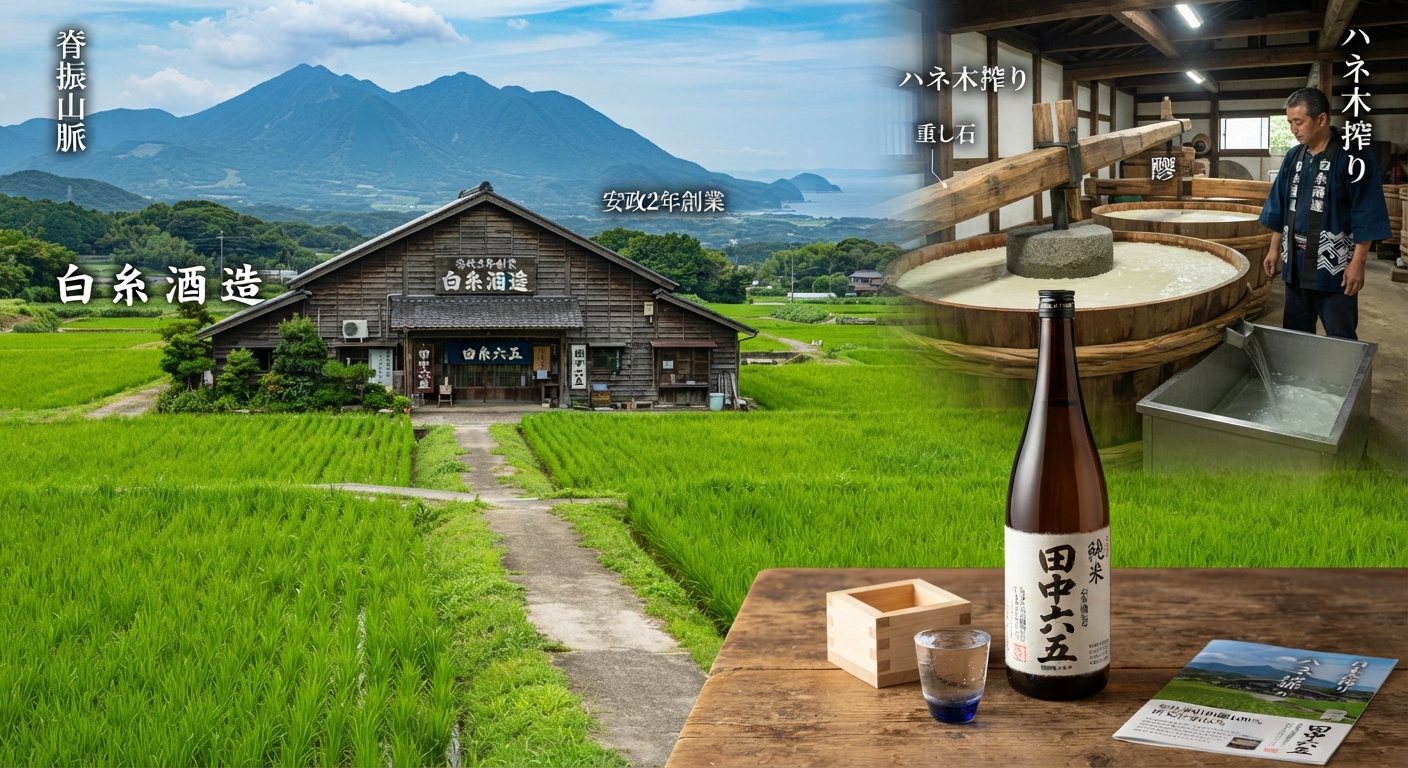
有限会社白糸酒造は、安政2年(1855年)創業。福岡県の西に位置する糸島市の、脊振山脈のふもとに広がる田園地帯に蔵を構えています。現在は8代目・田中克典氏が代表取締役を務めています。蔵の周りは山田錦の田んぼに囲まれ、名勝「白糸の滝」からの伏流水を仕込み水として使える立地に恵まれました。平成元年(1989年)からは、地元・糸島産の山田錦だけを使った酒造りを始めています。
代表銘柄「田中六五」は、8代目・田中克典氏が中心となって立ち上げたブランドです。名前は蔵元の姓「田中」と、「田んぼの中で醸される酒」という意味、そして糸島産山田錦を精米歩合65%で仕込むという数字を組み合わせたもの。大吟醸でも吟醸でもなく、日常的に飲んでもらえる純米酒一本に絞り込んだのは、「オンリーワンでもなく、ナンバーワンでもなく、定番」という蔵の言葉どおり、福岡の食卓でごく自然に親しまれる酒を目指したためです。搾りには、1本の木と重し石の重さで醪をゆっくり搾る「ハネ木搾り」という昔ながらの上槽法を用いており、2016年の蔵の改修では、この伝統的な木造の搾り場を残しながら、味を数値で把握できる新しい設備も導入されました。
土地の話
糸島市は福岡市の西隣、北に玄界灘、南に脊振山脈を望む半島の街です。酒米の最高峰とされる山田錦の産地としては全国でも有数で、その生産量は上位5指に入ります。白糸酒造はそんな山田錦の田んぼに囲まれ、蔵の名の由来である「白糸の滝」の伏流水を使える立地に恵まれました。蔵からは西九州自動車道の前原ICまで車で約5分、JR筑肥線の筑前前原駅までもバスですぐという、酒どころとして便利な場所にあります。
近年の糸島市は、海沿いのカフェやビーチが若い世代に人気を集める観光地としても知られるようになりましたが、白糸酒造が蔵を構える南部は、昔ながらの田園風景が広がるエリアです。新緑の季節、蔵の周辺は山田錦の苗の緑に染まり、それが酒造りの始まりを告げる合図になると、蔵元自身が公式サイトで紹介しています。
音楽の話
「博多ブルース」は1964年11月発売、西田佐知子のシングルレコード(発売元:ポリドール・レコード、現ユニバーサルミュージック、品番SDR-1037)。作詞は水木かおる、作曲・編曲は藤原秀行、演奏はポリドール・オーケストラです。同年1月に発売された「東京ブルース」の大ヒットを受けて生まれた「ご当地ブルース」群の一曲で、作詞・作曲のコンビは「東京ブルース」と同じ顔ぶれ。B面には同じコンビが手がけた「京都ブルース」を収め、博多(福岡市)と京都という西日本の2都市を歌ったシングルとして送り出されました。A面「博多ブルース」の収録時間は3分25秒です。
西田佐知子は1939年、大阪府大阪市城東区生まれ。1956年に「伊那の恋唄」でデビューし、1961年のヒット曲「コーヒールンバ」で広く名を知られるようになりました。翌1962年発売の「アカシアの雨がやむとき」は、村田英雄「王将」とともに第4回日本レコード大賞特別賞を受賞し、彼女の代表作となっています。「博多ブルース」は、そうした看板曲の陰に隠れがちな一曲ですが、同じ黄金コンビが手がけた確かな作りの「ご当地ソング」として、2000年代に入ってからのベストアルバムにも繰り返し収められています。1967年にはレコード売上1000万枚を突破し、1971年に俳優の関口宏と結婚したのを機に芸能活動を大きく縮小、1982年発売の「テレビを見ている女」が最後のシングルとなりました。
なぜこの組み合わせなのか
「田中六五」という酒が目指したのは、大吟醸のような特別な一本ではなく、「オンリーワンでもなく、ナンバーワンでもなく、定番」という立ち位置でした。精米歩合を65%に定め、純米酒一本に絞り込んだのは、華やかさよりも、日々の食卓にごく自然に置いてもらえることを選んだからです。
「博多ブルース」もまた、西田佐知子の代表作としてまず名前が挙がる曲ではありません。「コーヒールンバ」や「アカシアの雨がやむとき」のような看板曲の陰に隠れがちな一曲です。それでも「東京ブルース」を手がけた同じ作詞・作曲コンビによる確かな仕事ぶりは、発売から半世紀以上経った2000年代のベストアルバムにも収められ続けるという形で、静かに評価され続けてきました。
一番を目指すのではなく、日々のそばにあり続けることを選んだ酒と、看板曲の座を競うのではなく、確かな仕事として長く聴き継がれてきた曲。どちらも、派手な一番よりも、長く隣にいることを選んだ物語だと言えるかもしれません。
この一本を、探すなら
※楽天市場へのリンクは広告(アフィリエイト)です。在庫・取扱いは変動します。お近くの酒販店でも、ぜひ銘柄名を伝えて探してみてください。
🌡️ おすすめの飲み方:冷や(常温よりやや低め)で。米の旨みをまっすぐ感じられる食中酒なので、よく冷やしすぎるよりも、旨みののった温度で合わせるのがおすすめです。
合わせたい「アテ」
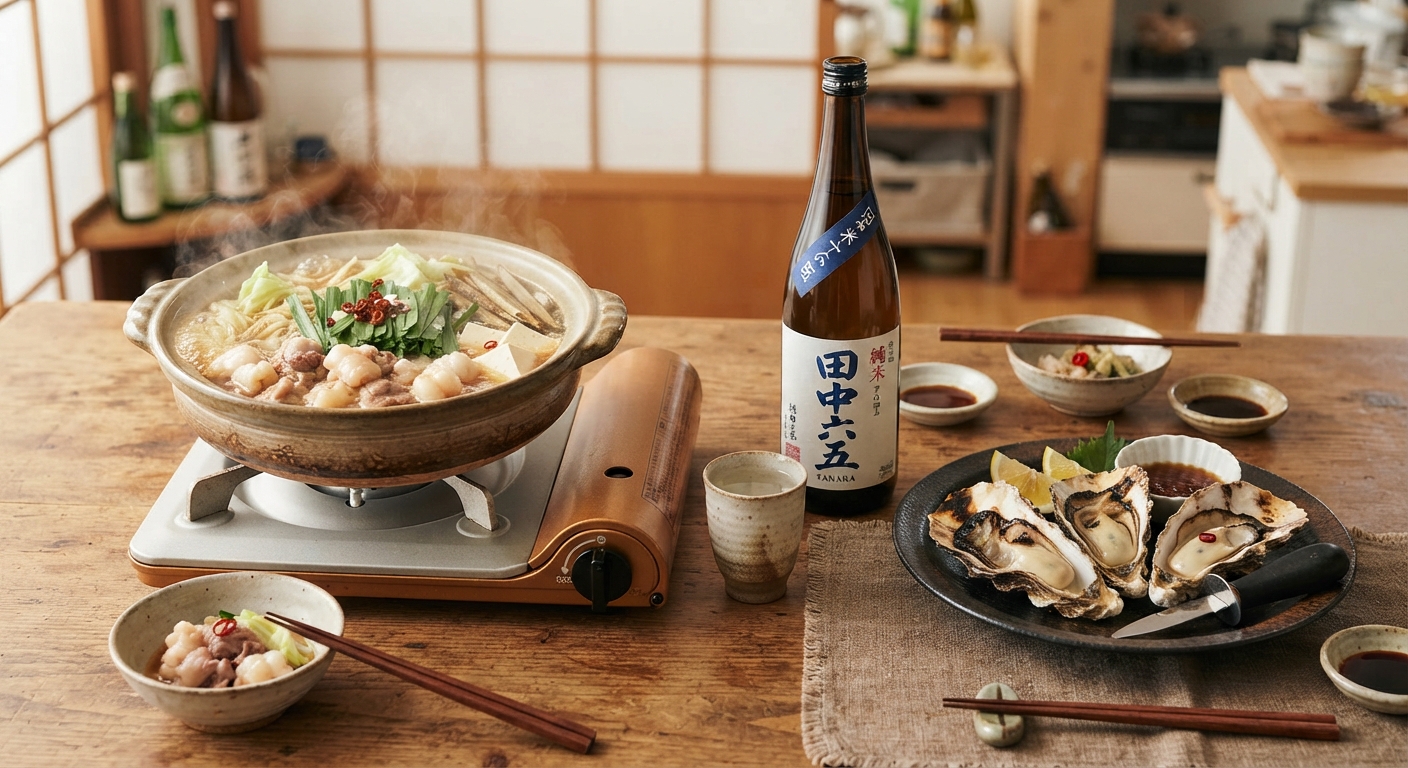
- 博多もつ鍋
博多を代表するソウルフード。醤油ベースのだしで牛ホルモンと野菜をじっくり煮込む、飾らない家庭の味です。「日常に馴染む食中酒」を目指した田中六五の旨みが、もつの脂とだしの旨みにまっすぐ寄り添います。
レシピはこちら:クラシル「最後まで美味しい!醤油ベースのもつ鍋」
- 糸島産牡蠣の殻付き焼き牡蠣
糸島半島は10月から3月にかけて牡蠣小屋が並ぶ、冬の牡蠣の名産地。蔵と同じ土地で育った牡蠣を、シンプルに殻付きのまま焼いて味わいます。
レシピはこちら:クラシル「トースターで作る殻付き焼き牡蠣」
科学的にひとこと:牡蠣に含まれるグリコーゲンやコハク酸などの旨み成分は、日本酒のアミノ酸系の旨味と重なり合うことで、口の中での旨味の相乗効果を生み出します。もつ鍋の醤油だしに使われる発酵調味料の香気成分も、純米酒の穏やかな香りと自然になじみ合う組み合わせです。
この蔵をたずねるなら
白糸酒造
福岡県糸島市本1986/JR筑肥線・筑前前原駅南口からバス(白糸線)で「本区」下車徒歩約1分、西九州自動車道 前原ICから車で約5分。
酒蔵見学は受け付けていませんが、蔵の名の由来となった「白糸の滝」をはじめ、糸島半島の観光スポットが車ですぐの距離に集まっています。
近くの観光スポット
- 白糸の滝/糸島市白糸|白糸酒造から車で約15分・約9km
落差24mの滝で、その伏流水はまさに白糸酒造の仕込み水。蔵の名前の由来にもなっている場所です。周辺の「ふれあいの里」は施設改修のため2025年11月〜2026年3月上旬まで一部休業していましたが、現在は営業を再開しています。駐車場約200台。
- 雷山千如寺大悲王院/糸島市雷山|白糸酒造から車で約15分・約8km
樹齢400年の大カエデ(県指定天然記念物)で知られる古刹。拝観時間9:00〜16:30、拝観料500円。紅葉の見頃は例年11月中旬です。
近くの温泉
- 二丈温泉 きららの湯/糸島市二丈深江|白糸酒造から車で約15分・約8km
糸島市内で唯一の天然温泉を使った日帰り入浴施設。営業時間10:00〜21:00(受付20:30まで)、定休日は第3火曜日。露天風呂やサウナも完備しています。
※営業時間・定休日・日帰り入浴の可否は変わることがあります。おでかけ前に各施設の公式情報をご確認ください。
ひとことメモ(日本酒の用語)
- 純米酒:米・米麹・水だけで造られ、醸造アルコールを添加していない日本酒。米の旨みをまっすぐ感じられるのが特徴です。
- 精米歩合:玄米を削り、残った部分の割合。数値が低いほど、米を多く磨いていることを示します。
参考
内容に誤りがございましたら、お手数ですが info@soundrecords.jp までご連絡いただけますと幸いです。
Today’s Pairing
- Sake: Tanaka Rokujugo — Junmai (sake made only from rice, rice koji, and water, with no added brewing alcohol), brewed entirely with Itoshima-grown Yamada Nishiki rice, seimai buai (rice-polishing ratio) 65% / Shiraito Sake Brewery Co., Ltd. (1986 Hon, Itoshima City, Fukuoka Prefecture)
Official site: http://www.shiraito.com/
- Kayoukyoku (classic Japanese popular song): “Hakata Blues” by Nishida Sachiko, 1964
YouTube: https://www.youtube.com/watch?v=mDRyuHy9_mc
▶ If the player above doesn’t play, open it on YouTube
The Story of the Brewery
Shiraito Sake Brewery Co., Ltd. was founded in 1855. Its brewhouse sits in the farmland at the foot of the Sefuri mountain range, in Itoshima City on the western edge of Fukuoka Prefecture. Today it’s led by its eighth-generation head, Tanaka Katsunori. Surrounded by rice paddies growing Yamada Nishiki — sake brewing’s most prized rice variety — the brewery is blessed with brewing water drawn from the underground flow of the nearby Shiraito Falls, a local scenic spot. Since 1989, it has brewed exclusively with Yamada Nishiki grown right there in Itoshima.
Its flagship label, Tanaka Rokujugo, was created under the direction of Tanaka Katsunori. The name combines the family name “Tanaka,” a nod to the meaning “brewed in the middle of a rice paddy” (ta no naka), and the number 65, for the seimai buai used to mill the Itoshima Yamada Nishiki. Rather than a Daiginjo or Ginjo, the brewery settled on a single Junmai sake meant for everyday drinking — true, as the brewery itself puts it, to the goal of being “not one of a kind, not the number one, but the standard” people reach for naturally at the Fukuoka table. The sake is pressed using hanegi-shibori, a traditional method that slowly presses the mash using the weight of a single wooden beam and hanging stones. When the brewery was renovated in 2016, this traditional wooden pressing space was preserved, while new equipment that quantifies flavor as data was added alongside it.
The Story of the Land
Itoshima City sits just west of Fukuoka City, a peninsula town facing the Genkai Sea to the north and the Sefuri mountains to the south. It’s one of Japan’s leading production areas for Yamada Nishiki, ranking among the top five nationwide by volume. Shiraito Brewery sits amid those very rice paddies, blessed with water from the underground flow of Shiraito Falls, the waterfall its name comes from. It’s a convenient location for a brewery, too — about 5 minutes by car from Maebaru IC on the Nishi-Kyushu Expressway, and a short bus ride from JR Chikuzen-Maebaru Station.
In recent years, Itoshima has become known as a destination in its own right, with seaside cafes and beaches drawing a younger crowd. But the southern part of the city, where Shiraito Brewery stands, remains a landscape of quiet rice paddies. In the season of new green leaves, the brewery’s surroundings turn the fresh green of young Yamada Nishiki seedlings — a sign, as the brewery describes it on its own site, that another year of sake brewing is about to begin.
The Story of the Song
“Hakata Blues” was released in November 1964 as a single by Nishida Sachiko (released by Polydor Records, now part of Universal Music; catalog number SDR-1037). The lyrics are by Mizuki Kaoru, the music and arrangement by Fujiwara Hideyuki, performed with the Polydor Orchestra. It was one of a wave of “local blues” songs that followed the massive hit “Tokyo Blues,” released the same year in January — written by the very same songwriting duo. The B-side, “Kyoto Blues,” was written by the same pair as well, making this a single built around two western Japanese cities, Hakata (Fukuoka City) and Kyoto. The A-side, “Hakata Blues,” runs 3 minutes and 25 seconds.
Nishida Sachiko was born in 1939 in Joto Ward, Osaka City. She debuted in 1956 with “Ina no Koiuta,” and rose to wide fame with her 1961 hit “Coffee Rumba.” The following year’s “Akashia no Ame ga Yamu Toki” (“When the Acacia Rain Stops”), released in 1962, won the Special Award at the 4th Japan Record Awards (shared with Murata Hideo’s “Osho”) and remains her signature song. “Hakata Blues” tends to live in the shadow of those marquee hits, but as a solidly crafted “local song” from the same hit-making duo, it has kept finding its way onto her best-of compilations well into the 2000s. She surpassed 10 million records sold in 1967, scaled back her entertainment career significantly after marrying actor Sekiguchi Hiroshi in 1971, and released her final single, “Terebi wo Miteiru Onna,” in 1982.
Why This Pairing
What Tanaka Rokujugo set out to be wasn’t a showcase Daiginjo, but, in the brewery’s own words, “not one of a kind, not the number one, but the standard.” Settling on a 65% seimai buai and a single Junmai sake was a choice for a natural place at the everyday table over flashiness.
“Hakata Blues,” too, isn’t the first song that comes to mind among Nishida Sachiko’s signature works. It tends to live in the shadow of marquee hits like “Coffee Rumba” or “Akashia no Ame ga Yamu Toki.” And yet the sure craftsmanship of the same songwriting duo behind “Tokyo Blues” has earned it a quiet, lasting recognition — still finding a place on best-of compilations released more than fifty years after it first came out.
A sake that chose to stay close to everyday life rather than chase the top spot, and a song that has been kept alive as solid, dependable work rather than compete for marquee status. Perhaps both are stories about choosing to stay close for the long run, rather than chase the flashiest spot for a moment.
Where to Find This Bottle
The Rakuten Ichiba link below is an affiliate link.
Note: the links above lead to Japan-based retailers. They’re most convenient for readers in Japan, or for those elsewhere who are able to arrange international shipping. Stock and availability change over time, so if you’re near a specialty sake shop, it’s well worth asking for this label by name.
🌡️ Recommended way to drink it: Cool (a little below room temperature). This is a food-friendly sake meant to carry the rice’s umami straight through, so serving it just cool — rather than icy cold — lets that umami show best.
Pairing Dishes Worth Trying
- Hakata motsunabe (offal hot pot)
Hakata’s quintessential soul food: beef offal and vegetables simmered slowly in a soy-based broth, an unpretentious home-style dish. The umami of Tanaka Rokujugo, brewed to be an everyday companion at the table, sits naturally alongside the richness of the offal and broth.
Recipe (in Japanese): Kurashiru, “Soy-Based Motsunabe That’s Delicious to the Last Bite”
- Grilled Itoshima oysters, in the shell
From October to March, the Itoshima Peninsula fills with seasonal oyster huts — a winter specialty of the very land this sake is brewed on. Simply grilled in the shell, the oysters need nothing more.
Recipe (in Japanese): Kurashiru, “Shell-On Grilled Oysters in a Toaster Oven”
A note on the science: umami compounds in oysters, such as glycogen and succinic acid, resonate with the amino-acid umami in sake, creating a synergistic boost of savoriness on the palate. The aromatic compounds from the fermented soy-based seasonings in motsunabe broth also blend naturally with the gentle aroma of a junmai sake.
Visiting the Brewery
Shiraito Sake Brewery
1986 Hon, Itoshima City, Fukuoka Prefecture. About a 1-minute walk from the “Honku” bus stop (Shiraito line) from the south exit of JR Chikuzen-Maebaru Station; about 5 minutes by car from Maebaru IC on the Nishi-Kyushu Expressway.
The brewery itself isn’t open for tours, but several of the Itoshima Peninsula’s sights — including the waterfall the brewery is named after — are just a short drive away.
Sights Nearby
- Shiraito Falls / Shiraito, Itoshima | ~15 min, ~9 km by car from the brewery
A 24-meter waterfall whose underground spring water is the very water Shiraito Brewery uses to brew its sake — and the source of the brewery’s name. The visitor facilities nearby were partly closed for renovation from November 2025 to early March 2026, but have since reopened. Parking for about 200 cars.
- Raizan Sennyoji Daihioin Temple / Raizan, Itoshima | ~15 min, ~8 km by car from the brewery
An old temple known for a roughly 400-year-old maple tree, a prefecture-designated natural monument. Open 9:00–16:30, admission ¥500. Best foliage is usually mid-November.
Hot Springs Nearby
- Nijo Onsen Kiraranoyu / Nijo-Fukae, Itoshima | ~15 min, ~8 km by car from the brewery
Itoshima’s only day-use bathhouse drawing on a natural hot spring. Open 10:00–21:00 (last entry 20:30), closed on the third Tuesday of the month. Includes an open-air bath and sauna.
Opening hours, closing days and day-use bathing availability can change. Please check each facility’s official information before visiting.
A Quick Glossary of Sake Terms
- Junmai: Sake made only from rice, rice koji, and water, with no added brewing alcohol. Lets the umami of the rice come through directly.
- Seimai buai (rice-polishing ratio): The percentage of the original grain remaining after milling. The lower the number, the more the rice has been polished down.
Sources
If you notice any errors in this article, please don’t hesitate to reach out at info@soundrecords.jp.
コメントを残す