日本語で読む | This is the English version of a bilingual article.
Today’s Pairing
- Sake: Tanaka Rokujugo — Junmai (sake made only from rice, rice koji, and water, with no added brewing alcohol), brewed entirely with Itoshima-grown Yamada Nishiki rice, seimai buai (rice-polishing ratio) 65% / Shiraito Sake Brewery Co., Ltd. (1986 Hon, Itoshima City, Fukuoka Prefecture)
Official site: http://www.shiraito.com/ - Kayoukyoku (classic Japanese popular song): “Hakata Blues” by Nishida Sachiko, 1964
YouTube: https://www.youtube.com/watch?v=mDRyuHy9_mc
▶ If the player above doesn’t play, open it on YouTube
The Story of the Brewery
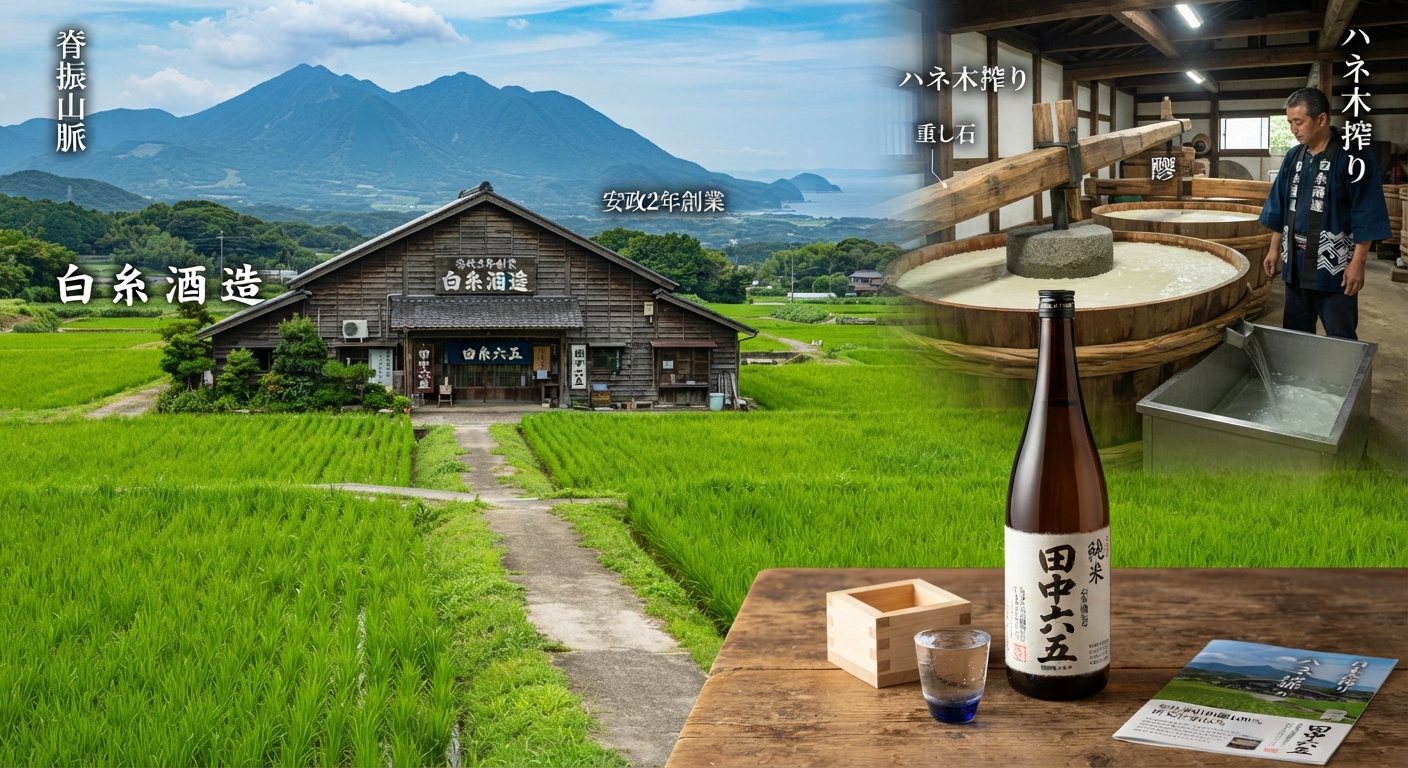
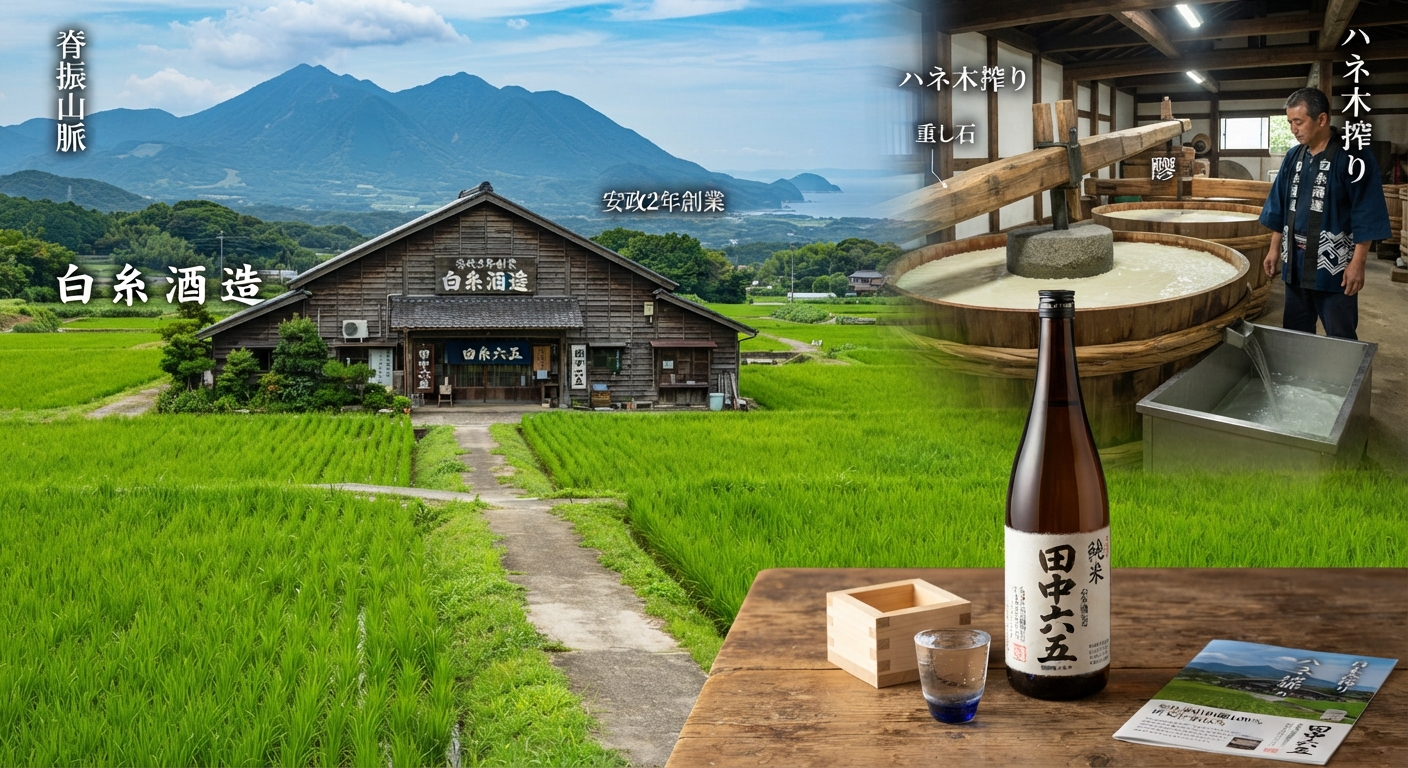
Shiraito Sake Brewery Co., Ltd. was founded in 1855. Its brewhouse sits in the farmland at the foot of the Sefuri mountain range, in Itoshima City on the western edge of Fukuoka Prefecture. Today it’s led by its eighth-generation head, Tanaka Katsunori. Surrounded by rice paddies growing Yamada Nishiki — sake brewing’s most prized rice variety — the brewery is blessed with brewing water drawn from the underground flow of the nearby Shiraito Falls, a local scenic spot. Since 1989, it has brewed exclusively with Yamada Nishiki grown right there in Itoshima.
Its flagship label, Tanaka Rokujugo, was created under the direction of Tanaka Katsunori. The name combines the family name “Tanaka,” a nod to the meaning “brewed in the middle of a rice paddy” (ta no naka), and the number 65, for the seimai buai used to mill the Itoshima Yamada Nishiki. Rather than a Daiginjo or Ginjo, the brewery settled on a single Junmai sake meant for everyday drinking — true, as the brewery itself puts it, to the goal of being “not one of a kind, not the number one, but the standard” people reach for naturally at the Fukuoka table. The sake is pressed using hanegi-shibori, a traditional method that slowly presses the mash using the weight of a single wooden beam and hanging stones. When the brewery was renovated in 2016, this traditional wooden pressing space was preserved, while new equipment that quantifies flavor as data was added alongside it.
The Story of the Land
Itoshima City sits just west of Fukuoka City, a peninsula town facing the Genkai Sea to the north and the Sefuri mountains to the south. It’s one of Japan’s leading production areas for Yamada Nishiki, ranking among the top five nationwide by volume. Shiraito Brewery sits amid those very rice paddies, blessed with water from the underground flow of Shiraito Falls, the waterfall its name comes from. It’s a convenient location for a brewery, too — about 5 minutes by car from Maebaru IC on the Nishi-Kyushu Expressway, and a short bus ride from JR Chikuzen-Maebaru Station.
In recent years, Itoshima has become known as a destination in its own right, with seaside cafes and beaches drawing a younger crowd. But the southern part of the city, where Shiraito Brewery stands, remains a landscape of quiet rice paddies. In the season of new green leaves, the brewery’s surroundings turn the fresh green of young Yamada Nishiki seedlings — a sign, as the brewery describes it on its own site, that another year of sake brewing is about to begin.
The Story of the Song
“Hakata Blues” was released in November 1964 as a single by Nishida Sachiko (released by Polydor Records, now part of Universal Music; catalog number SDR-1037). The lyrics are by Mizuki Kaoru, the music and arrangement by Fujiwara Hideyuki, performed with the Polydor Orchestra. It was one of a wave of “local blues” songs that followed the massive hit “Tokyo Blues,” released the same year in January — written by the very same songwriting duo. The B-side, “Kyoto Blues,” was written by the same pair as well, making this a single built around two western Japanese cities, Hakata (Fukuoka City) and Kyoto. The A-side, “Hakata Blues,” runs 3 minutes and 25 seconds.
Nishida Sachiko was born in 1939 in Joto Ward, Osaka City. She debuted in 1956 with “Ina no Koiuta,” and rose to wide fame with her 1961 hit “Coffee Rumba.” The following year’s “Akashia no Ame ga Yamu Toki” (“When the Acacia Rain Stops”), released in 1962, won the Special Award at the 4th Japan Record Awards (shared with Murata Hideo’s “Osho”) and remains her signature song. “Hakata Blues” tends to live in the shadow of those marquee hits, but as a solidly crafted “local song” from the same hit-making duo, it has kept finding its way onto her best-of compilations well into the 2000s. She surpassed 10 million records sold in 1967, scaled back her entertainment career significantly after marrying actor Sekiguchi Hiroshi in 1971, and released her final single, “Terebi wo Miteiru Onna,” in 1982.
Why This Pairing
What Tanaka Rokujugo set out to be wasn’t a showcase Daiginjo, but, in the brewery’s own words, “not one of a kind, not the number one, but the standard.” Settling on a 65% seimai buai and a single Junmai sake was a choice for a natural place at the everyday table over flashiness.
“Hakata Blues,” too, isn’t the first song that comes to mind among Nishida Sachiko’s signature works. It tends to live in the shadow of marquee hits like “Coffee Rumba” or “Akashia no Ame ga Yamu Toki.” And yet the sure craftsmanship of the same songwriting duo behind “Tokyo Blues” has earned it a quiet, lasting recognition — still finding a place on best-of compilations released more than fifty years after it first came out.
A sake that chose to stay close to everyday life rather than chase the top spot, and a song that has been kept alive as solid, dependable work rather than compete for marquee status. Perhaps both are stories about choosing to stay close for the long run, rather than chase the flashiest spot for a moment.
Where to Find This Bottle
The Rakuten Ichiba link below is an affiliate link.
- Brewery’s official site: http://www.shiraito.com/
- Buy on Rakuten Ichiba: View the product page (720ml, ¥2,148)
Note: the links above lead to Japan-based retailers. They’re most convenient for readers in Japan, or for those elsewhere who are able to arrange international shipping. Stock and availability change over time, so if you’re near a specialty sake shop, it’s well worth asking for this label by name.
Pairing Dishes Worth Trying
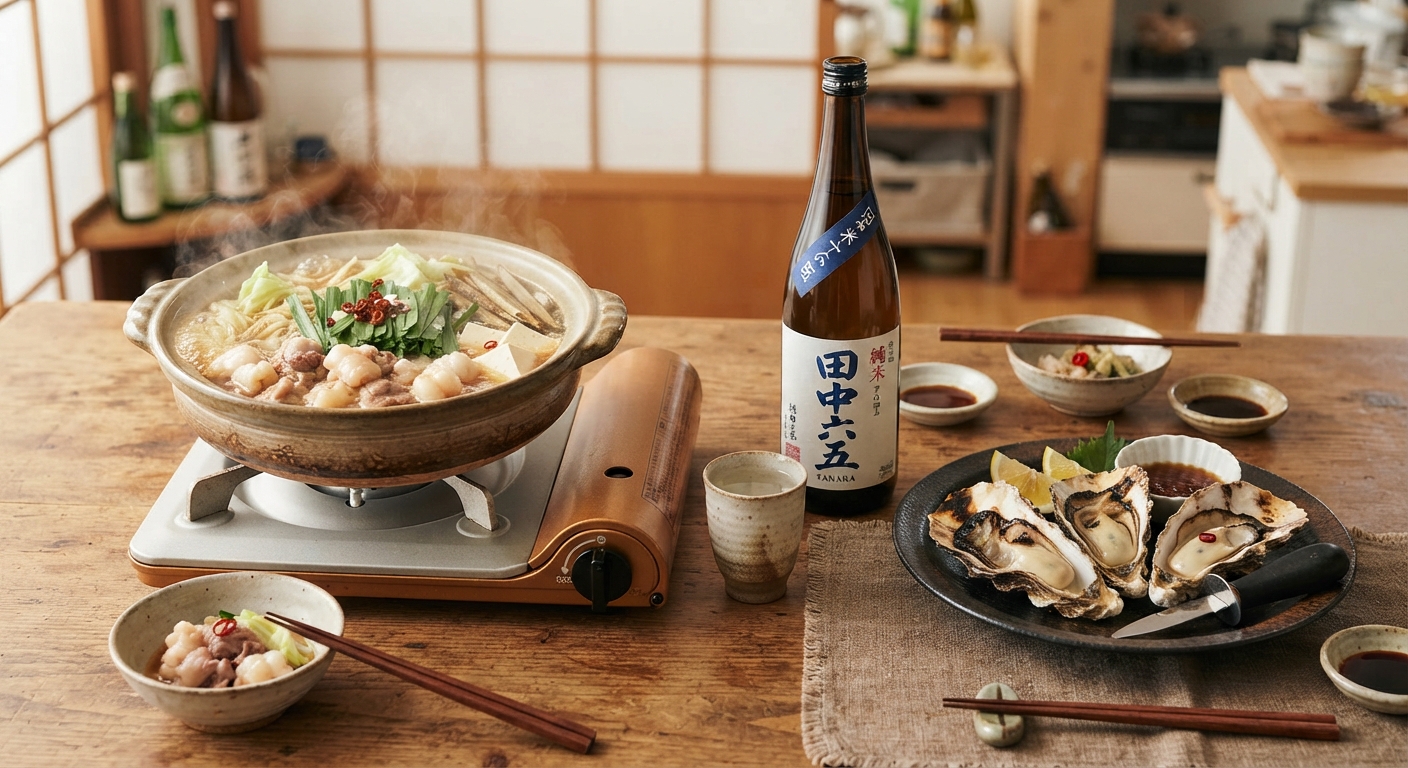
- Hakata motsunabe (offal hot pot)
Hakata’s quintessential soul food: beef offal and vegetables simmered slowly in a soy-based broth, an unpretentious home-style dish. The umami of Tanaka Rokujugo, brewed to be an everyday companion at the table, sits naturally alongside the richness of the offal and broth.
Recipe (in Japanese): Kurashiru, “Soy-Based Motsunabe That’s Delicious to the Last Bite” - Grilled Itoshima oysters, in the shell
From October to March, the Itoshima Peninsula fills with seasonal oyster huts — a winter specialty of the very land this sake is brewed on. Simply grilled in the shell, the oysters need nothing more.
Recipe (in Japanese): Kurashiru, “Shell-On Grilled Oysters in a Toaster Oven”
A note on the science: umami compounds in oysters, such as glycogen and succinic acid, resonate with the amino-acid umami in sake, creating a synergistic boost of savoriness on the palate. The aromatic compounds from the fermented soy-based seasonings in motsunabe broth also blend naturally with the gentle aroma of a junmai sake.
Visiting the Brewery
Shiraito Sake Brewery
1986 Hon, Itoshima City, Fukuoka Prefecture. About a 1-minute walk from the “Honku” bus stop (Shiraito line) from the south exit of JR Chikuzen-Maebaru Station; about 5 minutes by car from Maebaru IC on the Nishi-Kyushu Expressway.
The brewery itself isn’t open for tours, but several of the Itoshima Peninsula’s sights — including the waterfall the brewery is named after — are just a short drive away.
Sights Nearby
- Shiraito Falls / Shiraito, Itoshima | ~15 min, ~9 km by car from the brewery
A 24-meter waterfall whose underground spring water is the very water Shiraito Brewery uses to brew its sake — and the source of the brewery’s name. The visitor facilities nearby were partly closed for renovation from November 2025 to early March 2026, but have since reopened. Parking for about 200 cars. - Raizan Sennyoji Daihioin Temple / Raizan, Itoshima | ~15 min, ~8 km by car from the brewery
An old temple known for a roughly 400-year-old maple tree, a prefecture-designated natural monument. Open 9:00–16:30, admission ¥500. Best foliage is usually mid-November.
Hot Springs Nearby
- Nijo Onsen Kiraranoyu / Nijo-Fukae, Itoshima | ~15 min, ~8 km by car from the brewery
Itoshima’s only day-use bathhouse drawing on a natural hot spring. Open 10:00–21:00 (last entry 20:30), closed on the third Tuesday of the month. Includes an open-air bath and sauna.
Opening hours, closing days and day-use bathing availability can change. Please check each facility’s official information before visiting.
A Quick Glossary of Sake Terms
- Junmai: Sake made only from rice, rice koji, and water, with no added brewing alcohol. Lets the umami of the rice come through directly.
- Seimai buai (rice-polishing ratio): The percentage of the original grain remaining after milling. The lower the number, the more the rice has been polished down.
Sources
- ABOUT – Shiraito Sake Brewery Official Site
- Tanaka Rokujugo (65) – Shiraito Sake Brewery Official Site
- Hakata Blues – Wikipedia (Japanese)
- Nishida Sachiko – Wikipedia (Japanese)
If you notice any errors in this article, please don’t hesitate to reach out at info@soundrecords.jp.
Read this article in Japanese: 一番を目指さない酒が、いちばん近くにいる