今日のペアリング
▶ 上のプレーヤーで再生できない場合は、YouTubeで開く
醸造所の話
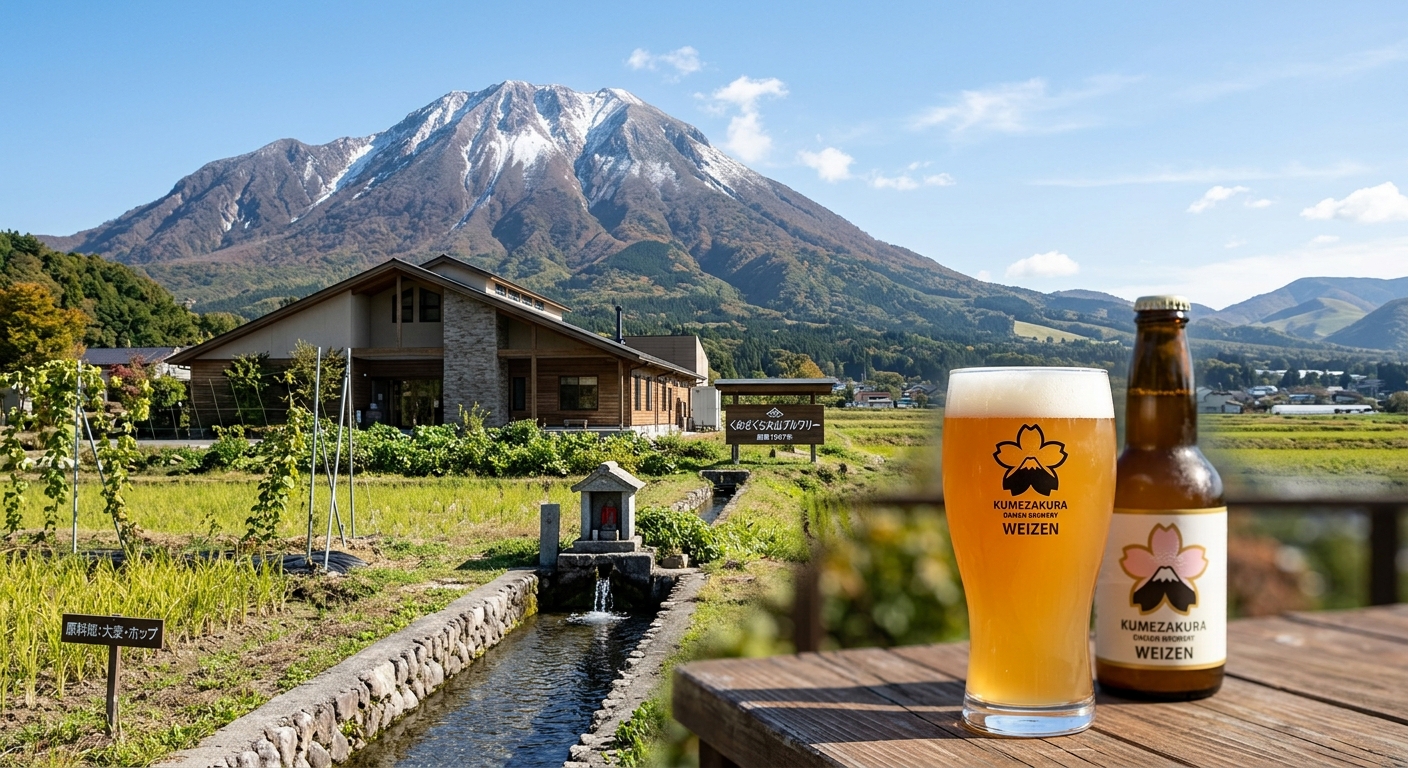
鳥取県西伯郡伯耆町丸山、国立公園・大山の山麓、標高300mの場所にくめざくら大山ブルワリーはあります。母体となる久米桜酒造は安政2年(1855年)創業の日本酒蔵。昭和60年(1985年)、大山のおいしい水を求めて米子市内の醸造場からこの地へ移転しました。平成8年(1996年)、久米桜酒造と山陰酸素工業株式会社が合資して久米桜麦酒株式会社を設立し、翌1997年からビールの醸造を始めています。2026年で、ビール造りは29年目を迎えました。
仕込みに使うのは、地下約150mから汲み上げる大山の伏流水です。きわめて軟らかい水質で、風味のバランスを取りやすいといいます。醸造所のすぐそばには、その伏流水が実際に湧き出す「地蔵滝の泉」があり、周辺の畑では原料となる大麦やホップ、酒米も育てられていて、時期によっては見学もできます。
今回選んだ「ヴァイツェン」は、南ドイツ・バイエルン地方生まれのスタイルです。小麦麦芽をベースに、ヴァイツェン酵母で発酵させることで、麦芽由来の甘みとは別に、バナナやクローブを思わせる華やかな香りが立ちます。苦みは控えめでIBUは20未満、アルコール分5.0%。麦芽にはドイツ・イギリス産のものを使っています。2011年、イギリスで開催されたワールド・ビア・アワードのヴァイツェン部門で世界一(World’s Best)を受賞したのを皮切りに、近年も2024年・2025年にカントリーウィナー・ジャパンゴールド、2026年にジャパンシルバーと、国際的な評価を重ねてきた一本です。
土地の話
大山(だいせん)は標高1,709m(最高点・剣ヶ峰は1,729m)、中国地方の最高峰です。西側から望むとなだらかな稜線を描くことから「伯耆富士」の異名を持ち、1936年に国内で2番目に指定された国立公園の一つ(現在は大山隠岐国立公園)でもあります。この山の伏流水は、くめざくら大山ブルワリーのビール造りだけでなく、山麓で牛を飼う酪農にも使われていて、「白バラ牛乳」で知られる大山乳業農業協同組合の牛乳・乳製品や、大山の麓を中心に育てられる銘柄鶏「大山どり」も、同じ山とその水に支えられて生まれています。ブルワリーがある伯耆町も、隣接する大山町も、それぞれ別の自治体でありながら、大山という一つの山を共通のシンボルとして戴いている点は変わりません。
音楽の話
「大山賛歌 わがこころの山」は1972年(昭和47年)11月、鳥取県大山町(当時)が、同年2月に大山で開催された第27回冬季国民体育大会スキー競技会を記念してつくった楽曲です。山陰放送の後援のもと、歌詞を全国から公募したところ736編の応募が集まり、選ばれたのは当時、大山中学校3年生だった松田美代子さんの作品でした。この詩に松井由利夫が補作を加え、川口真が作曲・編曲を担当。歌唱を任されたのは、当時すでに人気コーラスグループだったデューク・エイセスです。国体の開会式で披露されたのち、東芝音楽工業からシングルレコードとして発売されました。
一人の中学生が書いた詩は、その年だけの記念ソングでは終わりませんでした。2015年、大山町はこの曲を正式な町民歌に制定。今も町民の健康増進を目的とした「大山賛歌体操」がこの曲に合わせてつくられ、地域に根づいています。
なぜこの組み合わせなのか
どちらも、もとは山のふもとに暮らす、名もない誰かのものだったという点で重なります。ヴァイツェンの原料である大山の伏流水は、特定の誰かの所有物ではなく、地下150mから汲み上げれば誰もが使える水です。それを久米桜酒造という一つの蔵が、日本酒からビールへと造り方を変えてまで、あえて追いかけてこの地に移り住みました。一方の「大山賛歌」も、もとをたどれば大山中学校の一人の3年生が書いた詩にすぎません。それが736編の応募の中から選ばれ、補作・作曲・編曲というプロの手を経て、当時人気だったデューク・エイセスの声で歌われることで、一つの町の正式な歌にまで育ちました。
どちらも、山のふもとにありふれていたはずのもの――水であり、一人の生徒の言葉であり――が、専門の技術を経ることで、山を代表する一つの形に結晶しています。ヴァイツェンのグラスを傾けながらこの曲を聴くと、この土地が積み重ねてきたのは山そのものだけではなく、そこに暮らす人たちの手仕事の積み重ねでもあったのだと感じられます。
この一杯を、探すなら
※楽天市場へのリンクは広告(アフィリエイト)です。醸造所がタップルームや直営店を持っている場合は、できたてを現地で味わうのが一番のおすすめです。
🌡️ おすすめの飲み方(温度とグラス):8℃前後によく冷やし、口がすぼまらず上に広がる背の高いヴァイツェングラスへ。瓶の底に沈んだ酵母を軽く揺すって注ぎ込むと、白く豊かな泡が立ち、バナナとクローブの香りがいっそう引き立ちます。
合わせたい「アテ」
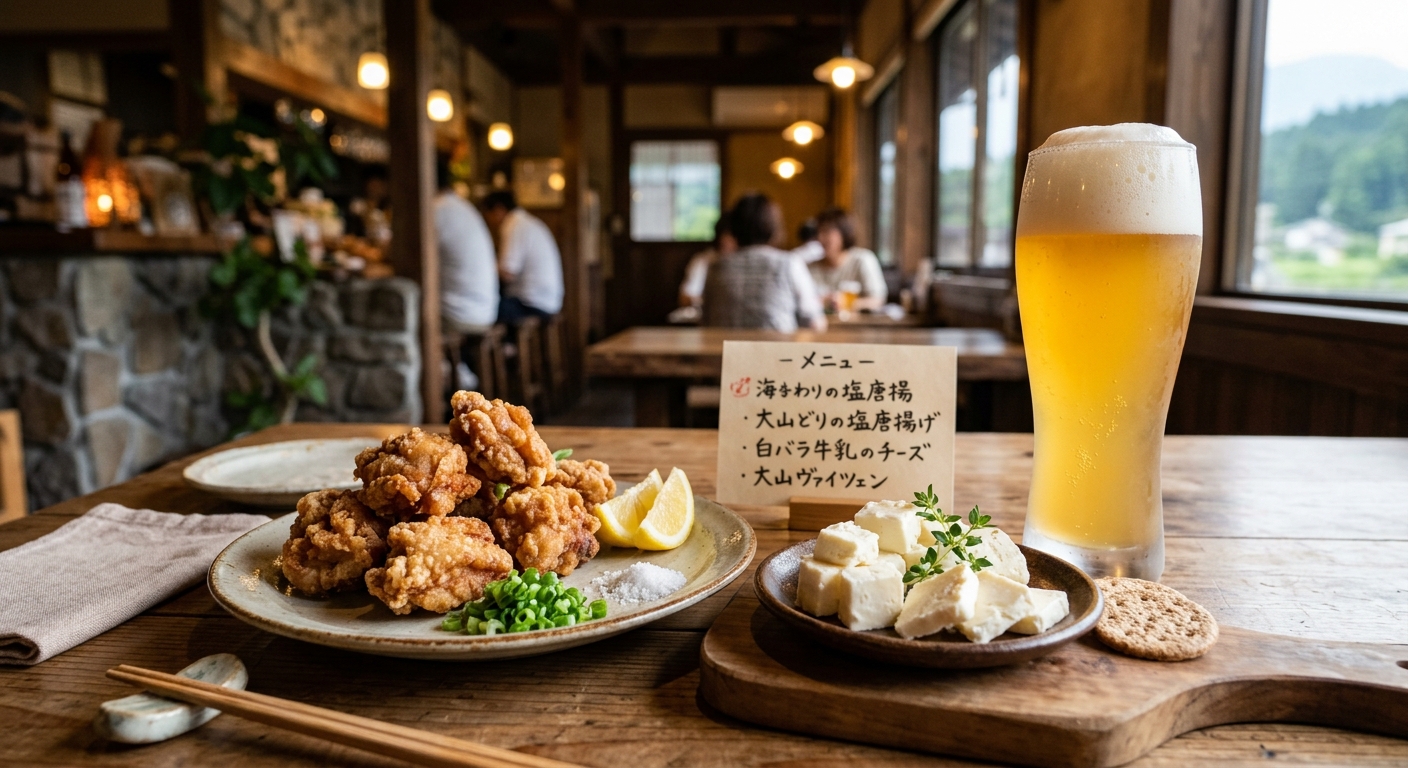
- 大山どりの塩唐揚げ
大山の麓を中心に育てられる鳥取のブランド鶏。柔らかな肉質とほどよい脂が、ヴァイツェンの華やかな香りをじゃませずに受け止めます。
- 白バラ牛乳のチーズ
大山乳業農業協同組合が手がける、同じ大山の恵みから生まれる乳製品。まろやかな乳脂肪が、小麦ビールのやさしい口当たりとよく合います。
科学的にひとこと:ヴァイツェン酵母は発酵の過程で、バナナを思わせる香り成分「酢酸イソアミル」と、クローブに近いスパイシーな香りの「4-ビニルグアヤコール」を生み出します。唐揚げの衣に付く焼き色は、糖とアミノ酸が加熱で結びつく「メイラード反応」によるもので、その香ばしさがこの2つの香り成分と重なり合って厚みを増します。チーズの乳脂肪は、ビールの炭酸とほのかな甘みによって後味がリセットされるため、脂っこさが気にならず何度でもグラスが進みます。
ひとことメモ(ビールの用語)
- クラフトビール:小規模な醸造所が、造り手の個性を前面に出して仕込むビールの総称。大量生産の均一な味とは別の方向を目指しています。
- ヴァイツェン:小麦を多く使う南ドイツ発祥の白いエール。バナナや丁子(クローブ)を思わせる香りが酵母から生まれます。
- モルト:発芽させた大麦(麦芽)のこと。ビールの甘み・色・コクの土台になり、焙煎の深さで色と香ばしさが決まります。
- ABV:アルコール度数(Alcohol By Volume)のこと。ビールでは5%前後が標準で、8%を超えると飲みごたえのある「強め」の部類になります。
- IBU:苦みの強さを表す国際的な数値。10前後だとほとんど苦みを感じず、60を超えるとはっきり苦いIPAの領域です。
参考
内容に誤りがございましたら、お手数ですが info@soundrecords.jp までご連絡いただけますと幸いです。
Today’s Pairing
- Craft beer: Daisen G Beer Weizen — Weizen (a wheat beer style from Bavaria, southern Germany), brewed with wheat malt (sourced from Germany and the UK) and Weizen yeast to bring out aromas of banana and clove, 5.0% ABV, under 20 IBU, 330ml / Kumezakura Beer Co., Ltd., Kumezakura Daisen Brewery (1740-30 Maruyama, Hoki, Saihaku District, Tottori)
Official site: http://g-beer.jp/
- Music: “Daisen Sanka: Waga Kokoro no Yama” (“Hymn to Mt. Daisen: The Mountain in My Heart”) by Duke Aces (1972)
YouTube: https://www.youtube.com/watch?v=Lr7SYoyUA5E
▶ If the player above doesn’t play, open it on YouTube
The Story of the Brewery
Kumezakura Daisen Brewery sits at an elevation of 300 meters, at the foot of Mt. Daisen inside a national park, in Maruyama, Hoki Town, Saihaku District, Tottori. Its parent company, Kumezakura Shuzo, is a sake brewery founded in 1855. In 1985, chasing the good water of Mt. Daisen, it relocated its brewing site from the city of Yonago to this spot. In 1996, Kumezakura Shuzo and Sanin Sanso Kogyo Co., Ltd. jointly established Kumezakura Beer Co., Ltd., and beer brewing began the following year, in 1997. As of 2026, the brewery has been making beer for 29 years.
Brewing draws on groundwater pumped from roughly 150 meters below Mt. Daisen — extremely soft water, said to make it easier to strike a good flavor balance. Right next to the brewery is “Jizodaki no Izumi,” a spring where that same groundwater actually surfaces, and the surrounding fields grow some of the barley, hops and sake rice used as ingredients, open to viewing depending on the season.
The Weizen featured here belongs to a style born in Bavaria, southern Germany. Brewed from wheat malt and fermented with Weizen yeast, it develops bright aromas of banana and clove alongside the malt’s natural sweetness. Bitterness stays gentle, under 20 IBU, at 5.0% ABV, using malt sourced from Germany and the UK. It won World’s Best in the Weizen category at the World Beer Awards in the UK in 2011, and has kept collecting international recognition since — Country Winner and Japan Gold in both 2024 and 2025, and Japan Silver in 2026.
The Story of the Land
Mt. Daisen stands 1,709 meters tall (its highest point, Kengamine, reaches 1,729 meters), the tallest peak in the Chugoku region. Seen from the west, its gently sloping silhouette has earned it the nickname “Hoki Fuji,” and it sits within one of Japan’s second-oldest national parks, designated in 1936 (now Daisen-Oki National Park). The mountain’s groundwater doesn’t only go into brewing at Kumezakura Daisen Brewery — it also feeds the dairy farms at its foot. The milk and dairy products of the Daisen Dairy Agricultural Cooperative, known for its “Shirabara” (White Rose) milk, and the branded chicken “Daisen-dori,” raised largely around the mountain’s base, are both sustained by that same mountain and its water. Hoki Town, home to the brewery, and neighboring Daisen Town remain separate municipalities, but both share the same mountain as their common symbol.
The Story of the Song
“Daisen Sanka: Waga Kokoro no Yama” was created in November 1972 by what was then Daisen Town, Tottori, to commemorate the skiing events of the 27th National Sports Festival’s winter games, held on Mt. Daisen that February. With backing from San-in Broadcasting, the town held a nationwide public contest for lyrics, drawing 736 entries. The winning poem was written by Matsuda Miyoko, then a third-year student at Daisen Junior High School. Matsui Yuo added supplementary lyrics, and Kawaguchi Makoto composed and arranged the music. The song was performed by Duke Aces, already a popular vocal group at the time. It was played at the festival’s opening ceremony and then released as a single record by Toshiba Music Industry.
A poem written by one junior high school student didn’t stay a one-year commemorative song. In 2015, Daisen Town formally adopted it as the town’s official anthem. A community exercise routine, “Daisen Sanka Taiso,” set to the same song and aimed at promoting residents’ health, is still practiced locally today.
Why This Pairing
Both started as something ordinary, belonging to no one in particular, at the foot of the mountain. The groundwater behind the Weizen isn’t owned by anyone specific — anyone who can pump it up from 150 meters underground can use it. Kumezakura Shuzo, a sake brewery, relocated here and eventually changed its craft from sake to beer just to chase that water. “Daisen Sanka,” traced back to its origin, is nothing more than a poem written by one third-year student at Daisen Junior High School. Selected from among 736 entries, then passed through the professional hands of a lyricist, composer and arranger, and sung by the already-popular Duke Aces, it grew into a town’s official anthem.
In both cases, something that should have been unremarkable at the mountain’s foot — water, or one student’s words — crystallized, through skilled craft, into a single form that now represents the mountain itself. Listening to this song over a glass of Weizen, it’s easy to feel that what this land has built up isn’t just the mountain — it’s also the accumulated handiwork of the people who live around it.
Where to Find This Beer
The Rakuten Ichiba link below is an affiliate link.
These are Japanese storefronts. If you are visiting the brewery, drinking it fresh at their own taproom is by far the best option.
🌡️ How to serve it:Chill it well, to around 8°C, and pour into a tall Weizen glass that flares outward at the top. Give the bottle a gentle swirl to bring up the yeast settled at the bottom before pouring — it builds a thick white head and lifts the banana and clove aromas even further.
Pairing Dishes Worth Trying
- Daisen-dori salted fried chicken
A branded chicken raised largely around the foot of Mt. Daisen. Its tender meat and moderate fat let the Weizen’s bright aroma come through without getting in the way.
- Shirabara milk cheese
A dairy product from the Daisen Dairy Agricultural Cooperative, drawing on the same mountain’s blessings. Its mellow milk fat pairs naturally with the gentle mouthfeel of a wheat beer.
A note on the science: Weizen yeast produces two key aroma compounds during fermentation — isoamyl acetate, which reads as banana, and 4-vinyl guaiacol, a spicy note close to clove. The browning on fried chicken’s crust comes from the Maillard reaction, sugars and amino acids bonding under heat, and that toastiness layers with those same two aromas for extra depth. The milk fat in cheese gets reset by the beer’s carbonation and mild sweetness, so the richness never feels heavy and the glass keeps moving.
A Quick Glossary of Beer Terms
- Craft beer: Beer made by small breweries that put the character of the maker front and centre, as opposed to the uniformity of mass production.
- Weizen: A white ale from southern Germany brewed with a high proportion of wheat. Its yeast produces aromas suggesting banana and clove.
- Malt: Germinated barley (or wheat). It forms the foundation of a beer’s sweetness, colour and body; how deeply it is roasted determines colour and toastiness.
- ABV: Alcohol By Volume. Beer typically runs around 5%; above 8% is considered strong.
- IBU: An international measure of bitterness. Around 10 you barely notice it; above 60 you are in clearly bitter IPA territory.
Sources
If you notice any errors in this article, please don’t hesitate to reach out at info@soundrecords.jp.
コメントを残す