今日のペアリング
▶ 上のプレーヤーで再生できない場合は、YouTubeで開く
酒蔵の話
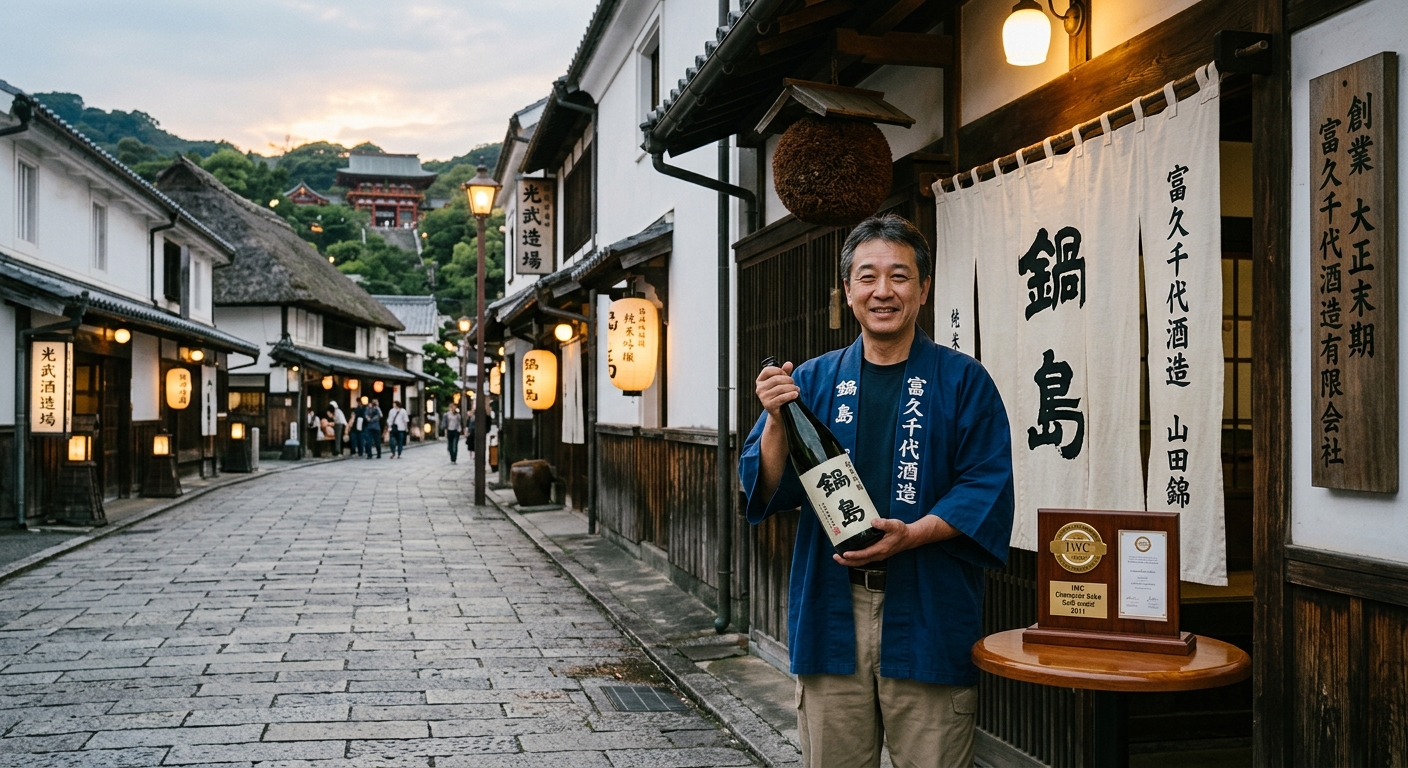
富久千代酒造有限会社は、大正末期に「盛寿」という酒銘で創業しました。戦時中の企業整理と戦後の再建を経て「富久千代」に改称し、2023年に創業100周年を迎えています。転機となったのは1987年、3代目蔵元に就任した飯盛直喜氏が、酒類販売の規制緩和によって小規模な酒蔵と地元の酒販店がともに苦しくなる将来を見越したことでした。地元の酒販店と手を組み、構想3年をかけて1998年に完成させた新しいブランドが「鍋島」です。名称は公募で決められ、旧鹿島藩主・鍋島家の子孫からも使用の許可を得たといいます。
小さな蔵の新しい挑戦は、やがて世界に届きました。2011年のインターナショナル・ワイン・チャレンジ(IWC)で、「鍋島 大吟醸」が清酒部門の最高賞「チャンピオン・サケ」を、「鍋島 特別純米」が金賞を、それぞれ受賞したのです。今回合わせる「鍋島 純米吟醸 山田錦」は、酒米の王様とも呼ばれる山田錦を精米歩合50%まで磨き上げ、アルコール度数16%で仕込んだ一本。甘くフルーティーな香りと、山田錦ならではのふくよかな米の旨味が特徴です。
土地の話
富久千代酒造が蔵を構える鹿島市浜町一帯は「肥前浜宿」と呼ばれ、白壁の酒蔵や茅葺きの町家が江戸時代から昭和初期の姿のまま軒を連ねています。2006年、この町並みは国の重要伝統的建造物群保存地区に選定されました。豊かな地下水と良質な米に恵まれたこの地では酒造りが盛んで、酒蔵通りの周辺だけで富久千代酒造を含む3つの酒蔵が今も徒歩圏内に集まっています。
車で約6分のところには、佐賀県を代表する神社のひとつ、祐徳稲荷神社があります。稲荷山の中腹まで朱塗りの社殿が連なる姿は壮観で、鹿島の酒蔵めぐりとあわせて訪れる人も少なくありません。
音楽の話
「王将」を歌った村田英雄は、1929年1月17日、佐賀県東松浦郡相知町(現・唐津市)の生まれです。5歳で浪曲師・酒井雲に弟子入りし「酒井雲坊」を名乗って舞台に立ち、13歳で真打に昇進、14歳で自らの一座の座長を務めるという早熟な芸歴を歩みました。転機は1958年。ラジオで村田の口演を聴いた作曲家・古賀政男に見出され、浪曲『無法松の一生』を歌謡曲化した楽曲で歌手としてデビューします。
その村田英雄の代表曲となったのが、1961年11月発売の「王将」です。作詞は西條八十、作曲は船村徹。発売の年のうちに村田は第12回NHK紅白歌合戦に初出場し、翌1962年には第4回日本レコード大賞特別賞を受賞しました。以降、村田は紅白歌合戦に通算4回出場しています。曲のモデルとなったのは、明治から昭和初期にかけて活躍した将棋棋士・坂田三吉(1870〜1946年)。大阪・堺の生まれで、独学で将棋を学び、当時東京中心だった将棋界の外側から1925年に「関西名人」を自称した、異色の棋士でした。坂田の死後、戯曲・映画『王将』が大ヒットしたことで再び注目を集め、1955年10月1日、日本将棋連盟は坂田に「贈名人」「贈王将」の称号を追贈しています。歴史上、この「贈王将」を受けたのは坂田ただ一人です。
なぜこの組み合わせなのか
中央の将棋界から離れた場所で独学を貫き、自ら「関西名人」を名乗った坂田三吉。浪曲師として舞台に立ち続けたのち、佐賀の小さな町から歌謡曲の頂点まで上り詰めた村田英雄。そして、地元の酒販店と手を組んだ小さな蔵が、丁寧な酒造りだけを武器に世界一の評価を勝ち取った鍋島。三者に共通するのは、大きな後ろ盾を持たない場所から、自分自身の腕一本で頂点にたどり着いたという物語です。
「王将」が歌う「吹けば飛ぶよな将棋の駒」という言葉は、決して恵まれた場所から始まったわけではない者たちへの応援歌のようにも聞こえます。肥前浜宿の小さな酒蔵で醸される一杯を傾けながら、そんな歩みに思いを馳せてみてください。
この一本を、探すなら
※楽天市場へのリンクは広告(アフィリエイト)です。在庫・取扱いは変動します。お近くの酒販店でも、ぜひ銘柄名を伝えて探してみてください。
🌡️ おすすめの飲み方:よく冷やして、または常温で。山田錦ならではのふくよかな米の旨味と、甘くフルーティーな香りが引き立ちます。
合わせたい「アテ」
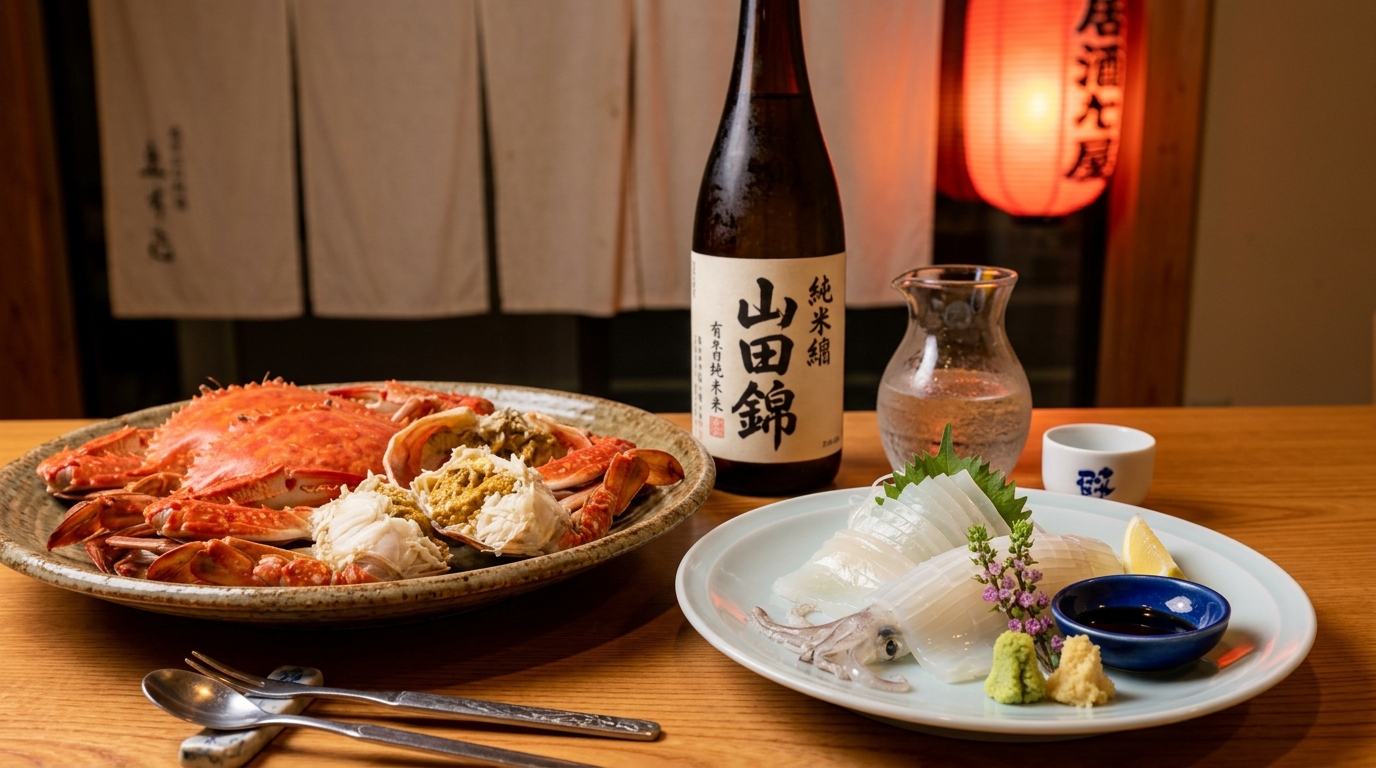
- 竹崎かに(ワタリガニ)の塩ゆで
鹿島市の南隣・太良町の名物で、有明海の広大な干潟で育ったワタリガニです。ぎゅっと詰まった身と濃厚なカニミソが、山田錦のふくよかな米の旨味と重なり合います。
レシピはこちら:クラシル「渡り蟹のゆで方」
- 呼子の剣先いかの刺身
村田英雄の生まれ故郷・相知町と同じ唐津市の名物。コリコリとした歯ごたえと上品な甘みが特徴のイカです。純米吟醸の穏やかな吟醸香と、イカ本来の甘みが引き立て合います。
レシピはこちら:クラシル「イカの刺身の切り方」
科学的にひとこと:カニやイカに多く含まれるグリシンなどの甘み系アミノ酸は、日本酒の米由来のアミノ酸系の旨味と重なり合い、口の中で旨味の相乗効果を生み出します。魚介の生臭みのもとになる成分は、日本酒に含まれる有機酸によって和らげられるため、生ものと日本酒の組み合わせは経験的に相性がよいとされています。
この蔵をたずねるなら
富久千代酒造(鍋島醸造元)
佐賀県鹿島市浜町1244-1/JR長崎本線 肥前浜駅から徒歩約5分、長崎自動車道 武雄北方ICから車で約30分。
白壁の酒蔵や茅葺きの町家が軒を連ねる「肥前浜宿 酒蔵通り」(国指定重要伝統的建造物群保存地区)の中に蔵を構えています。
近くの観光スポット
- 肥前浜宿 酒蔵通り/鹿島市|富久千代酒造から徒歩圏内
白壁の酒蔵と茅葺きの町家が立ち並ぶ、江戸〜昭和初期の町並み。富久千代酒造を含め、酒蔵通り周辺だけで3つの酒蔵が徒歩圏内に集まっています。
- 祐徳稲荷神社/鹿島市古枝|蔵から車で約6分
稲荷山の中腹まで朱塗りの社殿が連なる、佐賀県を代表する神社。参拝時間や駐車場の情報は、訪問前に公式サイトでご確認ください。
近くの温泉
- ひぜん祐徳温泉 宝乃湯/鹿島市納富分|蔵から車で約15分
祐徳稲荷神社に近い日帰り温泉施設。地下1000mから湧く単純温泉で、大人900円で日帰り入浴ができます(2026年時点の公式サイト掲載額)。営業時間・料金は変わることがあるため、訪問前にご確認ください。
※営業時間・定休日・日帰り入浴の可否は変わることがあります。おでかけ前に各施設の公式情報をご確認ください。
ひとことメモ(日本酒の用語)
- 純米吟醸酒:精米歩合60%以下まで磨いた米を低温でじっくり発酵させた純米酒。華やかな香りが特徴です。
- 精米歩合:玄米を削り、残った部分の割合。数値が低いほど、米を多く磨いていることを示します。
参考
内容に誤りがございましたら、お手数ですが info@soundrecords.jp までご連絡いただけますと幸いです。
Today’s Pairing
- Sake: Nabeshima Junmai Ginjo Yamada Nishiki — brewed with Yamada Nishiki sake rice, rice-polishing ratio (seimai buai) 50%, 16% alcohol / Fukuchiyo Shuzo Co., Ltd. (1244-1 Hamamachi, Kashima City, Saga Prefecture)
Official site: https://nabeshima.biz/
- Kayoukyoku (classic Japanese popular song): “Osho” (“King’s General,” a shogi piece) by Murata Hideo, 1961
YouTube: https://www.youtube.com/watch?v=nPpA2JZdwTU
▶ If the player above doesn’t play, open it on YouTube
The Story of the Brewery
Fukuchiyo Shuzo Co., Ltd. was founded in the closing years of the Taisho era under the name “Seiju.” After a wartime corporate reorganization and postwar rebuilding, it took the name Fukuchiyo, and marked its 100th anniversary in 2023. The turning point came in 1987, when Iimori Naoki became the brewery’s third-generation owner. Foreseeing that deregulation in sake sales would make survival harder for both small breweries and local liquor shops, he teamed up with local retailers, and after three years of planning, completed a new brand in 1998: Nabeshima. The name was chosen through a public naming contest, and permission to use it is said to have been granted by descendants of the Nabeshima clan, the former lords of the Kashima domain.
This small brewery’s new venture eventually reached the world stage. At the 2011 International Wine Challenge (IWC), “Nabeshima Daiginjo” won Champion Sake, the top prize in the sake category, while “Nabeshima Tokubetsu Junmai” won a gold medal. The bottle in this pairing, Nabeshima Junmai Ginjo Yamada Nishiki, is brewed with Yamada Nishiki — often called the king of sake rice — polished to a seimai buai of 50%, at 16% alcohol. It’s a Junmai Ginjo (Junmai — sake made only from rice, rice koji, and water — polished to 60% or less and fermented slowly at low temperatures) with a sweet, fruity aroma and the rich rice umami characteristic of Yamada Nishiki.
The Story of the Land
The Hamamachi district of Kashima City, where Fukuchiyo Shuzo stands, is known as Hizen-Hama-shuku. Its white-walled breweries and thatched-roof townhouses still stand much as they did from the Edo period through the early Showa era, and in 2006 the townscape was designated a National Important Preservation District for Groups of Historic Buildings. Blessed with abundant groundwater and good rice, this area has long been a center of sake brewing, and even today three breweries — including Fukuchiyo — stand within walking distance of one another along the brewery street.
About six minutes away by car is Yutoku Inari Shrine, one of Saga Prefecture’s leading shrines, where vermilion halls climb partway up the mountainside. Many visitors combine a stop here with a tour of Kashima’s breweries.
The Story of the Song
Murata Hideo, who sang “Osho,” was born on January 17, 1929, in what was then Aichi-cho, Higashimatsuura District, Saga Prefecture — now part of Karatsu City. At age five he apprenticed under the rokyoku (traditional narrative singing) performer Sakai Un, performing under the name “Sakai Unbo.” He was promoted to full performer status at 13 and led his own troupe at 14 — a remarkably early start. The turning point came in 1958, when composer Koga Masao heard a radio broadcast of Murata’s performance and discovered him; Murata made his singing debut with a song adapted from the rokyoku tale “Muho Matsu no Issho.”
That collaboration led to Murata’s signature song, “Osho,” released in November 1961. The lyrics are by Saijo Yaso, the music by Funamura Toru. Murata made his first appearance on NHK’s Kohaku Uta Gassen that same year (the 12th edition), and in 1962 he won the Special Award at the 4th Japan Record Awards. He would go on to appear on Kohaku four times in total. The song’s subject was Sakata Sankichi (1870–1946), a shogi (Japanese chess) player active from the Meiji through early Showa eras. Born in Sakai, Osaka, Sakata was self-taught and, standing outside the Tokyo-centered shogi establishment of his day, declared himself “Kansai Meijin” (Kansai Champion) in 1925 — an unconventional path for a player of his era. After his death, a play and film both titled “Osho” became major hits, renewing public attention on his life, and on October 1, 1955, the Japan Shogi Association posthumously awarded him the titles of Meijin (Master) and Osho (King’s General). To this day, he remains the only person ever to receive the posthumous title of Osho.
Why This Pairing
Sakata Sankichi taught himself shogi far from the game’s establishment and declared himself Kansai Champion on his own terms. Murata Hideo performed as a rokyoku artist before rising, from a small town in Saga, to the very top of kayoukyoku. And Fukuchiyo, a small brewery that partnered with local retailers, earned the world’s top honor armed with nothing but careful, deliberate brewing. What all three share is a story of reaching the summit through their own skill alone, starting from places with no great backing behind them.
The line in “Osho” — “a shogi piece so light a puff of wind could blow it away” — sounds almost like an anthem for anyone who never started from a position of privilege. As you raise a glass of sake brewed in this small corner of Hizen-Hama, it’s worth taking a moment to reflect on that journey.
Where to Find This Bottle
The Rakuten Ichiba link below is an affiliate link.
Note: the links above lead to Japan-based retailers. They’re most convenient for readers in Japan, or for those elsewhere who are able to arrange international shipping. Stock and availability change over time, so if you’re near a specialty sake shop, it’s well worth asking for this label by name.
🌡️ Recommended way to drink it: Well chilled, or at room temperature. Either brings out the rich rice umami of Yamada Nishiki and its sweet, fruity aroma.
Pairing Dishes Worth Trying
- Boiled Takezaki crab (blue swimmer crab)
A specialty of Tara, the town just south of Kashima, raised in the vast tidal flats of the Ariake Sea. Its dense meat and rich crab roe echo the rich rice umami of Yamada Nishiki.
Recipe (in Japanese): Kurashiru, “How to Boil Blue Swimmer Crab”
- Yobuko kensaki squid sashimi
A specialty of Karatsu City — the same city that now includes Aichi-cho, Murata Hideo’s birthplace. Known for its crisp texture and delicate sweetness, it pairs naturally with the gentle ginjo aroma of this Junmai Ginjo.
Recipe (in Japanese): Kurashiru, “How to Slice Squid Sashimi”
A note on the science: sweet-tasting amino acids such as glycine, abundant in crab and squid, resonate with the rice-derived amino-acid umami in sake, creating a synergistic boost of savoriness on the palate. The organic acids in sake are also known to soften the compounds responsible for seafood’s fishy notes, which is part of why raw seafood and sake have long been considered a natural match.
Visiting the Brewery
Fukuchiyo Shuzo (brewer of Nabeshima)
1244-1 Hamamachi, Kashima City, Saga Prefecture. About a 5-min walk from JR Hizen-Hama Station; about 30 min by car from Takeo-Kitakata IC on the Nagasaki Expressway.
The brewery sits within “Hizen-Hama-shuku Sakagura-dori,” a street of white-walled sake breweries and thatched-roof townhouses designated a National Important Preservation District for Groups of Historic Buildings.
Sights Nearby
- Hizen-Hama-shuku Sakagura-dori (Sake Brewery Street) / Kashima City | walking distance from Fukuchiyo Shuzo
A townscape of white-walled breweries and thatched-roof houses dating from the Edo to early Showa eras. Three breweries, including Fukuchiyo, sit within walking distance of each other here.
- Yutoku Inari Shrine / Furueda, Kashima City | about 6 min by car from the brewery
A major shrine whose vermilion halls climb partway up Mt. Inari. Check the official site for visiting hours and parking before you go.
Hot Springs Nearby
- Hizen Yutoku Onsen “Takara no Yu” / Nodomibun, Kashima City | about 15 min by car from the brewery
A day-use hot spring near Yutoku Inari Shrine, drawing simple thermal water from 1,000m underground. Adult admission is ¥900 (as listed on the official site in 2026). Hours and rates can change, so please check ahead.
Opening hours, closing days and day-use bathing availability can change. Please check each facility’s official information before visiting.
A Quick Glossary of Sake Terms
- Junmai Ginjo: Junmai (sake made only from rice, rice koji, and water, with no added brewing alcohol) that has been polished to a seimai buai of 60% or less and fermented slowly at low temperatures, giving it a fragrant aroma.
- Seimai buai (rice-polishing ratio): The percentage of the original grain remaining after milling. The lower the number, the more the rice has been polished down.
Sources
If you notice any errors in this article, please don’t hesitate to reach out at info@soundrecords.jp.
コメントを残す