日本語で読む | This is the English version of a bilingual article.
Today’s Pairing
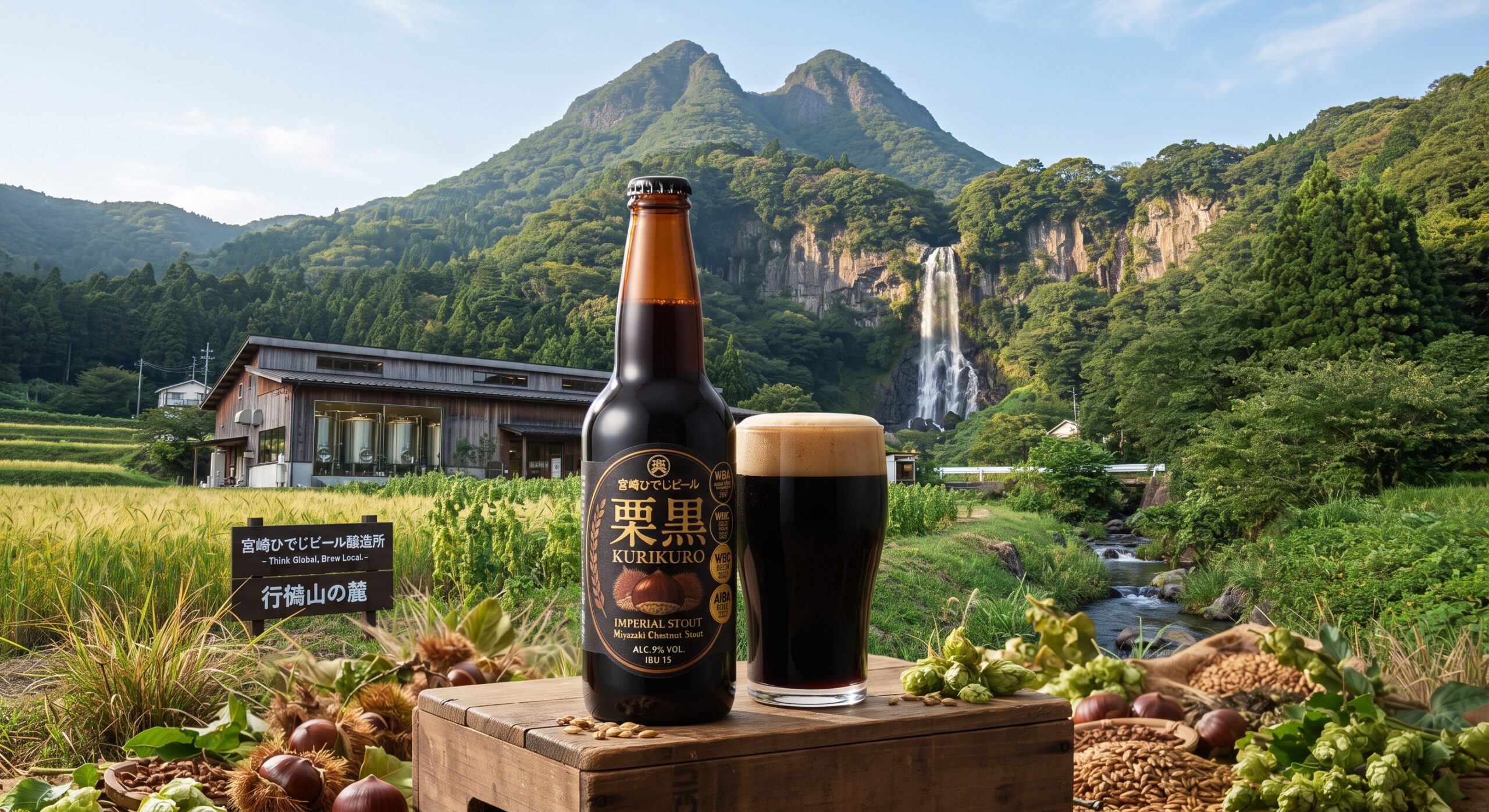
- Craft beer: Miyazaki Hideji Beer “Kuri Kuro” — Imperial Stout, brewed with roasted barley kiln-dried at high temperature until black, plus a paste of chestnuts grown in Miyazaki Prefecture added to the mash, 9% ABV, 15 IBU, 330ml / Miyazaki Hideji Beer Co., Ltd. (747-58 Mukabaki-cho, Nobeoka, Miyazaki)
Official site: https://hideji-beer.jp/ - Music: “Jidai” (“The Times”) by Miyuki Nakajima (1975)
YouTube: https://www.youtube.com/watch?v=aOOpDfmy7mw
▶ If the player above doesn’t play, open it on YouTube
The Story of the Brewery
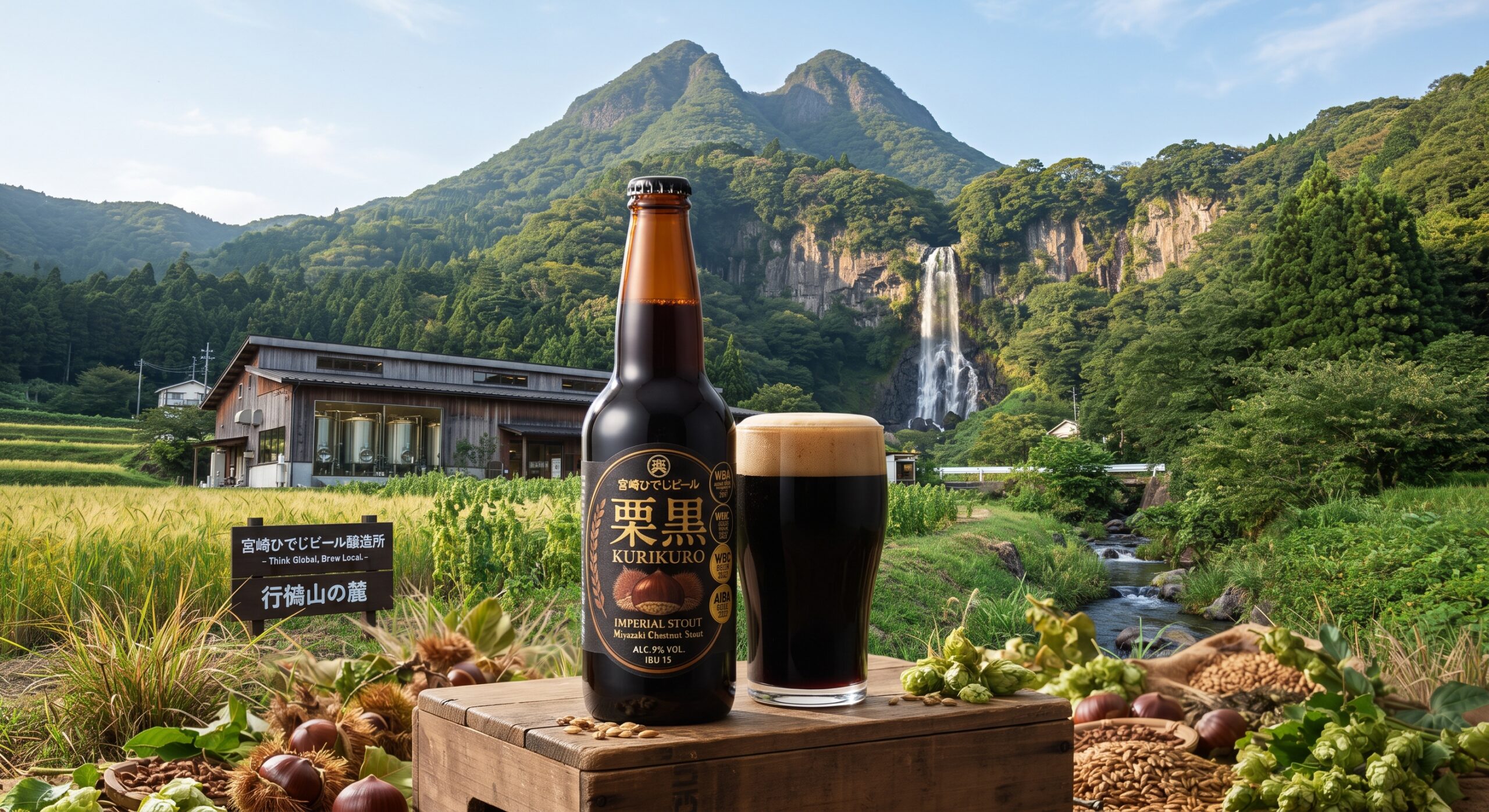
The brand name “Hideji” is a person’s name. In June 1996, when a revision of the liquor tax law opened the door to small-scale brewing in Japan, Eiji “Hideji” Nishida — already an elderly man — cleared a patch of ground at the foot of Mt. Mukabaki in Nobeoka, Miyazaki, and set up a brewery and a brewpub restaurant.
That first local-beer boom, however, ended within a few years. As breweries pulled out across the country, Hideji Beer dismantled its own plant to stabilise quality, polished every last stretch of pipework, brought in an adviser and rebuilt its brewing from the ground up. It set up a yeast lab and made in-house yeast propagation part of its own skill set.
Even so, after losing its previous president, Eitoshi Nishida, in an accident, the company received notice that the beer division would be shut down in six months. Nagano, who headed that division at the time, chose an employee buy-out. Miyazaki Hideji Beer Co., Ltd. was founded on 15 July 2010, and in November of the same year it acquired the beer production and sales business from Nishida Co., Ltd. That is where the new Hideji Beer begins.
Right after becoming independent, Miyazaki was hit by foot-and-mouth disease. The brewery’s own site records that every cow and pig disappeared from five towns in the eastern part of the prefecture. The following year, 2011, Mt. Shinmoedake erupted, and avian influenza broke out in the same year.
What came next was the “Miyazaki Agricultural Support Project” — planning, developing and branding products that make active use of Miyazaki’s farm, livestock and seafood produce, in order to energise the prefecture’s primary industries themselves. From a remark company president Nagano had been repeating since 2006 — “one day I’d like to brew a beer entirely from Miyazaki ingredients” — the brewery started growing two-row barley with local farmers, in a prefecture where production had been close to zero tonnes, and even had the malting equipment (steeping tanks, kilns, de-rooting machines) built locally until it reached its own house malt. “YAHAZU,” made with 100% Miyazaki malt, was named the best in Japan at the World Beer Awards’ Japanese round in 2023. From 2016 the brewery also took on growing its own hops; told it was impossible by experts both in Japan’s hop regions and in Germany, it got to a first harvest in early July 2017 and a first brew that same summer.
“Kuri Kuro” came out of that current. It is an imperial stout built on roasted barley kiln-dried at high temperature until black, with a paste of Miyazaki-grown chestnuts added to the mash: 9% ABV, 15 IBU. Coffee-like toastiness, the refined aroma of chestnut and a heavy, deep body all arrive together. The bitterness number is surprisingly low — the dark-beer toastiness comes from the roast, and the drinking heft comes from alcohol and body.
In 2017 it took two world titles at the World Beer Awards in the UK, winning both the style and the category in Stout & Porter. It was rated the best in Japan on RateBeer three years running, in 2018, 2019 and 2020; in 2022 it won gold in the speciality beer category at the World Beer Cup in Minneapolis, and gold at the Australian International Beer Awards the same year.
Because the alcohol runs high, this bottle also stands up to months or even years of ageing. The official site notes that with age the aroma, flavour and alcohol settle into the beer as a whole, the mouthfeel smooths out, and the taste turns mellower.
The Story of the Land
The brewery sits at the foot of Mt. Mukabaki, 831 meters high, with two rock peaks — Odake and Medake — and Mukabaki Falls dropping 77 meters between them. The falls are one of Japan’s “100 Best Waterfalls.” Mukabaki Shrine, at its foot, has been enshrined here for more than 1,300 years and treats the waterfall itself as one of its sacred bodies. The water Hideji brews with is this mountain’s natural water.
Nobeoka is also a company town built around Asahi Kasei. The brewery’s own site says the reason it could have its brewing tanks made locally was the high level of skill held by Nobeoka’s small and mid-sized manufacturers. Water welling out of the mountain, and metalworking expertise accumulated in the town: both of them end up inside the same glass.
The company’s stated stance is a single line — “Think Global, Brew Local.” Think on a global scale, act from a local point of view. The prefecture’s barley, the prefecture’s hops and the prefecture’s chestnuts are all concrete shapes that stance has taken.
The Story of the Song
“Jidai” was released on 21 December 1975 by Canyon Records, a single by Miyuki Nakajima. She wrote both the words and the music; Motoki Funayama arranged it.
Nakajima was born on 23 February 1952 in Sapporo, Hokkaido. She had only just made her recording debut in September 1975 with “Azami Jo no Lullaby,” and she was 23. That October, “Jidai” won the grand prize at the 10th Popular Song Contest finals at Tsumagoi. Then on 16 November, at the 6th World Popular Song Festival held at Nippon Budokan, the same song won the grand prize again. Within a few months of her debut, this one song had taken the top of two contests. The single sold 200,000 copies, and it was later chosen for Japan’s “100 Songs of Japan” list.
What it sings about is circling time. The times keep turning through partings and meetings, so even a day when you have fallen down and are crying will, in time, come around into something you can talk about. That is the song. The reason it didn’t end as a newcomer’s contest piece from 50 years ago, and is still sung today, probably lies right there.
Why This Pairing
What overlaps is that both were once told they were finished.
Hideji Beer was given notice that its division would be closed in six months. The people actually making the beer bought the company instead — and then met foot-and-mouth disease right after going independent, an eruption and avian influenza the next year, and later a pandemic that forced them to dump 6,000 litres of their “Taiyo no Lager.” They kept brewing, and they are the ones still here, having gone all the way to a world title with a dark beer made from Miyazaki chestnuts.
“Jidai” is a song about things coming back around, and the song itself kept coming around. It did not end as a piece written for a 1975 contest; half a century on, it is still being sung.
The other overlap is that time works in their favour. Left for months or years, Kuri Kuro lets its aroma, flavour and alcohol settle into one another, and the edges come off. This is not a drink that is at its best the day it is made. What “Jidai” says isn’t that the pain disappears either — it is that, given time, it turns into something you can speak of.
Both mellow as they come around. Drinking a 9% stout slowly from a small glass while this song plays, you start to feel there is no need to hurry.
Where to Find This Beer
The Rakuten Ichiba link below is an affiliate link.
- Brewery official site:https://hideji-beer.jp/
- Buy on Rakuten Ichiba: View the product page (¥990)
These are Japanese storefronts. If you are visiting the brewery, drinking it fresh at their own taproom is by far the best option.
Pairing Dishes Worth Trying
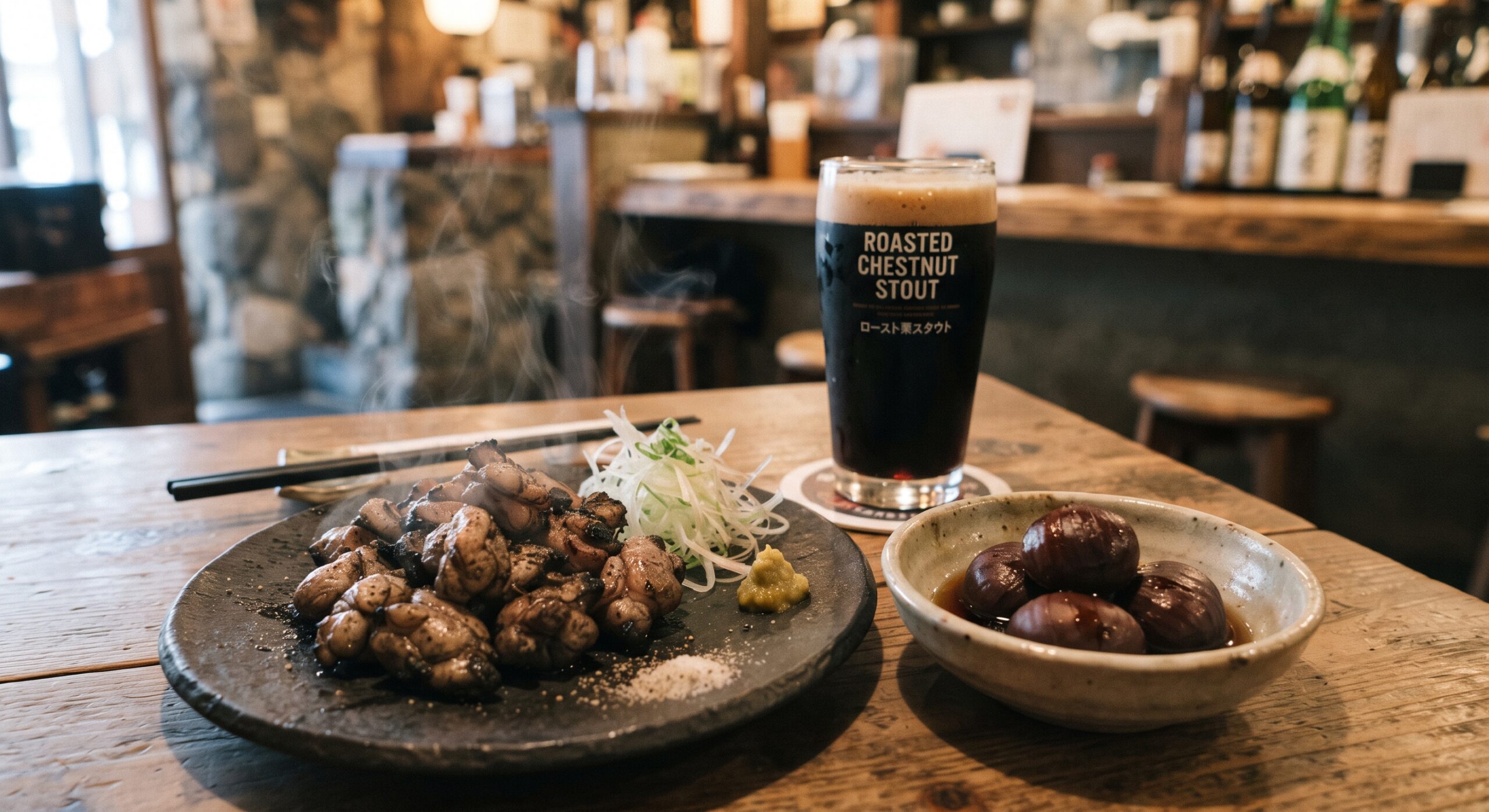
- Charcoal-grilled Miyazaki jitokko chicken
A Miyazaki staple. The toastiness of chicken seared fast over charcoal runs in the same direction as the roasted barley’s aroma. Grilled with just salt, rather than a sweet sauce, it stays out of the way of the beer’s chestnut note. - Chestnuts simmered in their inner skins (shibukawa-ni)
Chestnut on chestnut. The faint astringency left in the inner skin links up with the astringency of deeply roasted malt, so the sweetness never dominates.
A note on the science: roasted barley’s toastiness comes from the Maillard reaction, where sugars and amino acids bond as the grain is kilned at high temperature, and from caramelisation, where the sugars themselves colour. The char on charcoal-grilled chicken skin is the product of the same reactions, so the aroma families line up and gain depth. At 15 IBU, Kuri Kuro is low in bitterness, so the job of cutting through fat falls not to bitterness but to carbonation and 9% alcohol. The astringency in shibukawa-ni comes from tannins, working in the same direction as the astringency of heavily roasted malt, which keeps the chestnut sweetness from floating off on its own.
Visiting the Brewery
The brewery sits at 747-58 Mukabaki-cho, Nobeoka, Miyazaki, at the foot of Mt. Mukabaki. It is about 30 minutes by car from JR Nobeoka Station and about 20 minutes from the Nobeoka interchange on the Higashi-Kyushu Expressway. By public transport, it is a seven-minute walk from the Miyazaki Kotsu bus stop named “Mukabaki-zan Tozanguchi” (Mt. Mukabaki trailhead).
Sights Nearby
- Mt. Mukabaki and Mukabaki Falls / Nobeoka | about 2 min by car, about 0.5 km from the brewery (about a 7-minute walk)
Mt. Mukabaki rises 831 meters, and between its two rock peaks — Odake and Medake — Mukabaki Falls drops 77 meters, one of Japan’s “100 Best Waterfalls.” The falls are about 60 minutes on foot from the trailhead. The brewery’s nearest bus stop is literally named after that trailhead. - Mukabaki Shrine / Mukabaki-cho, Nobeoka | about 2 min by car, about 0.5 km from the brewery
An old shrine at the foot of Mt. Mukabaki, enshrined here for more than 1,300 years. Mukabaki Falls itself is treated as one of its sacred bodies. Open for worship from 7:30 a.m. to 4:30 p.m., with parking for about ten cars; hikers and those heading for the falls are directed to the trailhead car park further up.
Opening hours and closing days can change. Please check each facility’s official information before visiting.
A Quick Glossary of Beer Terms
- Craft beer: Beer made by small breweries that put the character of the maker front and centre, as opposed to the uniformity of mass production.
- Ale: Beer made by top fermentation, where the yeast works near the surface at temperatures closer to room temperature. It tends to show fruity aromas and a fuller body.
- Stout: A dark ale made with roasted barley, marked by coffee- or chocolate-like toastiness and a smooth mouthfeel.
- Malt: Germinated barley (or wheat). It forms the foundation of a beer’s sweetness, colour and body; how deeply it is roasted determines colour and toastiness.
- ABV: Alcohol By Volume. Beer typically runs around 5%; above 8% is considered strong.
- IBU: An international measure of bitterness. Around 10 you barely notice it; above 60 you are in clearly bitter IPA territory.
Sources
- Miyazaki Hideji Beer (official, Japanese)
- Kuri Kuro — Dark Chestnut Ale (official, Japanese)
- Hideji Story (official, Japanese)
- About Hideji Beer (official, Japanese)
- Company profile (official, Japanese)
- Access (official, Japanese)
- Mt. Mukabaki and Mukabaki Falls — City of Nobeoka (official, Japanese)
- Mt. Mukabaki and Mukabaki Falls — Miyazaki Prefecture official tourism site (Japanese)
- Mukabaki Shrine (official, Japanese)
- “Jidai” (Miyuki Nakajima song) — Wikipedia (Japanese)
- Miyuki Nakajima — Wikipedia (Japanese)
If you notice any errors in this article, please don’t hesitate to reach out at info@soundrecords.jp.
Read this article in Japanese: めぐりながら、まろやかになる