日本語で読む | This is the English version of a bilingual article.
Today’s Pairing
- Sake: Nabeshima Junmai Ginjo Yamada Nishiki — brewed with Yamada Nishiki sake rice, rice-polishing ratio (seimai buai) 50%, 16% alcohol / Fukuchiyo Shuzo Co., Ltd. (1244-1 Hamamachi, Kashima City, Saga Prefecture)
Official site: https://nabeshima.biz/ - Kayoukyoku (classic Japanese popular song): “Osho” (“King’s General,” a shogi piece) by Murata Hideo, 1961
YouTube: https://www.youtube.com/watch?v=nPpA2JZdwTU
▶ If the player above doesn’t play, open it on YouTube
The Story of the Brewery
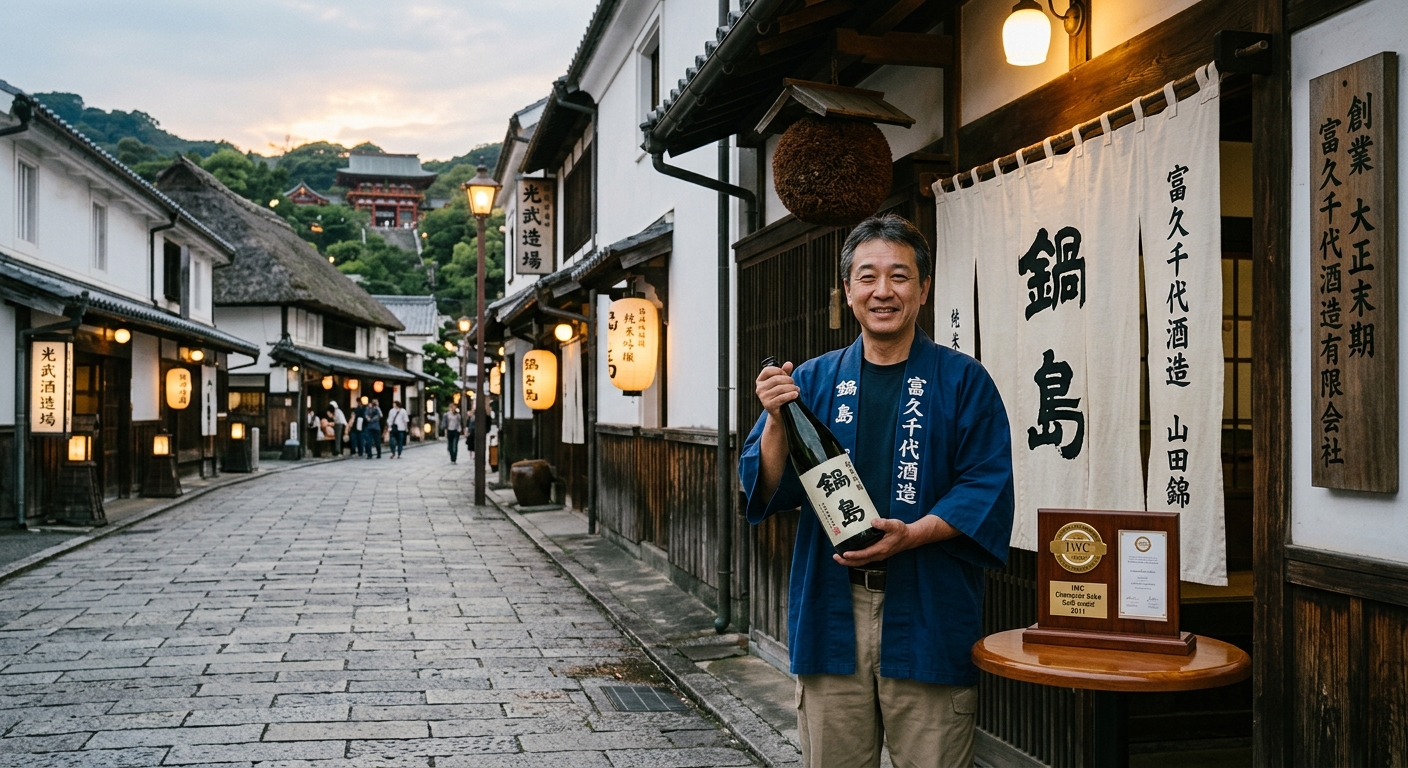
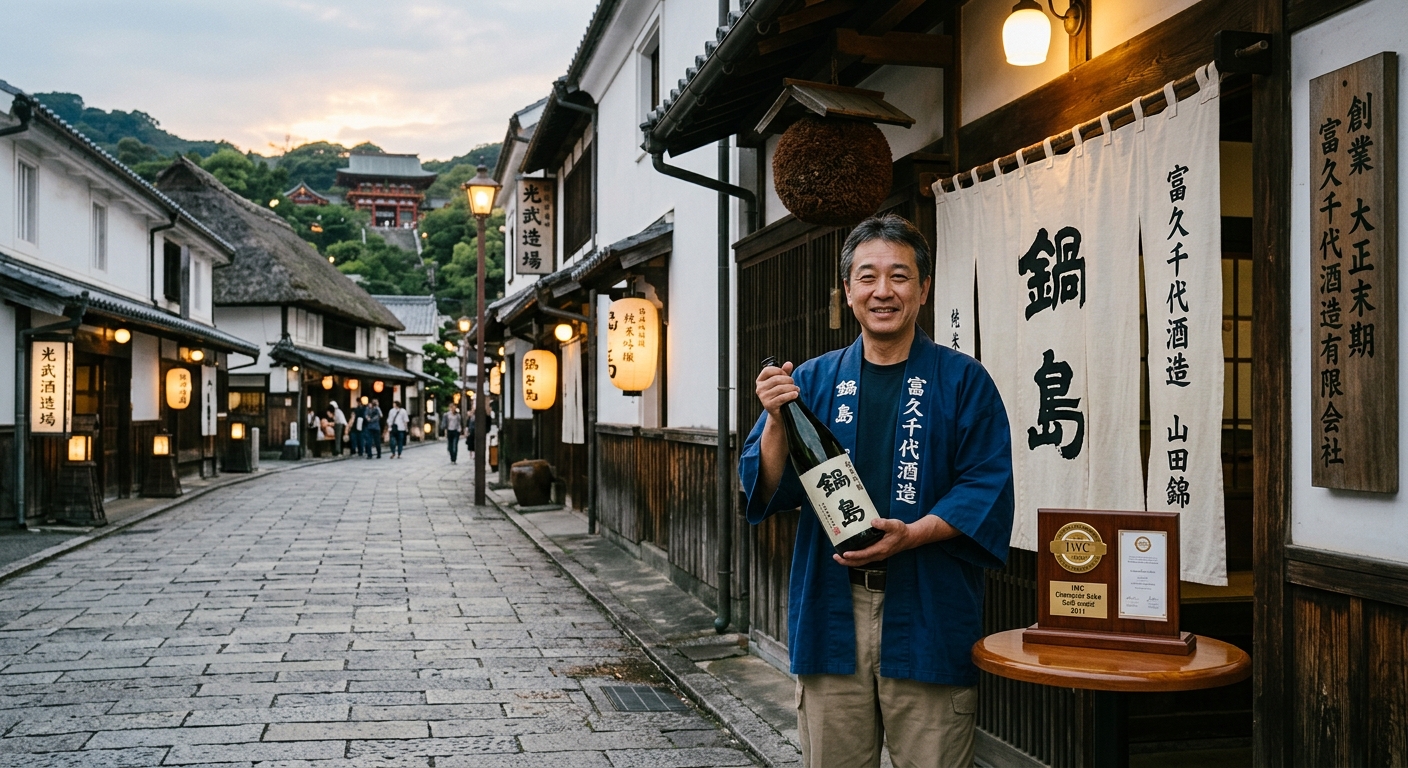
Fukuchiyo Shuzo Co., Ltd. was founded in the closing years of the Taisho era under the name “Seiju.” After a wartime corporate reorganization and postwar rebuilding, it took the name Fukuchiyo, and marked its 100th anniversary in 2023. The turning point came in 1987, when Iimori Naoki became the brewery’s third-generation owner. Foreseeing that deregulation in sake sales would make survival harder for both small breweries and local liquor shops, he teamed up with local retailers, and after three years of planning, completed a new brand in 1998: Nabeshima. The name was chosen through a public naming contest, and permission to use it is said to have been granted by descendants of the Nabeshima clan, the former lords of the Kashima domain.
This small brewery’s new venture eventually reached the world stage. At the 2011 International Wine Challenge (IWC), “Nabeshima Daiginjo” won Champion Sake, the top prize in the sake category, while “Nabeshima Tokubetsu Junmai” won a gold medal. The bottle in this pairing, Nabeshima Junmai Ginjo Yamada Nishiki, is brewed with Yamada Nishiki — often called the king of sake rice — polished to a seimai buai of 50%, at 16% alcohol. It’s a Junmai Ginjo (Junmai — sake made only from rice, rice koji, and water — polished to 60% or less and fermented slowly at low temperatures) with a sweet, fruity aroma and the rich rice umami characteristic of Yamada Nishiki.
The Story of the Land
The Hamamachi district of Kashima City, where Fukuchiyo Shuzo stands, is known as Hizen-Hama-shuku. Its white-walled breweries and thatched-roof townhouses still stand much as they did from the Edo period through the early Showa era, and in 2006 the townscape was designated a National Important Preservation District for Groups of Historic Buildings. Blessed with abundant groundwater and good rice, this area has long been a center of sake brewing, and even today three breweries — including Fukuchiyo — stand within walking distance of one another along the brewery street.
About six minutes away by car is Yutoku Inari Shrine, one of Saga Prefecture’s leading shrines, where vermilion halls climb partway up the mountainside. Many visitors combine a stop here with a tour of Kashima’s breweries.
The Story of the Song
Murata Hideo, who sang “Osho,” was born on January 17, 1929, in what was then Aichi-cho, Higashimatsuura District, Saga Prefecture — now part of Karatsu City. At age five he apprenticed under the rokyoku (traditional narrative singing) performer Sakai Un, performing under the name “Sakai Unbo.” He was promoted to full performer status at 13 and led his own troupe at 14 — a remarkably early start. The turning point came in 1958, when composer Koga Masao heard a radio broadcast of Murata’s performance and discovered him; Murata made his singing debut with a song adapted from the rokyoku tale “Muho Matsu no Issho.”
That collaboration led to Murata’s signature song, “Osho,” released in November 1961. The lyrics are by Saijo Yaso, the music by Funamura Toru. Murata made his first appearance on NHK’s Kohaku Uta Gassen that same year (the 12th edition), and in 1962 he won the Special Award at the 4th Japan Record Awards. He would go on to appear on Kohaku four times in total. The song’s subject was Sakata Sankichi (1870–1946), a shogi (Japanese chess) player active from the Meiji through early Showa eras. Born in Sakai, Osaka, Sakata was self-taught and, standing outside the Tokyo-centered shogi establishment of his day, declared himself “Kansai Meijin” (Kansai Champion) in 1925 — an unconventional path for a player of his era. After his death, a play and film both titled “Osho” became major hits, renewing public attention on his life, and on October 1, 1955, the Japan Shogi Association posthumously awarded him the titles of Meijin (Master) and Osho (King’s General). To this day, he remains the only person ever to receive the posthumous title of Osho.
Why This Pairing
Sakata Sankichi taught himself shogi far from the game’s establishment and declared himself Kansai Champion on his own terms. Murata Hideo performed as a rokyoku artist before rising, from a small town in Saga, to the very top of kayoukyoku. And Fukuchiyo, a small brewery that partnered with local retailers, earned the world’s top honor armed with nothing but careful, deliberate brewing. What all three share is a story of reaching the summit through their own skill alone, starting from places with no great backing behind them.
The line in “Osho” — “a shogi piece so light a puff of wind could blow it away” — sounds almost like an anthem for anyone who never started from a position of privilege. As you raise a glass of sake brewed in this small corner of Hizen-Hama, it’s worth taking a moment to reflect on that journey.
Where to Find This Bottle
The Rakuten Ichiba link below is an affiliate link.
- Brewery’s official site: https://nabeshima.biz/
- Buy on Rakuten Ichiba: View the product page (720ml, ¥3,850)
Note: the links above lead to Japan-based retailers. They’re most convenient for readers in Japan, or for those elsewhere who are able to arrange international shipping. Stock and availability change over time, so if you’re near a specialty sake shop, it’s well worth asking for this label by name.
Pairing Dishes Worth Trying
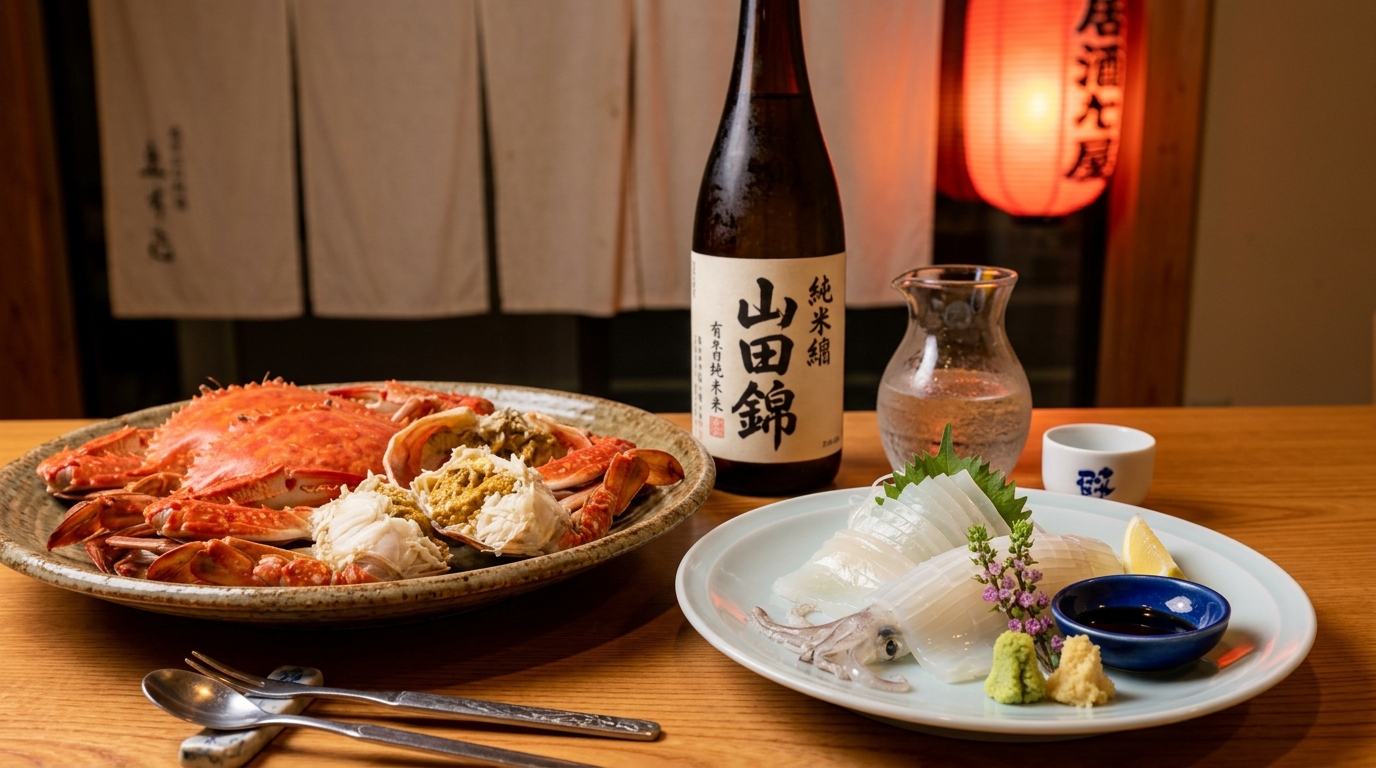
- Boiled Takezaki crab (blue swimmer crab)
A specialty of Tara, the town just south of Kashima, raised in the vast tidal flats of the Ariake Sea. Its dense meat and rich crab roe echo the rich rice umami of Yamada Nishiki.
Recipe (in Japanese): Kurashiru, “How to Boil Blue Swimmer Crab” - Yobuko kensaki squid sashimi
A specialty of Karatsu City — the same city that now includes Aichi-cho, Murata Hideo’s birthplace. Known for its crisp texture and delicate sweetness, it pairs naturally with the gentle ginjo aroma of this Junmai Ginjo.
Recipe (in Japanese): Kurashiru, “How to Slice Squid Sashimi”
A note on the science: sweet-tasting amino acids such as glycine, abundant in crab and squid, resonate with the rice-derived amino-acid umami in sake, creating a synergistic boost of savoriness on the palate. The organic acids in sake are also known to soften the compounds responsible for seafood’s fishy notes, which is part of why raw seafood and sake have long been considered a natural match.
Visiting the Brewery
Fukuchiyo Shuzo (brewer of Nabeshima)
1244-1 Hamamachi, Kashima City, Saga Prefecture. About a 5-min walk from JR Hizen-Hama Station; about 30 min by car from Takeo-Kitakata IC on the Nagasaki Expressway.
The brewery sits within “Hizen-Hama-shuku Sakagura-dori,” a street of white-walled sake breweries and thatched-roof townhouses designated a National Important Preservation District for Groups of Historic Buildings.
Sights Nearby
- Hizen-Hama-shuku Sakagura-dori (Sake Brewery Street) / Kashima City | walking distance from Fukuchiyo Shuzo
A townscape of white-walled breweries and thatched-roof houses dating from the Edo to early Showa eras. Three breweries, including Fukuchiyo, sit within walking distance of each other here. - Yutoku Inari Shrine / Furueda, Kashima City | about 6 min by car from the brewery
A major shrine whose vermilion halls climb partway up Mt. Inari. Check the official site for visiting hours and parking before you go.
Hot Springs Nearby
- Hizen Yutoku Onsen “Takara no Yu” / Nodomibun, Kashima City | about 15 min by car from the brewery
A day-use hot spring near Yutoku Inari Shrine, drawing simple thermal water from 1,000m underground. Adult admission is ¥900 (as listed on the official site in 2026). Hours and rates can change, so please check ahead.
Opening hours, closing days and day-use bathing availability can change. Please check each facility’s official information before visiting.
A Quick Glossary of Sake Terms
- Junmai Ginjo: Junmai (sake made only from rice, rice koji, and water, with no added brewing alcohol) that has been polished to a seimai buai of 60% or less and fermented slowly at low temperatures, giving it a fragrant aroma.
- Seimai buai (rice-polishing ratio): The percentage of the original grain remaining after milling. The lower the number, the more the rice has been polished down.
Sources
- Fukuchiyo Shuzo Co., Ltd. – Official Site (Nabeshima)
- Nabeshima – Official Site (English)
- Sake – Fukuchiyo Shuzo Official Site
- Fukuchiyo Shuzo – Wikipedia (Japanese)
- “Osho” (song) – Wikipedia (Japanese)
- Murata Hideo – Wikipedia (Japanese)
- Sakata Sankichi – Wikipedia (Japanese)
- About Hizen-Hama-shuku – Kashima City Tourism Association
- Access – Yutoku Inari Shrine Official Site
- Hizen Yutoku Onsen – Yutoku Onsen Group Official Site
If you notice any errors in this article, please don’t hesitate to reach out at info@soundrecords.jp.
Read this article in Japanese: 誰も知らない場所から、世界の頂点へ