日本語で読む | This is the English version of a bilingual article.
Today’s Pairing
- Sake: Shichiken “Birodo no Aji” (“The Taste of Velvet”) Junmai Ginjo — brewed with Yamanashi-grown Yumesansui sake rice, rice-polishing ratio (seimai buai) 57%, 15% alcohol / Yamanashi Meijo Co., Ltd. (2283 Daigahara, Hakushu-cho, Hokuto City, Yamanashi Prefecture)
Official site: https://www.sake-shichiken.co.jp/ - Kayoukyoku (classic Japanese popular song): “Takeda-bushi” by Mihashi Michiya, 1961
YouTube: https://www.youtube.com/watch?v=0TyNGDEVWrQ
▶ If the player above doesn’t play, open it on YouTube
The Story of the Brewery
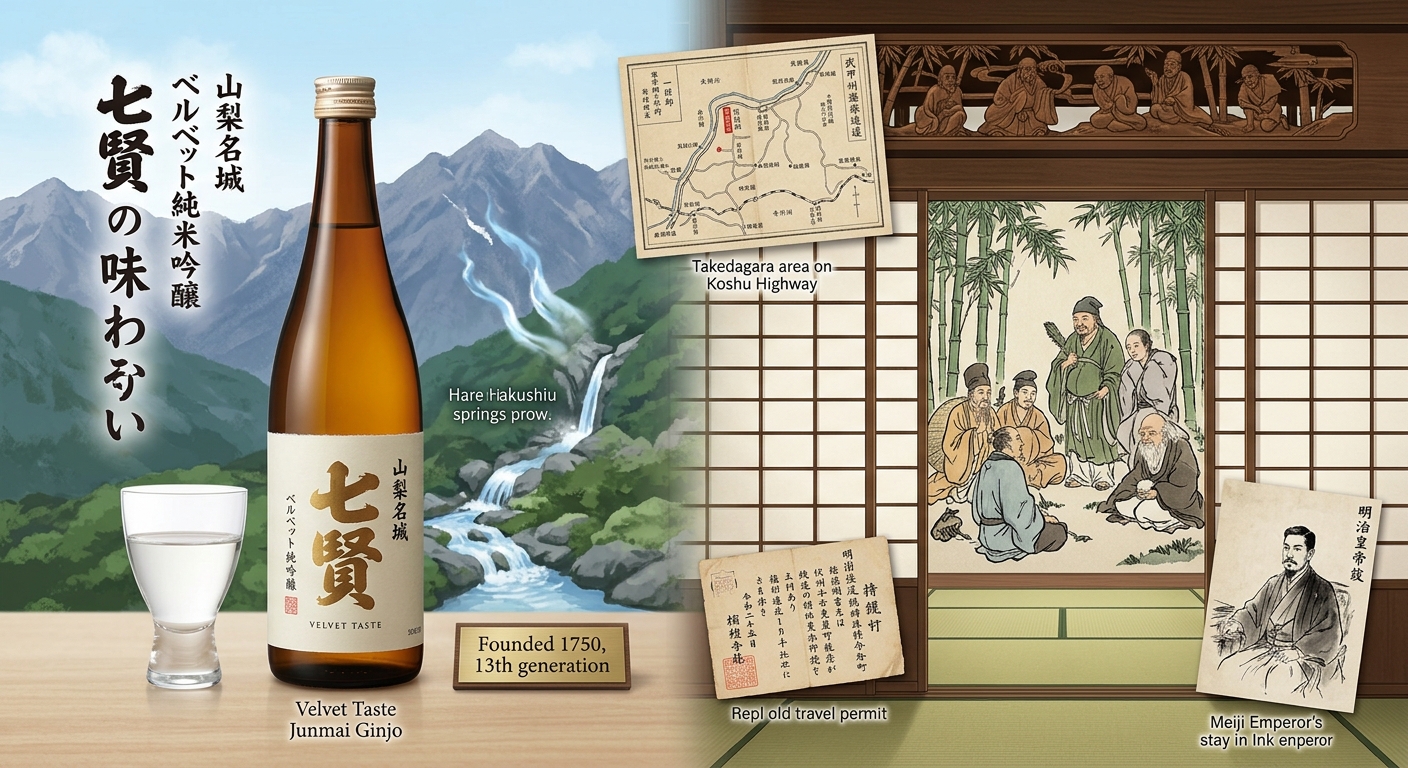
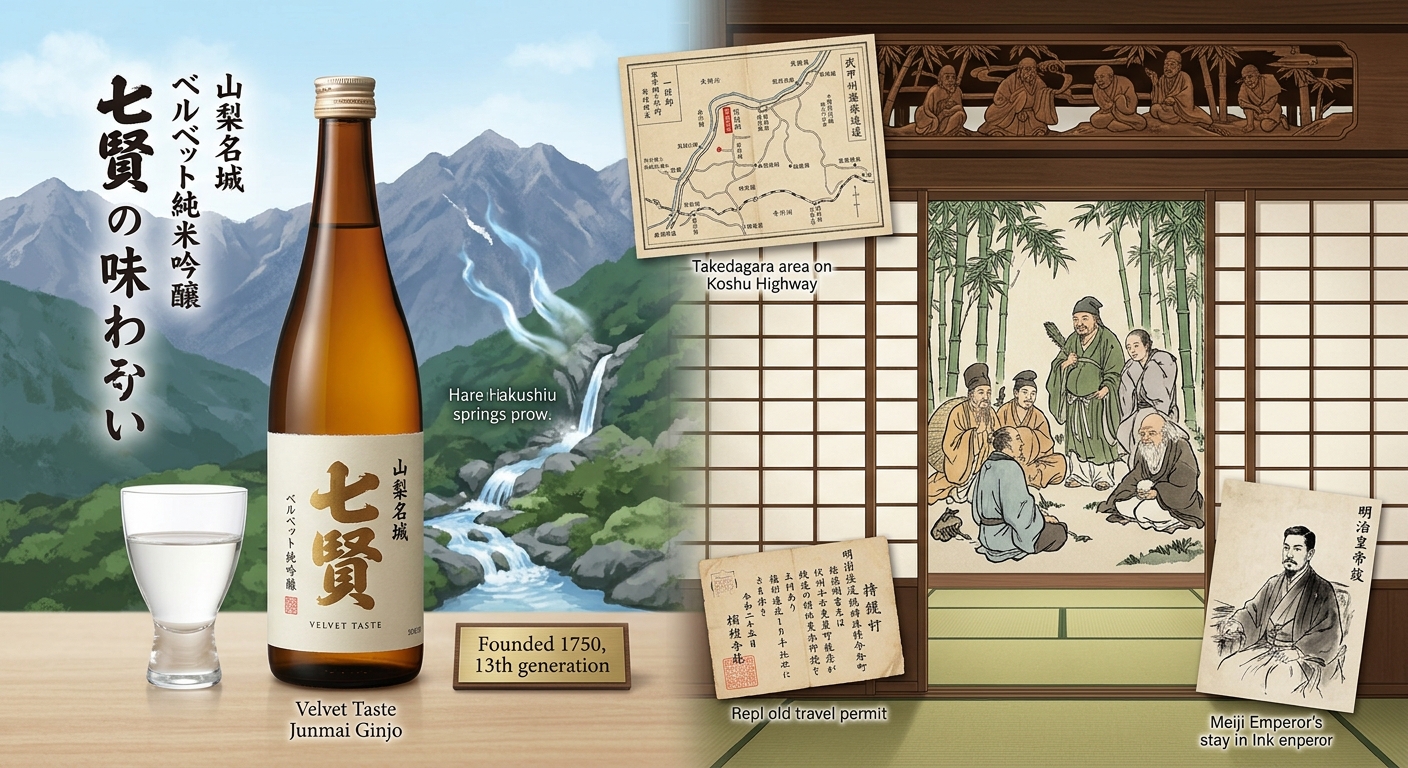
Yamanashi Meijo Co., Ltd. was founded in 1750. According to the brewery’s own account, its founder, Kitahara Ihee, came from a branch of the Kitahara family who had run a sake business in Takato, in Shinshu (present-day Ina City, Nagano Prefecture). While passing through Daigahara, a post town on the old Koshu Kaido highway, he fell in love with the local Hakushu spring water and opened a brewery there. In 1835, when the fifth-generation owner rebuilt the main house, the lord of the Takato domain at the time, Naito Suruga-no-kami, gave him a set of transom carvings depicting the “Seven Sages of the Bamboo Grove” — and the brewery took its name, Shichiken (“Seven Sages”), from that gift. In 1880, during an imperial tour, the inner parlor of the main house was chosen as the Emperor Meiji’s lodging, with the sixth-generation owner serving as his host. Today the thirteenth-generation owner, Kitahara Tsushima, serves as president, with his younger brother Kitahara Ryoko as executive director and head brewer, continuing to brew with spring water drawn from Mt. Kai-Komagatake in the Southern Alps.
The bottle in this pairing, “Birodo no Aji” (“The Taste of Velvet”) Junmai Ginjo, is brewed with Yumesansui, a sake rice variety Yamanashi Prefecture designates as recommended for sake brewing, polished to a seimai buai of 57%, at 15% alcohol. It’s a junmai ginjo — sake made only from rice, rice koji, and water, fermented at low temperatures for a fragrant aroma — known for its crisp fruit-forward character and light acidity, with a smoothness that lives up to its “velvet” name. It’s one of Shichiken’s standard, everyday bottles.
The Story of the Land
Daigahara, in Hakushu-cho, Hokuto City, grew up as a post town along the old Koshu Kaido highway. Just to the north stands Mt. Kai-Komagatake (2,967m), one of Japan’s “100 Famous Mountains,” and the spring water flowing down from the Southern Alps has long supported sake, whisky, and mineral water production across this area. Less than ten minutes by car from Daigahara sits the Suntory Hakushu Distillery — a sake brewery and a whisky distillery standing close together, drawn by the same water.
“Kai” is also the name of the old province where the Sengoku-period warlord Takeda Shingen made his base. Takato, the hometown of Shichiken’s founder Kitahara Ihee, was significantly rebuilt in 1547 by Shingen’s retainer Akiyama Nobutomo and remained an important Takeda stronghold for 35 years. The Naito family, who later gave the brewery its name-inspiring transom, only became lords of Takato in the Edo period, well after Takeda rule ended — but the town itself had been bound up with Takeda Shingen long before the brewery ever existed.
Hokuto City holds another site tied to Shingen and water: Sanbuichi Yusui, a spring about 15 minutes by car from Daigahara. According to local tradition, Shingen built a triangular stone pillar at the spring’s outlet to divide the flow evenly three ways, settling a water dispute among three villages.
The Story of the Song
“Takeda-bushi” was written in 1961, with lyrics by Yoneyama Aishi and music by Akemoto Kyosei. It was first recorded by Mihashi Michiya, and that record became a million-seller. A distinctive feature of the song is a passage of shigin (chanted poetry) reciting the words associated with Takeda Shingen’s battle standard — “swift as the wind, silent as the forest, fierce as fire, immovable as the mountain,” known as Furinkazan.
At the time, Yamanashi Prefecture had almost no folk song it could call its own. “Takeda-bushi,” originally written as a new song in folk-song style, filled that gap and has been sung ever since; today it’s treated as Yamanashi’s own min’yo (folk song). Since 2016 it has been used as the departure melody at JR Isawa Onsen Station, and it’s also designated as the school fight song of Tsuru University — cementing its place as a song that represents Yamanashi Prefecture.
Why This Pairing
Kai, the province Takeda Shingen ruled in “Takeda-bushi,” is the very same old name for the Yamanashi Prefecture where Shichiken brews its sake. Mt. Kai-Komagatake, rising near the brewery, carries that same name “Kai.”
And the brewery’s own origin quietly connects to Shingen’s territory as well. Takato, the hometown of founder Kitahara Ihee, was a town significantly rebuilt by Shingen’s retainers and remained a Takeda stronghold for 35 years. It was from that same Takato that the founder came to Daigahara and, falling in love with the water of Hakushu, began brewing — the start of Shichiken’s three centuries.
The nearby legend of Sanbuichi Yusui, where Shingen is said to have divided a water dispute three ways, speaks to a local spirit of treating water with care. A sake born from falling in love with water, and a land that still carries the wisdom of dividing it fairly — let that connection settle in as you pour a glass of “Birodo no Aji.”
Where to Find This Bottle
The Rakuten Ichiba link below is an affiliate link.
- Brewery’s official site: https://www.sake-shichiken.co.jp/
- Buy on Rakuten Ichiba: View the product page (720ml, ¥1,815)
Note: the links above lead to Japan-based retailers. They’re most convenient for readers in Japan, or for those elsewhere who are able to arrange international shipping. Stock and availability change over time, so if you’re near a specialty sake shop, it’s well worth asking for this label by name.
Pairing Dishes Worth Trying
- Kofu Torimotsu-ni (simmered chicken giblets)
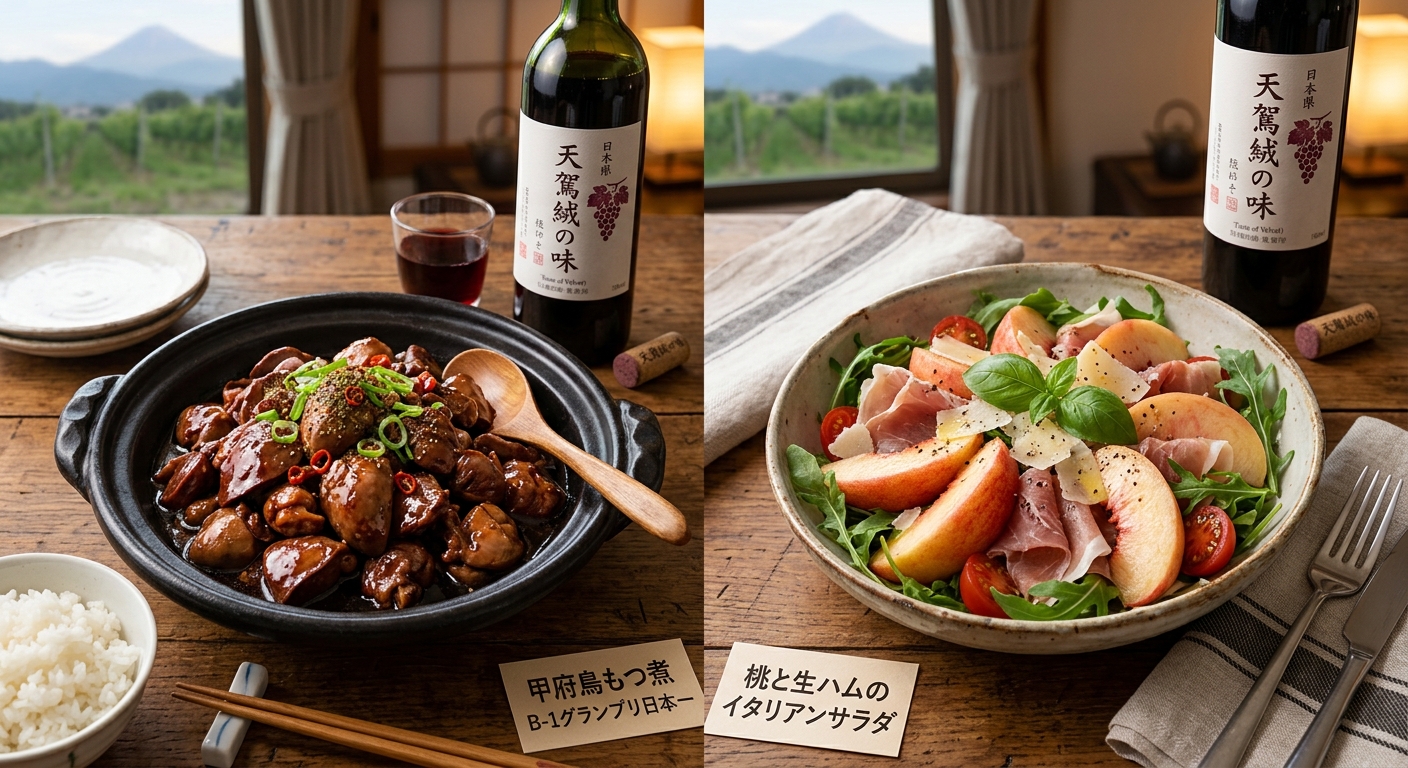
Yamanashi’s signature local dish: chicken liver, gizzard, and heart simmered to a glossy finish in soy sauce, sugar, and mizuame syrup, until it took the top prize at the 5th B-1 Grand Prix (a nationwide contest for local comfort food) in 2010. The light acidity of “Birodo no Aji” cuts cleanly through the umami of the giblets and the sweet-savory glaze, refreshing the palate.
Recipe (in Japanese): Kurashiru, “Torimotsu-ni” - Peach and prosciutto Italian salad
Yamanashi is Japan’s top producer of peaches. A salad of ripe peach and prosciutto, tossed with olive oil and red wine vinegar, resonates directly with the fruit-forward aroma of “Birodo no Aji.”
Recipe (in Japanese): Kurashiru, “Peach and Prosciutto Italian Salad”
A note on the science: heating the sweet-savory glaze on torimotsu-ni drives the Maillard reaction, producing toasty aromatic compounds that echo a sake’s own ginjo aroma, so the two reinforce each other. The acetate-ester aromatic compounds in ripe peach are structurally close to the fruit-like ginjo aromas in sake, so pairing the two makes the fruitiness of both stand out even more.
Visiting the Brewery
Shichiken (Yamanashi Meijo Co., Ltd.)
2283 Daigahara, Hakushu-cho, Hokuto City, Yamanashi. About a 15-min taxi ride from JR Hinoharu or Nagasaka Station; about 20 min by car from Kobuchisawa IC or Sutama IC on the Chuo Expressway.
The attached shop, “Sakadokoro Onakaya,” offers tastings (10:00–17:00), and guided tours of the main house — once a lodging for Emperor Meiji — are available a few times a day by reservation.
Sights Nearby
- Suntory Hakushu Distillery / Hakushu-cho, Hokuto City | ~6 min, ~5 km by car from Shichiken
A whisky distillery drawing on the same Southern Alps / Kai-Komagatake spring water as Shichiken. Guided tours (reservation required), plus a shop and bar. Check the official site for hours and tour availability before visiting. - Michinoeki Hakushu (roadside station) / Hakushu-cho, Hokuto City | ~2 min, ~1 km by car from Shichiken
Has a free water-drawing spot for the celebrated “Hakushu” spring water, plus a farmers’ market and food court. It closed temporarily in 2019 but is back to regular operation now. - Sanbuichi Yusui (spring) & Sanbuichi Yusuikan / Nagasaka-cho, Hokuto City | ~15 min, ~13 km by car from Shichiken
A famous spring said to have been divided evenly three ways by Takeda Shingen himself, to settle a water dispute among three villages. The adjoining visitor center also serves hand-cut soba.
Hot Springs Nearby
- Kai-Komagatake Onsen “Oshiro no Yu” (at Hakushu Oshiro no Mori Meisui Park “Verga”) / Hakushu-cho, Hokuto City | ~6 min, ~4 km by car from Shichiken
A brownish, sodium-chloride hot spring drawn from deep beneath the Oshirogawa river. Day-use bathing 10:00–21:00 (last entry 20:30), closed Wednesdays (or the following Thursday on a public holiday). ¥830 for adults (¥410 for Hokuto City residents).
Opening hours, closing days and day-use bathing availability can change. Please check each facility’s official information before visiting.
A Quick Glossary of Sake Terms
- Junmai Ginjo: Junmai (sake made only from rice, rice koji, and water, with no added brewing alcohol) that has been polished to a seimai buai of 60% or less and fermented slowly at low temperatures, giving it a fragrant aroma.
- Seimai buai (rice-polishing ratio): The percentage of the original grain remaining after milling. The lower the number, the more the rice has been polished down.
Sources
- Yamanashi Meijo Co., Ltd. “Shichiken” – Official Site
- 300 years of history – Shichiken Official Site (English)
- Shichiken / Yamanashi Meijo – Hokuto City Tourism Association
- The Water That Gave Birth to “Shichiken” – NIHONMONO
- Takeda-bushi – Wikipedia (Japanese)
- Takato Castle – Wikipedia (Japanese)
- Sanbuichi Yusui – Nippon Tabi Magazine
- Yamanashi Prefecture – Things Yamanashi Is Number One In (Official Site)
If you notice any errors in this article, please don’t hesitate to reach out at info@soundrecords.jp.
Read this article in Japanese: 水に惚れた蔵は、三百年を醸してきた