今日のペアリング
▶ 上のプレーヤーで再生できない場合は、YouTubeで開く
酒蔵の話
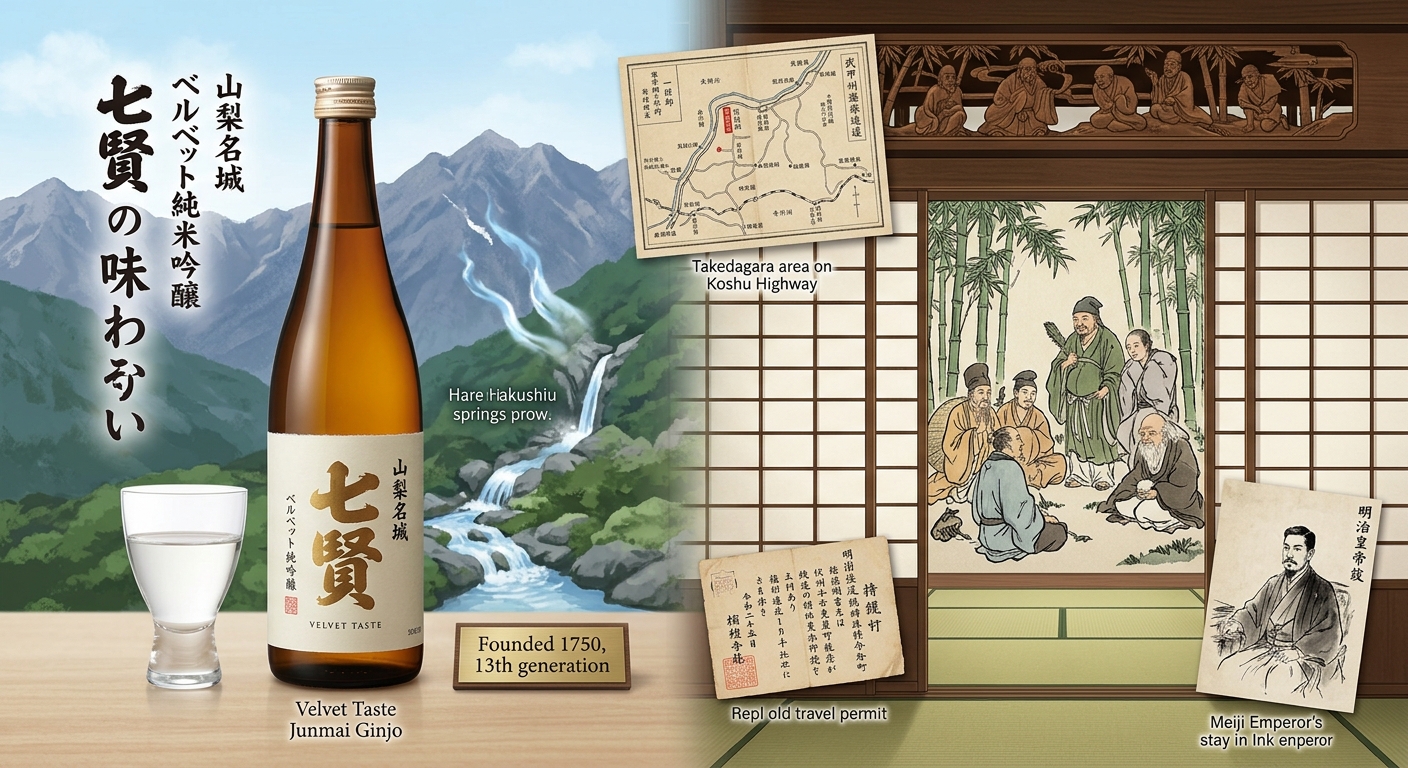
山梨銘醸株式会社の創業は寛延3年(1750年)。信州高遠(現・長野県伊那市高遠町)で酒造業を営んでいた北原家から分かれた初代・北原伊兵衛が、甲州街道の宿場町・台ヶ原を訪れた際、この地に湧く白州の水に惚れ込んで酒蔵を開いたのが始まりと、蔵元は公式サイトで伝えています。天保6年(1835年)、五代目当主が母屋を新築した際、当時の高遠藩主・内藤駿河守から「竹林の七賢人」を描いた欄間が贈られ、これにちなんで酒銘を「七賢」と定めました。明治13年(1880年)には明治天皇の巡幸にあたって母屋の奥座敷が行在所(宿泊所)に選ばれ、六代目当主が接待役を務めています。現在は十三代目・北原対馬氏が代表取締役社長を、弟の北原亮庫氏が専務取締役兼醸造責任者を務め、南アルプス・甲斐駒ヶ岳の伏流水を使った酒造りを続けています。
今回合わせる「天鵞絨(ビロード)の味 純米吟醸」は、山梨県が奨励品種に指定している酒造好適米「夢山水」を精米歩合57%まで磨き、アルコール度数15%で仕込んだ一本。キレのいい果実味と軽快な酸味が身上で、名前の通りなめらかな口当たりの、七賢の定番酒です。
土地の話
蔵のある北杜市白州町台ヶ原は、甲州街道の宿場町として栄えた町です。すぐ北には日本百名山の一つ・甲斐駒ヶ岳(標高2,967m)が控え、南アルプスの伏流水がこの土地一帯の酒・ウイスキー・ミネラルウォーターづくりを支えてきました。台ヶ原から車で10分弱の場所にはサントリー白州蒸溜所があり、同じ水を求めて酒とウイスキーの蔵がすぐそばに並んでいます。
「甲斐」は、戦国大名・武田信玄が本拠を置いた国の名でもあります。七賢の初代・北原伊兵衛の故郷である信州高遠は、天文16年(1547年)に信玄の家臣・秋山信友らによって大改修され、以後35年にわたって武田氏の重要拠点であり続けた城下町でした。「七賢」という酒銘の由来となった欄間を贈った内藤家が高遠藩主になったのは、それよりのちの江戸時代のことですが、この土地自体は、蔵が生まれるよりずっと前から武田信玄と深く結びついていたことになります。
北杜市には、信玄ゆかりの水にまつわる場所がもう一つあります。台ヶ原から車で15分ほどの三分一湧水です。かつて三つの村が水を奪い合っていたのを収めるため、信玄が湧水の出口に三角の石柱を築き、三方向へ均等に水を分けさせたと伝えられています。
音楽の話
「武田節」は昭和36年(1961年)、作詞・米山愛紫、作曲・明本京静によって作られた歌謡曲です。最初にレコードに吹き込んだのは三橋美智也で、このレコードはミリオンセラーとなりました。武田信玄の軍旗の言葉として知られる「疾如風、徐如林、侵掠如火、不動如山」、いわゆる「風林火山」を詩吟で読み上げる一節が曲の中に組み込まれているのが特徴です。
当時、山梨県には代表的な民謡と呼べる曲がほとんどありませんでした。もともと民謡調の新作歌謡として作られた「武田節」は、その空白を埋めるようにして歌い継がれ、今では山梨県の民謡として扱われています。平成28年(2016年)からはJR石和温泉駅の発車メロディに採用され、都留文科大学の応援歌にも指定されるなど、山梨県を代表する一曲としての地位を確かなものにしています。
なぜこの組み合わせなのか
「武田節」が歌う武田信玄の本拠地・甲斐は、まさに七賢が酒を醸す山梨県の旧国名です。蔵のそばにそびえる甲斐駒ヶ岳も、その名に「甲斐」を宿しています。
そして、蔵の始まりそのものが、信玄ゆかりの土地と静かにつながっています。初代・北原伊兵衛の故郷である信州高遠は、かつて信玄の家臣によって大改修され、35年にわたって武田氏の拠点であり続けた城下町でした。その高遠から台ヶ原へやってきた初代が、白州の水に惚れ込んで酒を仕込み始めたのが、七賢三百年の始まりです。
近くの三分一湧水に伝わる、水争いを三方向へ分けて収めたという信玄の逸話も、水を大切に、丁寧に扱ってきたこの土地の気風を物語っています。水に惚れて蔵を開いた酒と、水を分けた知恵を今に伝える土地の物語――「天鵞絨の味」の一杯を傾けながら、そんな結びつきに思いを馳せてみてください。
この一本を、探すなら
※楽天市場へのリンクは広告(アフィリエイト)です。在庫・取扱いは変動します。お近くの酒販店でも、ぜひ銘柄名を伝えて探してみてください。
🌡️ おすすめの飲み方:よく冷やして。夢山水ならではのキレのいい果実味と、天鵞絨の名の通りなめらかな口当たりが、冷やすことで一番きれいに引き立ちます。
合わせたい「アテ」
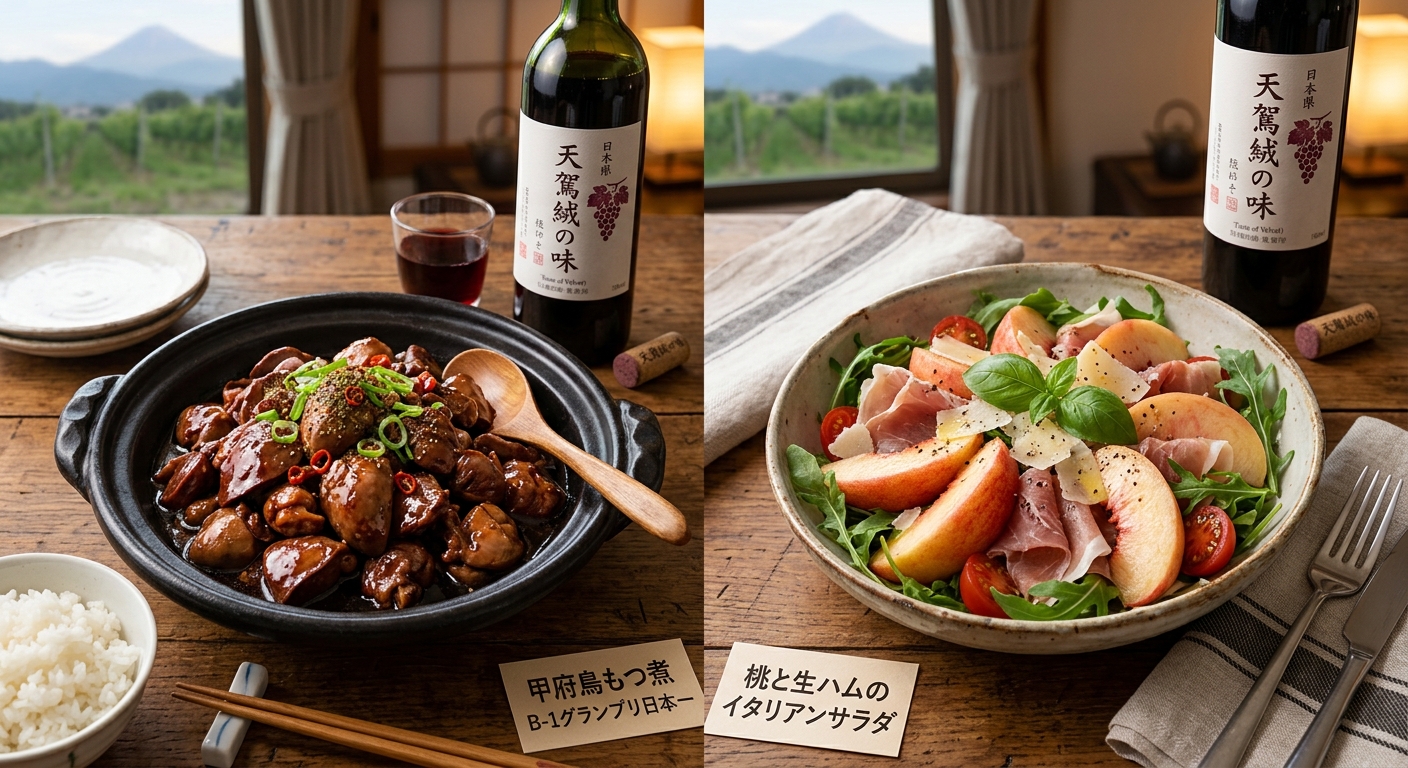
- 甲府鳥もつ煮
山梨県を代表するご当地グルメ。鶏のレバー・砂肝・ハツなどを、醤油・砂糖・水飴で照りよく甘辛く煮付けた一品で、2010年の第5回B-1グランプリで日本一に輝きました。もつの旨味と甘辛いタレの後味に、「天鵞絨の味」の軽快な酸味がすっと寄り添い、口の中をさっぱりと引き締めてくれます。
レシピはこちら:クラシル「鶏もつ煮」
- 桃と生ハムのイタリアンサラダ
山梨県は桃の生産量日本一を誇る土地。完熟した桃の甘みと生ハムの塩気を、オリーブオイルと赤ワインビネガーでまとめたサラダは、「天鵞絨の味」が持つ果実香とまっすぐに響き合います。
レシピはこちら:クラシル「桃と生ハムのイタリアンサラダ」
科学的にひとこと:鶏もつの甘辛いタレは加熱によってメイラード反応が進み、香ばしい香気成分を生み出します。この香りは日本酒の吟醸香とも重なり合い、互いの風味を引き立てます。桃に含まれる酢酸エステル類の香気成分は、日本酒の果実様の吟醸香と分子構造が近く、合わせることでフルーティーな印象がより一層際立ちます。
この蔵をたずねるなら
七賢(山梨銘醸株式会社)
山梨県北杜市白州町台ヶ原2283/JR中央本線 日野春駅・長坂駅からタクシーで約15分、中央自動車道 小淵沢IC・須玉ICから車で約20分。
併設の直売店「酒処大中屋」で試飲ができ(10:00〜17:00)、明治天皇の行在所となった母屋の見学(要予約、1日数回)もできます。
近くの観光スポット
- サントリー白州蒸溜所/北杜市白州町鳥原|七賢から車で約6分・約5km
七賢と同じ南アルプス・甲斐駒ヶ岳の伏流水を仕込みに使うウイスキー蒸溜所。見学ツアー(要予約)のほか、ショップやバーも利用できます。予約状況・営業時間は訪問前に公式サイトでご確認ください。
- 道の駅はくしゅう/北杜市白州町白須|七賢から車で約2分・約1km
名水百選「白州の名水」を汲める水汲み場のほか、ファーマーズマーケットや食堂を併設。2019年に一時休業した時期がありますが、現在は通常営業しています。
- 三分一湧水(三分一湧水館)/北杜市長坂町小荒間|七賢から車で約15分・約13km
三つの村の水争いを収めるため、武田信玄が湧水の出口に三角の石柱を築き、三方向へ均等に水を分けさせたと伝わる名水。隣接の三分一湧水館では手打ちそばも味わえます。
近くの温泉
- 甲斐駒ヶ岳温泉 尾白の湯(白州・尾白の森名水公園べるが)/北杜市白州町白須|七賢から車で約6分・約4km
尾白川の地下深くから湧く、褐色の「赤湯」が特徴のナトリウム-塩化物強塩泉。日帰り入浴10:00〜21:00(最終受付20:30)、水曜定休(祝日の場合は翌木曜)。大人830円(北杜市内在住者は410円)。
※営業時間・定休日・日帰り入浴の可否は変わることがあります。おでかけ前に各施設の公式情報をご確認ください。
ひとことメモ(日本酒の用語)
- 純米吟醸酒:精米歩合60%以下まで磨いた米を低温でじっくり発酵させた純米酒。華やかな香りが特徴です。
- 精米歩合:玄米を削り、残った部分の割合。数値が低いほど、米を多く磨いていることを示します。
参考
内容に誤りがございましたら、お手数ですが info@soundrecords.jp までご連絡いただけますと幸いです。
Today’s Pairing
- Sake: Shichiken “Birodo no Aji” (“The Taste of Velvet”) Junmai Ginjo — brewed with Yamanashi-grown Yumesansui sake rice, rice-polishing ratio (seimai buai) 57%, 15% alcohol / Yamanashi Meijo Co., Ltd. (2283 Daigahara, Hakushu-cho, Hokuto City, Yamanashi Prefecture)
Official site: https://www.sake-shichiken.co.jp/
- Kayoukyoku (classic Japanese popular song): “Takeda-bushi” by Mihashi Michiya, 1961
YouTube: https://www.youtube.com/watch?v=0TyNGDEVWrQ
▶ If the player above doesn’t play, open it on YouTube
The Story of the Brewery
Yamanashi Meijo Co., Ltd. was founded in 1750. According to the brewery’s own account, its founder, Kitahara Ihee, came from a branch of the Kitahara family who had run a sake business in Takato, in Shinshu (present-day Ina City, Nagano Prefecture). While passing through Daigahara, a post town on the old Koshu Kaido highway, he fell in love with the local Hakushu spring water and opened a brewery there. In 1835, when the fifth-generation owner rebuilt the main house, the lord of the Takato domain at the time, Naito Suruga-no-kami, gave him a set of transom carvings depicting the “Seven Sages of the Bamboo Grove” — and the brewery took its name, Shichiken (“Seven Sages”), from that gift. In 1880, during an imperial tour, the inner parlor of the main house was chosen as the Emperor Meiji’s lodging, with the sixth-generation owner serving as his host. Today the thirteenth-generation owner, Kitahara Tsushima, serves as president, with his younger brother Kitahara Ryoko as executive director and head brewer, continuing to brew with spring water drawn from Mt. Kai-Komagatake in the Southern Alps.
The bottle in this pairing, “Birodo no Aji” (“The Taste of Velvet”) Junmai Ginjo, is brewed with Yumesansui, a sake rice variety Yamanashi Prefecture designates as recommended for sake brewing, polished to a seimai buai of 57%, at 15% alcohol. It’s a junmai ginjo — sake made only from rice, rice koji, and water, fermented at low temperatures for a fragrant aroma — known for its crisp fruit-forward character and light acidity, with a smoothness that lives up to its “velvet” name. It’s one of Shichiken’s standard, everyday bottles.
The Story of the Land
Daigahara, in Hakushu-cho, Hokuto City, grew up as a post town along the old Koshu Kaido highway. Just to the north stands Mt. Kai-Komagatake (2,967m), one of Japan’s “100 Famous Mountains,” and the spring water flowing down from the Southern Alps has long supported sake, whisky, and mineral water production across this area. Less than ten minutes by car from Daigahara sits the Suntory Hakushu Distillery — a sake brewery and a whisky distillery standing close together, drawn by the same water.
“Kai” is also the name of the old province where the Sengoku-period warlord Takeda Shingen made his base. Takato, the hometown of Shichiken’s founder Kitahara Ihee, was significantly rebuilt in 1547 by Shingen’s retainer Akiyama Nobutomo and remained an important Takeda stronghold for 35 years. The Naito family, who later gave the brewery its name-inspiring transom, only became lords of Takato in the Edo period, well after Takeda rule ended — but the town itself had been bound up with Takeda Shingen long before the brewery ever existed.
Hokuto City holds another site tied to Shingen and water: Sanbuichi Yusui, a spring about 15 minutes by car from Daigahara. According to local tradition, Shingen built a triangular stone pillar at the spring’s outlet to divide the flow evenly three ways, settling a water dispute among three villages.
The Story of the Song
“Takeda-bushi” was written in 1961, with lyrics by Yoneyama Aishi and music by Akemoto Kyosei. It was first recorded by Mihashi Michiya, and that record became a million-seller. A distinctive feature of the song is a passage of shigin (chanted poetry) reciting the words associated with Takeda Shingen’s battle standard — “swift as the wind, silent as the forest, fierce as fire, immovable as the mountain,” known as Furinkazan.
At the time, Yamanashi Prefecture had almost no folk song it could call its own. “Takeda-bushi,” originally written as a new song in folk-song style, filled that gap and has been sung ever since; today it’s treated as Yamanashi’s own min’yo (folk song). Since 2016 it has been used as the departure melody at JR Isawa Onsen Station, and it’s also designated as the school fight song of Tsuru University — cementing its place as a song that represents Yamanashi Prefecture.
Why This Pairing
Kai, the province Takeda Shingen ruled in “Takeda-bushi,” is the very same old name for the Yamanashi Prefecture where Shichiken brews its sake. Mt. Kai-Komagatake, rising near the brewery, carries that same name “Kai.”
And the brewery’s own origin quietly connects to Shingen’s territory as well. Takato, the hometown of founder Kitahara Ihee, was a town significantly rebuilt by Shingen’s retainers and remained a Takeda stronghold for 35 years. It was from that same Takato that the founder came to Daigahara and, falling in love with the water of Hakushu, began brewing — the start of Shichiken’s three centuries.
The nearby legend of Sanbuichi Yusui, where Shingen is said to have divided a water dispute three ways, speaks to a local spirit of treating water with care. A sake born from falling in love with water, and a land that still carries the wisdom of dividing it fairly — let that connection settle in as you pour a glass of “Birodo no Aji.”
Where to Find This Bottle
The Rakuten Ichiba link below is an affiliate link.
Note: the links above lead to Japan-based retailers. They’re most convenient for readers in Japan, or for those elsewhere who are able to arrange international shipping. Stock and availability change over time, so if you’re near a specialty sake shop, it’s well worth asking for this label by name.
🌡️ Recommended way to drink it: Well chilled. The crisp fruit-forward character of Yumesansui rice and the velvet-smooth texture that gives this sake its name come through best served cold.
Pairing Dishes Worth Trying
- Kofu Torimotsu-ni (simmered chicken giblets)
Yamanashi’s signature local dish: chicken liver, gizzard, and heart simmered to a glossy finish in soy sauce, sugar, and mizuame syrup, until it took the top prize at the 5th B-1 Grand Prix (a nationwide contest for local comfort food) in 2010. The light acidity of “Birodo no Aji” cuts cleanly through the umami of the giblets and the sweet-savory glaze, refreshing the palate.
Recipe (in Japanese): Kurashiru, “Torimotsu-ni”
- Peach and prosciutto Italian salad
Yamanashi is Japan’s top producer of peaches. A salad of ripe peach and prosciutto, tossed with olive oil and red wine vinegar, resonates directly with the fruit-forward aroma of “Birodo no Aji.”
Recipe (in Japanese): Kurashiru, “Peach and Prosciutto Italian Salad”
A note on the science: heating the sweet-savory glaze on torimotsu-ni drives the Maillard reaction, producing toasty aromatic compounds that echo a sake’s own ginjo aroma, so the two reinforce each other. The acetate-ester aromatic compounds in ripe peach are structurally close to the fruit-like ginjo aromas in sake, so pairing the two makes the fruitiness of both stand out even more.
Visiting the Brewery
Shichiken (Yamanashi Meijo Co., Ltd.)
2283 Daigahara, Hakushu-cho, Hokuto City, Yamanashi. About a 15-min taxi ride from JR Hinoharu or Nagasaka Station; about 20 min by car from Kobuchisawa IC or Sutama IC on the Chuo Expressway.
The attached shop, “Sakadokoro Onakaya,” offers tastings (10:00–17:00), and guided tours of the main house — once a lodging for Emperor Meiji — are available a few times a day by reservation.
Sights Nearby
- Suntory Hakushu Distillery / Hakushu-cho, Hokuto City | ~6 min, ~5 km by car from Shichiken
A whisky distillery drawing on the same Southern Alps / Kai-Komagatake spring water as Shichiken. Guided tours (reservation required), plus a shop and bar. Check the official site for hours and tour availability before visiting.
- Michinoeki Hakushu (roadside station) / Hakushu-cho, Hokuto City | ~2 min, ~1 km by car from Shichiken
Has a free water-drawing spot for the celebrated “Hakushu” spring water, plus a farmers’ market and food court. It closed temporarily in 2019 but is back to regular operation now.
- Sanbuichi Yusui (spring) & Sanbuichi Yusuikan / Nagasaka-cho, Hokuto City | ~15 min, ~13 km by car from Shichiken
A famous spring said to have been divided evenly three ways by Takeda Shingen himself, to settle a water dispute among three villages. The adjoining visitor center also serves hand-cut soba.
Hot Springs Nearby
- Kai-Komagatake Onsen “Oshiro no Yu” (at Hakushu Oshiro no Mori Meisui Park “Verga”) / Hakushu-cho, Hokuto City | ~6 min, ~4 km by car from Shichiken
A brownish, sodium-chloride hot spring drawn from deep beneath the Oshirogawa river. Day-use bathing 10:00–21:00 (last entry 20:30), closed Wednesdays (or the following Thursday on a public holiday). ¥830 for adults (¥410 for Hokuto City residents).
Opening hours, closing days and day-use bathing availability can change. Please check each facility’s official information before visiting.
A Quick Glossary of Sake Terms
- Junmai Ginjo: Junmai (sake made only from rice, rice koji, and water, with no added brewing alcohol) that has been polished to a seimai buai of 60% or less and fermented slowly at low temperatures, giving it a fragrant aroma.
- Seimai buai (rice-polishing ratio): The percentage of the original grain remaining after milling. The lower the number, the more the rice has been polished down.
Sources
If you notice any errors in this article, please don’t hesitate to reach out at info@soundrecords.jp.
コメントを残す