今日のペアリング
▶ 上のプレーヤーで再生できない場合は、YouTubeで開く
醸造所の話
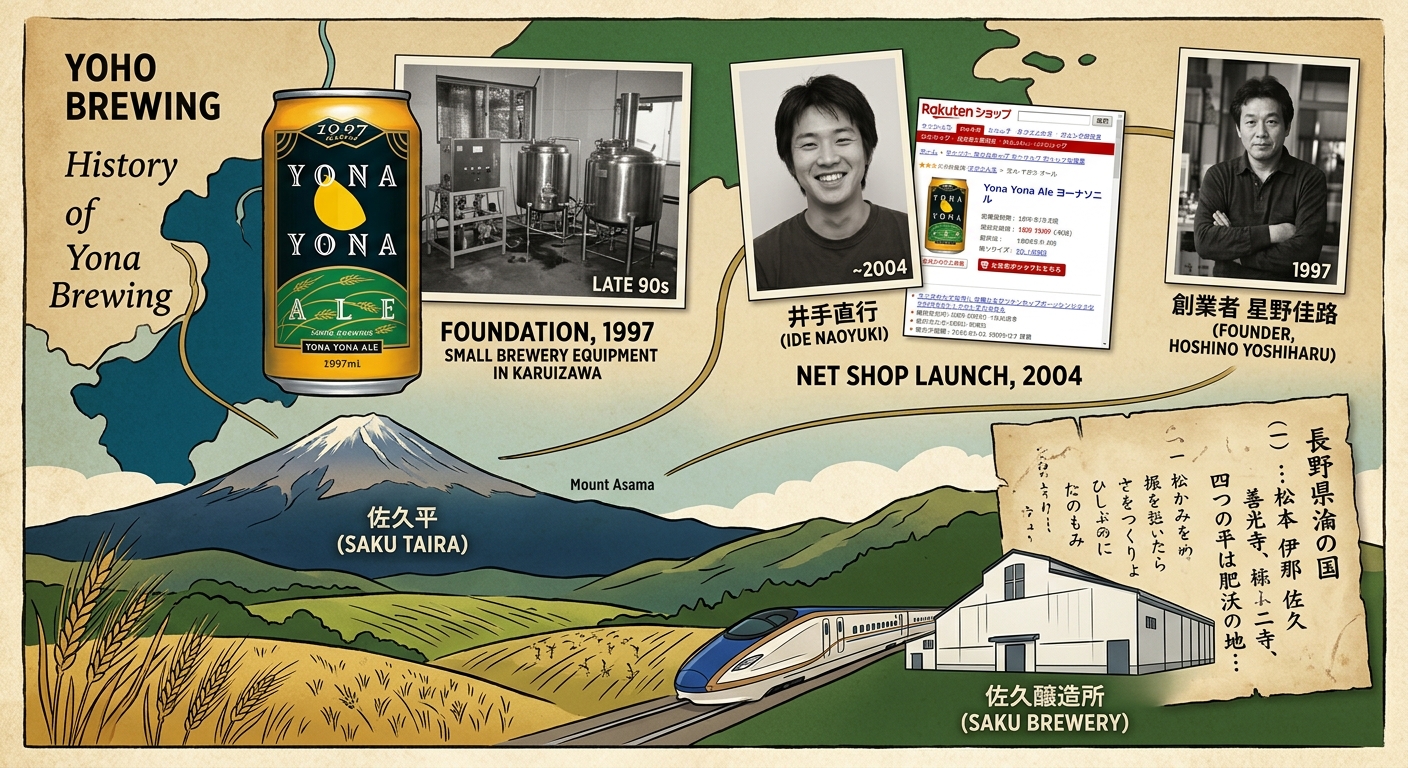
ヤッホーブルーイングは1997年6月、星野リゾート代表・星野佳路を創業者として長野県軽井沢町に設立されたクラフトビールメーカーです。当時の日本のビールは、大手メーカーが造る画一的なラガーがほとんど。そこに個性豊かなクラフトビールの文化を根付かせたいという思いから、同年7月7日、「よなよなエール」を全国向けの本格的な缶入りクラフトビールとして、日本で初めて発売しました。瓶ではなく缶を選んだのは、日光による劣化に強く、軽くて流通・陳列がしやすいという理由からです。
しかし、ここからの道のりは平坦ではありませんでした。1994年の酒税法改正をきっかけに全国で「地ビール」ブームが起こり、小規模醸造所が乱立しましたが、90年代末にブームが去ると、ヤッホーの経営も苦境に立たされます。2003年頃、社員だった井手直行(現社長)は、社内ロッカーの奥から、ほぼ同時期に起業した楽天の三木谷浩史からの出店礼状を偶然見つけました。同じスタートラインに立っていたはずの相手との差に衝撃を受けた井手氏は、自ら楽天のネットショップ講座に通い始め、2004年からインターネットでの直販に舵を切ります。ここから2005年から3年連続で売上30%以上増という急成長を遂げ、会社を立て直しました。
現在、会社の登記上の本社は創業の地・軽井沢町長倉にありますが、実際の醸造は隣接する御代田町・佐久市に移り、佐久市小田井にある「佐久醸造所」では有料の見学ツアー(約110分・1,980円税込、20歳未満は参加不可)も開催されています。
土地の話
佐久醸造所がある佐久市小田井は、浅間山の裾野に広がる「佐久平(さくだいら)」と呼ばれる高原盆地の一角です。標高700メートル前後、昼夜の寒暖差が大きい気候で、二条大麦や高原野菜の産地として知られています。北陸新幹線としなの鉄道の路線がすぐそばを通り、東京から新幹線で1時間ほどの距離です。
この佐久平は、これから紹介する長野県歌「信濃の国」が一番の冒頭で名指しする「松本・伊那・佐久・善光寺、四つの平(たいら)は肥沃の地」という、まさにその四つの盆地のひとつ。歌が生まれてから120年以上たった今も、この土地でビールが仕込まれているというのは、ちょっとした巡り合わせです。
音楽の話
「信濃の国」は1901年(明治34年)2月、長野県師範学校の教員だった浅井洌が作詞し、同僚の北村季晴が作曲した「信濃唱歌」の一篇として発表されました。日清戦争後、教育の現場に戦争を題材にした教材が増えることを憂えた信濃教育会が、地元の地理や歴史に根ざした教材をと教員たちに作らせたのがきっかけだったといわれています。歌詞は、松本・伊那・佐久・善光寺の四つの盆地から、木曽の山々、川中島の合戦、善光寺参りまで、信濃の国の地理と歴史を丁寧に歌い込んだものです。
この歌には、長野県民の結束を象徴する有名な逸話があります。1948年(昭和23年)4月1日、県議会で長野県を南北に分割する案が可決されようとしていたとき、傍聴に詰めかけた住民たちが議事堂の内外で「信濃の国」の大合唱を始めました。この合唱に押されるかたちで分県案は勢いを失い、廃案となったのです。「信濃の国」が県内で愛唱歌として歌い継がれてきたことを裏付ける出来事として、今も語り継がれています。正式に県歌として制定されたのは、それから20年後の1968年(昭和43年)5月20日のことでした。
なぜこの組み合わせなのか
どちらも、「ひとつに均されることを拒んだ」話です。よなよなエールは、大手メーカーのラガーしかなかった日本のビール売り場に、あえて個性の強いエールを持ち込むために生まれました。地ビールブームが去り、多くの小規模醸造所が消えていった中で、ヤッホーが生き残れたのは、自分たちの味を薄めて大量流通に合わせるのではなく、直販という形でファンと直接つながる道を選んだからです。「信濃の国」も同じで、1948年、県がふたつに分けられそうになったとき、それを押しとどめたのは、松本・伊那・佐久・善光寺という異なる土地の人々が、ひとつの歌を通じてひとつの信濃であり続けようとした結果でした。
もうひとつ、小さな重なりがあります。「よなよな」という名前には、特別な晩にだけでなく、毎晩のように気軽に個性豊かなビールを楽しんでほしいという願いが込められています。「信濃の国」も、県民が特別な式典でだけ歌う歌ではありません。結婚式でも、県人会の新年会でも、居酒屋の二次会でも、ふとした夜に誰かが歌い出せば、その場にいる長野県民は自然と声を揃えます。どちらも、晴れの舞台のためではなく、なんでもない夜のためにあるものです。
この一杯を、探すなら
※楽天市場へのリンクは広告(アフィリエイト)です。醸造所がタップルームや直営店を持っている場合は、できたてを現地で味わうのが一番のおすすめです。
🌡️ おすすめの飲み方(温度とグラス):よく冷やしすぎず6〜8℃ほどで。口径の広いタンブラーやチューリップ型のグラスに注ぐと、カスケードホップ由来の柑橘や松葉のような香りが立ちやすくなります。
合わせたい「アテ」
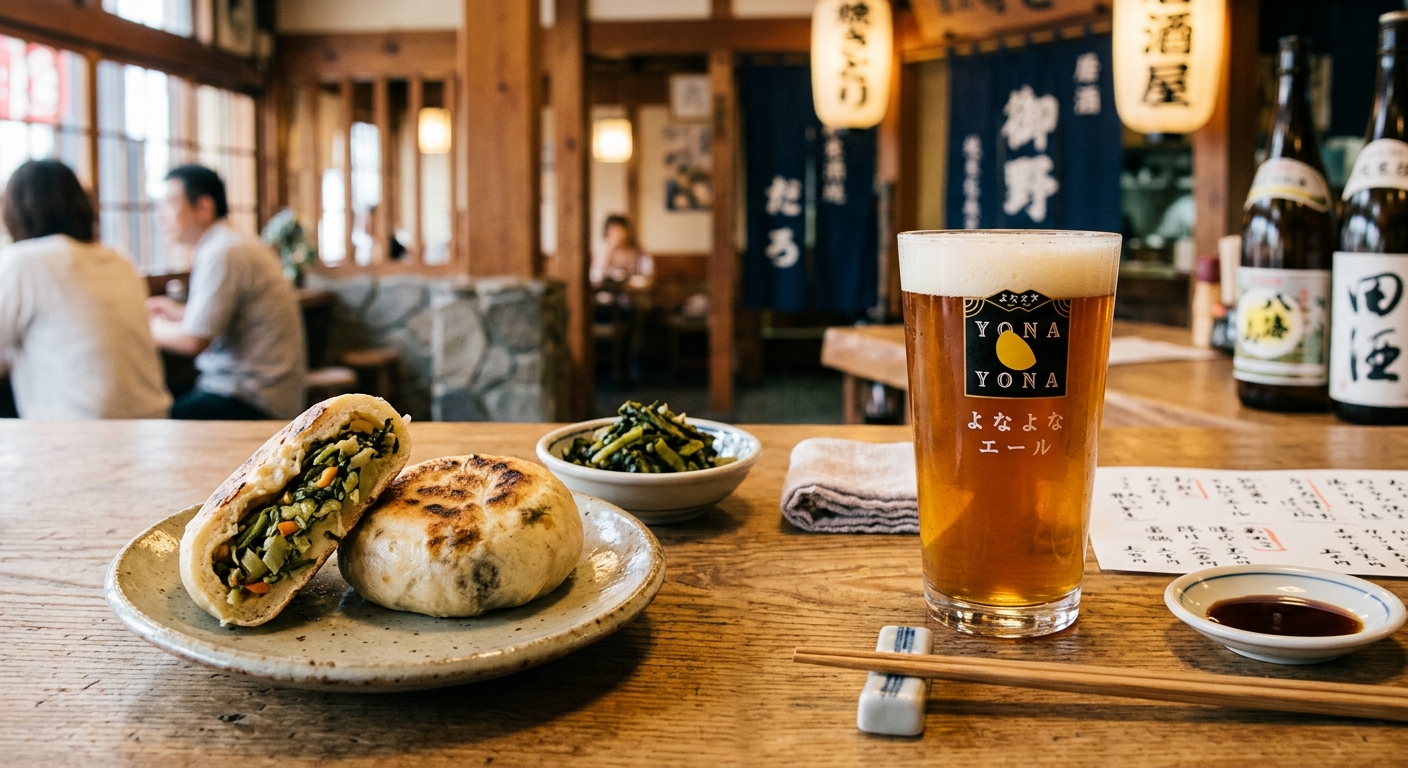
- おやき
長野県を代表する郷土食。小麦やそば粉の生地で野沢菜や野菜のあんを包んで焼き上げたもので、生地の香ばしさと具材のほのかな甘みが、カスケードホップの柑橘系の苦みとよく合います。
- 野沢菜漬け
信州の食卓に欠かせない漬物。塩気と乳酸発酵による酸味が、よなよなエールのモルトの甘みと苦みの間でちょうどいいアクセントになります。
科学的にひとこと:塩味や発酵由来の酸味は、炭酸とホップの苦み成分(イソα酸)によって後味がすっと引き、次のひと口をまた新鮮に感じさせてくれることが知られています。おやきの生地や野沢菜漬けの塩気と、よなよなエールの苦みが、互いの輪郭をはっきりさせ合う関係にあります。
この醸造所をたずねるなら
ヤッホーブルーイング 佐久醸造所
長野県佐久市小田井1119-1/しなの鉄道「御代田駅」からタクシーで約10分、北陸新幹線「佐久平駅」からタクシーで約20分。
有料の見学ツアー(約110分・1,980円税込、20歳未満は参加不可)を開催しています。
近くの観光スポット
- 小田井宿(中山道)/北佐久郡御代田町|醸造所から車で約15分
中山道六十九次のうち江戸から二十一番目の宿場。大名行列は隣の追分宿に泊まったため、姫君など女性の宿泊が中心となり「姫の宿」と呼ばれました。江戸初期そのままの姿で残る一里塚は、中山道の佐久地域では唯一の遺構で、長野県史跡に指定されています。
- 小諸城址 懐古園/小諸市|醸造所から車で約20分
城下町よりも低い場所に建つ珍しい「穴城」として知られる小諸城の跡地。島崎藤村の詩碑や動物園、遊園地もあり、しなの鉄道「小諸駅」から徒歩3分とアクセスも良好です。
※営業時間・定休日は変わることがあります。おでかけ前に各施設の公式情報をご確認ください。
ひとことメモ(ビールの用語)
- クラフトビール:小規模な醸造所が、造り手の個性を前面に出して仕込むビールの総称。大量生産の均一な味とは別の方向を目指しています。
- エール:常温に近い温度で、酵母が液面近くで働く「上面発酵」で造るビール。果実のような香りと厚みのある味わいが出やすいのが特徴です。
- ラガー:低温で、酵母が下に沈みながら働く「下面発酵」で造るビール。すっきりと澄んだ切れ味になり、日本の大手ビールの多くがこの系統です。
- ペールエール:淡い色のエール。麦の甘みとホップの香りのバランスが取れた、エール入門にあたるスタイルです。
- ホップ:ビールに苦みと香りを与えるつる性植物の毬花(まりばな)。品種によって、柑橘・トロピカルフルーツ・草原のように香りが変わります。
- モルト:発芽させた大麦(麦芽)のこと。ビールの甘み・色・コクの土台になり、焙煎の深さで色と香ばしさが決まります。
- ABV:アルコール度数(Alcohol By Volume)のこと。ビールでは5%前後が標準で、8%を超えると飲みごたえのある「強め」の部類になります。
- IBU:苦みの強さを表す国際的な数値。10前後だとほとんど苦みを感じず、60を超えるとはっきり苦いIPAの領域です。
- 地ビール:1994年の酒税法改正で小規模醸造が解禁された後、各地で生まれたビールの呼び名。現在は「クラフトビール」と呼ばれることが多くなっています。
参考
内容に誤りがございましたら、お手数ですが info@soundrecords.jp までご連絡いただけますと幸いです。
Today’s Pairing
▶ If the player above doesn’t play, open it on YouTube
The Story of the Brewery
Yoho Brewing was founded in June 1997 in Karuizawa, Nagano, by Yoshiharu Hoshino, head of Hoshino Resorts. At the time, Japanese beer meant, almost without exception, the uniform lagers of the major manufacturers. Wanting to plant a culture of distinctive, individual-character craft beer in that landscape, the company released Yona Yona Ale on July 7 that same year — Japan’s first canned craft beer brewed for nationwide distribution. They chose cans over bottles for their resistance to light damage and their lighter weight, which made distribution and shelf display easier.
The road from there was not smooth. A 1994 revision to the liquor tax law had touched off a nationwide “local beer” boom, and small breweries sprang up everywhere; but when that boom faded in the late 1990s, Yoho’s business fell into trouble too. Around 2003, Naoyuki Ide — then an employee, now the company’s president — found a thank-you letter tucked in the back of his office locker, sent by Hiroshi Mikitani of Rakuten, a company founded around the same time as Yoho. Struck by how far ahead a company that had started from the same line now stood, Ide began attending Rakuten’s own online-shop seminars and, from 2004, steered Yoho toward direct online sales. That shift drove three straight years of 30%-plus sales growth starting in 2005, and turned the company around.
Today the company’s registered head office remains in Nagakura, Karuizawa — where it was founded — but the actual brewing has since moved to the neighboring towns of Miyota and Saku. Its Saku Brewery, in Odai, Saku City, also offers a paid tour of the facility (about 110 minutes, 1,980 yen incl. tax; not open to guests under 20).
The Story of the Land
The Saku Brewery sits in Sakudaira, a highland basin at the foot of Mt. Asama. At roughly 700 meters above sea level, with sharp swings between day and night temperatures, it’s known as a growing region for two-row barley and highland vegetables. The Hokuriku Shinkansen and the Shinano Railway both run nearby, putting it about an hour from Tokyo by bullet train.
Sakudaira is one of the very four basins named in the opening lines of “Shinano no Kuni,” the Nagano prefectural anthem introduced below: “Matsumoto, Ina, Saku, Zenkoji — four fertile plains.” More than 120 years after that song was written, beer is still being brewed on that same ground — a small coincidence worth noting.
The Story of the Song
“Shinano no Kuni” was published in February 1901 as part of “Shinano Shoka,” a set of teaching songs, with lyrics by Retsu Asai, a teacher at the Nagano Prefectural Normal School, and music by his colleague Sueharu Kitamura. It’s said the Shinano Education Association commissioned local teachers to write the songs out of concern that, in the aftermath of the First Sino-Japanese War, teaching materials were increasingly built around war themes — they wanted material grounded instead in local geography and history. The lyrics carefully trace the geography and history of Shinano province, from its four basins — Matsumoto, Ina, Saku and Zenkoji — through the mountains of Kiso, the battles of Kawanakajima, and pilgrimages to Zenkoji Temple.
The song carries a famous story about the solidarity it represents among Nagano residents. On April 1, 1948, when the prefectural assembly was on the verge of passing a bill to split Nagano into northern and southern prefectures, the residents who had crowded into the public gallery began, spontaneously, to sing “Shinano no Kuni” — inside and outside the assembly hall. The chorus is said to have taken the wind out of the bill’s momentum, and the split was dropped. The episode is still retold today as proof of how deeply the song had already taken root as a shared, beloved song across the prefecture. It wasn’t formally designated the prefectural anthem until twenty years later, on May 20, 1968.
Why This Pairing
Both are stories about refusing to be smoothed into sameness. Yona Yona Ale was built specifically to bring a strongly individual beer into a Japanese market that, at the time, offered little beyond mass-produced lager. When the local-beer boom collapsed and many small breweries disappeared along with it, Yoho survived not by diluting its own character to fit mass distribution, but by choosing direct sales that kept it in touch with its own fans. “Shinano no Kuni” tells a similar story: in 1948, when the prefecture was on the verge of being split in two, what stopped it was people from different regions — Matsumoto, Ina, Saku, Zenkoji — choosing, through one shared song, to remain one Shinano.
There’s a smaller echo here too. The name “Yona Yona” (night after night) carries a wish that people enjoy this distinctive beer not just on special occasions, but casually, every night. “Shinano no Kuni” isn’t a song reserved for formal ceremonies either — it gets sung at weddings, at prefectural association New Year’s parties, at the second round of an izakaya night out. Whenever someone starts singing it, the Nagano natives in the room fall in without thinking. Neither one exists for the big stage. Both belong to the ordinary night.
Where to Find This Beer
The Rakuten Ichiba link below is an affiliate link.
These are Japanese storefronts. If you are visiting the brewery, drinking it fresh at their own taproom is by far the best option.
🌡️ How to serve it:Chill it, but not too hard — around 6–8°C. Pour it into a wide-mouthed tumbler or a tulip-shaped glass to let the citrus and pine notes from the Cascade hops open up.
Pairing Dishes Worth Trying
- Oyaki
A signature Nagano dish: wheat or buckwheat dough wrapped around a filling — often nozawana greens or other vegetables — and pan-grilled or steamed. The toasty dough and gently sweet filling play well against the citrusy bitterness of the Cascade hops.
- Nozawana-zuke (pickled nozawana greens)
A staple on the Shinshu table. Its saltiness and the tang of lactic fermentation land right between Yona Yona Ale’s malt sweetness and its bitterness, sharpening both.
A note on the science: saltiness and fermented acidity are both known to be cut cleanly by carbonation and by the iso-alpha acids that give hops their bitterness, refreshing the palate for the next bite. The salt in oyaki’s filling and in nozawana-zuke, set against Yona Yona Ale’s bitterness, sharpens the outline of both.
Visiting the Brewery
Yoho Brewing, Saku Brewery
1119-1 Odai, Saku City, Nagano. About a 10-minute taxi ride from Miyota Station on the Shinano Railway, or about 20 minutes by taxi from Sakudaira Station on the Hokuriku Shinkansen.
A paid brewery tour (about 110 minutes, 1,980 yen incl. tax; not open to guests under 20) is offered.
Sights Nearby
- Odai-juku (Nakasendo post town) / Miyota Town | ~15 min by car from the brewery
The 21st of the 69 stations of the Nakasendo highway, counting from Edo. Daimyo processions stayed at the neighboring Oiwake station instead, so Odai-juku mainly hosted women travelers, including ladies of samurai households, and became known as the “princess’s inn.” Its Edo-era ichirizuka mile marker survives intact, the only one of its kind left along the Nakasendo in the Saku area, and is a Nagano Prefecture historic site.
- Komoro Castle Ruins, Kaikoen Park / Komoro City | ~20 min by car from the brewery
The remains of Komoro Castle, unusual for being built lower than its own castle town — a style known as an “ana-jiro” (pit castle). The park also holds a poetry monument to novelist Toson Shimazaki, plus a small zoo and amusement park, and is a 3-minute walk from Komoro Station on the Shinano Railway.
Opening hours and closing days can change. Please check each facility’s official information before visiting.
A Quick Glossary of Beer Terms
- Craft beer: Beer made by small breweries that put the character of the maker front and centre, as opposed to the uniformity of mass production.
- Ale: Beer made through “top fermentation,” where yeast works near the surface of the liquid at close to room temperature. It tends to produce fruit-like aromas and a fuller body.
- Lager: Beer made through “bottom fermentation,” where yeast works at low temperatures while sinking to the bottom. It produces a crisp, clean finish, and is the style behind most major Japanese beer brands.
- Pale ale: A pale-colored ale that balances malt sweetness with hop aroma — often considered an entry point into ales.
- Hops: The cones of a climbing plant, which give beer its bitterness and aroma. Depending on the variety, that aroma can read as citrus, tropical fruit or open grassland.
- Malt: Germinated barley. It forms the foundation of a beer’s sweetness, colour and body; how deeply it is roasted determines colour and toastiness.
- ABV: Alcohol By Volume. Around 5% is standard for beer; anything above 8% is considered a stronger, more full-bodied style.
- IBU: An international scale for measuring bitterness. Around 10 registers as barely bitter at all; above 60 puts you in clearly bitter IPA territory.
- Local beer (ji-beer): The name given to beers that sprang up around Japan after a 1994 revision to the liquor tax law allowed small-scale brewing. These days most are called “craft beer” instead.
Sources
If you notice any errors in this article, please don’t hesitate to reach out at info@soundrecords.jp.
コメントを残す