日本語で読む | This is the English version of a bilingual article.
Today’s Pairing
- Craft beer: Yona Yona Ale — American pale ale, 5.5% ABV, IBU 35, brewed with Cascade aroma hops / Yoho Brewing Co., Ltd. (Nagakura, Karuizawa Town, Kitasaku District, Nagano)
Official site: https://yohobrewing.com/products/yonayonaale/ - Music: “Shinano no Kuni,” the official anthem of Nagano Prefecture (first published 1901)
YouTube: https://www.youtube.com/watch?v=f-ActEySmiY
▶ If the player above doesn’t play, open it on YouTube
The Story of the Brewery
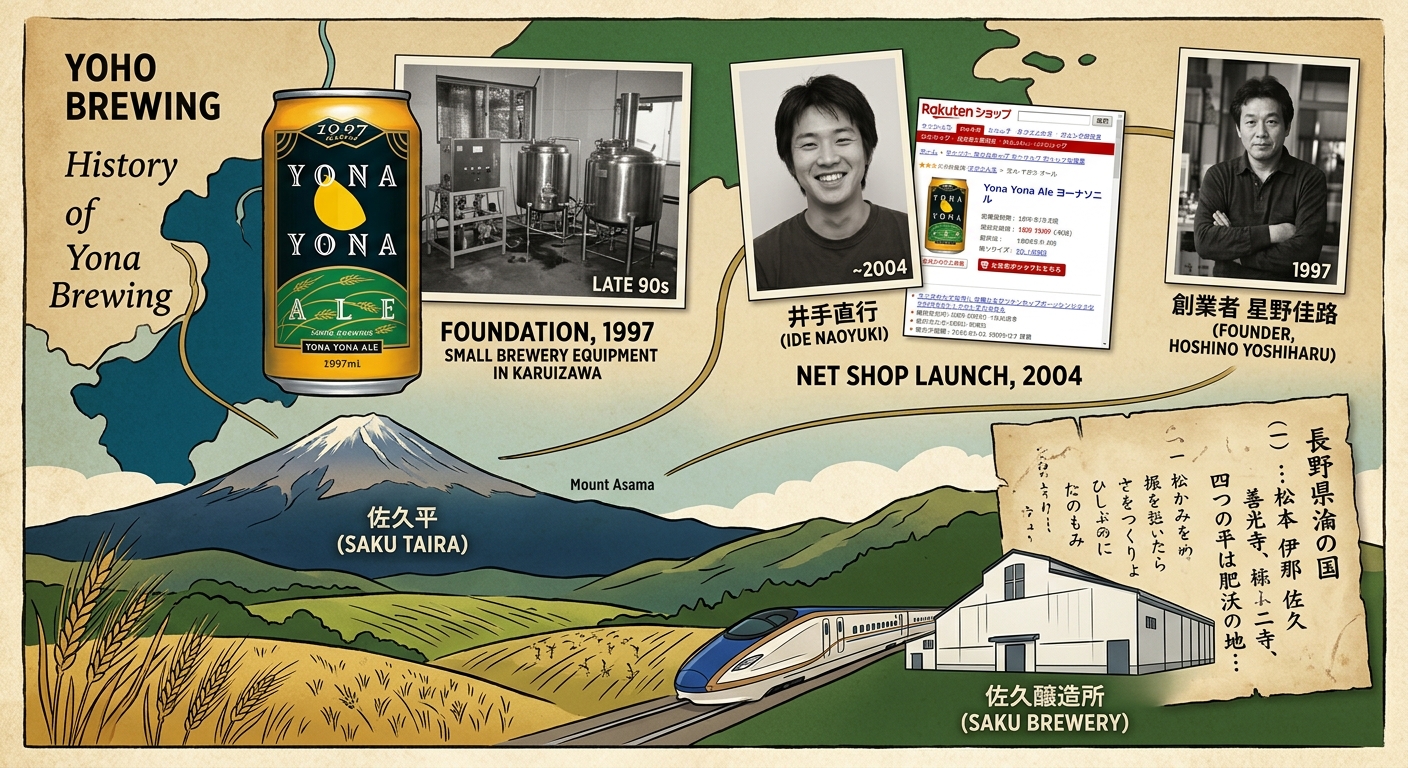
Yoho Brewing was founded in June 1997 in Karuizawa, Nagano, by Yoshiharu Hoshino, head of Hoshino Resorts. At the time, Japanese beer meant, almost without exception, the uniform lagers of the major manufacturers. Wanting to plant a culture of distinctive, individual-character craft beer in that landscape, the company released Yona Yona Ale on July 7 that same year — Japan’s first canned craft beer brewed for nationwide distribution. They chose cans over bottles for their resistance to light damage and their lighter weight, which made distribution and shelf display easier.
The road from there was not smooth. A 1994 revision to the liquor tax law had touched off a nationwide “local beer” boom, and small breweries sprang up everywhere; but when that boom faded in the late 1990s, Yoho’s business fell into trouble too. Around 2003, Naoyuki Ide — then an employee, now the company’s president — found a thank-you letter tucked in the back of his office locker, sent by Hiroshi Mikitani of Rakuten, a company founded around the same time as Yoho. Struck by how far ahead a company that had started from the same line now stood, Ide began attending Rakuten’s own online-shop seminars and, from 2004, steered Yoho toward direct online sales. That shift drove three straight years of 30%-plus sales growth starting in 2005, and turned the company around.
Today the company’s registered head office remains in Nagakura, Karuizawa — where it was founded — but the actual brewing has since moved to the neighboring towns of Miyota and Saku. Its Saku Brewery, in Odai, Saku City, also offers a paid tour of the facility (about 110 minutes, 1,980 yen incl. tax; not open to guests under 20).
The Story of the Land
The Saku Brewery sits in Sakudaira, a highland basin at the foot of Mt. Asama. At roughly 700 meters above sea level, with sharp swings between day and night temperatures, it’s known as a growing region for two-row barley and highland vegetables. The Hokuriku Shinkansen and the Shinano Railway both run nearby, putting it about an hour from Tokyo by bullet train.
Sakudaira is one of the very four basins named in the opening lines of “Shinano no Kuni,” the Nagano prefectural anthem introduced below: “Matsumoto, Ina, Saku, Zenkoji — four fertile plains.” More than 120 years after that song was written, beer is still being brewed on that same ground — a small coincidence worth noting.
The Story of the Song
“Shinano no Kuni” was published in February 1901 as part of “Shinano Shoka,” a set of teaching songs, with lyrics by Retsu Asai, a teacher at the Nagano Prefectural Normal School, and music by his colleague Sueharu Kitamura. It’s said the Shinano Education Association commissioned local teachers to write the songs out of concern that, in the aftermath of the First Sino-Japanese War, teaching materials were increasingly built around war themes — they wanted material grounded instead in local geography and history. The lyrics carefully trace the geography and history of Shinano province, from its four basins — Matsumoto, Ina, Saku and Zenkoji — through the mountains of Kiso, the battles of Kawanakajima, and pilgrimages to Zenkoji Temple.
The song carries a famous story about the solidarity it represents among Nagano residents. On April 1, 1948, when the prefectural assembly was on the verge of passing a bill to split Nagano into northern and southern prefectures, the residents who had crowded into the public gallery began, spontaneously, to sing “Shinano no Kuni” — inside and outside the assembly hall. The chorus is said to have taken the wind out of the bill’s momentum, and the split was dropped. The episode is still retold today as proof of how deeply the song had already taken root as a shared, beloved song across the prefecture. It wasn’t formally designated the prefectural anthem until twenty years later, on May 20, 1968.
Why This Pairing
Both are stories about refusing to be smoothed into sameness. Yona Yona Ale was built specifically to bring a strongly individual beer into a Japanese market that, at the time, offered little beyond mass-produced lager. When the local-beer boom collapsed and many small breweries disappeared along with it, Yoho survived not by diluting its own character to fit mass distribution, but by choosing direct sales that kept it in touch with its own fans. “Shinano no Kuni” tells a similar story: in 1948, when the prefecture was on the verge of being split in two, what stopped it was people from different regions — Matsumoto, Ina, Saku, Zenkoji — choosing, through one shared song, to remain one Shinano.
There’s a smaller echo here too. The name “Yona Yona” (night after night) carries a wish that people enjoy this distinctive beer not just on special occasions, but casually, every night. “Shinano no Kuni” isn’t a song reserved for formal ceremonies either — it gets sung at weddings, at prefectural association New Year’s parties, at the second round of an izakaya night out. Whenever someone starts singing it, the Nagano natives in the room fall in without thinking. Neither one exists for the big stage. Both belong to the ordinary night.
Where to Find This Beer
The Rakuten Ichiba link below is an affiliate link.
- Brewery official site:https://yohobrewing.com/products/yonayonaale/
- Buy on Rakuten Ichiba: View the product page (350ml, ¥6,360)
These are Japanese storefronts. If you are visiting the brewery, drinking it fresh at their own taproom is by far the best option.
Pairing Dishes Worth Trying
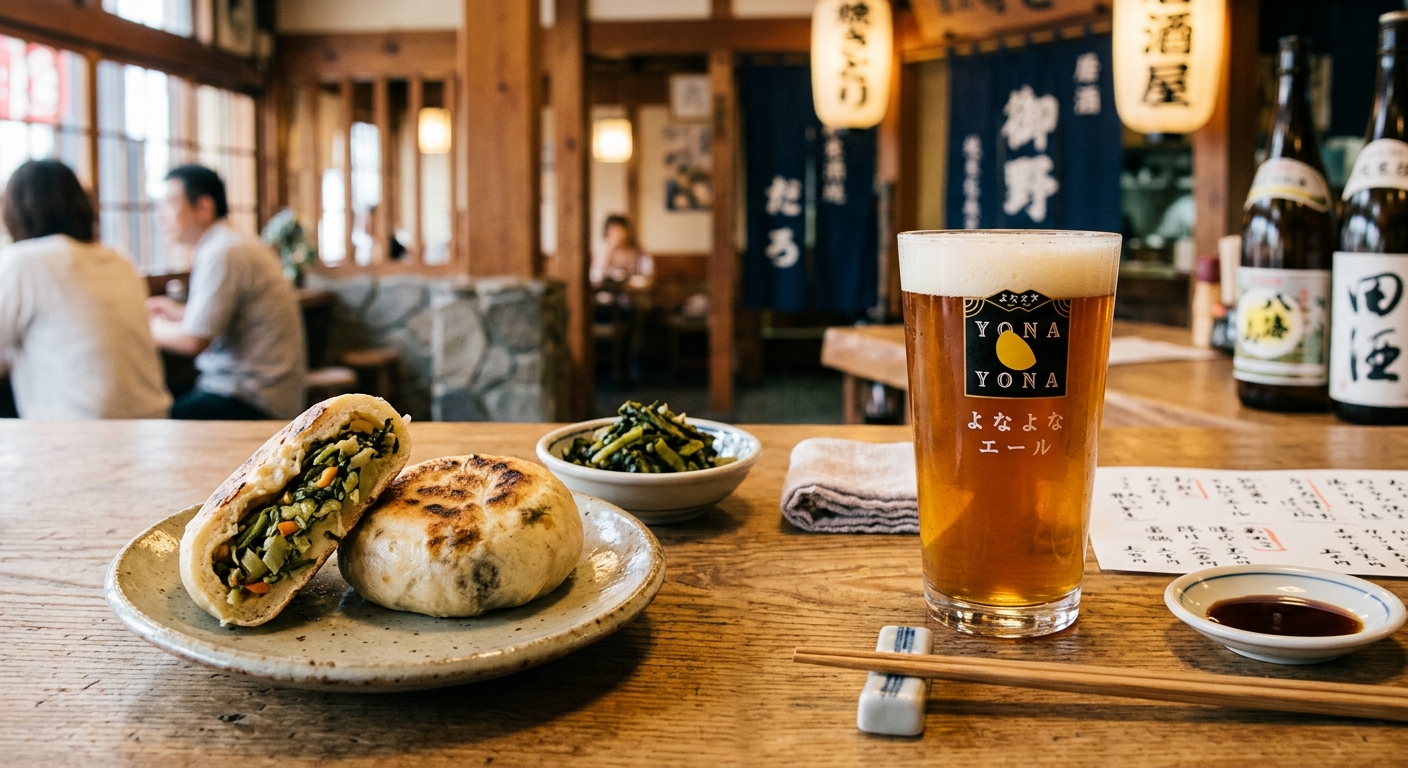
- Oyaki
A signature Nagano dish: wheat or buckwheat dough wrapped around a filling — often nozawana greens or other vegetables — and pan-grilled or steamed. The toasty dough and gently sweet filling play well against the citrusy bitterness of the Cascade hops. - Nozawana-zuke (pickled nozawana greens)
A staple on the Shinshu table. Its saltiness and the tang of lactic fermentation land right between Yona Yona Ale’s malt sweetness and its bitterness, sharpening both.
A note on the science: saltiness and fermented acidity are both known to be cut cleanly by carbonation and by the iso-alpha acids that give hops their bitterness, refreshing the palate for the next bite. The salt in oyaki’s filling and in nozawana-zuke, set against Yona Yona Ale’s bitterness, sharpens the outline of both.
Visiting the Brewery
Yoho Brewing, Saku Brewery
1119-1 Odai, Saku City, Nagano. About a 10-minute taxi ride from Miyota Station on the Shinano Railway, or about 20 minutes by taxi from Sakudaira Station on the Hokuriku Shinkansen.
A paid brewery tour (about 110 minutes, 1,980 yen incl. tax; not open to guests under 20) is offered.
Sights Nearby
- Odai-juku (Nakasendo post town) / Miyota Town | ~15 min by car from the brewery
The 21st of the 69 stations of the Nakasendo highway, counting from Edo. Daimyo processions stayed at the neighboring Oiwake station instead, so Odai-juku mainly hosted women travelers, including ladies of samurai households, and became known as the “princess’s inn.” Its Edo-era ichirizuka mile marker survives intact, the only one of its kind left along the Nakasendo in the Saku area, and is a Nagano Prefecture historic site. - Komoro Castle Ruins, Kaikoen Park / Komoro City | ~20 min by car from the brewery
The remains of Komoro Castle, unusual for being built lower than its own castle town — a style known as an “ana-jiro” (pit castle). The park also holds a poetry monument to novelist Toson Shimazaki, plus a small zoo and amusement park, and is a 3-minute walk from Komoro Station on the Shinano Railway.
Opening hours and closing days can change. Please check each facility’s official information before visiting.
A Quick Glossary of Beer Terms
- Craft beer: Beer made by small breweries that put the character of the maker front and centre, as opposed to the uniformity of mass production.
- Ale: Beer made through “top fermentation,” where yeast works near the surface of the liquid at close to room temperature. It tends to produce fruit-like aromas and a fuller body.
- Lager: Beer made through “bottom fermentation,” where yeast works at low temperatures while sinking to the bottom. It produces a crisp, clean finish, and is the style behind most major Japanese beer brands.
- Pale ale: A pale-colored ale that balances malt sweetness with hop aroma — often considered an entry point into ales.
- Hops: The cones of a climbing plant, which give beer its bitterness and aroma. Depending on the variety, that aroma can read as citrus, tropical fruit or open grassland.
- Malt: Germinated barley. It forms the foundation of a beer’s sweetness, colour and body; how deeply it is roasted determines colour and toastiness.
- ABV: Alcohol By Volume. Around 5% is standard for beer; anything above 8% is considered a stronger, more full-bodied style.
- IBU: An international scale for measuring bitterness. Around 10 registers as barely bitter at all; above 60 puts you in clearly bitter IPA territory.
- Local beer (ji-beer): The name given to beers that sprang up around Japan after a 1994 revision to the liquor tax law allowed small-scale brewing. These days most are called “craft beer” instead.
Sources
- Yona Yona Ale, Yoho Brewing Co., Ltd. (official)
- Company information, Yoho Brewing Co., Ltd. (official)
- “Yona Yona Ale, 25th Anniversary,” Yoho Brewing Co., Ltd. (official)
- “Prefectural Anthem: Shinano no Kuni,” Nagano Prefecture (official)
- “Shinano no Kuni” — Wikipedia (Japanese)
- “Odai-juku” — Wikipedia (Japanese)
If you notice any errors in this article, please don’t hesitate to reach out at info@soundrecords.jp.
Read this article in Japanese: 誰の真似でもない夜に