日本語で読む | This is the English version of a bilingual article.
Today’s Pairing
- Sake: Kinryo “Koiai” Junmai Ginjo — brewed with Kagawa-grown Oseto sake rice, rice-polishing ratio (seimai buai) 58%, 15–16% alcohol / Nishino Kinryo Co., Ltd. (623 Kotohira-cho, Nakatado-gun, Kagawa Prefecture)
Official site: https://www.nishino-kinryo.co.jp/ - Kayoukyoku (classic Japanese popular song): “Seto no Hanayome” (“The Bride of the Seto Sea”) by Koyanagi Rumiko, 1972
YouTube: https://www.youtube.com/watch?v=1tsdlNUg_1Q
▶ If the player above doesn’t play, open it on YouTube
The Story of the Brewery
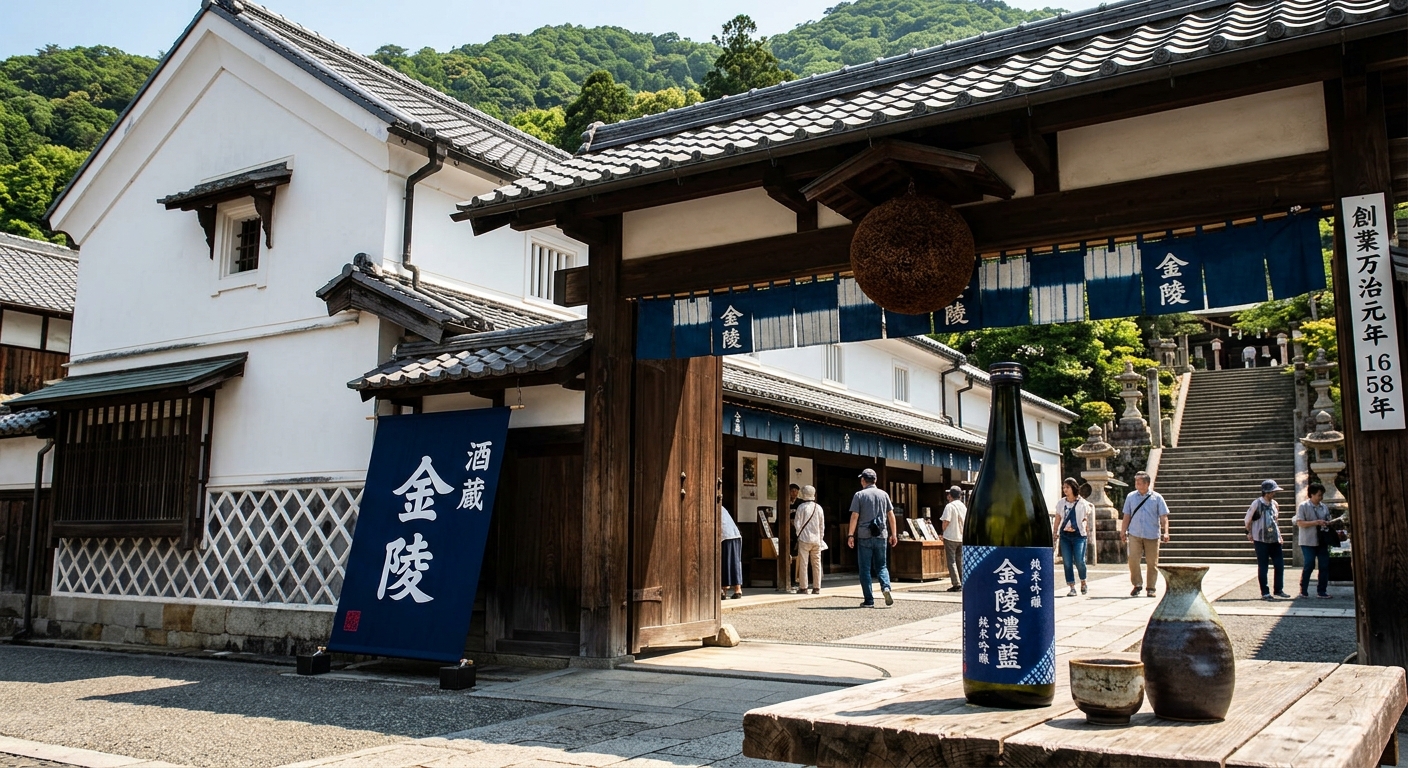
The history of Nishino Kinryo Co., Ltd. goes back to 1658, when the first-generation Kaemon began trading in Awa indigo dye. The name Kaemon was passed down through the generations, and in 1789 the eighth-generation Kaemon branched into sake brewing in Kotohira, in the Sanuki region (present-day Kagawa). From that year on, the sacred sake offered at Kotohira-gu Shrine — popularly known as “Konpira-san” — was designated as Kinryo, and it has been cherished ever since as “the sake of Sanuki’s Konpira pilgrimage” by visitors arriving from across Japan. The company was incorporated in 1918, took its present name, Nishino Kinryo Co., Ltd., in 1982, and marked its 350th anniversary in 2008. Its current president is Nishino Hiroaki.
The bottle in this pairing, Kinryo “Koiai” Junmai Ginjo, is brewed with Kagawa-grown Oseto sake rice, polished to a seimai buai of 58%, at 15–16% alcohol. It’s a medium-dry junmai ginjo — sake made only from rice, rice koji, and water, fermented at low temperatures for a fragrant aroma — where a refreshing fruit-like aroma meets a smooth umami. The indigo blue on its label reaches back more than a century before the brewery ever made sake, to the indigo-dye trade where it all began; the brewery’s own website describes it simply: “Kinryo’s roots lie in indigo.”
The Story of the Land
Kotohira, in Nakatado District, spreads out at the foot of Mt. Kotohira (also called Mt. Zozu), long known as a landmark for ships navigating the Seto Inland Sea. It’s the temple town that has grown up around the approach to Konpira-san. According to the brewery, “Kinryo no Sato,” its visitor complex at the entrance to that approach, opened in 1988 — the very same year the Seto Ohashi Bridge opened, connecting Honshu and Shikoku across the strait. The complex was built around a restoration of the white-walled brewery building from the company’s earliest sake-making days.
Kotohira-gu Shrine’s own history reaches back further still. Mt. Kotohira is said to have once been an island in the Seto Inland Sea, and the shrine is said to have been founded on the site of a temporary shrine (angu) of the deity Onamuchi no Kami. Onamuchi no Kami is honored for broad blessings spanning agriculture, industry, medicine, and protection at sea, and as Japan’s shipping routes expanded nationwide during the Edo period, devotional groups called “Konpira-ko” formed in ports around the country. Even today, Kotohira-gu is beloved as “the god of the sea,” continuing to watch over sailors crossing the Seto Inland Sea.
The Story of the Song
“Seto no Hanayome” was released on April 10, 1972, Koyanagi Rumiko’s fourth single. The lyrics are by Yamagami Michio, the music by Hirao Masaaki, and the arrangement by Morioka Kenichiro. It topped Oricon’s weekly singles chart and finished as the second-best-selling single of 1972 for the year. That same year it won the Grand Prix at the 3rd Japan Music Awards (Nihon Kayo Taisho) and the Best Vocal Performance award at the 14th Japan Record Awards.
Koyanagi Rumiko was born in Fukuoka City in 1952. She graduated top of her class from the Takarazuka Music School in 1970, and the following year, 1971, debuted as a singer with “Watashi no Jokamachi,” an instant hit that sold 1.6 million copies and won her the Best New Artist award at the 13th Japan Record Awards. “Seto no Hanayome,” her fourth single, rode that same momentum. The song follows the feelings of a woman marrying into a small Seto Inland Sea island community and her resolve to begin a new life there — though it later became clear that the specific island said to have inspired the lyrics doesn’t actually exist. Lyricist Yamagami Michio himself had never visited any of the Seto Inland Sea’s islands; the images in the lyrics are said to have come from the scenery he saw while crossing from Onomichi, in Hiroshima, to Shikoku by boat.
Why This Pairing
Kotohira-gu has, since ancient times, watched over the safety of sailors crossing the Seto Inland Sea. Kinryo, as the sacred sake offered at that very shrine, has likewise stayed close to everyone making that crossing.
“Seto no Hanayome,” meanwhile, portrays a woman crossing that same sea toward a new life. Kagawa Prefecture still carries a custom tied to sawara, the fish that heralds spring here: a young bride would once be sent home to visit her family carrying one large sawara. A bride crossing the sea, in other words, is not a distant image for this region — it’s part of its own folk memory.
Just as a brewery that began in the indigo trade has gone on brewing the sea god’s sacred sake for generations, this song has been sung for more than fifty years, carrying the feelings of countless brides who crossed the Seto Inland Sea. One thing watches over those who cross the sea; the other sings of them. Let that thought settle in as you look at the indigo-blue label in your hand.
Where to Find This Bottle
The Rakuten Ichiba link below is an affiliate link.
- Brewery’s official site: https://www.nishino-kinryo.co.jp/
- Search on Rakuten Ichiba: See search results for “Kinryo Koiai Junmai Ginjo”
Note: the links above lead to Japan-based retailers. They’re most convenient for readers in Japan, or for those elsewhere who are able to arrange international shipping. Stock and availability change over time, so if you’re near a specialty sake shop, it’s well worth asking for this label by name.
Pairing Dishes Worth Trying
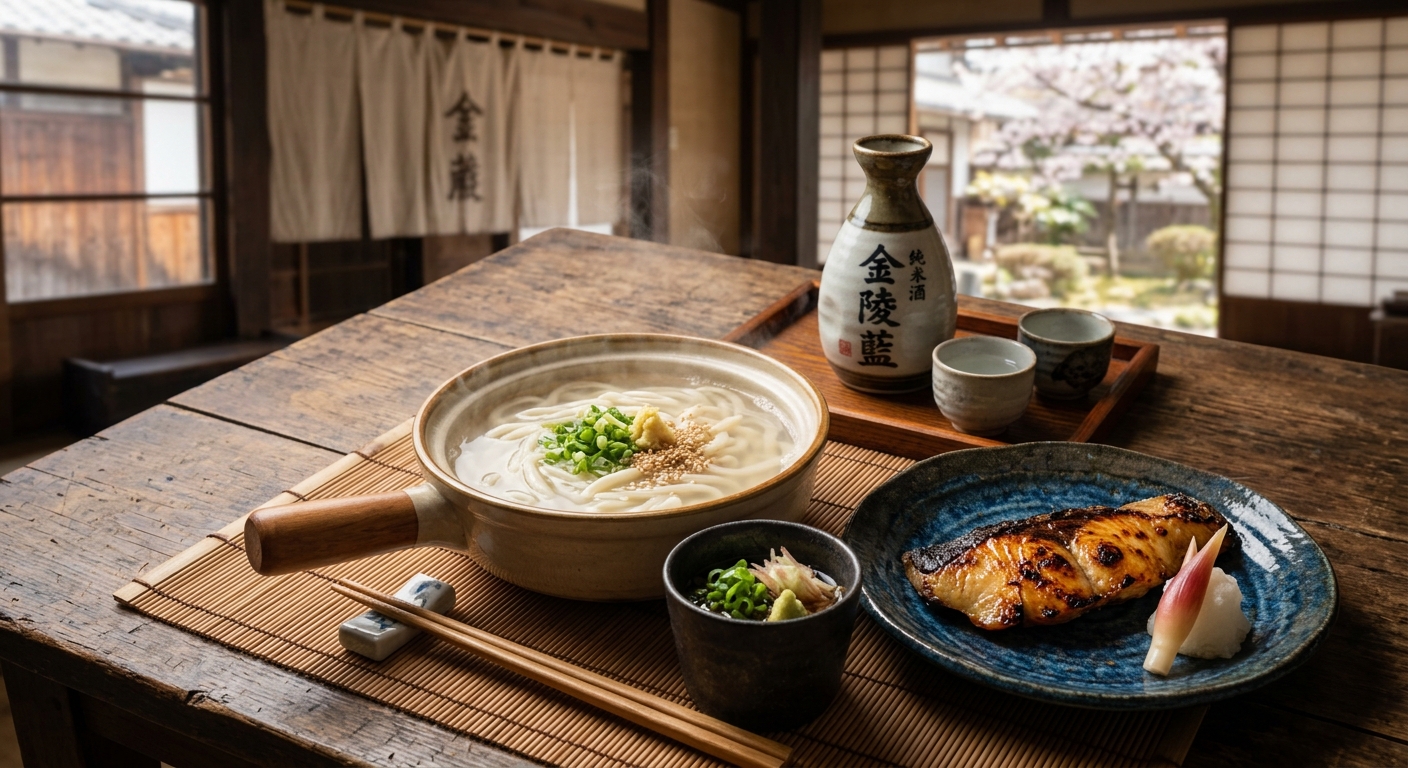
- Kamaage udon
Kagawa’s signature soul food. The brewery itself even sells a junmai sake called “the sake that goes with udon” — in this region, sake and udon are simply inseparable. The rich, iriko (dried sardine) -based dipping sauce and the piping-hot, freshly boiled noodles pair naturally with the smooth umami of this junmai ginjo.
Recipe (in Japanese): Kurashiru, “Kamaage Udon with Homemade Dipping Sauce” - Sawara (Spanish mackerel) saikyo-yaki
Sawara is beloved in Kagawa as the fish that announces spring — so much so that a local custom once had a newly married daughter carry one large sawara home on her first visit back to her family, making it a fish long tied to brides here. The sweetness and toasted aroma of the white miso marinade echo the refreshing fruit-like aroma of Kinryo “Koiai.”
Recipe (in Japanese): Kurashiru, “Marinate and Grill: Sawara Saikyo-yaki”
A note on the science: the umami compounds in udon dashi — inosinic acid from iriko and glutamic acid from kombu — resonate with the amino-acid umami in sake, creating a synergistic boost of savoriness on the palate. The fermentation in white miso (saikyo miso) develops sweet aromatic compounds that echo the gentle ginjo aroma of a junmai ginjo, creating a sense of unity between the dish’s fragrance and the sake’s.
Visiting the Brewery
Kinryo (Nishino Kinryo head office & “Kinryo no Sato” sake museum)
623 Kotohira-cho, Nakatado-gun, Kagawa. About a 10-min walk from JR / Kotoden Kotohira Station; about 15 min by car from Zentsuji IC on the Takamatsu Expressway.
The sake museum “Kinryo no Sato” next to the head office is free to enter (weekdays 9:00–16:00, weekends & holidays 9:00–18:00) and sits right on the main approach to Kotohira-gu Shrine.
Sights Nearby
- Kotohira-gu Shrine (Konpira-san) / Kotohira-cho | a short walk up the approach from Kinryo
785 stone steps lead to the main hall. Kinryo is the official brewer of this shrine’s sacred sake. Visiting hours vary by day, so check the official site before you go. - Kanamaru-za (old Konpira Grand Playhouse) / Kotohira-cho | ~10 min on foot, ~5 min by car from Kinryo
Built in 1835, the oldest surviving playhouse in Japan (an Important Cultural Property). Open for interior tours on non-performance days (9:00–17:00; closed during kabuki runs). - Zentsu-ji Temple / Zentsuji City | ~15 min, ~7 km by car from Kinryo
Temple 75 of the Shikoku pilgrimage, said to be the birthplace of Kobo Daishi (Kukai), with two large temple precincts side by side.
Hot Springs Nearby
- Konpira Onsen-kyo / along the shrine approach, Kotohira-cho | walking distance from Kinryo
A cluster of inns along the approach. Some offer day-use bathing (e.g. Konpira Onsen Yumoto Yachiyo, ¥800 for adults). Hours and days vary by inn, so check ahead.
Opening hours, closing days and day-use bathing availability can change. Please check each facility’s official information before visiting.
A Quick Glossary of Sake Terms
- Junmai Ginjo: Junmai (sake made only from rice, rice koji, and water, with no added brewing alcohol) that has been polished to a seimai buai of 60% or less and fermented slowly at low temperatures, giving it a fragrant aroma.
- Seimai buai (rice-polishing ratio): The percentage of the original grain remaining after milling. The lower the number, the more the rice has been polished down.
Sources
- Nishino Kinryo Co., Ltd. – Official Online Store
- Company Profile – Nishino Kinryo Official Site
- Company History – Nishino Kinryo Chemicals Division Official Site
- Kinryo “Koiai” Junmai Ginjo – Nishino Kinryo Official Online Store
- Seto no Hanayome – Wikipedia (Japanese)
- Koyanagi Rumiko – Wikipedia (Japanese)
- History – Kotohira-gu Shrine Official Site
- Sanuki no Sawara – Pride Fish (Japan Fisheries Cooperatives)
If you notice any errors in this article, please don’t hesitate to reach out at info@soundrecords.jp.
Read this article in Japanese: 瀬戸を渡る花嫁を、藍色の酒はずっと見ていた