日本語で読む | This is the English version of a bilingual article.
Today’s Pairing
- Sake: Junmai “Kitakami Yakyoku” Nama Genshu (unpasteurized, undiluted) — made with 100% Kitakami City-grown “Kameno-o” rice / Kikuzakari Sake Brewery Co., Ltd. (3-54 Sarashina, Kitakami City, Iwate Prefecture)
Official site: http://kikuzakari.jp/ - Kayoukyoku (classic Japanese popular song): “Kitakami Yakyoku” (“Kitakami Night Song”) by Tama Sachiko & Hiroshi Wada and the Mahina Stars, 1961
YouTube: https://www.youtube.com/watch?v=kbdcrhyqXvE
▶ If the player above doesn’t play, open it on YouTube
The Story of the Brewery
Kikuzakari Sake Brewery was founded in 1894 in the Sarashina district of Kitakami City, Iwate Prefecture, as “Fujimura Sake Brewery.” It took its current name, Kikuzakari, in 1951.
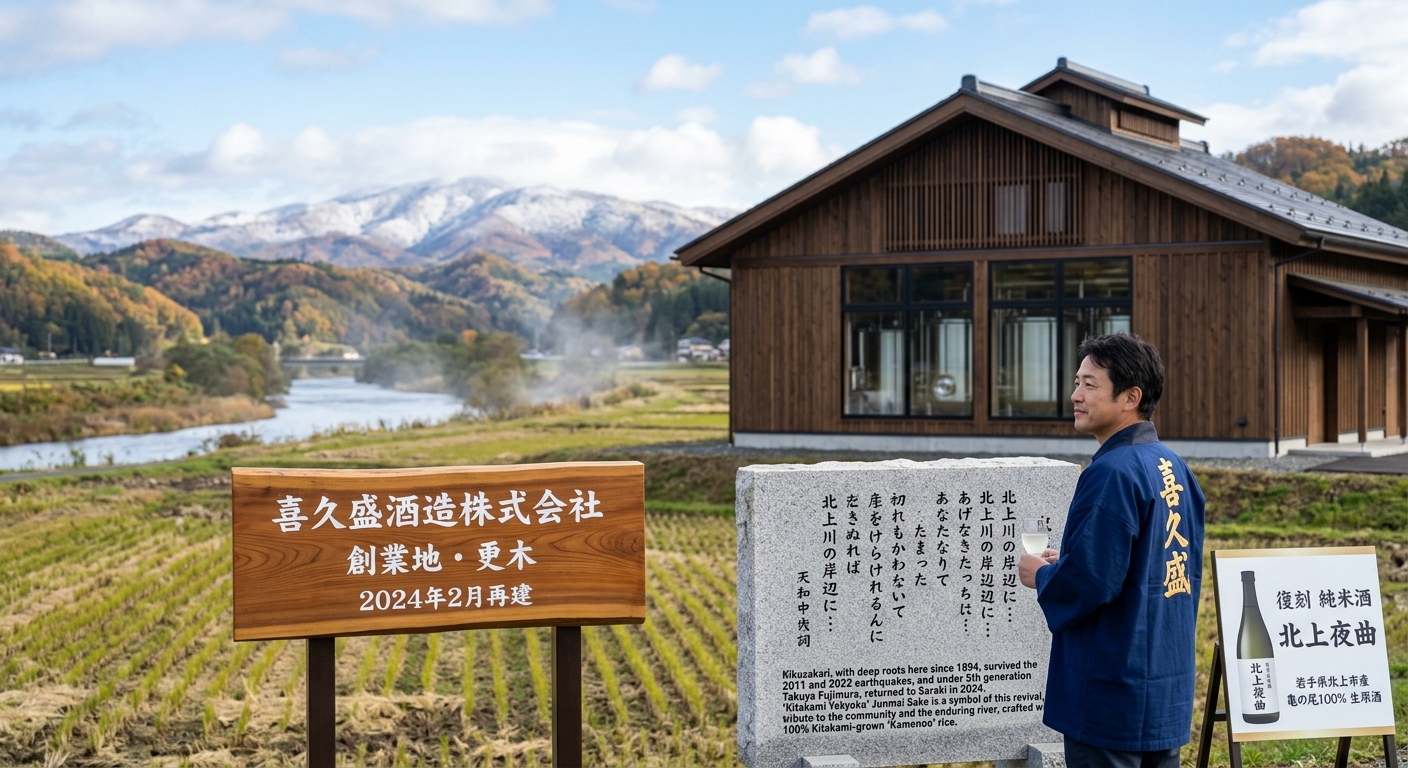
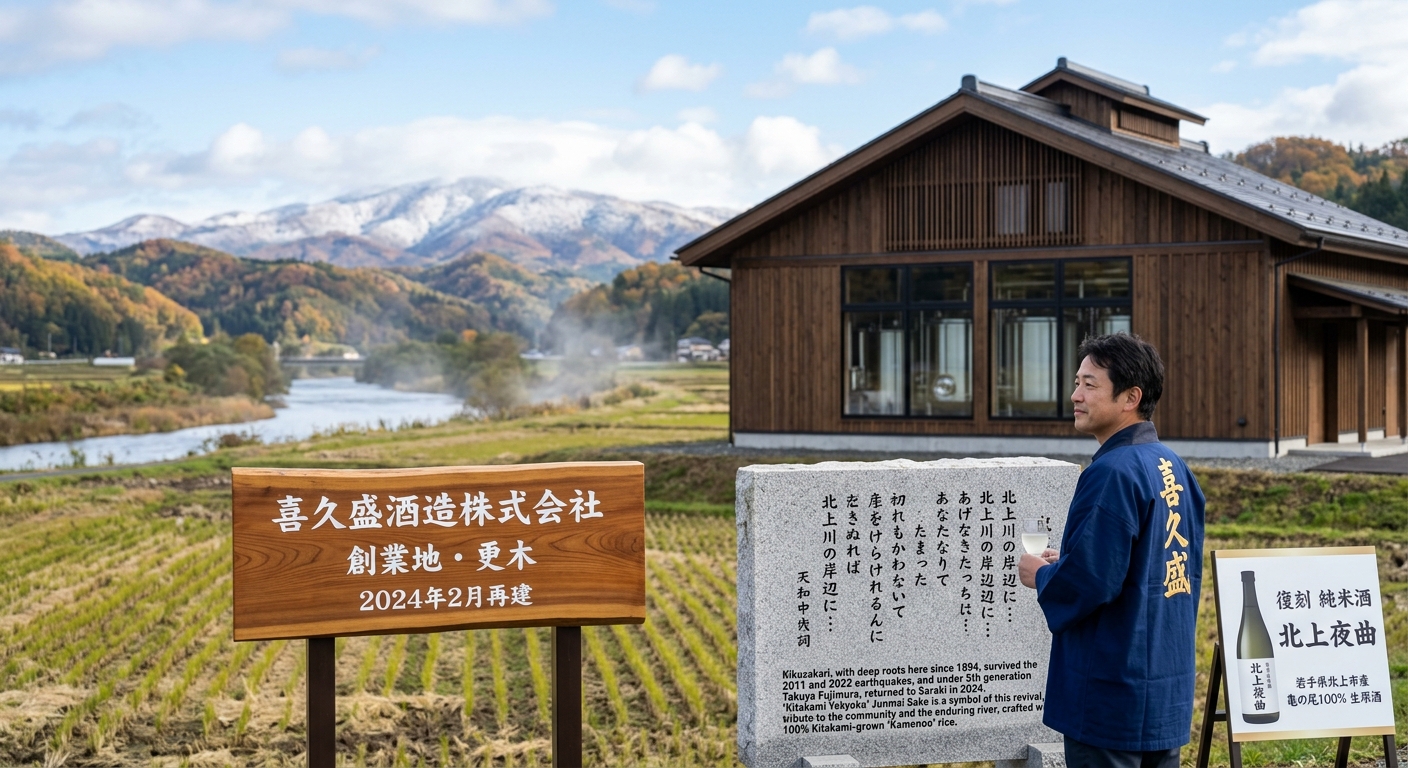
The Great East Japan Earthquake of 2011 badly damaged the brewery’s main storehouse in Sarashina — its roof partially collapsed and its earthen walls crumbled, leaving the building half-destroyed. From then on, the brewery kept brewing by renting space at a closed competitor’s facility in neighboring Hanamaki City. In 2014, it committed to becoming an all-Junmai brewery, using no added brewing alcohol, and switched entirely to Iwate-grown rice. After a 2022 earthquake caused further damage to the already-weakened storehouse, fifth-generation owner Takuya Fujimura decided to rebuild on the brewery’s original site in Sarashina. In February 2024, marking the brewery’s 130th anniversary, a new brewing facility was completed there, and the brewery finally returned home.
The Junmai sake in this pairing, “Kitakami Yakyoku,” is a label Fujimura revived in 2019. It had once disappeared during his father’s time as owner, and Fujimura brought the name back to a bottle. The name has an older connection to the brewery than that: Fujimura’s grandfather, two generations before him, once served as chairman of the Kitakami Tourism Association, and in 1974 was involved in erecting a monument in Kitakami City to the song “Kitakami Yakyoku.” The sake is brewed entirely from “Kameno-o” rice grown locally in Kitakami City, and bottled undiluted and unpasteurized as nama genshu.
The Story of the Land
Kitakami City sits along the middle stretch of the Kitakami River, the longest river in the Tohoku region. At Tenshochi, the city’s best-known cherry blossom spot, stands the monument to “Kitakami Yakyoku.” It was erected in 1974 and moved to its current location beside the Tenshochi rest house in 1989. Rare among monuments nationwide, it bears the lyricist’s own handwriting and the composer’s own musical score, and a button lets visitors play the song. A national “Kitakami Yakyoku” singing contest was even held locally each year until 2011.
The “Kameno-o” rice used for the Kitakami Yakyoku sake is also grown in Kitakami City, nourished by the same river. The riverbank remembered in song and cast in stone, and the rice paddies that grow the sake’s rice, are connected by the same waters of the Kitakami River.
The Story of the Song
“Kitakami Yakyoku” was written in December 1940 by Kiku Kikuchi (1923–1989), then a student at Mizusawa Agricultural School, with music added the following February, 1941, by his friend Mutsuo Ando (1924–2007), a student at the old Hachinohe Middle School. Both men were from Iwate Prefecture and had lived in the same boarding house. The song was originally titled “Whispers of the Kitakami River,” but was renamed “Kitakami Yakyoku” in imitation of the then-popular song “Soshu Yakyoku” (“Suzhou Serenade”).
For years after the war it spread by word of mouth with its authors unknown, becoming a favorite at Shinjuku’s “utagoe kissa” (singing cafes) from the mid-1950s onward. It was first recorded, on a flexi disc, on January 22, 1961, and that same year several record companies released competing versions. In the end, six record companies put out 22 different recordings of the song. Among them, the version by Dark Ducks (on King Records) and the version by Tama Sachiko & Hiroshi Wada and the Mahina Stars (on Victor) became especially big hits — the latter surpassing two million copies sold by 1970. That same year, 1961, the two long-unknown authors finally came forward, and it became widely known that the song had been written entirely by two teenagers during the darkest years of the war.
Why This Pairing
The monument to “Kitakami Yakyoku” in Kitakami City was built under the chairmanship of a Kikuzakari family member — two generations before the current owner — who led the local tourism association at the time. The bond between the song and the brewery predates the sake that now carries the song’s name. That name, once discontinued under the previous generation, was revived as a Junmai sake by fifth-generation owner Takuya Fujimura in 2019.
And the brewery itself was driven from its hometown by the 2011 earthquake. It brewed in neighboring Hanamaki City for eleven years, and after a further setback in a 2022 earthquake, finally returned to Sarashina in 2024. A song written in longing for a home beside the river, a brewery that has returned to its home beside the same river, and a sake that carries the song’s name: three stories quietly overlapping on the banks of the Kitakami.
Where to Find This Bottle
The Rakuten Ichiba link below is an affiliate link.
- Brewery’s official site: http://kikuzakari.jp/
- Search on Rakuten Ichiba: See search results for “Kikuzakari Kitakami Yakyoku”
Note: the links above lead to Japan-based retailers. They’re most convenient for readers in Japan, or for those elsewhere who are able to arrange international shipping. Stock and availability change over time, so if you’re near a specialty sake shop, it’s well worth asking for this label by name.
Pairing Dishes Worth Trying
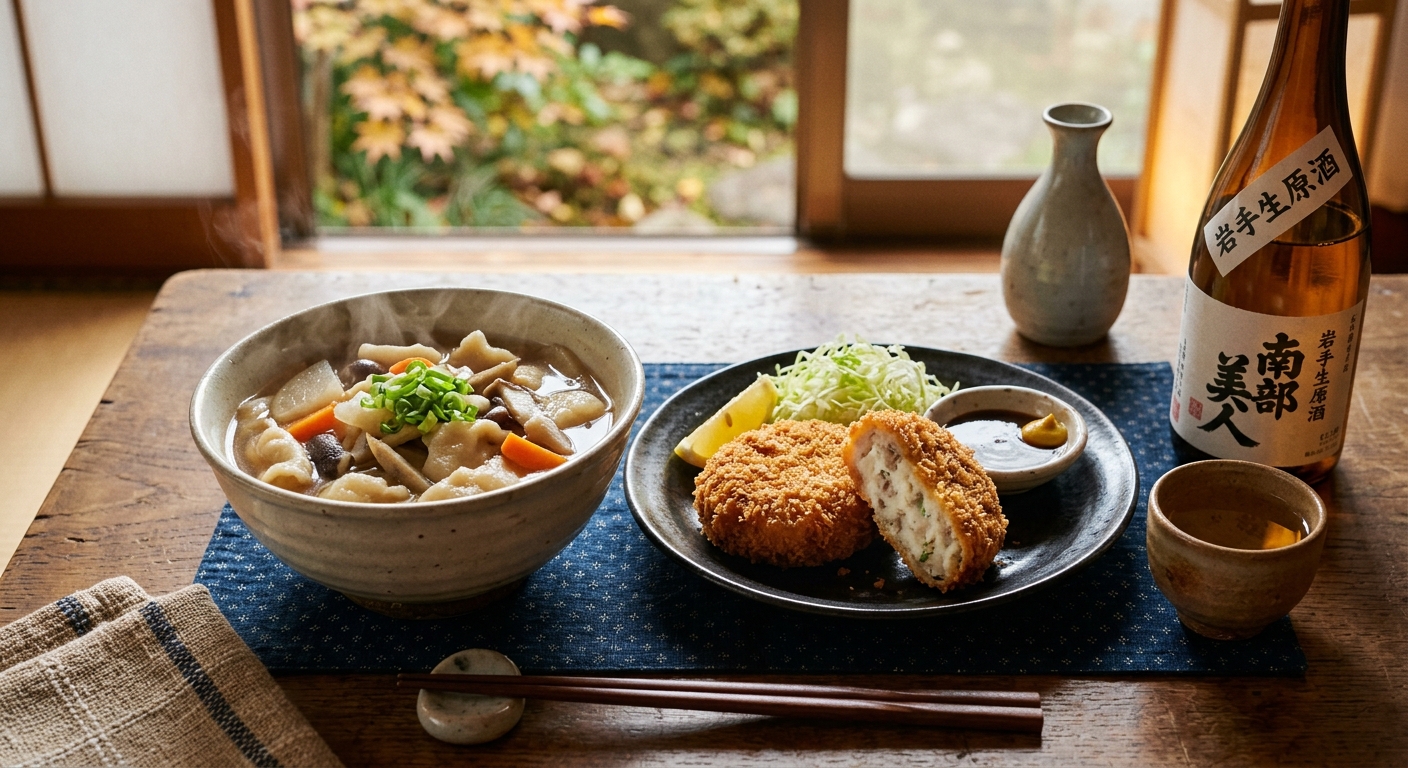
- Hittsumi soup
A rustic home-style soup from Iwate, made by kneading and stretching wheat dough, tearing it by hand, and simmering it with vegetables. Its plain wheat sweetness and savory broth stand up well to the bold rice umami of this undiluted nama genshu.
Recipe (in Japanese): Kurashiru, “Iwate’s Regional Hittsumi Soup” - Kitakami croquette
A local specialty croquette made not with potato but with “Futago” taro, a variety grown in Kitakami City. The taro lends a sticky texture and gentle sweetness quite different from a potato croquette — a pairing of two things grown and made in the same city as the sake.
A note on the science: the mild sweetness that starches in wheat and taro release complements the organic acids and umami compounds in sake, each enhancing the other’s flavor. Hot soup and freshly fried croquettes release aroma more readily, which also makes the gentle rice-driven fragrance of this nama genshu easier to notice.
Visiting the Brewery
Kikuzakari Sake Brewery
3-54 Saragi, Kitakami City, Iwate. About 15 min by car from Kitakami Station.
Founded in Saragi in 1894, the brewery returned to its home ground of Saragi in 2024.
Sights Nearby
- Tenshochi Park / Kitakami City | ~10 min, ~6 km by car from the brewery
A row of cherry trees running about 2 km along the east bank of the Kitakami River, one of Japan’s “100 best cherry-blossom spots.” There are boat trips on the river, and the Michinoku Folklore Village is in the park. - Michinoku Folklore Village / Kitakami City (within Tenshochi Park) | ~10 min, ~6 km by car from the brewery
One of Tohoku’s largest open-air museums, with about 20 relocated buildings from the Edo to Taisho periods, including Nanbu magariya farmhouses. Free entry.
Opening hours and closing days can change. Please check each facility’s official information before visiting.
A Quick Glossary of Sake Terms
- Junmai: Sake made only from rice, rice koji, and water, with no added brewing alcohol, giving a straightforward sense of the rice’s own umami.
- Nama genshu: Sake bottled without pasteurization (hi-ire) and without dilution with water, letting drinkers enjoy a flavor close to what comes straight from the press.
Sources
- Kikuzakari Sake Brewery – Official Site
- “Brewing Sake at Home, Once Again” – Kitakami Shigotonin Zukan (Japanese)
- “Kitakami Yakyoku and Its Monument” – City of Kitakami official site (Japanese)
- Kitakami Yakyoku – Wikipedia (Japanese)
If you notice any errors in this article, please don’t hesitate to reach out at info@soundrecords.jp.
Read this article in Japanese: 歌になった川へ、酒は帰ってきた