日本語で読む | This is the English version of a bilingual article.
Today’s Pairing
- Sake: Junmai Ginjo Uragasumi Zen / Saura Co., Ltd. (Shiogama City, Miyagi Prefecture)
Official site: https://www.urakasumi.com/ - Kayoukyoku (classic Japanese popular song): “Aoba-jo Koiuta” (“Love Song of Aoba Castle”), performed by Sato Muneyuki (1978)
YouTube: https://www.youtube.com/watch?v=rrXXfau5vx4
▶ If the player above doesn’t play, open it on YouTube
The Story of the Brewery
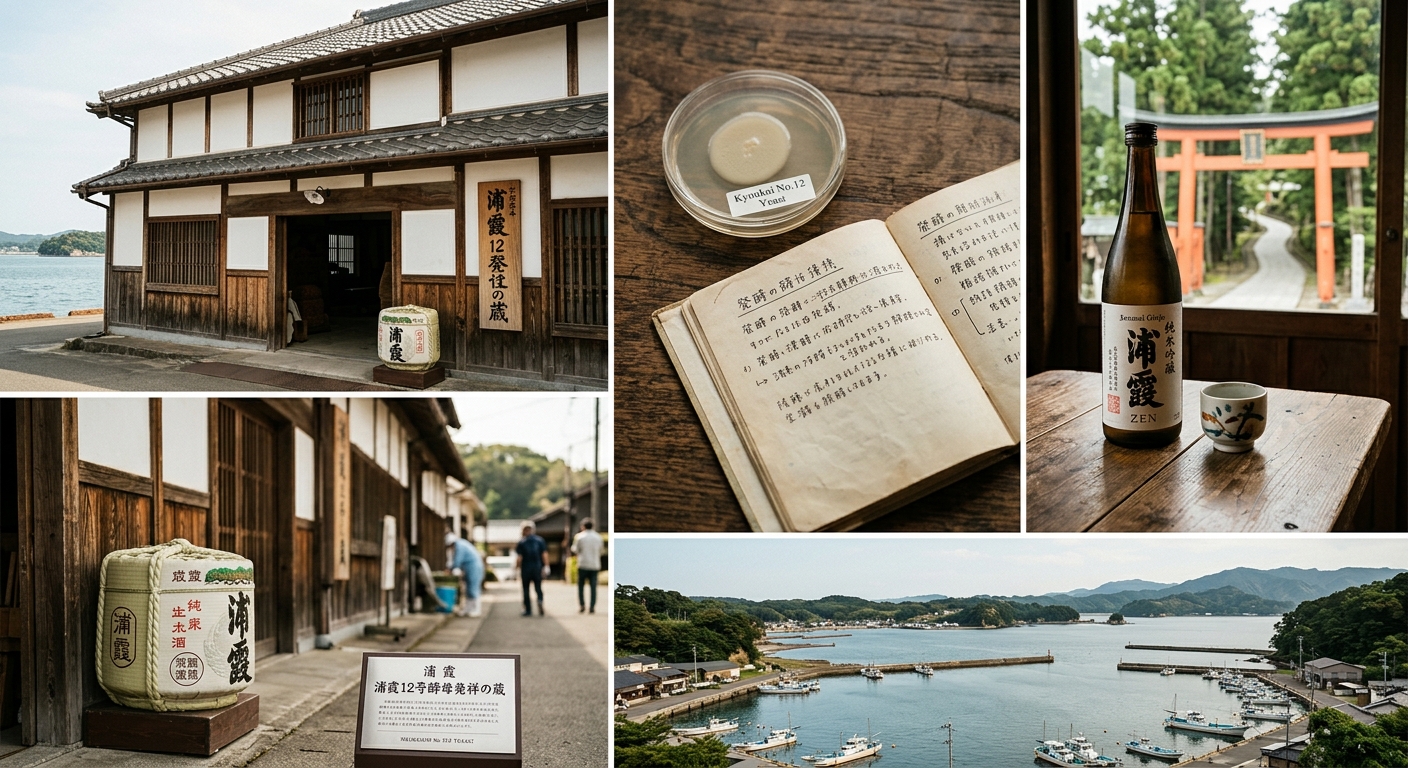
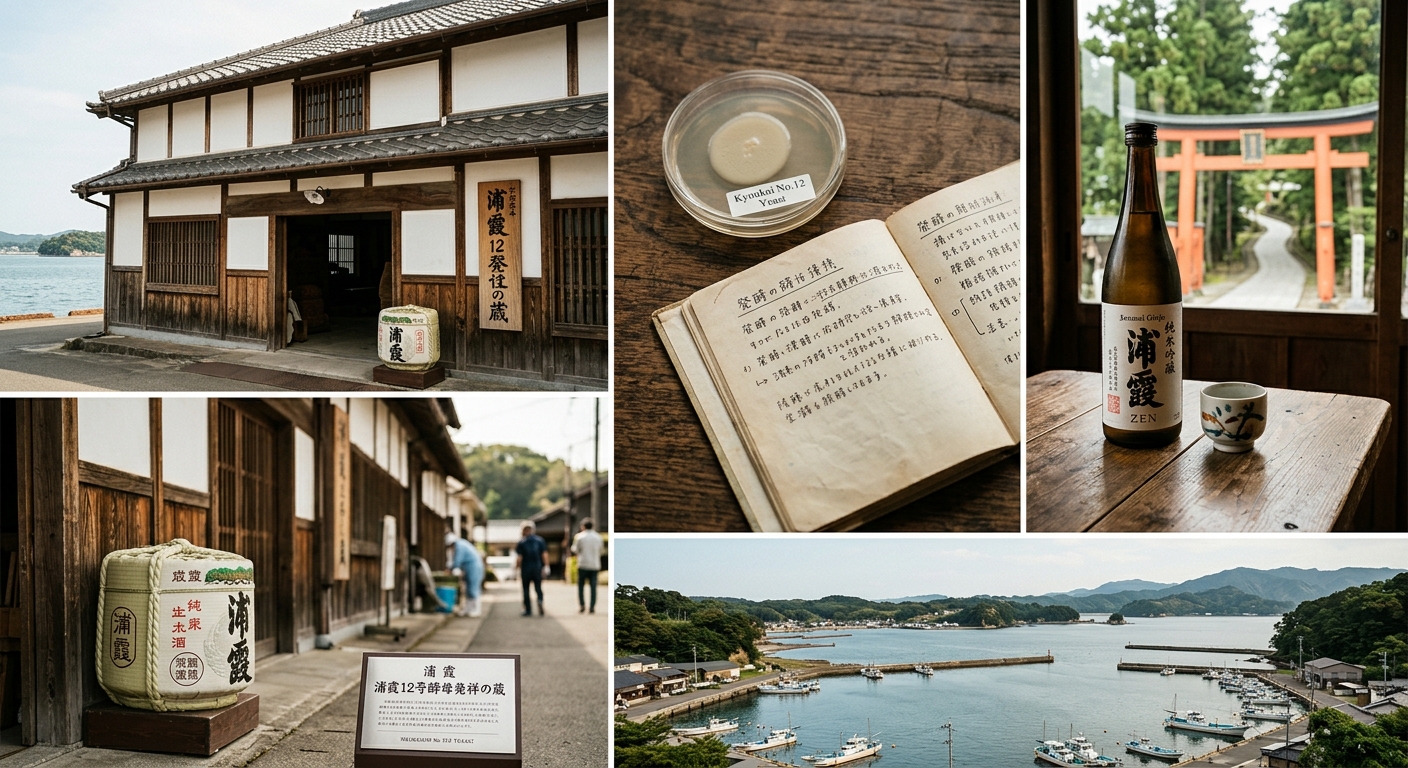
Saura Co., Ltd., brewer of Uragasumi, was founded in 1724. The brewery stands in Shiogama, a port town in Miyagi Prefecture facing Sendai Bay. In the latter half of the Edo period it became the official sake supplier to Shiogama Shrine, the region’s foremost shrine and one long revered by the Date clan, lords of the Sendai domain — a role it continues to this day. The current owner is the thirteenth generation, Saura Koichi.
Around 1965, a technician at the Miyagi Sake Brewers’ Cooperative research laboratory isolated a yeast strain from the ginjo mash at Uragasumi. That strain was later registered by the Japan Sake and Shochu Makers Association as “Kyokai No. 12 Yeast,” and from around 1985 it was distributed to breweries across the country. Uragasumi has since called itself “the brewery where Kyokai No. 12 yeast was born” — a single yeast strain that first appeared quietly in one brewery’s mash and went on to support sake brewing nationwide.
The bottle in this pairing, Junmai Ginjo Uragasumi Zen, has been the brewery’s long-selling flagship since it was first released in 1973. It is brewed from Yamada Nishiki and Toyonishiki, a sake rice variety bred in Miyagi, polished to a seimai buai of 50%. It comes in at 15% alcohol, with a nihonshu-do (sake meter value) of +2 to +3. Its gentle, fruit-like aroma and fresh, well-balanced umami make it, by the brewery’s own description, a sake built to be enjoyed with food.
The Story of the Land
Shiogama faces Sendai Bay and also serves as a gateway to Matsushima Bay. Blessed with rich fishing grounds, it has long flourished as the town at the gate of Shiogama Shrine, and Saura has walked alongside the region for centuries as the brewery entrusted with offering sake to that shrine.
Just as a small yeast strain born inside the brewery’s mash unexpectedly spread to sake breweries across Japan, this port town is a place where something quietly nurtured at home has a way of reaching far beyond it.
The Story of the Song
“Aoba-jo Koiuta” was born in June 1977. Sato Muneyuki was hosting a program called “FM Request Hour” on NHK-FM Sendai, and had started a segment in which he set listeners’ submitted poems to music. Among those submissions was a poem from a Sendai resident, Hoshima Funaichi. Sato added his own touches to the text, and the song came together in about five minutes.
The demo tape caught the ear of a director at King Records, and the song was released as a single on May 5, 1978, marketed as a competing release alongside a version by The Dark Ducks. Sato’s version reached number three on the weekly Oricon chart and sold over a million copies, and that year it won the Best New Artist award at the Japan Record Awards, along with the Grand Prize at the Japan Lyricist Award, the Best New Artist award at the Japan Cable Broadcasting Awards, and the Best New Artist award at the FNS Music Festival.
Weaving in the Hirose River, Aoba Street, and the Sendai Tanabata festival, the song is a lyric poem of lost love set against the old castle town of Sendai. It is regarded as a representative local song of Sendai, Miyagi Prefecture, and the wider Tohoku region, and it is credited with spreading Sendai’s poetic nickname, “Mori no Miyako” (“the City of Trees”), across the country.
Why This Pairing
Both the sake and the song carry the same kind of story: something born quietly in one small place that unexpectedly reached far beyond it. The yeast strain found in Uragasumi’s mash spread, over the course of twenty years, to breweries across the country and now underpins the flavor of countless sakes. In much the same way, a single poem sent in to a local Sendai radio program became a song in about five minutes, and eventually grew into one sung across all of Japan.
Uragasumi Zen’s gentle, fruit-like aroma and fresh umami carry an unadorned simplicity. That quality echoes the modest charm of a song that, without any showiness, quietly seeped into the hearts of listeners nationwide. Something born humbly in a local place, loved widely without ever losing that humility — that is the shared thread behind this pairing.
Where to Find This Bottle
The Rakuten Ichiba link below is an affiliate link.
- Brewery’s official site: https://www.urakasumi.com/
- Search on Rakuten Ichiba: Urakasumi “Zen” Junmai Ginjo (gift box)
Note: both Rakuten and Amazon links above lead to Japan-based retailers. They’re most convenient for readers in Japan, or for those elsewhere who are able to arrange international shipping. Stock and availability change over time, so if you’re near a specialty sake shop, it’s well worth asking for this label by name.
A Pairing Dish Worth Trying
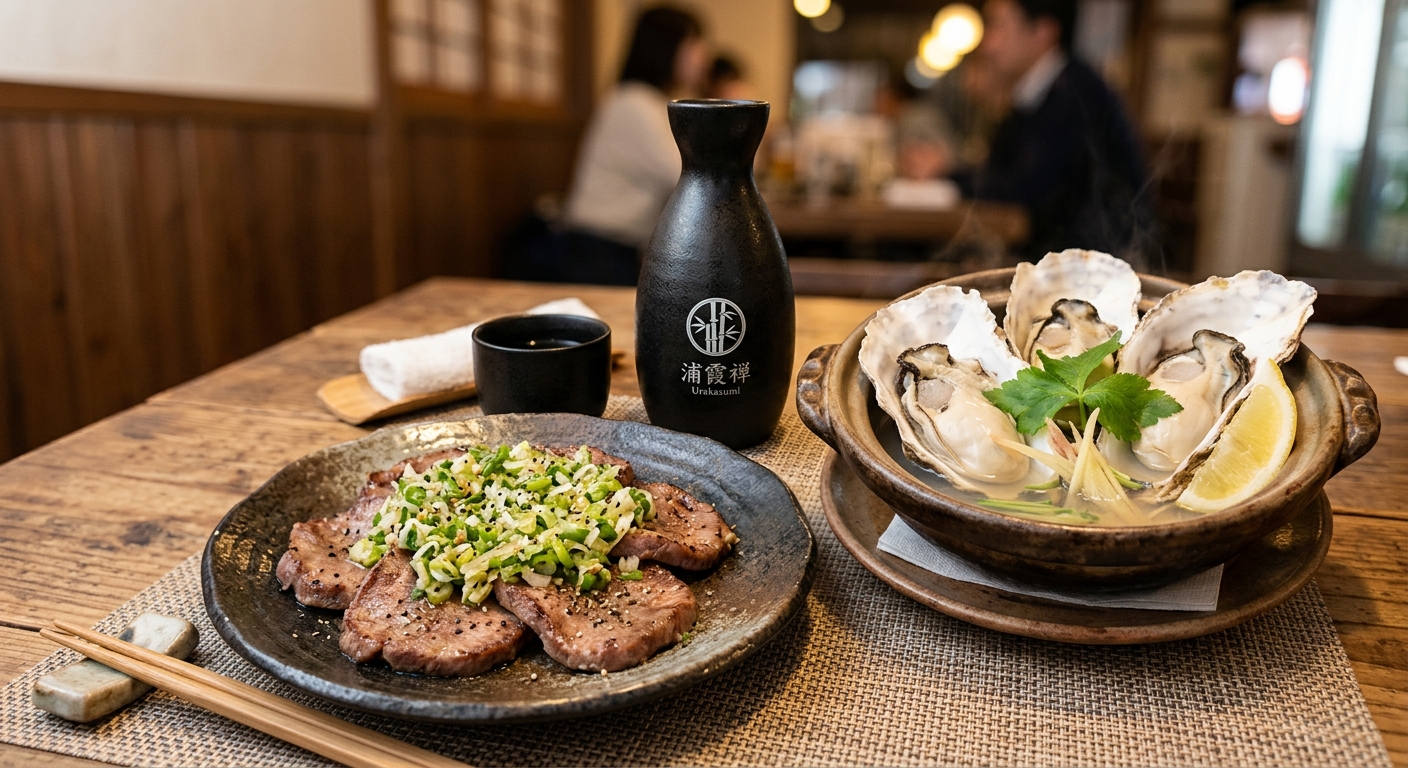
- Negishio gyutan (salt-and-scallion grilled beef tongue)
Sendai’s signature dish, grilled and finished with scallion and salt. The rich fat of the tongue and the brightness of the scallion-salt sit well against Uragasumi Zen’s fresh acidity and gentle umami, which keep the finish light.
Recipe (in Japanese): Kurashiru, “Simple Negishio Gyutan” - Sake-steamed oysters in the shell
Oysters from Miyagi’s coast, including Matsushima Bay, simply steamed in sake. Their concentrated umami sits alongside the gentle aroma that’s characteristic of a junmai ginjo.
Recipe (in Japanese): Kurashiru, “Easy Pot-Steamed Oysters in the Shell”
A note on the science: the fat in grilled beef tongue is cut through by the sake’s gentle acidity and clean finish, resetting the palate for the next bite. The glutamic acid and succinic acid abundant in oysters overlap with the amino-acid-derived umami in the sake, lifting both flavors through mutual synergy.
Visiting the Brewery
Urakasumi — Saura Co.
2-19 Honcho, Shiogama City, Miyagi. About a 7-min walk from Hon-Shiogama Station (JR Senseki Line).
The “Urakasumi Sake Gallery” at the head office sells Miyagi-only bottles and more (10:00-17:00; closed Sundays and some other days).
Sights Nearby
- Shiwahiko Shrine & Shiogama Shrine / Shiogama City | ~15-min walk (~5 min by car) from the brewery
The first-ranked shrine of the old Mutsu Province, long revered for safety at sea and good catches; known also for the 202 stone steps of its main approach. - Marine Gate Shiogama / Shiogama City | ~5 min, ~1.5 km by car from the brewery
The terminal for Matsushima Bay sightseeing boats and the municipal ferry to the Urato Islands, with shops and eateries. - Matsushima (Zuiganji Temple, Godaido Hall) / Matsushima Town | ~25 min, ~13 km by car from the brewery
One of Japan’s three great scenic views, with Date Masamune’s Zuiganji temple and the Godaido hall standing out over the water.
Hot Springs Nearby
- Matsushima Onsen / Matsushima Town | ~25 min, ~13 km by car from the brewery
A hot spring first tapped in 2008. Some of the bay-view hotels accept day-use bathers; check each one’s hours before you go.
Opening hours, closing days and day-use bathing availability can change. Please check each facility’s official information before visiting.
A Quick Glossary of Sake Terms
- Junmai Ginjo: A junmai (pure rice) sake — made only from rice, rice koji, and water, with no added brewing alcohol — brewed from rice polished to 60% or less of its original size (a “ginjo” level of polish) and fermented slowly at low temperatures, giving it a fragrant aroma.
- Seimai buai (rice-polishing ratio): The percentage of the original brown rice grain remaining after polishing. The lower the number, the more the rice has been polished down.
Sources
- Saura Co., Ltd. – Company Profile
- Uragasumi No.12 (Kyokai No. 12 Yeast) – Official Site
- Junmai Ginjo Uragasumi Zen – Official Site
- Aoba-jo Koiuta – Wikipedia
If you notice any errors in this article, please don’t hesitate to reach out at info@soundrecords.jp.
Read this article in Japanese: 小さな一滴が、国中へ広がってゆく