日本語で読む | This is the English version of a bilingual article.
Today’s Pairing
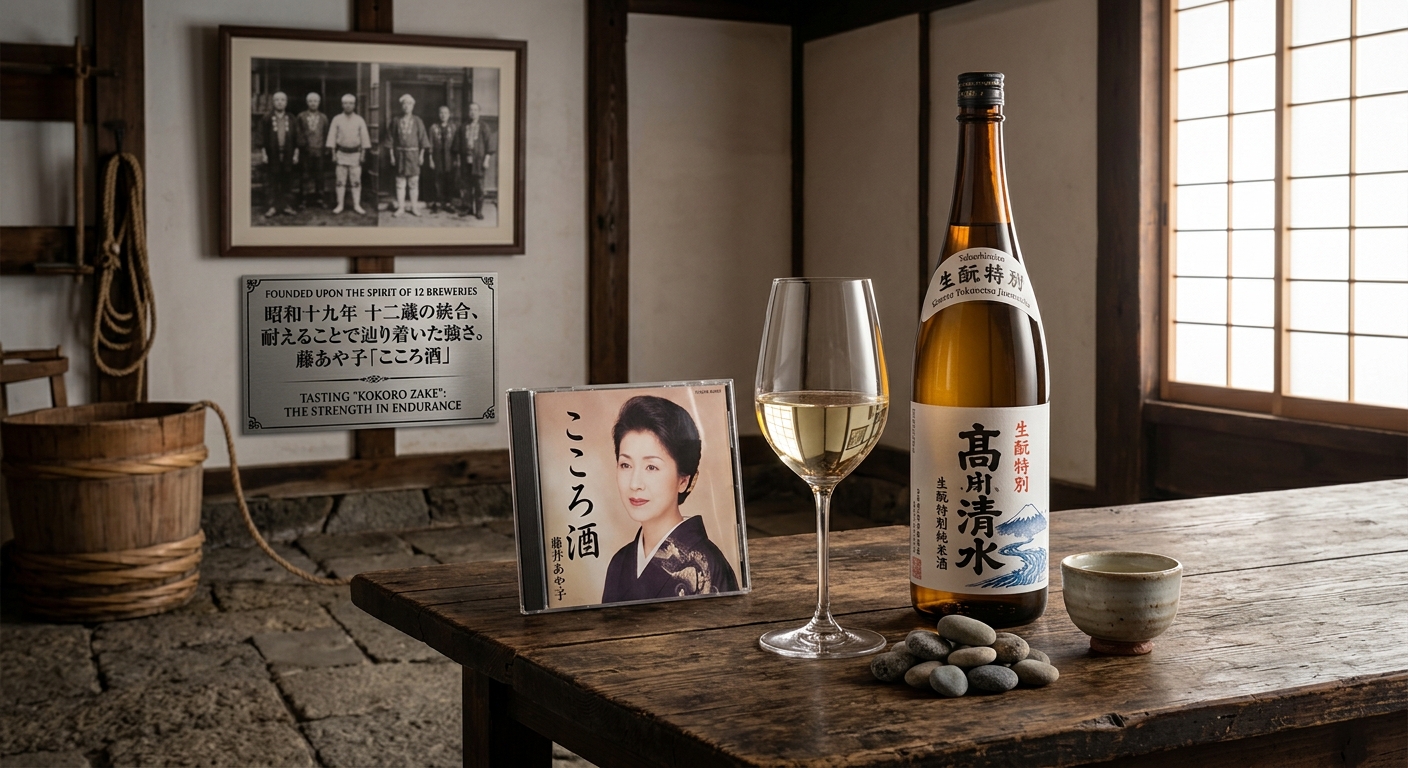
- Sake: Takashimizu Kimoto Tokubetsu Junmai (Special Junmai brewed by the kimoto method) / Akita Shurui Seizo Co., Ltd. (4-12 Kawamoto Mutsumi-cho, Akita City, Akita Prefecture)
Official site: https://www.takashimizu.co.jp/ - Kayoukyoku (classic Japanese popular song): “Kokoro-zake” (“Sake of the Heart”), performed by Fuji Ayako (1992)
YouTube: https://www.youtube.com/watch?v=fXOHrIhO83o
▶ If the player above doesn’t play, open it on YouTube
The Story of the Brewery
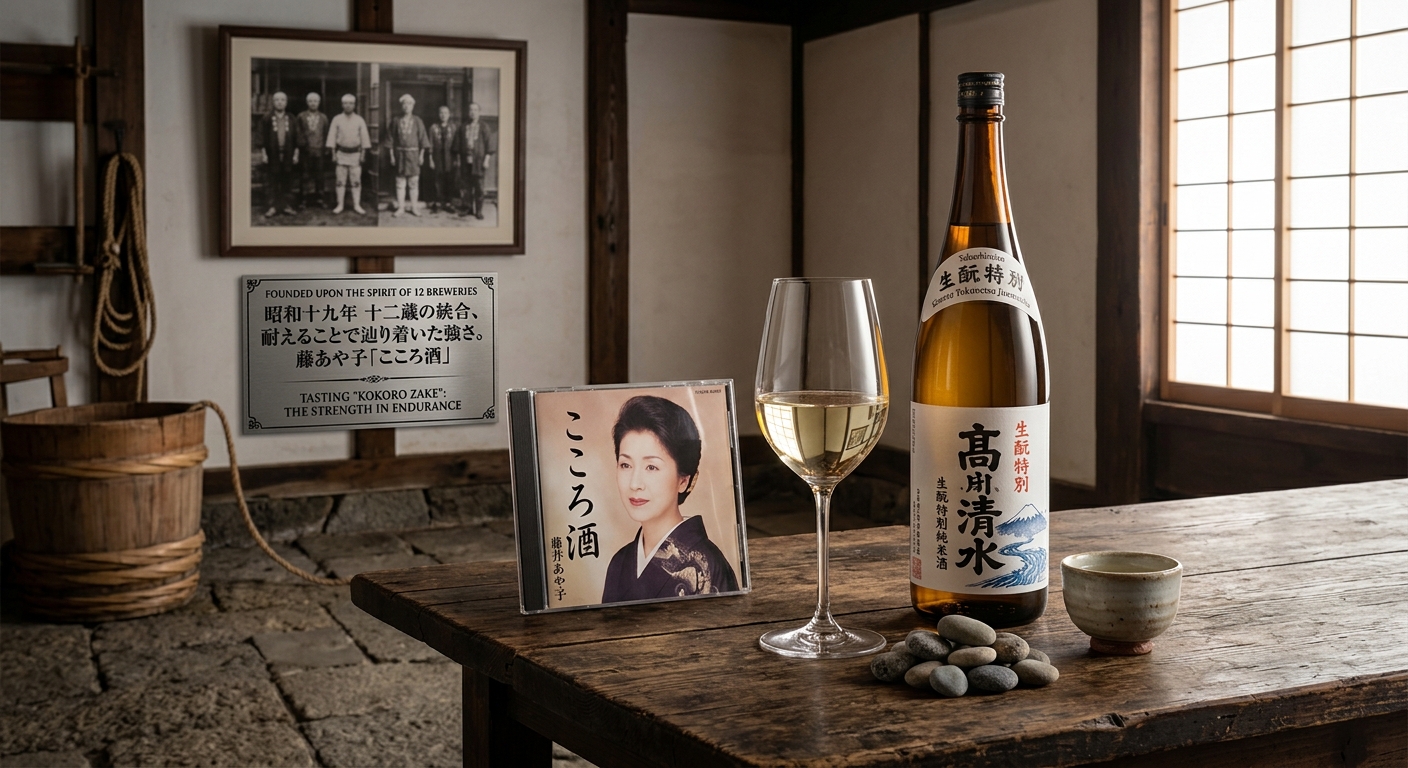
Akita Shurui Seizo did not begin as a single brewery. It was born in 1944, in the middle of the war, when a government reorganization ordinance merged twelve separate breweries from across Akita Prefecture into one company. Trace the oldest thread back far enough and you arrive at a house founded in 1656, which brewed a sake called “Kikusui” for roughly two hundred and ninety years. Twelve long-established breweries, each carrying its own techniques and its own pride, pooled everything into a single enterprise. That merger is where this brewery starts.
The brand name “Takashimizu” was settled in 1947, not long after the war ended. It was chosen from among 5,037 suggestions sent in from all over Japan, and it points to the brewery’s home ground: Kawamoto in Akita City had been known since the days of the feudal domain as a place where fine spring water rises. The thoughts of many breweries gathering into one clear spring — the name itself still tells the story of how this company came to be.
The bottle in this pairing, the Kimoto Tokubetsu Junmai, is made from Miyama Nishiki, a sake rice grown in Akita, polished to a seimai buai of 60% for both the koji rice and the main mash rice. It is brewed by kimoto, the traditional and labor-intensive method of building the yeast starter by drawing in lactic acid bacteria naturally and letting it develop slowly. At 15.5% alcohol and a sake meter value of +3, it leans slightly dry, with a clear, soft aroma suggesting banana and a mellow, expansive umami.
The Story of the Land
Kawamoto in Akita City has been celebrated as a source of fine water since the domain era. It was on this ground, blessed with abundant subsoil water, that the twelve newly merged breweries built their base and began again. Like spring water rising ceaselessly from beneath an unremarkable patch of land, the skills of brewers scattered across the prefecture — people who rarely stood in the spotlight — were quietly gathered here into a single current and passed on.
Akita is also a land of deep-snow winters and wide swings in temperature, conditions well suited to sake made slowly and patiently. The way a kimoto starter is raised — unhurried, enduring — mirrors the climate that surrounds it.
The Story of the Song
Fuji Ayako was born on May 10, 1961, in Kakunodate, Senboku District, Akita Prefecture (today part of Senboku City). Kakunodate is known as “the little Kyoto of Michinoku,” and it was there that she began studying min’yo folk singing in the fourth grade. She won a “Miss Bride” contest in her teens and took first place on NHK’s singing competition program in 1985, showing her voice early. After debuting in 1987 under the name Murase Manami, she re-debuted in 1989 as Fuji Ayako with the single “Onna.”
Her third single, “Kokoro-zake,” released on September 1, 1992, gives voice to a woman drinking alone in a quiet corner of the city and to the ache she carries. It entered the Oricon chart at number six and sold more than 810,000 copies — the biggest hit of her career — eventually passing one million in cumulative sales and ranking third among all enka and kayoukyoku singles released in the Heisei era. The song won her the 25th Japan Yusen Taisho and brought her first appearance on NHK’s Kohaku Uta Gassen that same year. She sings it plainly and straight, and what comes through is the quiet strength of endurance.
Why This Pairing
Twelve breweries, under the pressures of wartime, brought their techniques and their pride together and endured their way into becoming one house. The woman in “Kokoro-zake” sits alone with her cup and finds that she can bear what is hard as long as there is someone to bear it for. Different stories, but the same shape: a strength that can only be reached by enduring.
A kimoto starter asks the brewer to spare no effort and then to wait for lactic acid bacteria to do their slow work. The woman in the song is doing something similar — taking her time, facing what she feels. Unhurried, and thorough. It is precisely sake made that way that arrives at a mellow, expansive kind of umami.
Where to Find This Bottle
The Rakuten Ichiba link below is an affiliate link.
- Brewery’s official site: https://www.takashimizu.co.jp/
- Search on Rakuten Ichiba: Takashimizu Kimoto Tokubetsu Junmai (720ml / 1800ml)
Note: both Rakuten and Amazon links above lead to Japan-based retailers. They’re most convenient for readers in Japan, or for those elsewhere who are able to arrange international shipping. Stock and availability change over time, so if you’re near a specialty sake shop, it’s well worth asking for this label by name.
A Pairing Dish Worth Trying
- Madai no kabutoni
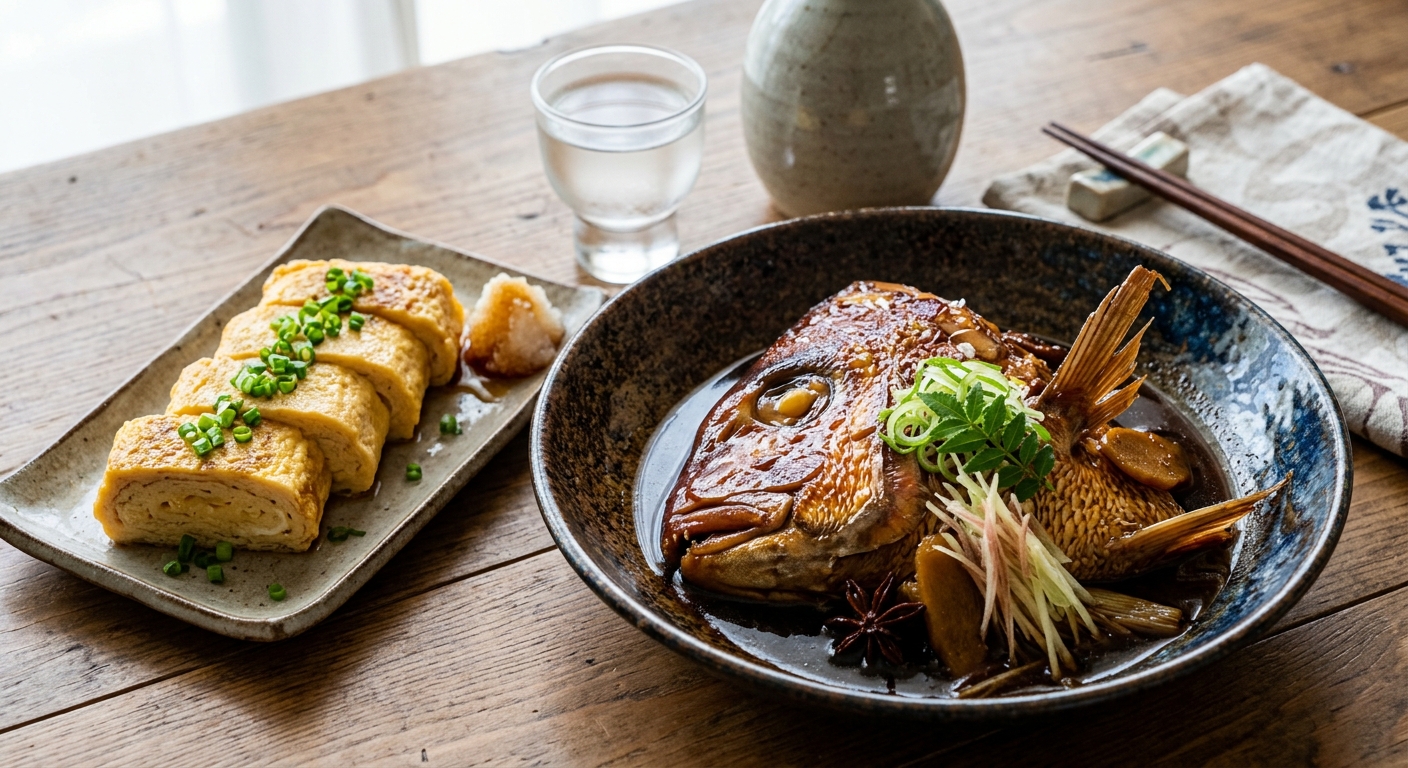
The head of a red sea bream, simmered slowly in a sweet-salty soy broth — a dish packed with concentrated umami. The firm acidity and depth that kimoto brewing gives this sake stand up to the strong broth rather than being flattened by it.
Recipe (in Japanese): Kurashiru, “Sea Bream Kabutoni” - Dashimaki tamago
A softly rolled omelette in which the sweetness of egg and the umami of dashi spread gently. It harmonizes with the mellow richness particular to kimoto, and brings out the softness of the sake served cold — a different pleasure from the warmed cup.
Recipe (in Japanese): Kurashiru, “Easy Dashimaki Tamago with Shiro-dashi”
A note on the science: the lactic-acid-derived acidity abundant in kimoto-brewed sake has a rinsing effect on the finish of an oil-rich simmered fish like kabutoni, resetting the palate; and with the umami compounds in the dashi of a rolled omelette, the rice-derived amino acids in the sake overlap to produce a gentle synergy of savoriness.
Visiting the Brewery
Akita Seishu (Takashimizu)
4-12 Kawamoto-mutsumicho, Akita City, Akita. About 7 min by car from Akita Station.
The brewery, formed by the merger of twelve breweries from around the prefecture, has its head office in central Akita.
Sights Nearby
- Senshu Park (Kubota Castle ruins) / Akita City | ~7 min, ~2 km by car from the brewery
A park laid out on the ruins of Kubota Castle, seat of the Satake clan. The grounds are open at all hours and free; the corner turret and the Satake Historical Museum are paid, with set hours. - Akita Museum of Art / Akita City | ~7 min, ~2 km by car from the brewery
Known for Fujita Tsuguharu’s vast mural “Events in Akita” (20.5 m wide), in a building designed by Ando Tadao. 10:00-18:00, ¥310 for adults, free for high-school age and younger.
Hot Springs Nearby
- Akita Onsen Plaza / Akita City | ~15 min, ~7 km by car from the brewery
A day-use natural hot spring known as “the beauty bath.” Open 10:00-21:00 (from 13:00 on the 2nd and 4th Monday).
Opening hours, closing days and day-use bathing availability can change. Please check each facility’s official information before visiting.
A Quick Glossary of Sake Terms
- Tokubetsu junmai (special pure rice sake): A junmai sake made by some special method or with especially well-polished rice — typically a seimai buai of 60% or lower — with the distinction stated on the label.
- Kimoto: A traditional, labor-intensive method of building the sake starter (moto) by naturally cultivating wild lactic acid bacteria, rather than adding purified lactic acid.
- Seimai buai (rice-polishing ratio): The percentage of the original brown rice grain remaining after polishing. The lower the number, the more the rice has been polished down.
Sources
- Takashimizu (Akita Shurui Seizo Co., Ltd.) – Official Site
- Takashimizu – The History of the Brewery
- Kokoro-zake – Wikipedia
If you notice any errors in this article, please don’t hesitate to reach out at info@soundrecords.jp.
Read this article in Japanese: 十二の蔵が、一つの清水になるまで