日本語で読む | This is the English version of a bilingual article.
Today’s Pairing
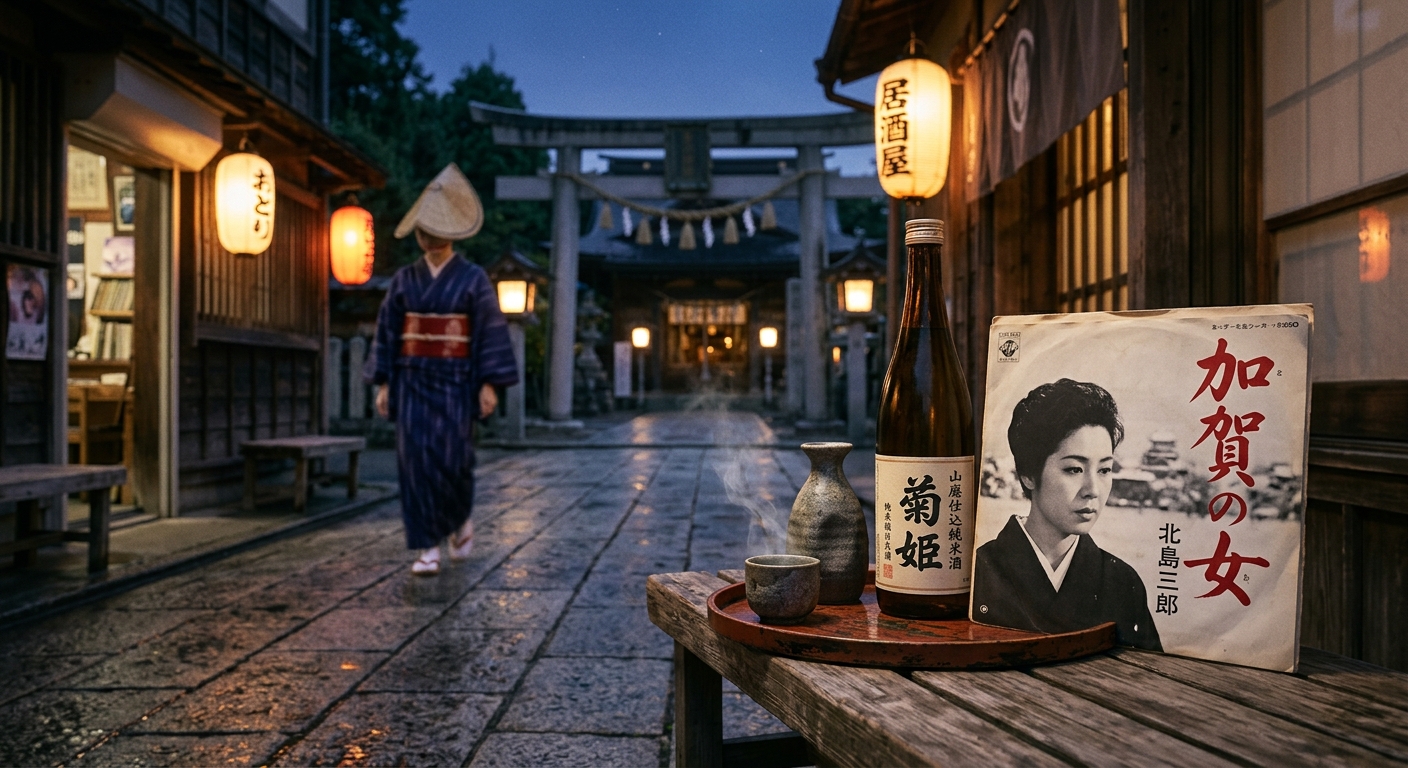
- Sake: Kikuhime Yamahai-jikomi Junmai (Junmai brewed by the yamahai method) / Kikuhime Co., Ltd. (Tsurugi-shinmachi, Hakusan City, Ishikawa Prefecture)
Official site: https://www.kikuhime.co.jp/ - Kayoukyoku (classic Japanese popular song): “Kaga no Onna” (“The Woman of Kaga”), performed by Kitajima Saburo (1969)
YouTube: https://www.youtube.com/watch?v=gio86K8mFKw
▶ If the player above doesn’t play, open it on YouTube
The Story of the Brewery
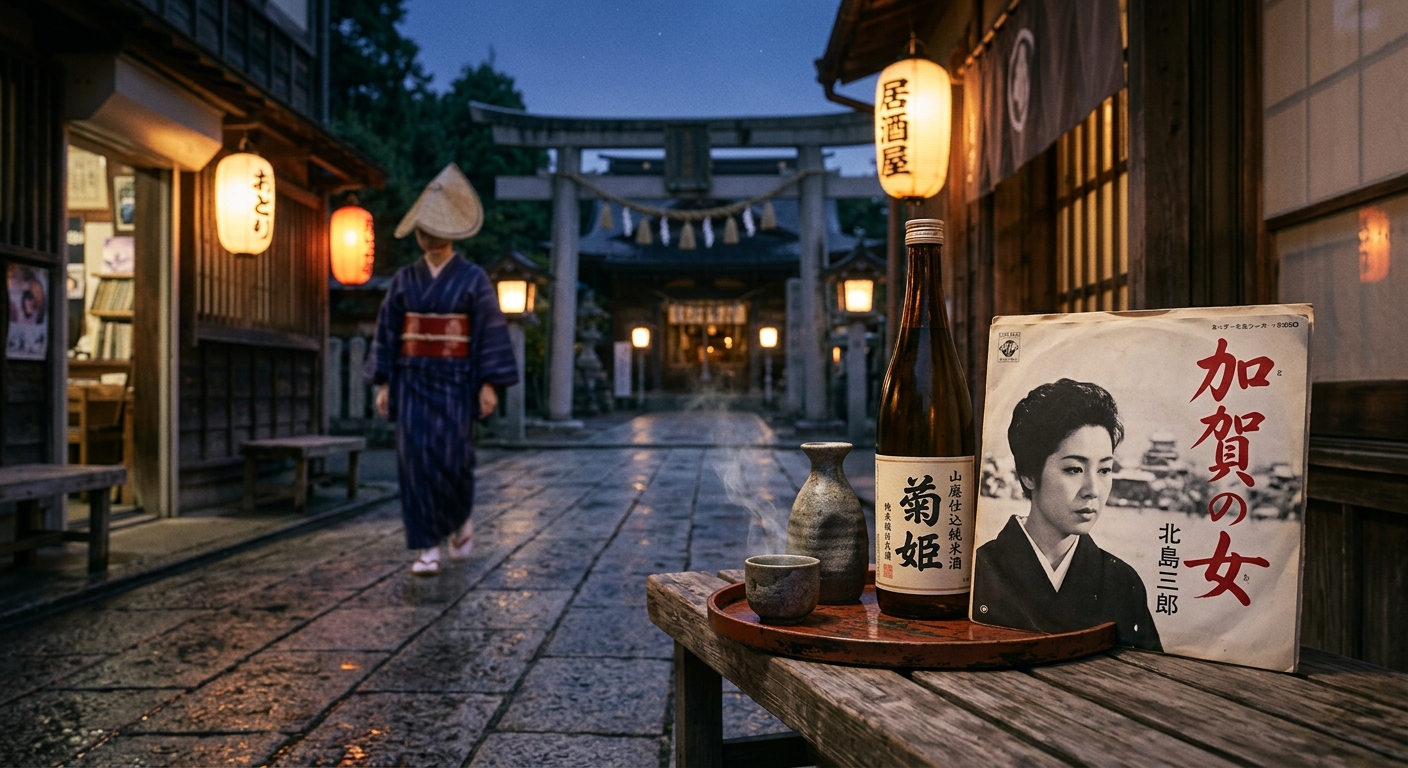
Kikuhime Co., Ltd. is based in Tsurugi, Hakusan City, Ishikawa Prefecture, at the foot of the sacred Mt. Hakusan. The brewery traces its shop name, “Koyanagiya,” back to the Tensho era (1573–1592), but the story of sake in this town runs deeper still: as the temple town of the local guardian shrine, Shirayamahime Shrine, it’s said sacred sake has been brewed here since the Nara period. The brand name “Kikuhime” comes from Kukurihime, the deity enshrined at Shirayamahime Shrine.
By the Muromachi period, sake from this area was already known as “Kaga no Kikuzake” (“Kaga’s chrysanthemum sake”), and according to the Taikoki chronicle, Toyotomi Hideyoshi is said to have had this very sake brought to his famous cherry-blossom viewing party at Daigo-ji in 1598. For more than four hundred years, this brewery has upheld a lineage of sake renowned across Japan.
Central to Kikuhime today is the Yamahai-jikomi Junmai featured in this pairing. In 1983, Kikuhime became the first in the industry to release a junmai sake explicitly labeled as brewed by the yamahai method. Yamahai is a traditional kimoto-style yeast-starter method, distinguished by omitting the labor-intensive “yamaoroshi” (rice-mashing) step, allowing wild yeast and lactic bacteria to slowly build the starter’s character together. Kikuhime polishes Yamada Nishiki rice from the Special-A district of Yokawa in Miki, Hyogo Prefecture, at a seimai buai of 70%, and ages the sake for one to two years after pressing before shipping — the house’s signature approach. The result is a rich, full-bodied style often called “otoko-zake” (“a man’s sake”): a fragrant bouquet reminiscent of nuts and caramel, bold acidity, and deep rice umami, all fused into one.
The Story of the Land
Tsurugi, where the brewery stands, still keeps the old townscape that grew up as the temple town of Shirayamahime Shrine. The clear spring water flowing down from Mt. Hakusan is the very brewing water that has nurtured “Kaga Kikuzake” since ancient times.
Ishikawa Prefecture is made up of two former provinces, Kaga and Noto. Within Kaga, the region that includes Tsurugi still carries strong traces of Kanazawa’s samurai culture, Kaga Yuzen dyeing, and Kaga cuisine. In a sense, Kikuhime’s sake has carried the name of this “Kaga” land on its shoulders for nearly a thousand years.
The Story of the Song
“Kaga no Onna” was released by Kitajima Saburo on July 1, 1969, on the Nippon Columbia sublabel Nippon Crown. It was written by Tetsuro Hoshino and composed and arranged by Nobuo Shimazu. The fourth installment in Kitajima’s so-called “Onna (Woman) series,” following “Hakodate no Onna” (1965), “Onomichi no Onna” (1966), “Hakata no Onna” (1967), and “Satsuma no Onna” (1968), it became a hit selling over 800,000 copies and was performed at the 20th NHK Kohaku Uta Gassen.
Though the title says “Kaga,” the lyrics actually describe Kanazawa landmarks — Korinbo, Tenjinbashi, Kaga Hosho noh theater. Framed under the old provincial name “Kaga,” the song is really a portrait of Kanazawa, its central city.
Why This Pairing
The “Kaga” in the song’s title is the very same “Kaga” that Kikuhime has carried for centuries in “Kaga Kikuzake.” Kanazawa and Tsurugi, where Kikuhime’s brewery stands, both belong to this same former province — one song and one sake singing and brewing the name of the same land, from different corners of it.
And the bold acidity of a yamahai-brewed junmai, deepened by patient aging, echoes something in Kitajima Saburo’s own weathered, weighty voice — carried on through five, then ten installments of his “Onna series.” Both are things that only grow richer with time.
Where to Find This Bottle
The Rakuten Ichiba link below is an affiliate link.
- Brewery’s official site: https://www.kikuhime.co.jp/
- Search on Rakuten Ichiba: Kikuhime Yamahai Junmai
Note: both Rakuten and Amazon links above lead to Japan-based retailers. They’re most convenient for readers in Japan, or for those elsewhere who are able to arrange international shipping. Stock and availability change over time, so if you’re near a specialty sake shop, it’s well worth asking for this label by name.
A Pairing Dish Worth Trying
- Jibuni
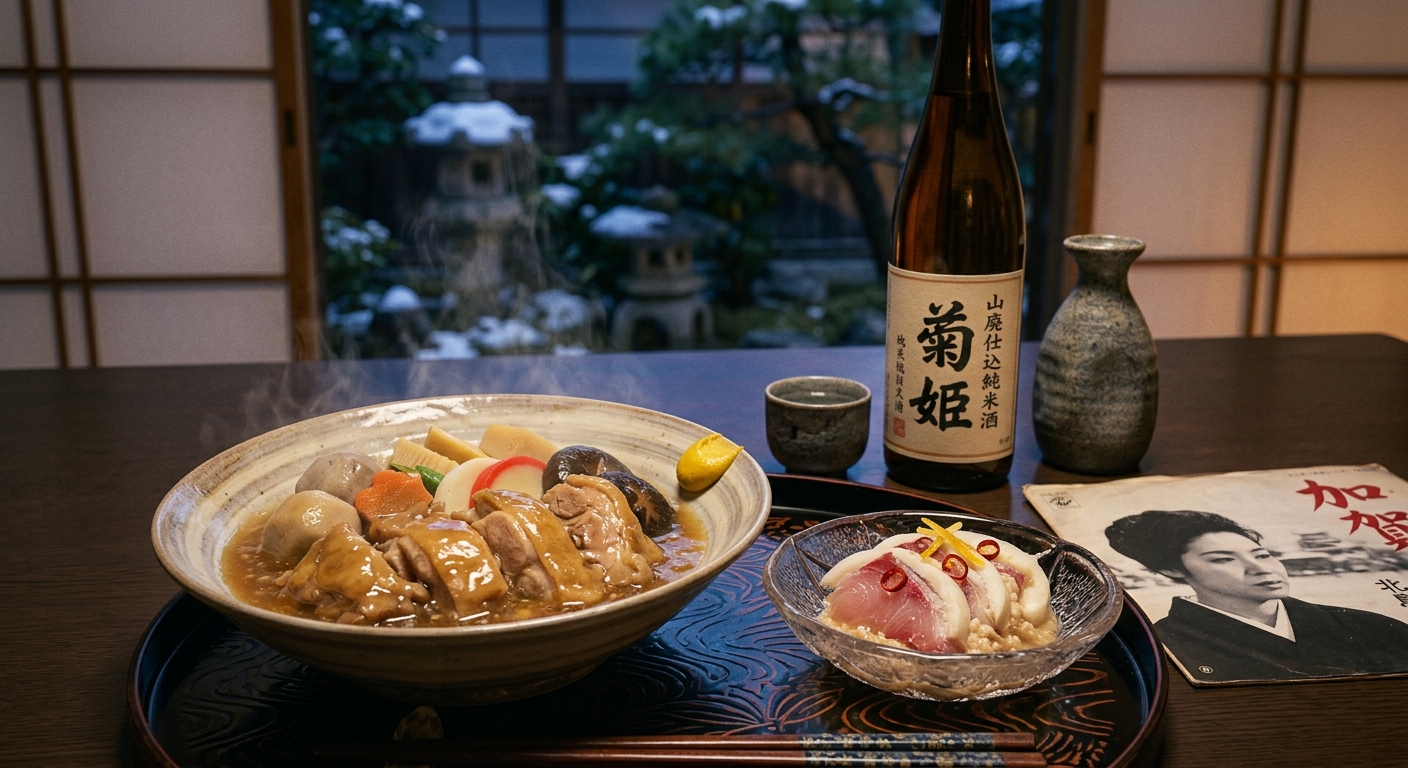
A signature Kaga dish of duck or chicken dusted in flour and simmered in a thickened soy-based broth. The rich, glossy sauce pairs beautifully with the yamahai junmai’s bold acidity and deep rice umami, each bringing out the other.
Recipe (in Japanese): Kurashiru, “Chicken Thigh Jibuni” - Kaburazushi
A Kanazawa winter specialty: salted turnip and yellowtail pickled with rice malt (koji) and left to lacto-ferment. Its gentle koji-born acidity and umami resonate with the acidity born of the yamahai starter — two things shaped by the same land.
Recipe (in Japanese): Kurashiru, “Traditional Kaburazushi”
A note on the science: both kaburazushi and yamahai junmai are born of natural fermentation driven by lactic acid bacteria, so the lactic acidity each carries resonates together on the palate, softening the edges and creating a rounder sense of unity than either would give on its own.
Visiting the Brewery
Kikuhime
Ta-8 Tsurugi Shinmachi, Hakusan City, Ishikawa. About a 10-min walk from Tsurugi Station (Hokuriku Railway Ishikawa Line).
The brewery is in Tsurugi, the town before the gate of Shirayama-hime Shrine.
Sights Nearby
- Shirayama-hime Shrine / Hakusan City | ~7 min, ~2 km by car from the brewery
The head shrine of the roughly 3,000 Hakusan shrines across Japan, known for its cedar-lined main approach. The grounds are open at all hours (the treasure hall is paid and open on set days). - Shishiku Kogen / Hakusan City | ~10 min, ~3 km by car from the brewery
A gondola climbs to about 650 m, where the Kaga plain and the alluvial fan of the Tedori River open out below. It’s also a well-known paragliding spot.
Hot Springs Nearby
- Meotoiwa Onsen “Rakuyo” / Hakusan City | ~18 min, ~9 km by car from the brewery
A day-use hot spring near the “Meoto-iwa” rocks along the Tedori River. 15:00-21:00, closed Mondays, ¥400 for adults; the water has a light, silky feel.
Opening hours, closing days and day-use bathing availability can change. Please check each facility’s official information before visiting.
A Quick Glossary of Sake Terms
- Junmai (pure rice sake): Sake made only from rice, rice koji, and water, with no added brewing alcohol — letting the rice’s own umami come through directly.
- Seimai buai (rice-polishing ratio): The percentage of the original brown rice grain remaining after polishing. The lower the number, the more the rice has been polished down.
- Kimoto: A traditional, labor-intensive method of building the sake starter (moto) by naturally cultivating wild lactic acid bacteria, rather than adding purified lactic acid.
Sources
If you notice any errors in this article, please don’t hesitate to reach out at info@soundrecords.jp.
Read this article in Japanese: 白山の水に、千年の菊は香る