今日のペアリング
▶ 上のプレーヤーで再生できない場合は、YouTubeで開く
醸造所の話
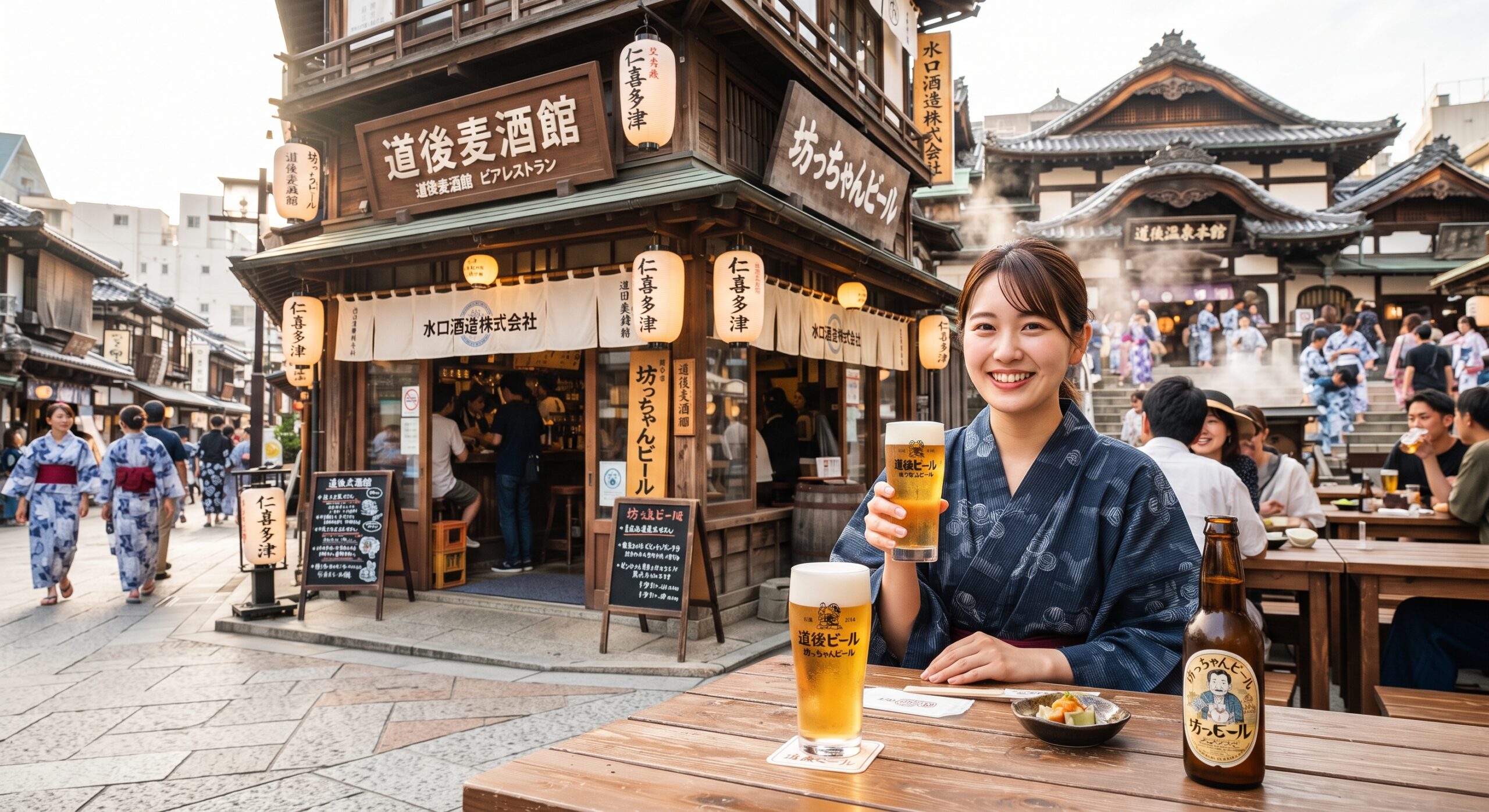
道後ビールを造る水口酒造は、1895年(明治28年)創業、道後温泉のすぐそばに蔵を構える、道後地区に唯一残る造り酒屋です。創業時から続く清酒の銘柄は「仁喜多津(にきたつ)」。水口酒造の公式サイトによれば、この名前は万葉集に詠まれた「熟田津(にきたつ)」の歌にちなみ、「仁愛と喜び多き津渡」の意味を込めて名づけられました。2024年10月1日には、五代目・水口義継氏が会長に退き、六代目・水口皓介氏が新たに代表取締役に就任しています(同社プレスリリース)。
1996年6月にビール製造免許を取得し、同年8月に「道後ビール」を発売。同年11月には道後温泉本館のそばに直営のビアレストラン「道後麦酒館」を開きました(Wikipedia「道後ビール」)。ラインナップはすべて、夏目漱石の小説『坊っちゃん』にちなんだ愛称を持っています。ケルシュ風は「坊っちゃんビール」、アルトは「マドンナビール」、スタウトは「漱石ビール」、ヴァイツェンは「のぼさんビール」。2000年のジャパン・ビア・グランプリでは、スタウトが金賞、アルトが銀賞、ケルシュ風が銅賞を受賞しています(同Wikipedia)。
今回選んだケルシュ風「坊っちゃんビール」は、公式サイトの商品説明によれば、清酒「仁喜多津」を生んだ熟田津の良水を仕込み水に使い、麦芽やホップの厳選から製法まで、長年の清酒づくりの技を生かして醸造したもの。良質のモルトを贅沢に使い、熱処理を施さず酵母が生きたままの生ビールです。ケルシュはドイツ・ケルン地方で主に飲まれているビアスタイルで、公式サイトは「フルーティーな香りが特長の切れ味の良いマイルドタイプのビール」と説明しています。
土地の話
道後温泉は、道後温泉の公式サイトによれば約3000年の歴史を持ち、「日本最古の温泉」と言われています。本館は1994年12月、全国の公衆浴場として初めて国の重要文化財に指定されました。
その歴史の中でもとりわけ有名なのが、西暦661年の出来事です。斉明天皇が九州へ向かう途中、潮の流れを待つため道後に2カ月あまり滞在し、随行していた額田王が、万葉集初期の代表作とされる一首を詠みました。「熟田津に船乗りせむと月待てば潮もかなひぬ今は漕ぎ出でな」――熟田津で船出をしようと月の出を待っていると、月も潮も船出にちょうどよい具合になった、さあ今こそ漕ぎ出そう、という意味の歌です(道後温泉公式サイト)。
水口酒造のビールの仕込み水の名前「熟田津」は、まさにこの歌に由来しています。1300年以上前に詠まれた、何かが整うのを「待つ」歌が、いまもグラスの中身の名前として残っているわけです。そしてもうひとつ。水口酒造が創業した1895年は、夏目漱石が愛媛県尋常中学校の英語教師として松山に赴任した年でもあります(1895年4月〜1896年4月、Wikipedia「坊っちゃん」)。漱石はこの1年の体験をもとに、10年後の1906年、小説『坊っちゃん』を発表しました。そのちょうど100年後にあたる1996年、同じ松山の地で、この小説の登場人物にちなんだ名前のビールが生まれています。
音楽の話
「待つわ」は、岡村孝子・加藤晴子によるデュオ「あみん」のデビュー・シングルで、1982年7月21日にPHILIPS RECORDS/日本フォノグラム(現・ユニバーサルミュージック)から発売されました。作詞・作曲はすべて岡村孝子が手がけ、編曲は萩田光雄。発売当時、二人は椙山女学園大学に通う現役の女子大生で、第23回ヤマハポピュラーソングコンテストでグランプリを獲得したのをきっかけにデビューしています。
「待つわ」はオリコン週間チャートで1位を獲得し、1982年度の年間チャートでも1位。累計売上は120万枚を超えるヒットとなりました(Wikipedia「待つわ」)。タイトルの通り、恋人をどこまでも、無条件に待ち続けるという一途な思いを歌った曲です。
なぜこの組み合わせなのか
額田王の「熟田津」の歌と、あみんの「待つわ」。どちらも「待つ」ことを歌にしていますが、その中身はまるで違います。熟田津の歌が待っているのは、月の出と潮の満ち具合という、条件が整う瞬間です。待つこと自体が目的ではなく、船を漕ぎ出すための「待つ」。一方の「待つわ」が歌う「待つ」は、条件も見返りも問わず、ただ待ち続けることそのものを選び取る「待つ」です。同じ言葉が、1300年以上の時を隔てて、正反対の二つの待ち方を抱えています。
そしてこのビール自体も、「待ってから飲む」一杯です。道後ビールは道後温泉の「湯上がりビール」としてデザインされていて、熱い湯にしばらく浸かる時間を待ってから、ようやくグラスに手を伸ばすことになります。仕込み水の名前が「熟田津」である一本を、まさに何かを待ったあとに開ける。歌の中の「待つ」も、湯上がりの「待つ」も、どちらも最後には満ちて、動き出す瞬間が待っています。
この一杯を、探すなら
※楽天市場へのリンクは広告(アフィリエイト)です。醸造所がタップルームや直営店を持っている場合は、できたてを現地で味わうのが一番のおすすめです。
🌡️ おすすめの飲み方(温度とグラス):8℃前後によく冷やして。ケルシュは本来、ドイツ・ケルン地方で細身の円筒グラス「シュタンゲ」(200ml程度の小ぶりなグラス)に注がれるスタイルです。手元になければ、香りを逃さない薄手のピルスナーグラスでも代用できます。小さめのグラスで繰り返し注ぎ足し、冷たさとフルーティーな香りが保たれているうちに飲み切るのがおすすめです。
合わせたい「アテ」
- じゃこ天
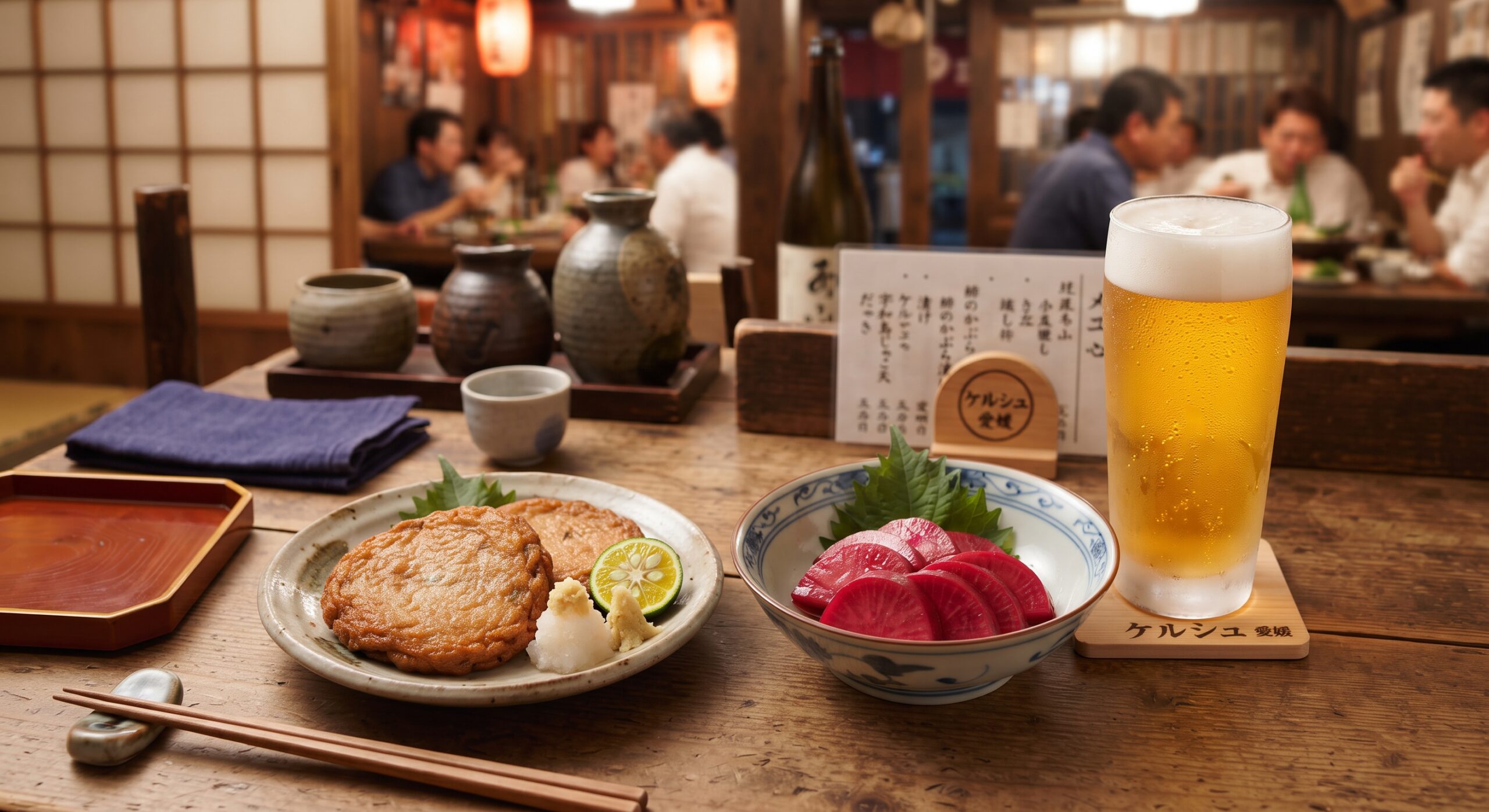
農林水産省「にっぽん伝統食図鑑」によれば、愛媛県南予地方(宇和島市・八幡浜市など)に伝わる、宇和海でとれた小魚を皮や骨ごとすり身にして揚げた一品。元和元年(1615年)、宇和島藩初代藩主・伊達秀宗が故郷の仙台を偲んで蒲鉾職人を連れてきてつくらせたのが始まりとされています。骨ごとすり身にするため、カルシウムなど栄養価も高い食べ物です。揚げたての香ばしさと、ケルシュの切れの良い後味がよく合います。
- 緋のかぶら漬け
同じ「にっぽん伝統食図鑑」によれば、約300年前、松山藩主・蒲生忠知が先祖の地である近江国日野(現・滋賀県)から蕪を移植したのが始まりとされる、愛媛県の伝統野菜の漬物。だいだい酢と砂糖で漬け込み、愛媛県の民謡「伊予節」にも登場する一品です。酸味の効いた甘酸っぱさが、ケルシュのフルーティーな香りと同じ方向を向いています。
科学的にひとこと:緋のかぶら漬けの鮮やかな緋色は、蕪に含まれるアントシアニン色素が、だいだい酢の酸に反応して発色することで生まれます。酸性に傾くと赤みが増すというこの化学変化は、梅干しや紫キャベツの酢漬けと同じ原理です。じゃこ天のような揚げ物は、炭酸と適度な苦みを持つビールと合わせることで、口の中に残る油分が洗い流され、次の一口をさっぱりと迎えられます。
この醸造所をたずねるなら
水口酒造株式会社(道後ビール)
〒790-0848 愛媛県松山市道後喜多町3-23。1895年(明治28年)創業、道後地区唯一の造り酒屋です。道後温泉本館から商店街を抜けて少し歩いた場所にあります。
近くの観光スポット
- 道後温泉本館/松山市道後湯之町|醸造所から徒歩数分(商店街を抜けてすぐ)
1994年12月、全国の公衆浴場として初めて国の重要文化財に指定された木造三層楼の建物。道後温泉公式サイトは「日本最古の温泉」と言われる歴史を持つと紹介しています。水口酒造の商品ページ自身が、本館から商店街を抜けて醸造所へ向かう道筋を説明しており、徒歩で行き来できる距離です。
近くの温泉
- 道後温泉本館(神の湯階下)/松山市道後湯之町|醸造所から徒歩数分
上と同じ建物にある日帰り入浴。「神の湯階下」は大人700円、営業時間6:00〜23:00(札止22:30)、年1回の大掃除日を除いて営業しています(松山市公式サイトで確認)。湯上がりに、すぐ近くの醸造所まで歩いて道後ビールを一杯、という回り方ができます。
※営業時間・定休日・日帰り入浴の可否は変わることがあります。おでかけ前に各施設の公式情報をご確認ください。
ひとことメモ(ビールの用語)
- クラフトビール:小規模な醸造所が、造り手の個性を前面に出して仕込むビールの総称。大量生産の均一な味とは別の方向を目指しています。
- モルト:発芽させた大麦(麦芽)のこと。ビールの甘み・色・コクの土台になり、焙煎の深さで色と香ばしさが決まります。
- ホップ:ビールに苦みと香りを与えるつる性植物の毬花(まりばな)。品種によって、柑橘・トロピカルフルーツ・草原のように香りが変わります。
- ABV:アルコール度数(Alcohol By Volume)のこと。ビールでは5%前後が標準で、8%を超えると飲みごたえのある「強め」の部類になります。
- 地ビール:1994年の酒税法改正で小規模醸造が解禁された後、各地で生まれたビールの呼び名。現在は「クラフトビール」と呼ばれることが多くなっています。
参考
内容に誤りがございましたら、お手数ですが info@soundrecords.jp までご連絡いただけますと幸いです。
Today’s Pairing
- Craft beer: Dogo Beer “Kölsch” (“Botchan Beer”) — 5.0% ABV; 330 ml; brewed from malt (produced in Germany, Canada and elsewhere), hops and wheat / Minakuchi Shuzo Co., Ltd. (3-23 Dogo-Kitamachi, Matsuyama City, Ehime Prefecture)
Official site: https://minakuchi-shuzo.jp/
- Music: “Matsuwa” (“I Will Wait”) by Amin, 1982 / Words and music by Takako Okamura
YouTube: https://www.youtube.com/watch?v=a7WhrI0Bbnk
▶ If the player above doesn’t play, open it on YouTube
The Story of the Brewery
Dogo Beer is brewed by Minakuchi Shuzo, founded in 1895 and now the only sake brewery remaining in the Dogo Onsen district. Its sake, brewed since its founding, is called “Nikitatsu.” According to the brewery’s official site, the name refers to the ancient “Nikitatsu” poem in the Man’yōshū anthology, carrying the meaning “a harbor of benevolence and abundant joy.” On October 1, 2024, fifth-generation head Yoshitsugu Minakuchi stepped back to become chairman, and sixth-generation Kosuke Minakuchi took over as president (per the company’s press release).
The brewery obtained its beer manufacturing license in June 1996 and launched “Dogo Beer” that August. That November, it opened a brewery restaurant, “Dogo Bakushukan,” near Dogo Onsen Honkan (per the Japanese Wikipedia entry for Dogo Beer). Every beer in the line-up carries a nickname drawn from Natsume Soseki’s novel Botchan: the Kölsch is “Botchan Beer,” the Alt is “Madonna Beer,” the Stout is “Soseki Beer,” and the Weizen is “Nobosan Beer.” At the 2000 Japan Beer Grand Prix, the Stout won gold, the Alt silver, and the Kölsch bronze (same source).
The Kölsch featured here, according to the official product description, is brewed using the same fine water of Nikitatsu that gave rise to the sake “Nikitatsu,” drawing on the brewery’s long sake-making expertise in selecting malt and hops and in its brewing method. It uses a generous amount of quality malt and is unpasteurized, with live yeast still in the bottle. Kölsch is a style drunk mainly around Cologne, Germany; the official site describes it as “a mild, crisp beer known for its fruity aroma.”
The Story of the Land
According to the official Dogo Onsen site, the hot spring carries roughly 3,000 years of history and is said to be Japan’s oldest. The main bathhouse building, Dogo Onsen Honkan, became in December 1994 the first public bathhouse in Japan to be designated a National Important Cultural Property.
One of the most famous episodes in that history dates to 661 CE. Empress Saimei, travelling toward Kyushu, stopped at Dogo for over two months to wait for favourable tides, and Nukata no Ōkimi, who accompanied her, composed what is considered one of the representative early poems of the Man’yōshū: “At Nikitatsu, as we wait to set sail, the moon rises and the tide turns favourable — now, let us row out.” (Source: the official Dogo Onsen site.)
The name of Minakuchi Shuzo’s brewing water, “Nikitatsu,” comes directly from this poem. A poem about waiting for conditions to align — composed more than 1,300 years ago — still survives today as the name of the water in the glass. There’s a second coincidence. 1895, the year Minakuchi Shuzo was founded, is also the year Natsume Soseki arrived in Matsuyama to teach English at the prefectural middle school (April 1895 to April 1896, per the Japanese Wikipedia entry for Botchan). Ten years later, in 1906, Soseki published Botchan, based on that year’s experience. Exactly a century after that arrival, in 1996, a beer named after the novel’s characters was born in the very same town.
The Story of the Song
“Matsuwa” (“I Will Wait”) was the debut single of Amin, a duo made up of Takako Okamura and Haruko Kato, released July 21, 1982 on PHILIPS RECORDS / Nippon Phonogram (now Universal Music Japan). Okamura wrote and composed the song in full, with arrangement by Mitsuo Hagita. At the time of release, the pair were still undergraduates at Sugiyama Jogakuen University, and had debuted after winning the grand prize at the 23rd Yamaha Popular Song Contest.
“Matsuwa” reached No. 1 on the Oricon weekly chart and was the top single of 1982 on the year-end chart, with cumulative sales exceeding 1.2 million copies (per the Japanese Wikipedia entry for the song). True to its title, it is a single-minded song about waiting for a lover, unconditionally, for as long as it takes.
Why This Pairing
Nukata no Ōkimi’s Nikitatsu poem and Amin’s “Matsuwa” both sing about waiting, but the waiting itself means something different in each. In the Nikitatsu poem, what’s being waited for is a moment when conditions align — the moon risen, the tide turned. The waiting isn’t the point; it’s preparation for rowing out. In “Matsuwa,” waiting is the point: no condition, no guarantee, just the choice to keep waiting. The same word carries two opposite kinds of waiting, more than 1,300 years apart.
And this beer, too, is a drink you wait for. Dogo Beer is built around the idea of a “post-bath beer,” meant to be opened only after you’ve sat in the hot water a while — you wait, and only then reach for the glass. A beer whose brewing water is literally named after a poem about waiting for the right moment. The waiting in the song, and the waiting after the bath, both end the same way: with something that was building finally arriving, and starting to move.
Where to Find This Beer
The Rakuten Ichiba link below is an affiliate link.
These are Japanese storefronts. If you are visiting the brewery, drinking it fresh at their own taproom is by far the best option.
🌡️ How to serve it: Serve well chilled, around 8°C. Kölsch is traditionally poured in Cologne in a tall, slender cylindrical glass called a “Stange” (roughly 200 ml). If you don’t have one, a thin-walled Pilsner glass works as a substitute. Pour small amounts repeatedly and drink it while it’s still cold and the fruity aroma hasn’t faded, rather than nursing one large glass.
Pairing Dishes Worth Trying
- Jako-ten
According to the Ministry of Agriculture, Forestry and Fisheries’ “Traditional Foods of Japan,” this is a fried fish cake from the Nan’yo region of Ehime (Uwajima, Yawatahama and nearby areas), made by grinding small fish caught in the Uwa Sea — skin, bones and all — into a paste. It’s said to date to 1615, when Date Munemune, first lord of the Uwajima domain, brought fish-cake craftsmen from his native Sendai to recreate a familiar taste. Because the bones are ground in too, it’s also a good source of calcium. Its fried, savoury crunch suits the Kölsch’s crisp finish.
- Hi-no-kaburazuke (red turnip pickle)
The same MAFF source traces this Ehime heirloom vegetable pickle to roughly 300 years ago, when Gamo Tadatomo, lord of Matsuyama domain, transplanted turnips from his ancestral home of Hino in Ōmi Province (today’s Shiga Prefecture). It’s pickled in bitter-orange vinegar and sugar, and appears by name in Ehime’s folk song “Iyo-bushi.” Its sweet-and-sour brightness runs in the same direction as the Kölsch’s fruity aroma.
A note on the science: the vivid red of hi-no-kaburazuke comes from anthocyanin pigment in the turnip reacting with the acid in the bitter-orange vinegar — the same chemistry that turns pickled plums or vinegared red cabbage redder as acidity rises. Fried food like jako-ten, meanwhile, pairs well with a beer that has carbonation and a touch of bitterness, since both help rinse the oil coating off your palate so the next bite tastes fresh again.
Visiting the Brewery
Minakuchi Shuzo Co., Ltd. (Dogo Beer)
3-23 Dogo-Kitamachi, Matsuyama City, Ehime Prefecture 790-0848. Founded in 1895, it is the only sake brewery remaining in the Dogo district. It sits a short walk from Dogo Onsen Honkan, past the shopping arcade.
Sights Nearby
- Dogo Onsen Honkan / Dogo-Yunomachi, Matsuyama | a few minutes’ walk from the brewery (just past the shopping arcade)
A three-storey wooden bathhouse that became, in December 1994, the first public bathhouse in Japan to be designated a National Important Cultural Property. The official Dogo Onsen site describes it as carrying a history said to make it Japan’s oldest hot spring. The brewery’s own product page describes the walking route from the Honkan, past the arcade, to the brewery — it’s a distance you can cover on foot.
Hot Springs Nearby
- Dogo Onsen Honkan (Kami-no-yu, ground floor) / Dogo-Yunomachi, Matsuyama | a few minutes’ walk from the brewery
Day bathing in the same building listed above. The ground-floor Kami-no-yu course costs ¥700 for adults, open 6:00–23:00 (last entry 22:30), closed only for one annual cleaning day (confirmed on the City of Matsuyama’s official site). You can bathe, then walk the short distance to the brewery for a glass of Dogo Beer.
Opening hours, closing days and day-use bathing availability can change. Please check each facility’s official information before visiting.
A Quick Glossary of Beer Terms
- Craft beer: Beer made by small breweries that put the character of the maker front and centre, as opposed to the uniformity of mass production.
- Malt: Germinated barley. It forms the foundation of a beer’s sweetness, colour and body; how deeply it is roasted determines colour and toastiness.
- Hops: The cones of a climbing plant, which give beer its bitterness and aroma. Depending on the variety, that aroma can read as citrus, tropical fruit or open grassland.
- ABV: Alcohol By Volume. Beer typically runs around 5%; above 8% is considered a strong, heavier-drinking beer.
- Ji-biru: The name given to the beers that appeared across Japan after the 1994 liquor tax reform opened small-scale brewing. Today most of them are simply called craft beer.
Sources
If you notice any errors in this article, please don’t hesitate to reach out at info@soundrecords.jp.
コメントを残す