日本語で読む | This is the English version of a bilingual article.
Today’s Pairing
- Sake: Masuizumi Junmai “Shirahagi” — a Junmai sake (made only from rice, rice koji, and water) / Masuizumi Shuzoten Co., Ltd. (269 Higashi-Iwase-cho, Toyama City, Toyama Prefecture)
Official site: https://www.masuizumi.co.jp/ - Kayoukyoku (classic Japanese popular song): “Kawa no Nagare no You ni” (“Like the Flow of a River”) by Hibari Misora, 1989
YouTube: https://www.youtube.com/watch?v=p4kt1rhDR6Y
▶ If the player above doesn’t play, open it on YouTube
The Story of the Brewery
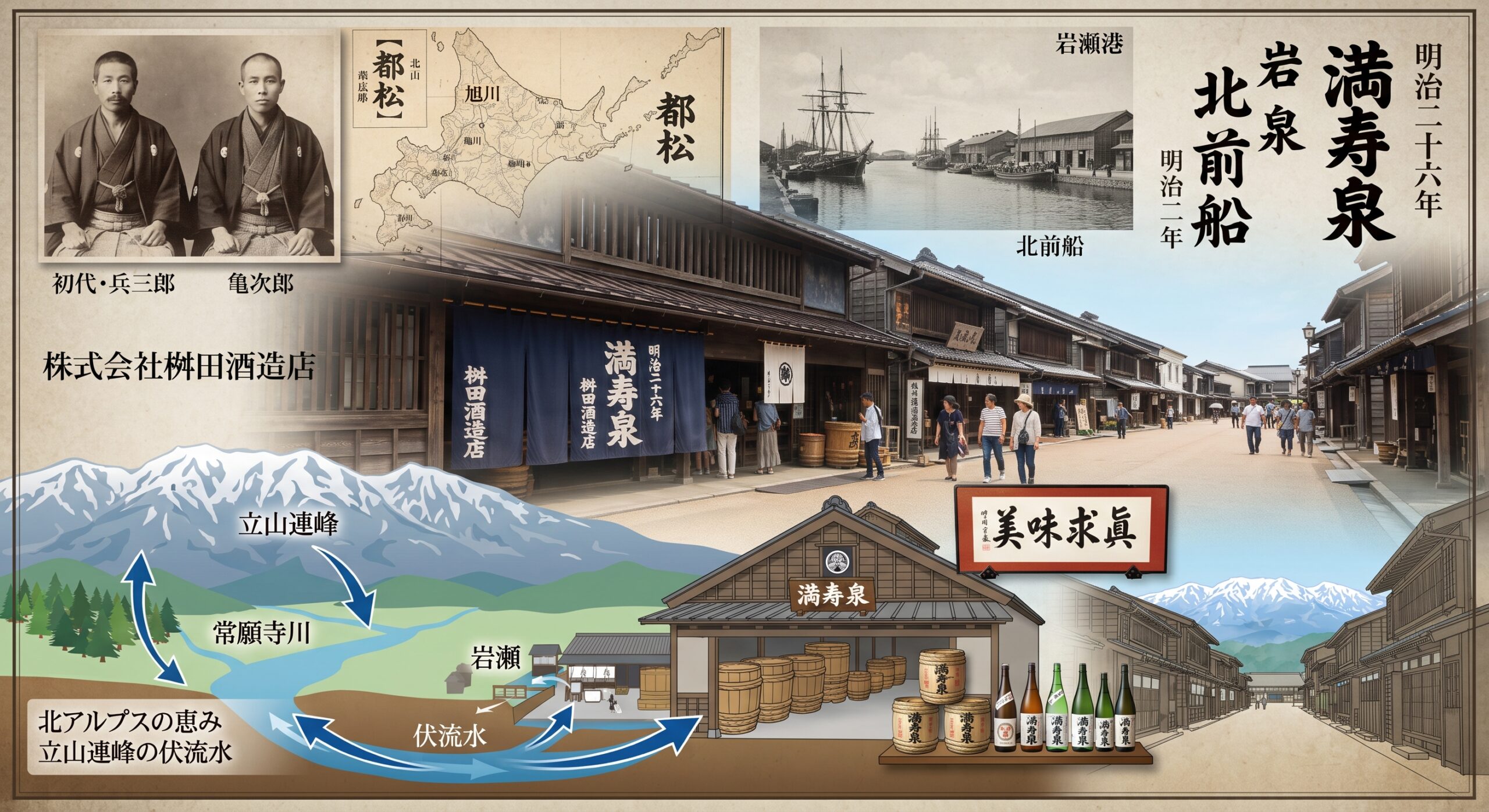
The history of Masuizumi Shuzoten goes back to 1893. Hyozaburo, the brewery’s founder, left the port town of Iwase in Toyama together with his eldest son Kamejiro and moved to Asahikawa, Hokkaido, where they began brewing sake under the brand name “Tomatsu.” By around 1897 their output had grown to 1,500 koku (roughly 270,000 liters), a scale that ranked among the largest in Japan at the time. But the bitter cold of 1902 made Kamejiro’s wife Fude long for home, and in 1905 Kamejiro returned to Iwase, restarting the brewery under the name “Iwaizumi.” In the early Showa era, a sake named “Masuizumi” — an auspicious name chosen to please the geisha of the port town, playing on the family name Masuda — became a hit, and it has been the brewery’s main brand ever since.
The brewery’s fourth-generation owner, Masuda Keijiro, worked together with toji (master brewer) Sanbai Koichi — later known as one of the “Four Heavenly Kings of Noto Toji” — to bring ginjo sake to market at a time when it was still largely unknown. The brewery’s guiding philosophy is “bimikyushin” (美味求眞, “seeking truth through delicious taste”): the idea that only someone whose palate has been trained by truly delicious food can brew real sake. The current, fifth-generation owner, Masuda Ryuichiro, has said that “sake exists together with culture,” and has put real energy into the revitalization of Iwase, the town where the brewery stands.
The Story of the Land
Masuizumi Shuzoten stands in Iwase, a port town at the mouth of the Jinzu River in Toyama City. According to the brewery’s own website, Iwase appears as a post station in the Heian-era legal code Engishiki, and in the Muromachi-era shipping code Kaisen Shikimoku it’s named, as “Etchu Iwase Harbor,” among the “three ports and seven harbors” (santsu-shichiso) ranked as Japan’s leading ports of the time. From the late Edo period into the Meiji era, Iwase thrived as a port of call for Kitamaebune trading ships, and the shipping merchants known as the “Five Great Families of Iwase” lined its streets. A great fire in 1873 destroyed the old townscape, but the houses rebuilt afterward still stand today as Iwase’s historic streetscape.
The water used to brew Masuizumi is spring water drawn from the Joganji River system, whose source lies in the Tateyama mountain range of the Northern Japan Alps. Snow and rain that fall on Mt. Tateyama seep into the ground and, over a long stretch of time, travel down the river to reach the brewery here in Iwase — a journey the brewery’s own website describes in just those words.
The Story of the Song
“Kawa no Nagare no You ni” was released on January 11, 1989, a single by Hibari Misora. The lyrics are by Akimoto Yasushi, the music by Mitake Shoichi, the arrangement by Tatsuzaki Koji, and it was released on Nippon Columbia. It peaked at number 8 on Oricon’s weekly singles chart, and went on to win the Gold Prize and the Composition Award at the 31st Japan Record Awards, as well as a Special Honor Award at the 20th Japan Music Awards (Nihon Kayo Taisho).
Hibari Misora was born on May 29, 1937, in Yokohama, Kanagawa Prefecture, and passed away on June 24, 1989, at the age of 52. “Kawa no Nagare no You ni” became the last single she released during her lifetime; its sales grew after her death, and it went on to become the best-selling single of her career. On July 2 of that year, Misora was awarded the People’s Honor Award (Kokumin Eiyo-sho) — the first woman ever to receive it.
Why This Pairing
The water used to brew Masuizumi begins as snow and rain on the Tateyama mountains, travels down the Joganji River, and arrives, after a long journey, at the brewery here in Iwase. And Iwase itself was once a port where Kitamaebune ships from all across Japan would call, before setting out again across the sea. Starting in the mountains, running down the river, and heading out to sea — this pattern of water, and of people, has repeated itself here for a very long time.
“Kawa no Nagare no You ni” is a song about living by simply letting yourself go with the flow, without knowing where you’ll eventually end up. Knowing that it was released just six months before Hibari Misora’s death, as the last single of her life, gives the song an added weight. The long journey of water that begins as snowmelt on Mt. Tateyama and flows, by way of a river, out to sea, and the song a single singer left behind at the end of her life — both come to look, in the end, like things that take their time, flowing slowly from the mountains to the sea.
Where to Find This Bottle
The Rakuten Ichiba link below is an affiliate link.
- Brewery’s official site: https://www.masuizumi.co.jp/
- Buy on Rakuten Ichiba: View the product page (720ml, ¥2,915)
Note: the links above lead to Japan-based retailers. They’re most convenient for readers in Japan, or for those elsewhere who are able to arrange international shipping. Stock and availability change over time, so if you’re near a specialty sake shop, it’s well worth asking for this label by name.
Pairing Dishes Worth Trying
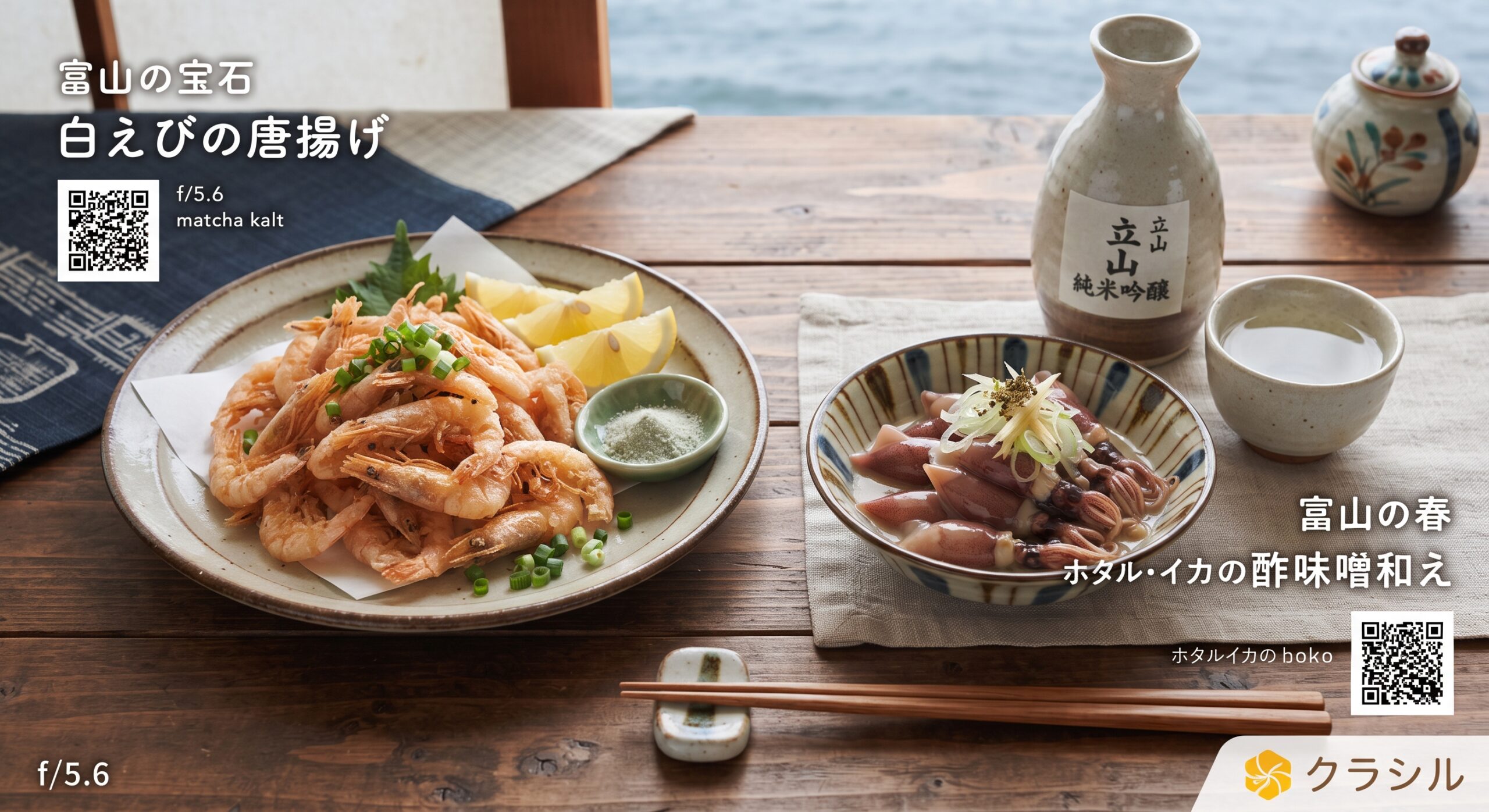
- Shiroebi (white shrimp) karaage
Toyama Bay is the only place in Japan where shiroebi, a tiny shrimp just 5–8 cm long, is caught in commercially meaningful quantities. Freshly landed, it’s a translucent, pale pink, which is why it’s known as “the jewel of Toyama Bay.” Its refined sweetness, fried up crisp, sits naturally alongside the straightforward rice umami of a junmai sake.
Recipe (in Japanese): Kurashiru, “Crispy Shiroebi Karaage” - Hotaru-ika (firefly squid) with vinegar miso
Every year between March and May, huge schools of firefly squid come to Toyama Bay to spawn. The waters stretching from the mouth of the Joganji River to Uozu City were designated a Special Natural Monument of Japan in 1952 as the “Hotaruika Gunyu Kaimen” (Firefly Squid Mass Appearance Sea Surface). The squid’s plump texture pairs naturally with the tang of vinegar miso, in a dish that announces spring in Toyama.
Recipe (in Japanese): Kurashiru, “Hotaru-ika with Vinegar Miso”
A note on the science: fried dishes like shiroebi karaage leave oil on the palate, and sake’s acidity and light carbonation help rinse that richness away, so the next bite tastes just as good as the first. The distinctive umami of hotaru-ika resonates with the glutamic acid produced by the fermentation in vinegar miso, creating a synergistic boost of savoriness.
Visiting the Brewery
Masuizumi Shuzoten (Masuda Sake Brewing)
269 Higashi-Iwase-cho, Toyama City, Toyama Prefecture. About a 5-minute walk from Toyama Light Rail’s Higashi-Iwase Station.
The brewery sits in Iwase, a port district that once thrived as a Kitamaebune (coastal trading ship) port, and still keeps much of its old townscape today.
Sights Nearby
- Former Baba Residence / Iwase, Toyama City | ~3 min on foot (~0.2 km) from the brewery
The grandest of the “Five Great Families of Iwase,” former owners who prospered as Kitamaebune shipping merchants. A nationally registered tangible cultural property. Reopened May 1, 2024. Open 9:00–17:00 (last entry 16:30), closed over New Year’s (Dec 28–Jan 4), ¥100 for adults. - Iwase Canal Hall / Iwase, Toyama City | ~8 min on foot (~0.6 km) from the brewery
A visitor center at the dock for the Fugan Suijo Line canal cruise, with a local-goods shop, an exhibit lounge, and bicycle rentals (hours vary by counter, so check before you go).
Hot Springs Nearby
- Hagi no Yu / Iwase, Toyama City | walking distance from the brewery
A small neighborhood mineral-spring bathhouse (42.0°C) rooted in the port town of Iwase. Open 14:00–21:00, closed Tuesdays. Day-use bathing is available (check the Toyama public-bath association’s site, Toyasen, for the latest details).
Opening hours, closing days and day-use bathing availability can change. Please check each facility’s official information before visiting.
A Quick Glossary of Sake Terms
- Junmai: Sake made only from rice, rice koji, and water, with no added brewing alcohol. Its character lets the straightforward umami of rice come through clearly.
Sources
- Masuizumi – Masuizumi Shuzoten Co., Ltd. (official site)
- Masuizumi, Toyama – Tanoshii Osake.jp
- Kawa no Nagare no You ni – Wikipedia (Japanese)
- Hibari Misora – Wikipedia (Japanese)
- Former Baba Residence – Toyama City official website
- Nationally Designated Cultural Property (Hotaruika Gunyu Kaimen) – Namerikawa City official website
- Hagi no Yu – Toyasen (Toyama Public Bath Association)
If you notice any errors in this article, please don’t hesitate to reach out at info@soundrecords.jp.
Read this article in Japanese: 山の水は、海を目指して流れていく