今日のペアリング
▶ 上のプレーヤーで再生できない場合は、YouTubeで開く
醸造所の話
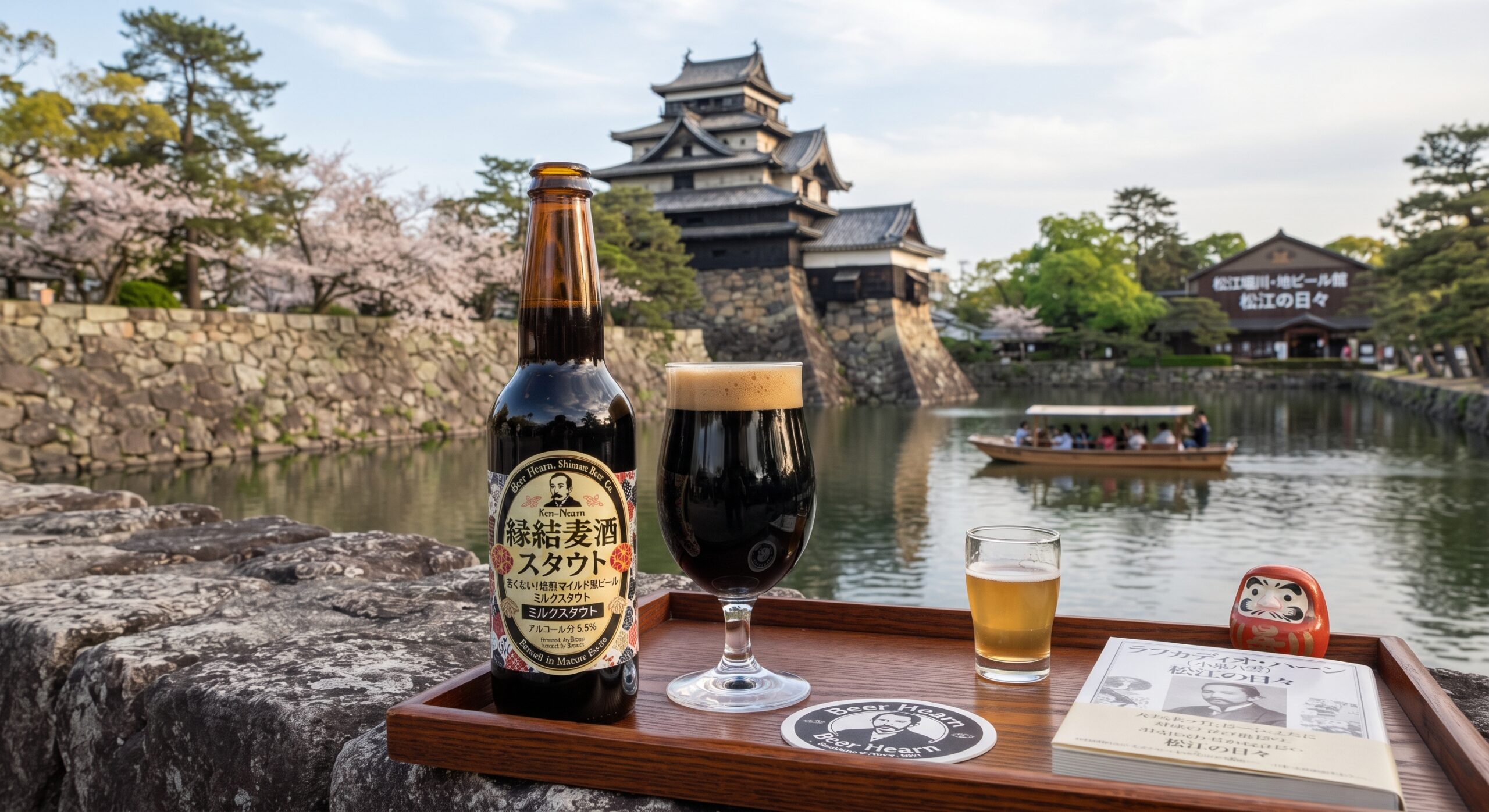
島根ビール株式会社は、松江城の堀端にある「松江堀川・地ビール館」の中に醸造所を構えています。公式サイトの会社概要によれば、設立は1996年10月で、製造を始めたのは1999年。従業員は8名、代表取締役は矢野学氏です。公式サイトのビールのページには、「伝統を守りつつ新しいものへ挑戦してきた『松江』に1999年4月『麦酒醸造所』が生まれました」と書かれています。仕込みに使うのは北山山系の湧き水です。
同じページには、この醸造所が何を目指しているかもはっきり書かれています。「外国のビールのものまねではなく、『地元に愛され、地元の方にうまいと言われるビール。』『日本人に愛され、日本人にうまいと言われるビール。』を目指して」造り続ける、と。そして「ビアへるん」という名前は、公式サイトによれば、地元・松江で「へるん先生」と親しまれた明治の文豪・小泉八雲(ラフカディオ・ハーン)にあやかったものです。「日本で一番有名でないかもしれない島根の食・文化・人々を世界の方々に知ってほしい」。そんな思いが込められている、とあります。サイトの冒頭に掲げられた言葉は、「ビールでつなぐ『縁結び』。」です。
今回の一本、縁結麦酒スタウトについて、公式サイトはこう説明しています。「アイルランド発祥の黒ビール。焙煎麦芽の香ばしい風味と伝統的な製法から乳糖を使用したマイルドな口当たり。ピルスナーとのハーフ&ハーフもおすすめです。」同社のオンラインショップに載っている規格では、スタイルはミルクスタウト(アイルランドスタイル)、アルコール5.5%、苦味はIBU16、色は90EBC(漆黒)、ホップはマグナム、副原料は乳糖。商品名そのものが「苦くない!焙煎マイルド黒ビール」です。ちなみに同じ蔵のペールエールはIBU23なので、この黒ビールのほうが数字の上では苦くありません。見た目の重さと口当たりの軽さの落差が、このビールの中心にあります。なお、乳糖はアレルギー物質なので、公式サイトも注意書きを添えています。
土地の話
小泉八雲記念館の年譜によれば、ラフカディオ・ハーンは1850年6月27日、ギリシャのレフカダ島で生まれました。父チャールズはアイルランド出身の軍医、母ローザはギリシャ・キシラ島の出身です。2歳の1852年8月、母子は父の実家があるダブリンに移ります。4歳のとき父がクリミア戦争に発ち、母は実家のキシラ島へ帰り、7歳で両親は離婚。16歳で遊戯中の事故により左目を失明し、17歳で学費が続かず学校を中退、19歳でひとり移民船に乗ってアメリカへ渡りました。
ニューオーリンズやカリブ海のマルティニーク島を経て、39歳の1890年4月、ハーンは日本の土を踏みます。同年8月には松江の島根県尋常中学校に英語教師として赴任。1891年11月に熊本の第五高等中学校へ移るまで、松江にいたのは約1年3カ月でした。1896年、松江の士族の娘・小泉セツと正式に結婚し、日本に帰化。妻の姓を継いで「小泉八雲」になります。1904年9月26日、心臓発作で54歳の生涯を閉じました。
ここで、ビールの話に戻ります。アイルランド発祥の黒ビールを、アイルランドで育った人の愛称を冠した醸造所が造り、「縁結」という出雲の言葉を名前に付けて売っている。偶然の重なりに見えますが、縁という言葉がこの土地でどれだけ重いかを思うと、そう軽くもありません。国土交通省の多言語解説文データベースによれば、旧暦10月は全国では「神無月」と呼ばれるのに対し、出雲地方では「神在月」と呼ばれます。この時期、全国から八百万の神々が出雲に集まり、来年の人々の関係について会議をする。その会議が「神議(かみはか)り」で、話し合われる内容は、縁です。縁を決める会議が毎年開かれている土地で、ビールに「縁結」と名づけるというのは、語呂合わせより少し深いところに足をかけています。
音楽の話
Official髭男dismは、公式プロフィールによれば2012年に結成された4人組です。鳥取県の公式サイトが公式プロフィールを引いて紹介しているところでは、島根大学と松江高専の卒業生によるバンドで、山陰から活動を始めました。メンバーは藤原聡(ボーカル・ピアノ)、小笹大輔(ギター)、楢﨑誠(ベース・サックス)、松浦匡希(ドラムス)。2015年4月のミニアルバム『ラブとピースは君の中』でデビューし、2018年4月のシングル「ノーダウト」でメジャーデビューしています。
「Pretender」は、2019年5月15日に発売された2作目のシングルです(デジタル配信は同年4月17日が先行)。作詞・作曲は藤原聡、編曲はOfficial髭男dism。映画『コンフィデンスマンJP ロマンス編』の主題歌で、アルバム『Traveler』に収録されています。Billboard JAPAN Hot 100で週間1位となり、日本レコード協会からストリーミングのダイヤモンド認定を受けました。歌われているのは、相手への思いを抱えながら、その思いが相手と同じ形では結ばれないと分かっている側の心です。違う出会い方であれば、という想像を最後まで手放せないまま、歌は終わります。
なぜこの組み合わせなのか
縁を結ぶ土地から出てきたバンドの代表曲が、結ばれなかった縁の歌である。この一点が、今回の出発点でした。島根は縁結びの土地として知られていますが、縁という言葉は、結ばれたぶんだけを数える言葉ではありません。結ばれなかった縁も、たしかに縁です。むしろ、結ばれなかったほうを数えた人にしか、結ばれた一つの重さは分からないのかもしれません。
ハーンの前半生は、結ばれなかった縁の連続でした。2歳で生まれた島を離れ、4歳で父と、ほどなく母とも離れ、7歳で両親は離婚し、17歳で学校を去り、19歳でひとり海を渡る。シンシナティでの最初の結婚も破綻しています。ギリシャ、アイルランド、イギリス、フランス、アメリカ、カリブ海。そうして流れ着いた先が日本で、松江にいたのはたった1年3カ月でした。それでも彼は、その町で出会った人の姓を、生涯の名前にしています。前半生がほどけ続けた人の、最後に結ばれた一つがそれだったわけです。
そしてこのビールは、黒いのに苦くありません。焙煎した麦芽は焦げの香りを持っていますが、副原料の乳糖がその角を丸めます。IBUは16で、同じ蔵のペールエールより低い。見た目はいちばん重いのに、口に入るといちばん丸い。結ばれなかった縁も、時間が経つとそういう形になります。無かったことにはならないし、色も薄くはならない。ただ、最初ほど苦くはなくなる。そういう一杯として、この黒を選びました。
この一杯を、探すなら
※楽天市場へのリンクは広告(アフィリエイト)です。醸造所がタップルームや直営店を持っている場合は、できたてを現地で味わうのが一番のおすすめです。
🌡️ おすすめの飲み方(温度とグラス):8〜10℃くらい。冷やしすぎると、焙煎麦芽の香ばしさと乳糖のまろやかさが閉じてしまいます。グラスは口がすぼまらないパイントグラス(ノニックパイント)か、香りをためられるチューリップ型がおすすめです。泡をしっかり立てて注ぐと、焦げの香りの角がいっそう取れます。醸造所自身は、同じ蔵のピルスナーと合わせるハーフ&ハーフもすすめています。
合わせたい「アテ」
- 焼き牡蠣
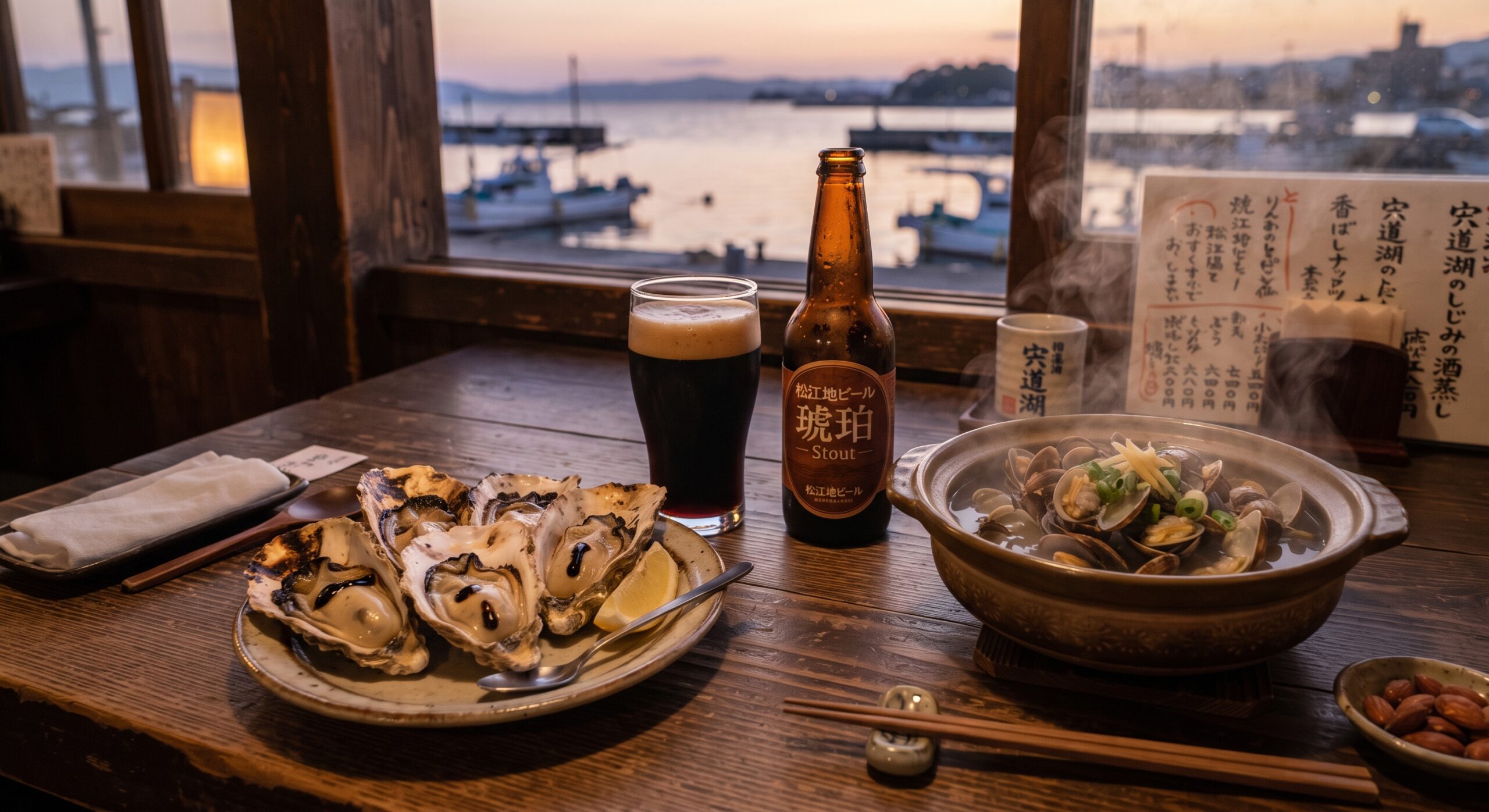
醸造所の公式サイトが、このビールに合うものとして挙げているのが「香ばしいナッツ類」と「ミルキーなあじわいの牡蠣」です。黒ビールと牡蠣は海の向こうでも古くからの取り合わせで、焼いて殻が開いたところに、この黒を少し。焦げた縁の香りと、焙煎麦芽の香ばしさが同じ方向を向きます。
- 宍道湖のしじみの酒蒸し
農林水産省の地理的表示(GI)第171号に登録されている「宍道湖産ヤマトシジミ」。宍道湖は塩分が海水のおよそ10分の1という汽水湖で、ヤマトシジミが好む環境です。江戸時代には松江藩の「御用しじみ」とされ、周辺の縄文時代の貝塚からも多数見つかっています。松江市の1世帯当たりしじみ購入量は、令和6年時点で14年連続全国1位。地元の食卓の定番を、地元の黒ビールと合わせる形です。
科学的にひとこと:貝類のうま味の中心はコハク酸で、牡蠣にはこれに加えてグルタミン酸も含まれます。種類の違ううま味成分が重なると、それぞれの合計より強く感じられる(うま味の相乗効果)というのは、だしの世界で昆布と鰹節を合わせるのと同じ原理です。一方、焙煎麦芽の香ばしさは、加熱によって糖とアミノ酸が反応して生まれる香り(メイラード反応)と、焦がした香りが重なったもの。焼いた貝の香りと同じ方向にあるので、ぶつかりません。さらに乳糖のほのかな甘みが、貝の塩気とミネラル感の角を丸めてくれます。
この醸造所をたずねるなら
島根ビール株式会社(松江ビアへるん)
〒690-0876 島根県松江市黒田町509-1(松江堀川・地ビール館内)。松江城の堀のすぐそばで、堀川めぐりの遊覧船が通る一角にあります。醸造所に併設のレストランと売店があります。
近くの観光スポット
- 小泉八雲記念館・小泉八雲旧居/松江市奥谷町・北堀町|醸造所から車で約1分・約0.3km
ビールの名前の由来になった「へるん先生」の記念館と、八雲とセツが1891年6月から11月まで暮らした武家屋敷。旧居は1940年8月30日に国の史跡に指定されています(文化庁「文化遺産オンライン」)。記念館は旧居の西隣にあり、館長は八雲の曾孫にあたる小泉凡氏です。歩いて行ける距離なので、ビールを飲む前後に寄れます。
- 松江城/松江市殿町|醸造所から車で約5分・約1.4km
1611年(慶長16年)に堀尾吉晴が築いた城で、2015年7月に天守が国宝に指定されました。島根県公式サイトによれば、全国に現存する12の天守のうちの一つで、山陰では唯一です。別名は「千鳥城」。醸造所はこの城の堀端にあります。
- 八重垣神社/松江市佐草町|醸造所から車で約15分・約7.3km
素盞嗚尊と稲田姫命を祀る、縁結びで知られる神社。奥の院にある「鏡の池」に硬貨をのせた紙を浮かべる縁占いが有名で、松江市の観光白書にも良縁を願う人に人気のスポットとして載っています。「縁結麦酒」を飲む日に寄るなら、ここです。
近くの温泉
- 玉造温泉/松江市玉湯町玉造|醸造所から車で約20分・約9.2km
『出雲国風土記』にも登場する古い湯で、宍道湖の南側にあります。旅館だけでなく、日帰り入浴ができる公衆浴場「玉造温泉ゆ〜ゆ」(松江市玉湯町玉造255)があります。月曜が休館で、営業時間と入浴料は案内している媒体によって書かれている内容が違っていたので、行く前に電話で確かめてください。
※営業時間・定休日・日帰り入浴の可否は変わることがあります。おでかけ前に各施設の公式情報をご確認ください。
ひとことメモ(ビールの用語)
- クラフトビール:小規模な醸造所が、造り手の個性を前面に出して仕込むビールの総称。大量生産の均一な味とは別の方向を目指しています。
- スタウト:焙煎した大麦を使う黒いエール。コーヒーやチョコレートのような香ばしさと、なめらかな口当たりが特徴です。
- モルト:発芽させた大麦(麦芽)のこと。ビールの甘み・色・コクの土台になり、焙煎の深さで色と香ばしさが決まります。
- ホップ:ビールに苦みと香りを与えるつる性植物の毬花(まりばな)。品種によって、柑橘・トロピカルフルーツ・草原のように香りが変わります。
- ABV:アルコール度数(Alcohol By Volume)のこと。ビールでは5%前後が標準で、8%を超えると飲みごたえのある「強め」の部類になります。
- IBU:苦みの強さを表す国際的な数値。10前後だとほとんど苦みを感じず、60を超えるとはっきり苦いIPAの領域です。
参考
内容に誤りがございましたら、お手数ですが info@soundrecords.jp までご連絡いただけますと幸いです。
Today’s Pairing
- Craft beer: Matsue Beer Hearn “Enmusubeer Stout” — milk stout (Irish style); 5.5% ABV; 16 IBU; pale ale, Pilsner, caramel and roasted malts (from the UK and Germany); lactose as an adjunct; Magnum hops / Shimane Beer Co., Ltd. (509-1 Kuroda-cho, Matsue City, Shimane Prefecture, inside the Matsue Horikawa Jibiiru-kan)
Official site: https://www.shimane-beer.co.jp/
- Music: “Pretender” by Official HIGE DANdism, 2019 / Words and music by Satoshi Fujihara
YouTube: https://www.youtube.com/watch?v=TQ8WlA2GXbk
▶ If the player above doesn’t play, open it on YouTube
The Story of the Brewery
Shimane Beer Co., Ltd. brews inside the Matsue Horikawa Jibiiru-kan, a building that stands beside the moat of Matsue Castle. According to the company profile on its official site, the firm was established in October 1996 and began production in 1999. It has eight employees, and its president is Manabu Yano. The brewery’s own beer page puts it this way: “in 1999, in April, a beer brewery was born in Matsue — a town that has kept its traditions while reaching for what is new.” The brewing water comes from springs in the Kitayama range.
The same page states plainly what the brewery is after. Not an imitation of foreign beer, but “a beer loved locally, a beer local people call good” and “a beer loved in Japan, a beer Japanese people call good.” As for the name: according to the official site, “Beer Hearn” is borrowed from Lafcadio Hearn — the Meiji-era writer known in Matsue by the affectionate name “Hearn-sensei.” The site says the name carries the wish that people around the world might come to know “the food, the culture and the people of Shimane, perhaps the least famous place in Japan.” The line at the top of the site reads: “Beer that ties the knot.”
Of this particular beer, the official site says: “A dark beer that originated in Ireland. The toasty character of roasted malt, and a mild mouthfeel that comes from the traditional use of lactose. We also recommend it as a half-and-half with our Pilsner.” The specification listed in the brewery’s own online shop gives the style as milk stout (Irish style), 5.5% ABV, 16 IBU, colour 90 EBC (jet black), Magnum hops, lactose as the adjunct. The product name itself reads “Not bitter! Roasted, mild dark beer.” For comparison, the same brewery’s pale ale is 23 IBU — so on paper this black beer is the less bitter of the two. That gap, between how heavy it looks and how light it lands, is the whole point of it. The site also carries an allergy notice, since lactose is present.
The Story of the Land
According to the chronology published by the Lafcadio Hearn Memorial Museum, Hearn was born on June 27, 1850, on the Greek island of Lefkada. His father Charles was an army surgeon from Ireland; his mother Rosa came from the Greek island of Kythira. In August 1852, when he was two, mother and son moved to Dublin, where his father’s family lived. When he was four his father left for the Crimean War and his mother returned to Kythira; at seven, his parents divorced. At sixteen he lost the sight in his left eye in an accident during play; at seventeen he had to leave school when the money ran out; at nineteen he boarded an emigrant ship alone for America.
By way of New Orleans and the Caribbean island of Martinique, Hearn set foot in Japan in April 1890, aged thirty-nine. That August he took up a post in Matsue as an English teacher at the Shimane Prefectural Ordinary Middle School. He stayed about a year and three months, leaving in November 1891 for the Fifth Higher Middle School in Kumamoto. In 1896 he formally married Setsu Koizumi, the daughter of a Matsue samurai family, and naturalised as a Japanese citizen, taking his wife’s surname to become Yakumo Koizumi. He died of a heart attack on September 26, 1904, at fifty-four.
Now back to the beer. A dark beer that originated in Ireland, brewed by a brewery named after a man raised in Ireland, and sold under an Izumo word meaning “tying bonds.” It looks like a pile-up of coincidences, but the word carries real weight here. According to the multilingual commentary database published by Japan’s Ministry of Land, Infrastructure, Transport and Tourism, the tenth month of the lunar calendar is called Kannazuki, “the month without gods,” across most of Japan — but in the Izumo region it is Kamiarizuki, “the month with gods.” In that month, the myriad deities of Japan gather in Izumo and hold a council about people’s relationships for the coming year. The council is called kamihakari, and what it decides is ties between people. In a land where a council on bonds convenes every year, naming a beer “Enmusubeer” reaches a little deeper than wordplay.
The Story of the Song
Official HIGE DANdism is a four-piece band formed in 2012, according to its official profile. As quoted from that profile on the Tottori prefectural website, the members are graduates of Shimane University and Matsue College, and the band began its activity in the San’in region. The line-up is Satoshi Fujihara (vocals, piano), Daisuke Ozasa (guitar), Makoto Narazaki (bass, saxophone) and Masaki Matsuura (drums). They debuted in April 2015 with the mini-album Love to Peace wa Kimi no Naka, and made their major-label debut in April 2018 with the single “No Doubt.”
“Pretender” was released on May 15, 2019 as their second single, with a digital release preceding it on April 17 of the same year. Fujihara wrote the words and music; the band arranged it. It was the theme song for the film Confidence Man JP: Romance, and appears on the album Traveler. It reached No. 1 on the Billboard JAPAN Hot 100 and holds a Diamond streaming certification from the Recording Industry Association of Japan. What it sings about is the state of carrying feelings for someone while already knowing those feelings will not meet theirs in the same shape. The song ends without ever letting go of the thought of how it might have gone, had they met some other way.
Why This Pairing
A band out of the land that ties bonds, whose best-known song is about a bond that didn’t hold. That single fact is where this pairing started. Shimane is known as the place where ties are made, but the word for ties doesn’t only count the ones that held. The ones that didn’t are ties as well. Perhaps only someone who has counted the ones that came apart can feel the full weight of the one that lasted.
The first half of Hearn’s life was a run of ties that didn’t hold. At two he left the island he was born on; at four he lost his father, and soon after his mother; at seven his parents divorced; at seventeen he left school; at nineteen he crossed an ocean alone. His first marriage, in Cincinnati, broke down. Greece, Ireland, England, France, America, the Caribbean. Where he finally washed up was Japan, and he spent only a year and three months in Matsue. Even so, he took the surname of a person he met in that town and carried it for the rest of his life. For a man whose early life kept unravelling, that was the one thread that held.
And this beer is black without being bitter. Roasted malt brings a burnt note, and the lactose rounds off its edge. At 16 IBU it is less bitter than the brewery’s own pale ale: the heaviest-looking beer in the line-up is the softest on the tongue. Ties that didn’t hold end up in a similar shape, given time. They don’t disappear, and they don’t fade in colour. They simply stop being as bitter as they were at first. That is the glass I wanted for this one.
Where to Find This Beer
The Rakuten Ichiba link below is an affiliate link.
These are Japanese storefronts. If you are visiting the brewery, drinking it fresh at their own taproom is by far the best option.
🌡️ How to serve it: Serve at about 8–10°C. Chill it much harder than that and both the toasty malt and the softness from the lactose close up. For the glass, use a nonic pint that doesn’t taper at the rim, or a tulip that holds the aroma. Pour to raise a proper head — it takes a further edge off the burnt note. The brewery itself also recommends drinking it as a half-and-half with its own Pilsner.
Pairing Dishes Worth Trying
- Grilled oysters
The brewery’s official site names “toasty nuts” and “oysters with a milky character” as the things to eat with this beer. Dark beer and oysters have been served together for a long time outside Japan too. Grill them until the shells open, then pour a little of this black beside them: the scorched edge of the shell and the roast of the malt run in the same direction.
- Lake Shinji shijimi clams steamed in sake
Shijimi (Yamato clams) from Lake Shinji are registered under Japan’s Geographical Indication system as entry No. 171 by the Ministry of Agriculture, Forestry and Fisheries. Lake Shinji is a brackish lake whose salinity is roughly a tenth of seawater — exactly what these clams like. In the Edo period they were reserved as the Matsue domain’s own clams, and they turn up in quantity in Jomon-period shell mounds around the lake. Matsue households bought more shijimi than those of any other Japanese city for fourteen consecutive years as of 2024. A local staple, meeting the local dark beer.
A note on the science: the core savoury compound in shellfish is succinic acid, and oysters add glutamate on top of it. When different umami compounds appear together, each is perceived more strongly than it would be alone — the same synergy behind combining kombu and bonito flakes in a Japanese stock. The toasty quality of roasted malt, meanwhile, comes from aromas created when sugars and amino acids react under heat (the Maillard reaction), layered with a touch of char. That sits in the same direction as the smell of a grilled shell, so the two don’t fight. The faint sweetness of the lactose then rounds off the salt and minerality of the shellfish.
Visiting the Brewery
Shimane Beer Co., Ltd. (Matsue Beer Hearn)
509-1 Kuroda-cho, Matsue City, Shimane Prefecture 690-0876 (inside the Matsue Horikawa Jibiiru-kan). It stands right beside the moat of Matsue Castle, on the stretch where the Horikawa sightseeing boats pass. There is a restaurant and a bottle shop attached to the brewery.
Sights Nearby
- Lafcadio Hearn Memorial Museum & Hearn’s Old Residence / Okudani-cho and Kitahori-cho, Matsue | about 1 minute by car from the brewery, 0.3 km
The museum devoted to “Hearn-sensei” — the man the beer is named after — and the samurai house where Hearn and his wife Setsu lived from June to November 1891. The residence was designated a National Historic Site on August 30, 1940 (Agency for Cultural Affairs, Cultural Heritage Online). The museum stands just west of the house, and its director is Bon Koizumi, Hearn’s great-grandson. Both are within walking distance of the brewery.
- Matsue Castle / Tonomachi, Matsue | about 5 minutes by car from the brewery, 1.4 km
Built in 1611 by Yoshiharu Horio, its keep was designated a National Treasure in July 2015. According to the Shimane prefectural site, it is one of only twelve original castle keeps still standing in Japan, and the only one in the San’in region. It is also known as “Chidori Castle.” The brewery sits beside this castle’s moat.
- Yaegaki Shrine / Sakusa-cho, Matsue | about 15 minutes by car from the brewery, 7.3 km
A shrine to Susanoo-no-mikoto and Kushinada-hime, long associated with the tying of bonds. Its inner precinct holds the “Mirror Pond,” where visitors float a slip of paper weighted with a coin to divine a future match; the City of Matsue’s own tourism white paper lists it as a popular spot for those hoping for a good match. If you are drinking a beer called “Enmusubeer,” this is the place to visit first.
Hot Springs Nearby
- Tamatsukuri Onsen / Tamayu-cho Tamatsukuri, Matsue | about 20 minutes by car from the brewery, 9.2 km
An old hot spring south of Lake Shinji, mentioned in the eighth-century Izumo no Kuni Fudoki gazetteer. Besides the inns, there is a public bathhouse open to day visitors, Tamatsukuri Onsen Yu-Yu (255 Tamatsukuri, Tamayu-cho, Matsue). It is closed on Mondays. Opening hours and the bathing fee were listed differently by different guides, so please call ahead to confirm before you go.
Opening hours, closing days and day-use bathing availability can change. Please check each facility’s official information before visiting.
A Quick Glossary of Beer Terms
- Craft beer: Beer made by small breweries that put the character of the maker front and centre, as opposed to the uniformity of mass production.
- Stout: A near-black beer built on deeply roasted malt, with coffee and chocolate notes and a firm roasted bitterness.
- Malt: Germinated barley. It forms the foundation of a beer’s sweetness, colour and body; how deeply it is roasted determines colour and toastiness.
- Hops: The cones of a climbing plant, which give beer its bitterness and aroma. Depending on the variety, that aroma can read as citrus, tropical fruit or open grassland.
- ABV: Alcohol By Volume. Beer typically runs around 5%; above 8% is considered a strong, heavier-drinking beer.
- IBU: International Bitterness Units, a scale for how bitter a beer tastes. Around 10 is barely noticeable bitterness; above 60 lands in clearly bitter IPA territory.
Sources
If you notice any errors in this article, please don’t hesitate to reach out at info@soundrecords.jp.
コメントを残す