日本語で読む | This is the English version of a bilingual article.
Today’s Pairing
- Sake: Kikusakari Junmai Ginjo — brewed with 100% Hyogo-grown Yamada Nishiki sake rice, rice-polishing ratio (seimai buai) 50%, 16–17% alcohol / Kiuchi Brewery Co., Ltd. (1257 Konosu, Naka City, Ibaraki Prefecture)
Official site: https://kiuchibrewery.co.jp/products/sake/list/junmai-ginzukuri-2/ - Kayoukyoku (classic Japanese popular song): “Itako-gasa” (“The Straw Hat of Itako”) by Hashi Yukio, 1960
YouTube: https://www.youtube.com/watch?v=lqk54HKf800
▶ If the player above doesn’t play, open it on YouTube
The Story of the Brewery
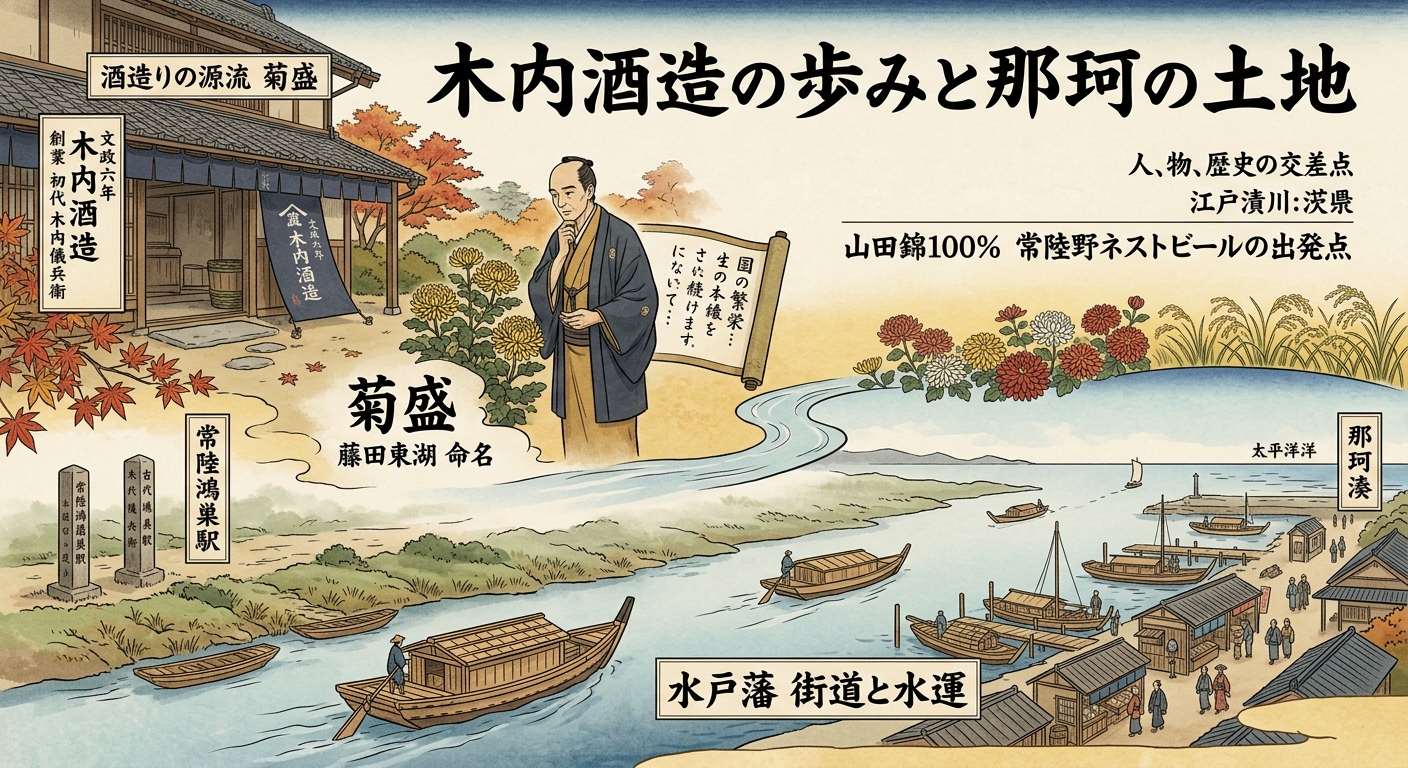
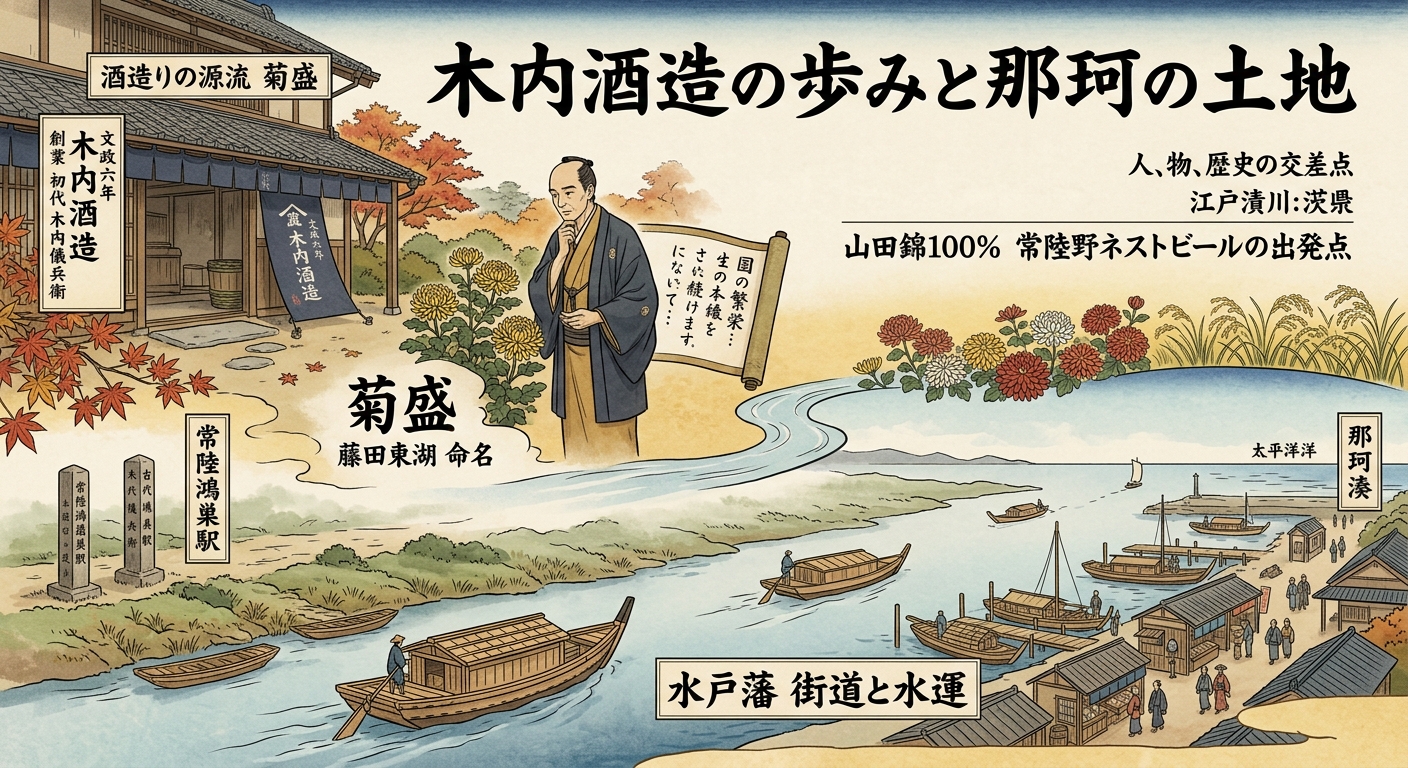
Kiuchi Brewery Co., Ltd. traces back to 1823, when the first-generation Kiuchi Gihei began brewing sake on the site of present-day Naka City, Ibaraki Prefecture. Its flagship brand, Kikusakari (“blooming chrysanthemum”), is said to have been named by Fujita Toko, a central figure of the Mito School of scholarship who had ties to the Kiuchi family: one autumn day, seeing chrysanthemums in full bloom in a garden, he likened their flourishing to the prosperity he hoped for Japan. A scholar’s hope for his country’s future, voiced at the end of the Edo period in Mito, has been carried down through the generations as the very name of this sake. The brewery’s current representative is Kiuchi Toshiyuki.
Kiuchi Brewery isn’t only a sake maker. In 1995 it took on brewing beer for the first time, and in October 1996 released its first batch of Hitachino Nest Beer. The brewery has since become known internationally for that craft beer, but its starting point, unchanged since the Edo period, remains its sake, Kikusakari.
The bottle in this pairing, Kikusakari Junmai Ginjo, is brewed with 100% Yamada Nishiki sake rice from Hyogo Prefecture, polished to a seimai buai of 50%, at 16–17% alcohol. It’s a junmai ginjo — sake made only from rice, rice koji, and water, fermented at low temperatures for a fragrant aroma — where a rich umami meets a refreshing fragrance.
The Story of the Land
Kiuchi Brewery’s head store sits a few minutes’ walk from Hitachi-Konosu Station on the JR Suigun Line, in Naka City on the banks of the Naka River. In the Edo period, this area lay along the route connecting Mito, the castle town of the Mito Domain, with the Pacific port of Nakaminato — a crossroads where both river traffic and overland travel converged. This was also the very domain where scholars of the Mito School, Fujita Toko among them, were active.
A short way down the Naka River lies a port town once known, in the Edo period, as Itako. It prospered on the river traffic of the Tone River system, as a place where boats bound for Edo or for pilgrimage to Ise came and went — and it became the setting for countless stories of wanderers and travelers passing through. Within the same Mito Domain, a brewery where sake was made and a port town where travelers crossed paths were gently connected by the same river.
The Story of the Song
“Itako-gasa” was released on July 5, 1960, as Hashi Yukio’s debut single. The lyrics are by Saeki Takao, the music and arrangement by Yoshida Tadashi. It sold roughly 1.2 million copies and won the Best New Artist award at the 2nd Japan Record Awards that same year. It’s a “matatabi-mono” — a kayoukyoku about the feelings of a wandering gambler of old — set in Itako, a port town in Ibaraki Prefecture that thrived on the river traffic of the Tone River system.
Hashi Yukio was born on May 3, 1943, in Arakawa Ward, Tokyo. His 1960 debut with “Itako-gasa” became a massive hit, and together with Funaki Kazuo and Saigo Teruhiko he was celebrated as one of the “Mitsu Goke” (“Three Princes”), the top teen idols of the era. He went on to win further Japan Record Awards for “Itsudemo Yume wo” (a duet with Yoshinaga Sayuri) and “Muhyo,” remaining at the forefront of the kayoukyoku world for decades. He passed away on September 4, 2025, at the age of 82.
Why This Pairing
The name Kikusakari comes from Fujita Toko, a scholar of the Mito School, who looked at chrysanthemums blooming in a garden and saw in them his hopes for Japan’s prosperity. A short way down the Naka River, within that same Mito Domain, lies the port town of Itako — a place where, in the Edo period, river traffic carried countless travelers and wanderers through.
“Itako-gasa” is a song set in that very Itako, following one man wandering through, straw hat tilted low. A sake named for a hope in the nation’s prosperity, and a song about a traveler crossing the very same Mito Domain — both carry, in different forms, the memory of this land reaching back to the Edo period.
Hashi Yukio passed away in 2025, but “Itako-gasa” is still sung today. As you raise your cup, let your thoughts wander between two scenes: a scholar in Mito looking at chrysanthemums, and a traveler crossing Itako with his hat tilted against the wind.
Where to Find This Bottle
The Rakuten Ichiba link below is an affiliate link.
- Brewery’s official site: https://kiuchibrewery.co.jp/products/sake/list/junmai-ginzukuri-2/
- Buy on Rakuten Ichiba: View the product page (720ml, ¥1,815)
Note: the links above lead to Japan-based retailers. They’re most convenient for readers in Japan, or for those elsewhere who are able to arrange international shipping. Stock and availability change over time, so if you’re near a specialty sake shop, it’s well worth asking for this label by name.
Pairing Dishes Worth Trying
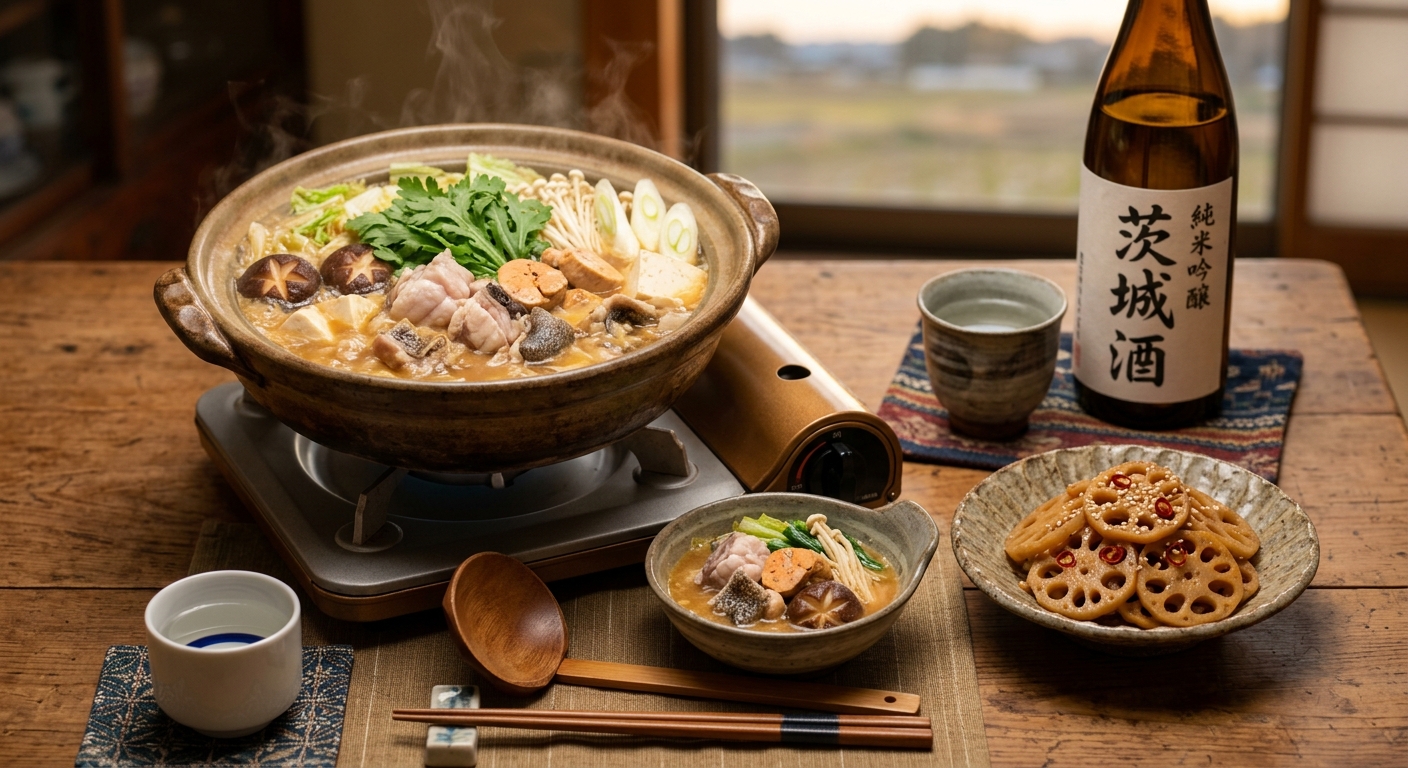
- Anko-nabe (monkfish hot pot)
A beloved winter specialty around Oarai and Kita-Ibaraki, on Ibaraki’s Pacific coast. Nearly every part of the fish — flesh, liver, skin — goes into a rich miso-based hot pot, whose deep umami pairs naturally with the rounded umami of this junmai ginjo.
Recipe (in Japanese): Kurashiru, “Easy Anko-nabe with Shiradashi” - Renkon no kinpira (sauteed lotus root)
Ibaraki grows roughly half of Japan’s entire lotus root harvest, the most of any prefecture, with most of it coming from around Lake Kasumigaura, including Tsuchiura City (2023-harvest MAFF crop statistics). The crisp texture and sweet-savory seasoning of kinpira echo the refreshing aroma of this junmai ginjo.
Recipe (in Japanese): Kurashiru, “Crisp Renkon Kinpira”
A note on the science: the amino-acid umami in anko-nabe’s rich miso broth resonates with the rice-derived umami in junmai ginjo, creating a synergistic boost of savoriness on the palate. The sweetness and crunch of lotus root, together with the toasted aroma of sesame oil, bring out the gentle ginjo fragrance of this sake.
Visiting the Brewery
Kiuchi Brewery Head Store (Honten)
1257 Konosu, Naka City, Ibaraki. About a 5–6-min walk from JR Suigun Line’s Hitachi-Konosu Station; about 5 min by car from Naka IC on the Joban Expressway.
The tasting counter sells freshly bottled sake, and the brewery grounds also house a soba restaurant and a dining restaurant.
Sights Nearby
- Shizumine Furusato Park / Naka City | ~10 min by car from Kiuchi Brewery
One of Japan’s “100 Best Cherry Blossom Spots,” with about 2,000 double-flowered cherry trees and 200 Somei Yoshino, giving two separate blooming seasons. Open 9:00–17:00, free admission (closed Mondays and year-end/New Year). - Kotoku Pond / Koto area, Naka City | ~13 min by car from Kiuchi Brewery
A farm reservoir visited by whooper and tundra swans from early November to mid-March. Since the swans spend daytime hours foraging in nearby fields, early morning (before around 7:00) or evening is recommended for viewing.
Opening hours and closing days can change. Please check each facility’s official information before visiting.
A Quick Glossary of Sake Terms
- Junmai Ginjo: Junmai (sake made only from rice, rice koji, and water, with no added brewing alcohol) that has been polished to a seimai buai of 60% or less and fermented slowly at low temperatures, giving it a fragrant aroma.
- Seimai buai (rice-polishing ratio): The percentage of the original grain remaining after milling. The lower the number, the more the rice has been polished down.
Sources
- Kiuchi Brewery Co., Ltd. – Official Site
- Our Story – Kiuchi Brewery Official Site
- Kikusakari Junmai Ginjo – Kiuchi Brewery Official Site
- Head Store – Kiuchi Brewery Official Site
- Company Profile – Kiuchi Brewery Official Site
- Kiuchi Shuzo 1823 – Ibaraki Export Support Desk (Ibaraki Prefecture)
- Itako-gasa – Wikipedia (Japanese)
- Hashi Yukio – Wikipedia (Japanese)
- Shizumine Furusato Park – Naka City Official Site
- Kotoku Pond – Naka City Official Site
- Lotus Root – Ibaraki Food Promotion Site (Ibaraki Prefectural Government)
If you notice any errors in this article, please don’t hesitate to reach out at info@soundrecords.jp.
Read this article in Japanese: ある秋の日、菊の花に国の誇りを見た人がいた