日本語で読む | This is the English version of a bilingual article.
Today’s Pairing
- Craft beer: Miyajima Beer “Weizen” — a South German-style weizen; 5.0% ABV; IBU under 20 / MIYAJIMA BEER Co., Ltd. (459-2 Miyajima-cho, Hatsukaichi City, Hiroshima Prefecture)
Official site: https://miyajimabeer.com/ - Music: “Seto no Hanayome” (“The Bride of the Inland Sea”) by Rumiko Koyanagi, 1972 / Words by Michio Yamagami, music by Masaaki Hirao
YouTube: https://www.youtube.com/watch?v=1tsdlNUg_1Q
▶ If the player above doesn’t play, open it on YouTube
The Story of the Brewery
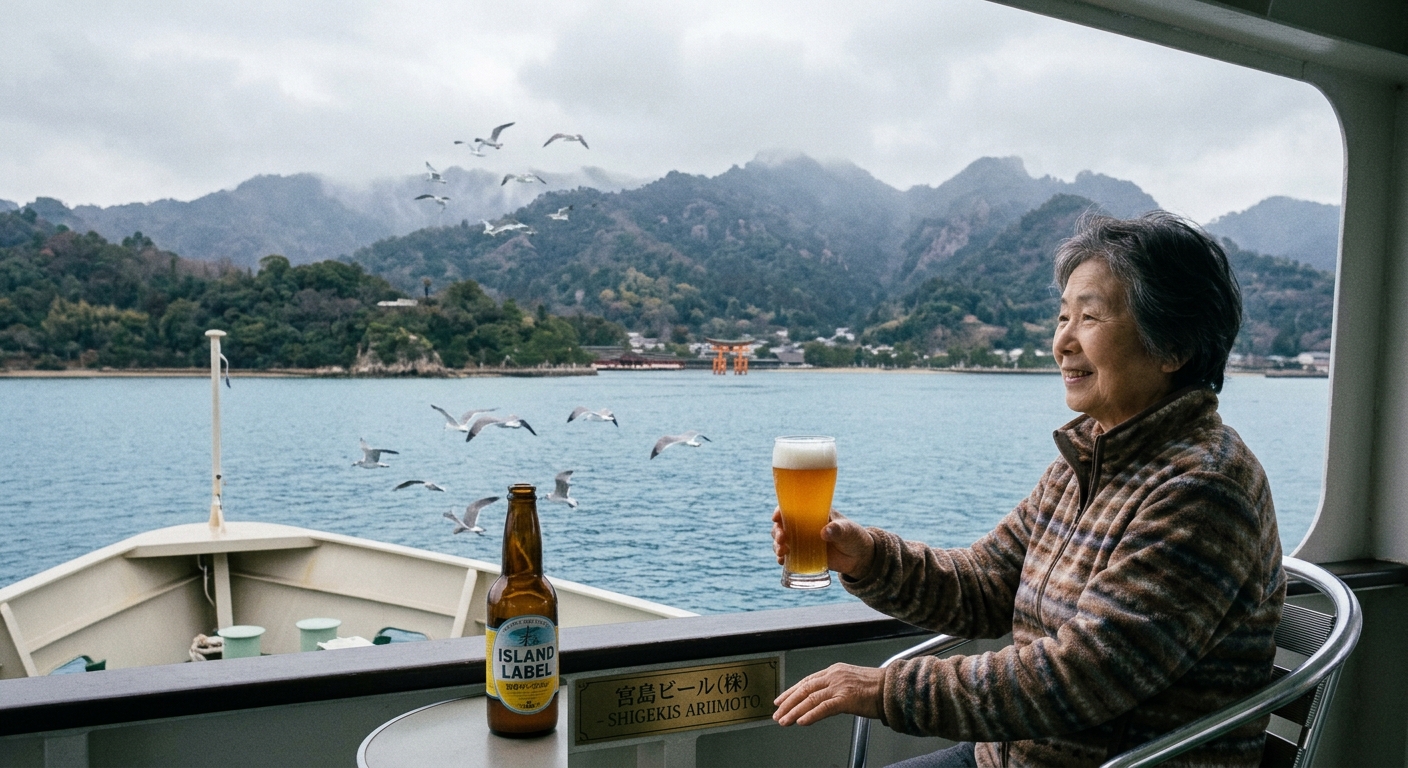
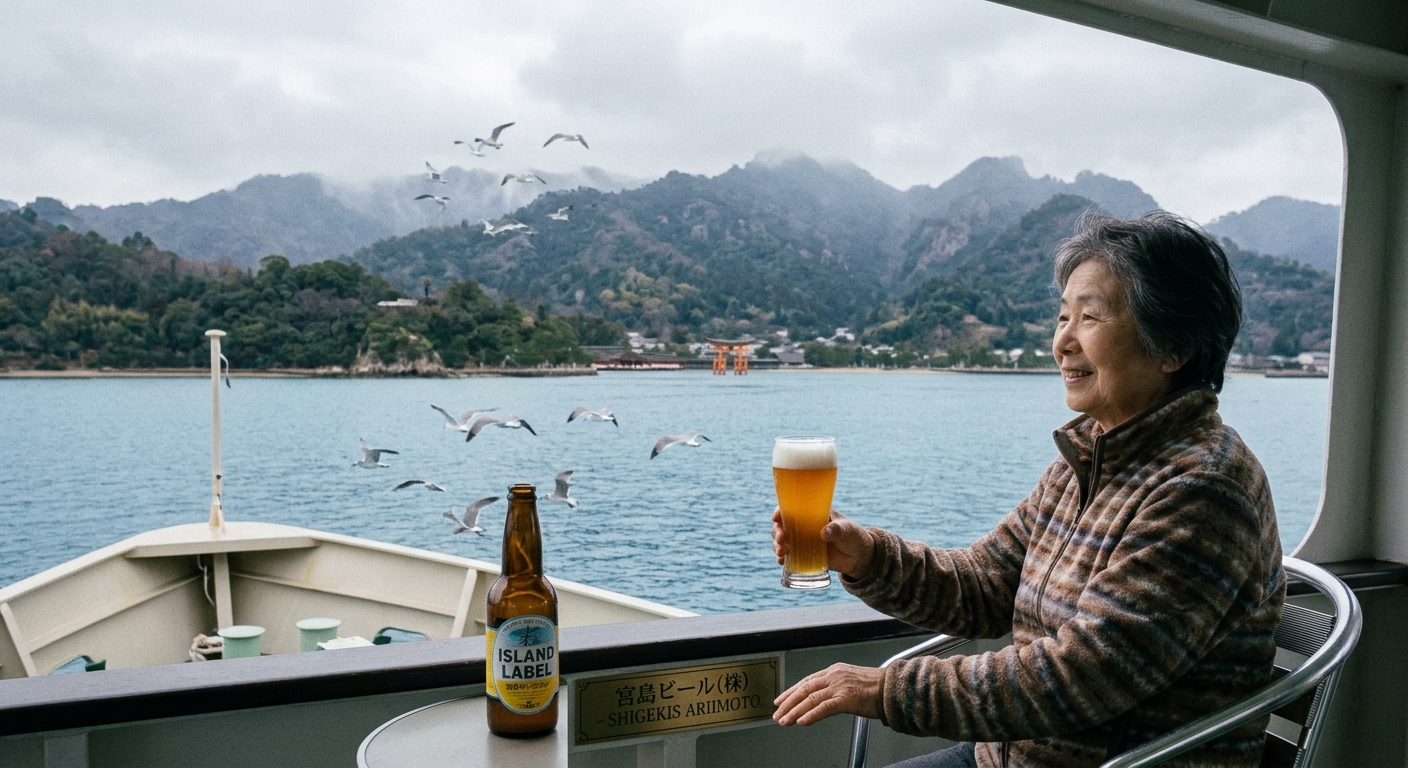
MIYAJIMA BEER Co., Ltd. (formerly Miyajima Beer Co., Ltd.), the company behind Miyajima Beer, was founded on March 19, 2010. Its representative director, Shigeki Arimoto, grew up as the 20th generation of an old inn family on Miyajima. According to the “STORY” page on the official site, the inn closed after the previous generation passed away, and Arimoto became a salaried employee at a foreign-affiliated financial firm. In 2009, that firm decided to withdraw from Japan, and he was encouraged to leave — a turning point in his life.
Coming home, he saw shop after shop in his hometown losing its vitality under the consumption slump, and resolved to act: using the former inn’s site, by then a parking lot, he decided to “produce a new local specialty that could help revitalise the area.” What finally pushed him to commit, he says, were his mother’s words — that the family name Arimoto meant “the main house of Arinoura,” passed down from his ancestors, and that hearing this cemented his decision to devote his life to Miyajima’s future. Craft beer he had been moved by in San Francisco was also part of what drew him to brewing himself.
The first product was developed with help from Niigata Beer, through more than ten trial brews over three months, tasted by over 300 people, according to the official site. After years of contract brewing elsewhere, Miyajima Beer began brewing on the island itself in 2018. According to the Japan Hop Promotion Committee’s site, part of its brewing water is drawn from the spring water of the Mount Misen primeval forest, part of the World Heritage site. Today’s core “ISLAND LABEL” lineup is four beers: Misen Dragon IPA (a hazy IPA), Best Wishes (a red IPA), Miyajima Weizen, and Miyajima Oyster Stout, made with the meat and shells of Miyajima oysters. At the brewery’s own shop, MIYAJIMA BREWERY (459-2 Miyajima-cho; a ground-floor beer stand and shop, open 10:30–17:00), you can drink this self-brewed beer fresh.
Here is something worth stating plainly. The Weizen in this pairing, as sold in 350ml cans (a case of 24) on Rakuten Ichiba or Amazon, was not brewed on Miyajima. As the can itself states, it is contract-brewed by Helios Shuzo in Nago, Okinawa, and planned and sold by Miyajima Beer. The glass poured on the island and the can delivered to your door share a name and, presumably, a recipe lineage — but not a birthplace. This is not unusual; it is a common arrangement when a small craft brewery cannot handle nationwide canning on its own equipment. If anything, this fact — a glass that has travelled a long way to reach you — connects directly to the song paired with it below.
The Story of the Land
Miyajima has no bridge. The only way across from Miyajimaguchi, on the mainland side, is by ferry. On December 5, 1996, 431.2 hectares — about 14% of the whole island, including the halls of Itsukushima Shrine, the sea in front of them, and the primeval forest of Mount Misen behind — was inscribed as a UNESCO World Heritage Site. Counted among Japan’s “Three Views,” the floating great torii gate is, for most visitors from home and abroad, the single image that comes to mind first.
The brewery sits on this same island. A 7-minute walk from the Miyajima pier, along the souvenir-shop-lined approach street, stands MIYAJIMA BREWERY’s own shop. Keep walking the same street and you reach Itsukushima Shrine; go a little further and you reach Momijidani Park, at the foot of the Mount Misen primeval forest. In other words, anyone who wants this beer at its freshest has to cross the sea once, just to get there.
And the Seto Inland Sea itself is also where today’s song was born. As the next section explains, the lyricist of “Seto no Hanayome” drew on scenery he saw not from Miyajima, but from a boat travelling from Onomichi, Hiroshima, toward Shikoku. Miyajima and Onomichi are both views of the same sea, in the same prefecture.
The Story of the Song
Rumiko Koyanagi came up through the Takarazuka Revue before debuting as a singer in 1971; her hit “Watashi no Jokamachi” launched her singing career that year. “Seto no Hanayome” was her fourth single, released April 10, 1972, with words by Michio Yamagami, music by Masaaki Hirao, and arrangement by Kenichiro Morioka, on Warner-Pioneer (handled under the Reprise Records label). According to Wikipedia, it reached No. 1 on Oricon’s weekly chart and No. 2 on the year-end chart for 1972. It won the Grand Prize at the 3rd Japan Music Awards and the Singing Award at the 14th Japan Record Awards.
The song rode the “Discover Japan” line — a travel and homeland-rediscovery campaign the national railway ran through the 1970s — as a local song themed on the Seto Inland Sea. What’s notable, per Wikipedia, is how it was written. Lyricist Michio Yamagami never actually visited the islands of the Seto Inland Sea; travelling for work to Shikoku, he rode a hydrofoil many times from Onomichi, Hiroshima, and it was the terraced fields and the sunset-lit islands he saw from that boat that stayed with him and became the song’s imagery. The island in the lyrics is not any one real place, but a composite of memories seen from a boat crossing this sea.
What the song sings about is the feelings of a bride marrying into a small island in the Seto Inland Sea, and her resolve to begin a new life. Leaving home, crossing the sea, starting over somewhere unfamiliar — that tension and resolve run underneath the whole song.
Why This Pairing
First, the places overlap. Miyajima, and Onomichi where the lyricist saw his scenery, are both in Hiroshima Prefecture, on the same Seto Inland Sea. The sunset-lit islands of “Seto no Hanayome” aren’t any one specific island, but Miyajima is very much one of the islands that sea holds.
Second, crossing the sea itself links the two. Miyajima has no bridge; anyone visiting crosses by ferry. The bride in “Seto no Hanayome” leaves her home island and crosses the sea toward a new life. The direction is reversed — she leaves the island, while anyone wanting this beer travels into it — but in both cases, crossing the sea marks the start of something new.
Third, the brewery’s own founder, Shigeki Arimoto, traces something like a mirror image of the song’s shape. The bride leaves her home island for somewhere unknown; Arimoto did the opposite, leaving the “outside world” of a foreign financial firm to return to Miyajima, his hometown, after the inn his family had run for generations had closed. Pairing a song about the resolve to leave with a beer brewed out of the resolve to return is not just two places that happen to overlap — it’s the same shape, crossing the same sea, pointed in opposite directions.
And one more small coincidence. The 350ml can of Weizen that reaches your table was not brewed on Miyajima at all, but contract-brewed by Helios Shuzo in Nago, Okinawa. Which means this beer has already crossed the sea — not the Seto Inland Sea, but nearly the length of the Japanese archipelago — before it ever reaches you. Just as the bride in the song crosses the sea, so does the glass in your hand. A beer carrying the name of an island reachable only by water turns out, in practice, to arrive from far across that water. That slight twist adds one more layer to this particular pairing.
Where to Find This Beer
The Rakuten Ichiba link below is an affiliate link.
- Brewery official site:https://miyajimabeer.com/
- Search on Rakuten Ichiba:see results for “宮島ビール ヴァイツェン”
These are Japanese storefronts. If you are visiting the brewery, drinking it fresh at their own taproom is by far the best option.
Pairing Dishes Worth Trying
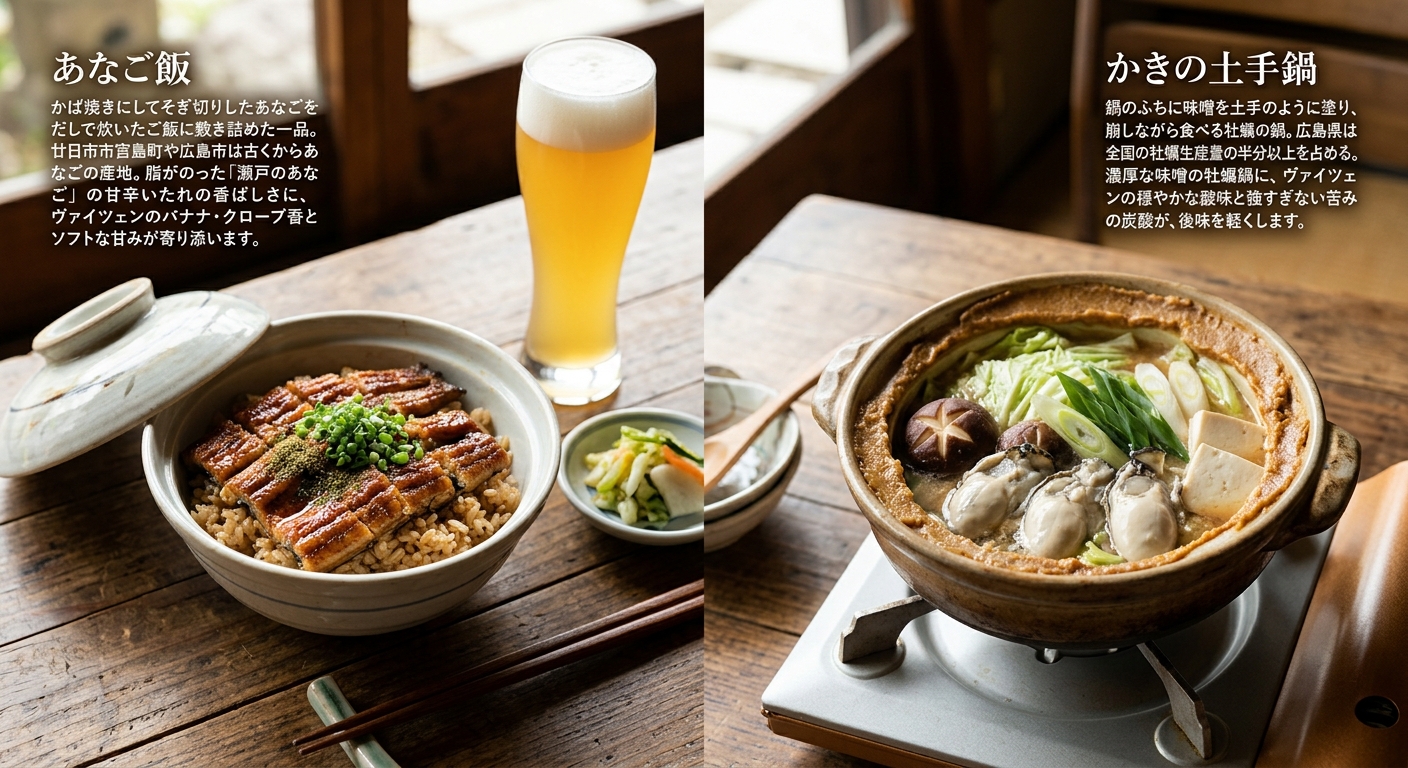
- Anago gohan (grilled conger eel over rice)
According to the Ministry of Agriculture, Forestry and Fisheries’ “Our Regional Cuisines,” this dish lays thinly sliced, kabayaki-grilled conger eel over rice cooked in dashi. Miyajima-cho in Hatsukaichi and Hiroshima City have been centres of conger-eel fishing since old times, recorded even in Edo-period local gazetteers; conger eel from the Ono-Seto strait near Hatsukaichi is prized as “Seto anago” for its rich fat and flavour. The dish traces back to a station bento sold near Miyajimaguchi Station in 1901. The savoury, sweet-salty glaze pairs naturally with the weizen’s soft banana-and-clove sweetness.
Recipe (in Japanese): Kurashiru, “Anago Gohan” - Kaki no dote-nabe (oyster hot pot with a miso rim)
The same MAFF source lists this as a dish handed down in Hiroshima City, Etajima, Miyajima, Kure and the Ondo area: a hot pot in which miso is spread like a “dote” (embankment) around the rim of the pot and gradually stirred in to adjust the broth’s flavour as it cooks. Hiroshima Prefecture accounts for more than half of Japan’s oyster production. Against the rich, miso-forward broth of an oyster hot pot, the weizen’s gentle acidity and restrained bitterness lighten the finish.
Recipe (in Japanese): Kurashiru, “Piping-Hot Oyster Miso Dote-nabe”
A note on the science: a weizen’s banana and clove aromas come not from the malt but from the yeast during fermentation (isoamyl acetate and 4-vinylguaiacol, respectively). Because hop bitterness is kept low, it doesn’t fight the delicate umami of oyster or conger eel or the sweetness of a soy-based glaze; the carbonation and mild acidity simply clear away fat and salt, lightening the next bite.
Visiting the Brewery
MIYAJIMA BREWERY (the brewery’s own shop, run by MIYAJIMA BEER Co., Ltd.)
459-2 Miyajima-cho, Hatsukaichi City, Hiroshima Prefecture. A 7-minute walk from the Miyajima ferry pier, along the souvenir-shop-lined approach street. The ground floor is a beer stand and shop (10:30–17:00) where you can drink their own fresh draft beer on the spot.
The 350ml canned Weizen that reaches you via Rakuten or Amazon, however, was not brewed here. The can is contract-brewed by Helios Shuzo in Nago, Okinawa, under a licence from Miyajima Beer, which plans and sells it. The glass you drink on the island and the can that arrives at your door share a name, but not a birthplace.
Sights Nearby
- Itsukushima Shrine / Miyajima-cho, Hatsukaichi | a short walk from the brewery, straight down the same approach street
A World Heritage shrine whose main halls stand mostly over the sea. In 1996, 431.2 hectares including the shrine and the primeval forest of Mount Misen behind it were inscribed as a World Heritage Site. According to the Miyajima Tourist Association’s model sightseeing course, it is a 10-minute walk from the pier to the beach at Mikasa-no-hama, then 2 more minutes to the shrine — about 12 minutes in total. The brewery sits partway along that same street, so from there it is considerably closer still. Admission is ¥300 for adults, ¥200 for high-school students and ¥100 for younger children (official site); opening hours vary by season, and it is open year-round. - Momijidani Park / Miyajima-cho, Hatsukaichi | a further short walk from the brewery
Miyajima’s best-known spot for autumn leaves, at the foot of the Mount Misen primeval forest. Along the Momijidani stream stands a sabo (erosion-control) structure built during disaster-recovery work in 1948–1950, its boulders fitted together without being broken, in a style resembling a Japanese garden. Admission is free and it is open for strolling at any time. The Miyajima Tourist Association’s official blog gives the distance as a 15-minute walk from the pier.
Hot Springs Nearby
- LiVEMAX RESORT Aki Miyajima / Miyajima-cho, Hatsukaichi | on the same approach street as the brewery, a short walk away
A rare natural hot spring on Miyajima with its own source, called “Kami no Yu.” The scenic open-air bath looks out toward the floating torii of Itsukushima Shrine. The official site gives its location (634 Uonotana-cho, Miyajima-cho) as about a 10-minute walk from the pier, toward Itsukushima Shrine. Day-use bathing runs in two sessions, 8:00–11:00 (last entry 10:30) and 15:00–24:00 (last reception 22:00). The Hot Spring Course costs ¥1,100 for adults and ¥800 for elementary-school children, free for younger children (a rental towel set is an extra ¥300). The official site notes that day-use bathing may be declined due to hotel-guest congestion, bad weather or maintenance, so it’s worth checking before you go.
Opening hours, closing days and day-use bathing availability can change. Please check each facility’s official information before visiting.
A Quick Glossary of Beer Terms
- Craft beer: Beer made by small breweries that put the character of the maker front and centre, as opposed to the uniformity of mass production.
- Weizen: A German wheat beer. The yeast leaves aromas often described as banana and clove, over a soft, rounded body.
- Hops: The cones of a climbing plant, which give beer its bitterness and aroma. Depending on the variety, that aroma can read as citrus, tropical fruit or open grassland.
- Malt: Germinated barley. It forms the foundation of a beer’s sweetness, colour and body; how deeply it is roasted determines colour and toastiness.
- ABV: Alcohol By Volume. Beer typically runs around 5%; above 8% is considered a strong, heavier-drinking beer.
- IBU: International Bitterness Units, a scale for how bitter a beer tastes. Around 10 is barely noticeable bitterness; above 60 lands in clearly bitter IPA territory.
Sources
- Miyajima Beer – Official Site
- Line-up – Miyajima Beer Official Site
- STORY – Miyajima Beer Official Site
- Company Profile – Miyajima Beer Official Site
- Where to Buy / Drink – Miyajima Beer Official Site
- About Us – MIYAJIMA BREWERY Official Site
- Miyajima Brewery – Japan Hop Promotion Committee
- Vol.25 Shigeki Arimoto, Miyajima Beer Co., Ltd. – Hatsukaichi City Public Relations
- Miyajima Beer Weizen Can, 350ml x 24 (brewed under contract by Helios Shuzo, Okinawa) – Yahoo! Shopping
- Seto no Hanayome – Wikipedia (Japanese)
- History and Admission – Itsukushima Shrine Official Site
- Walking Is the Easiest Way to See Miyajima – Miyajima Tourist Association
- 3-Hour Sightseeing Course – Miyajima Tourist Association
- Miyajima’s Autumn Leaves Peak in November – Miyajima Tourist Association
- Access – LiVEMAX RESORT Aki Miyajima Official Site
- Day Trip Use – LiVEMAX RESORT Aki Miyajima Official Site
- Anago Gohan (Hiroshima) – MAFF, “Our Regional Cuisines”
- Kaki no Dote-nabe (Hiroshima) – MAFF, “Our Regional Cuisines”
If you notice any errors in this article, please don’t hesitate to reach out at info@soundrecords.jp.
Read this article in Japanese: 海を渡ってきた一杯、海を渡っていった花嫁