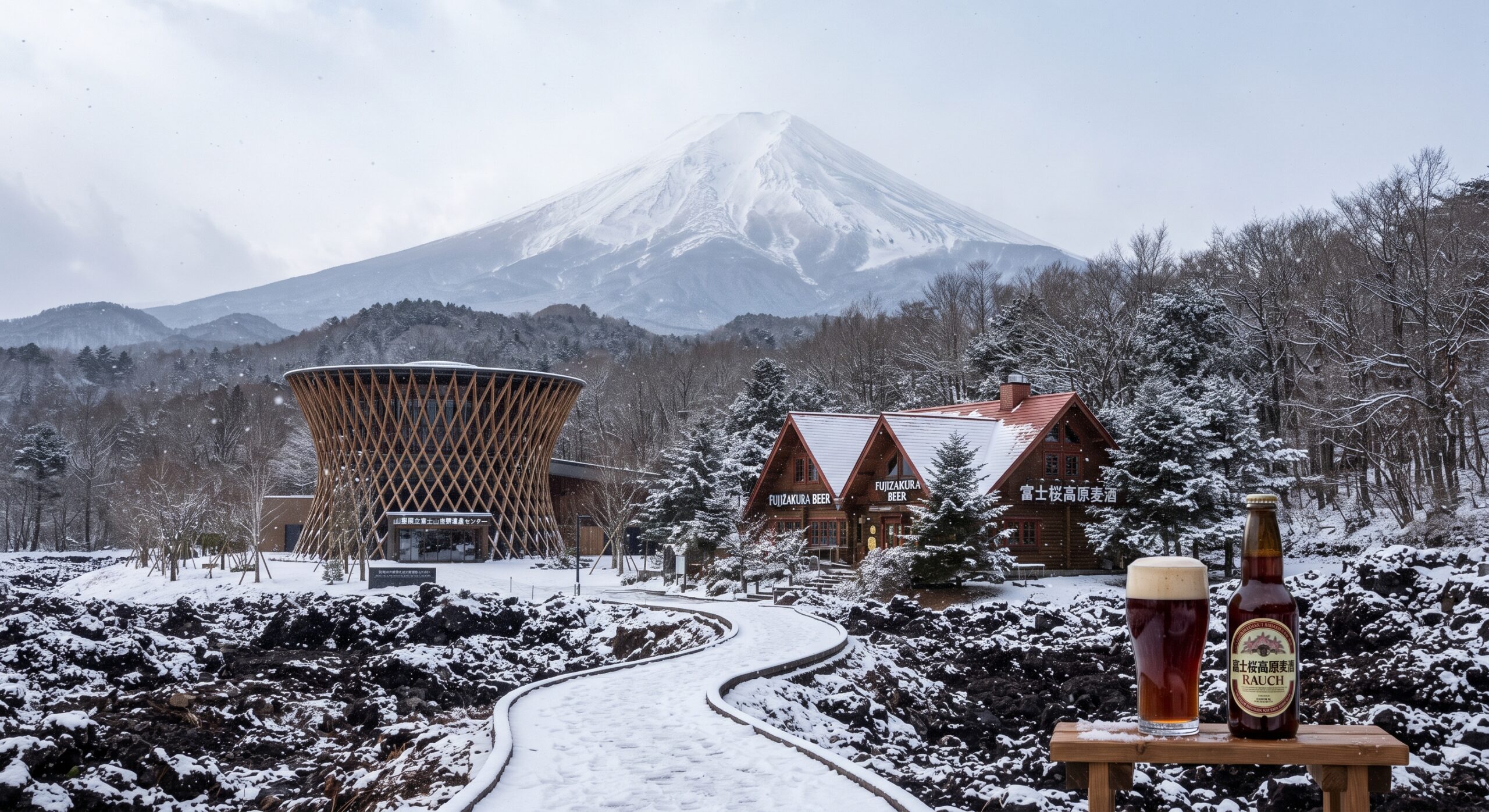
日本語で読む | This is the English version of a bilingual article.
Today’s Pairing
- Craft beer: Fujizakura Heights Beer “Rauch” — Bamberg-style rauchbier; 5.5% ABV; IBU 21; brewed with malt smoked over beech chips / Fuji Kanko Kaihatsu Co., Ltd. (6663-1 Kenmaruo, Funatsu, Fujikawaguchiko Town, Minamitsuru County, Yamanashi Prefecture)
Official site: https://www.fujizakura-beer.jp/ - Music: “Konayuki” (“Powder Snow”) by Remioromen, 2005 / Words and music by Ryota Fujimaki
YouTube: https://www.youtube.com/watch?v=1wxTksLZ1Mw
▶ If the player above doesn’t play, open it on YouTube
The Story of the Brewery
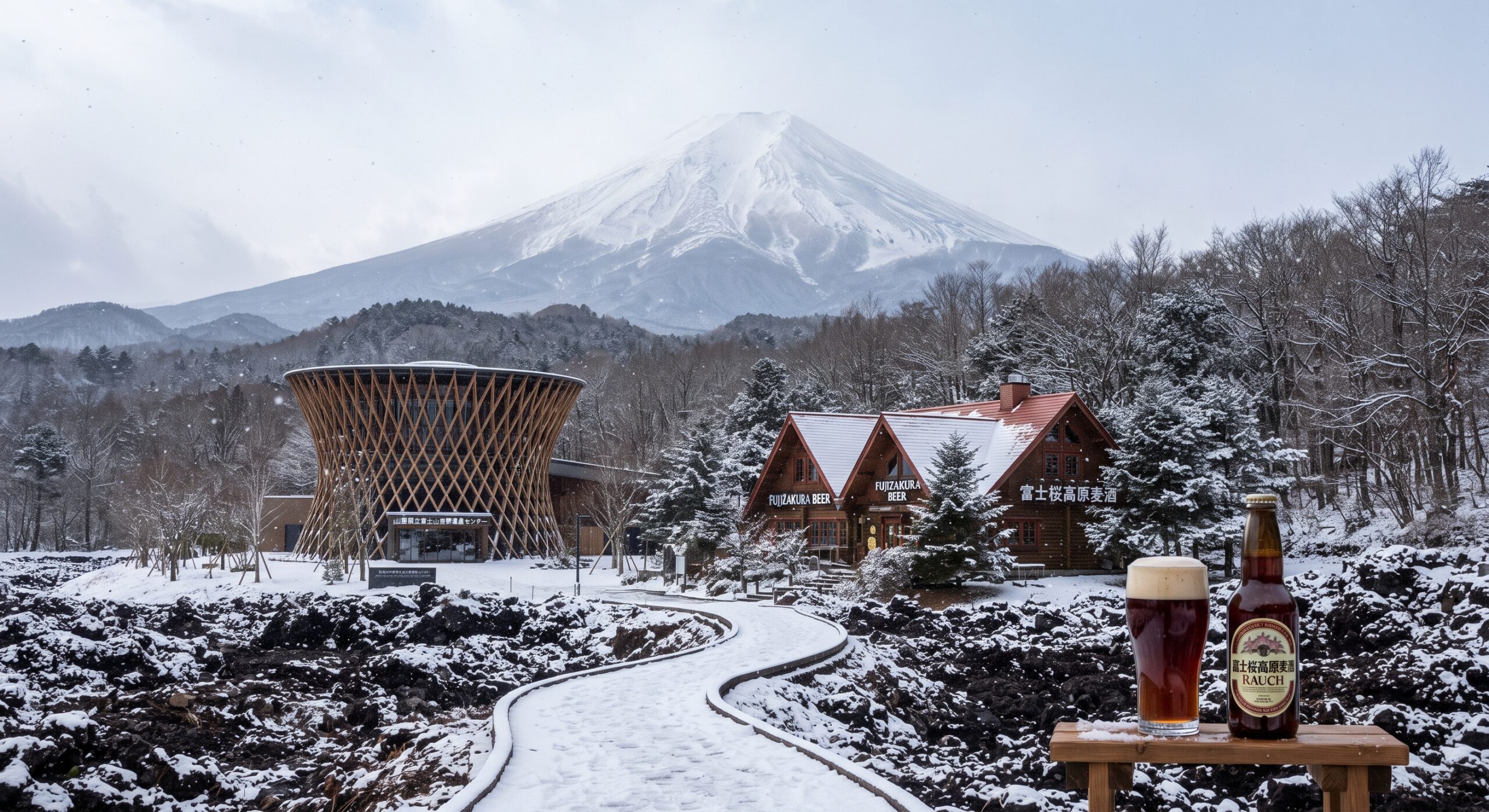
Fujizakura Heights Beer sits on the northern foot of Mount Fuji, in a place called Kenmaruo along Route 139. It is run by Fuji Kanko Kaihatsu Co., Ltd. The official site lists four year-round beers: Pils, Weizen, Rauch and Schwarz Weizen — all built on German styles — and states that the brewery has “more than 150 awards.”
Rauch, the beer in this pairing, has the strongest character of those four. “Rauch” is German for smoke. According to the official site, it is a “smoked beer,” made by smoking the malt over beech chips to seal the smoke flavour into the grain. The style is Bamberg-style rauchbier, after the German city where it is traditional; 5.5% ABV, IBU 21. The official description calls the aroma “a dense smoke” and the flavour “smoky, with malt sweetness.” In 2012 it took a double win at the World Beer Cup and the World Beer Awards.
The point worth holding onto is that what was smoked is the malt. The smoke aroma is not added to finished beer; wood chips go into the fire that dries the grain, at the raw-ingredient stage. Which means this beer’s aroma was decided long before it was ever bottled. The time the barley spent beside a fire is still there, as scent. That is how this glass is made.
One practical note: the beer restaurant Sylvans that adjoined the brewery later became “FUJI GATEWAY,” and according to a notice on the official site it ended service at the end of March 2024. Operation of the former Sylvans space, on the brewery’s second floor, is closed for the time being. Brewing and sales continue, but if you go there today, there is no open space to be poured a glass. Worth knowing before you plan a visit.
The Story of the Land
The brewery’s address is 6663-1 Kenmaruo, Funatsu, Fujikawaguchiko Town, Minamitsuru County, Yamanashi. It is high ground between Lake Kawaguchi and Fujiyoshida, where the skirts of Mount Fuji spread out. The place name Kenmaruo refers to the traces of a lava flow that once ran down from Mount Fuji — this ground is itself a product of the mountain’s eruptions.
At the same address, 6663-1 Funatsu, stands the Yamanashi Prefectural Mount Fuji World Heritage Centre. It is a prefectural facility devoted to how Mount Fuji — inscribed in 2013 as the World Heritage site “Fujisan, sacred place and source of artistic inspiration” — has been worshipped and depicted, and admission is free, special exhibitions included. A brewery and a centre about faith in Mount Fuji, side by side at one address, on the same lava flow.
And this is a place where snow falls. The highland here sits at roughly 850 metres, and in winter the northern foot of Fuji turns white. A beer that carries a smoke aroma, and snow. The fact that both are gathered in the same place is where this pairing began.
The Story of the Song
According to the biography on their official site, Remioromen formed on December 6, 2000, as a three-piece band of three classmates from Yamanashi Prefecture who had gone through elementary, junior high and high school together: Ryota Fujimaki (vocals, guitar), Keisuke Maeda (bass) and Osamu Jinguji (drums). The official site says the band name was made by “connecting favourite words of one, two and three characters, in the order they won at rock-paper-scissors.” They made their major-label debut in 2003.
“Konayuki” was released on November 16, 2005, written and composed by Ryota Fujimaki and issued on SPEEDSTAR RECORDS / Ukigumo Label. It was their seventh major single (eighth overall), and was used as an insert song in the Fuji TV drama 1 Litre of Tears. It reached No. 2 on Oricon’s weekly chart, holding that position for two consecutive weeks and four weeks in total, and was certified Triple Platinum by the Recording Industry Association of Japan. It first appeared on the original album HORIZON. The band’s official biography names it as a song passed down across generations.
The song itself has a clear peak: the chorus lifts the voice high. What it sings about is falling snow, and feelings that never quite got put into words. Konayuki — powder snow — is not snow that settles. It is snow that falls and vanishes, that does not remain. A song about something that does not remain, which has itself remained for twenty years.
Why This Pairing
First, Yamanashi connects them. Fujizakura Heights Beer is brewed at Kenmaruo on Fuji’s northern foot, and Remioromen is three classmates from Yamanashi. Both came out of a prefecture with Mount Fuji at its back.
Second, the two make a pair of “what remains” and “what doesn’t.” Powder snow is snow that vanishes without settling. Rauch’s smoke aroma is the opposite. Beech smoke meets the grain as it dries, and the scent is sealed inside the malt. Once sealed in, it does not leave — not in the bottle, not in the glass, not in your mouth. What the official site calls “a dense smoke” is a record of time spent beside a fire.
Drinking a beer whose aroma does not fade, while listening to a song about snow that already has. This is less an argument than a matter of texture. Bring the glass to your nose and something like a bonfire, or smoked food, rises out of it. That scent is still there after the song ends. A song about what didn’t remain, and an aroma that did. Set side by side, each one’s outline gets sharper.
One last thing. You cannot drink this one at the brewery. The restaurant on site is closed, so you either buy a bottle to take home or have it shipped. An aroma brewed on the skirts of Mount Fuji, opened in your own room. Which is not a bad way to drink it. Songs about snow are usually heard indoors.
Where to Find This Beer
The Rakuten Ichiba link below is an affiliate link.
- Brewery official site:https://www.fujizakura-beer.jp/
- Buy on Rakuten Ichiba: View the product page (¥2,112)
These are Japanese storefronts. If you are visiting the brewery, drinking it fresh at their own taproom is by far the best option.
Pairing Dishes Worth Trying
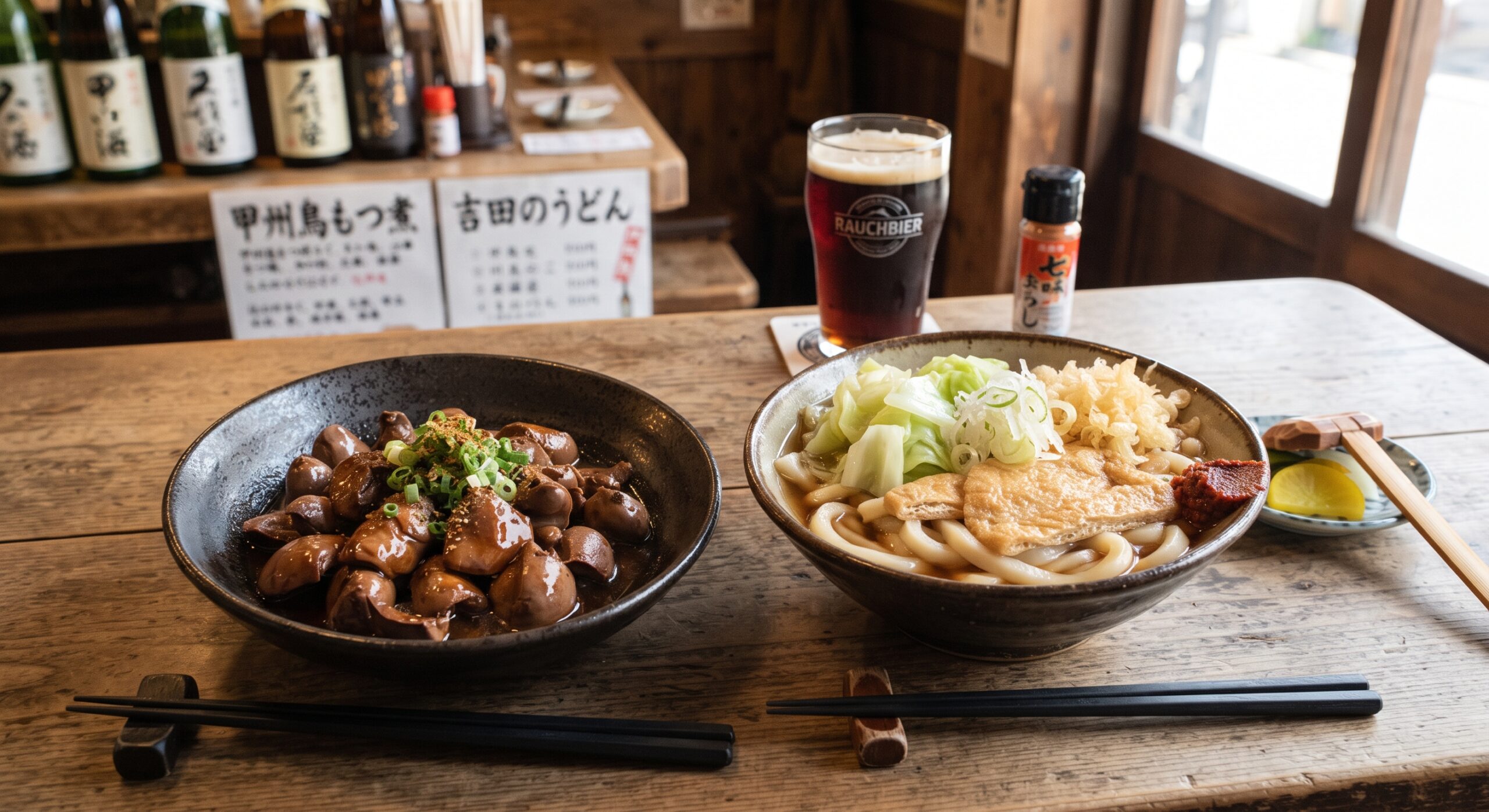
- Koshu tori motsu-ni (simmered chicken offal)
According to the Ministry of Agriculture, Forestry and Fisheries’ “Traditional Foods of Japan,” chicken liver, gizzard, heart, immature egg and oviduct are simmered hard and fast in a small amount of soy sauce, sugar and sake, until a glaze coats the surface and seals in the savouriness and sweetness of the offal — an everyday local dish. The deep flavour of liver and that sweet-savoury glaze meet Rauch’s smoke from the same direction: smoking and offal are both flavours made of fire and time. - Yoshida no udon
The same Ministry of Agriculture source describes it as a hand-cut udon from Fujiyoshida City characterised by a startling chew and firmness, standing alongside hoto as a representative traditional food of Yamanashi’s flour-based cuisine. It is the taste of Fujiyoshida, about twenty minutes by car from the brewery, and the plain sweetness of the wheat goes well with the aroma of smoked malt. Grain with grain.
A note on the science: the main aromatic compounds that smoking leaves behind are phenols, which belong to the same family of aromas as grilled meat and the toasted smell of soy sauce (the aromas produced by the Maillard reaction). So they add to the glaze on the motsu-ni and the toasty soy sauce rather than colliding with them. Hop bitterness and carbonation, meanwhile, clear the fat and richness of liver and sauce, so a heavily flavoured dish doesn’t sit heavy.
Visiting the Brewery
Fujizakura Heights Beer (Fuji Kanko Kaihatsu Co., Ltd.)
6663-1 Kenmaruo, Funatsu, Fujikawaguchiko Town, Minamitsuru County, Yamanashi Prefecture. On Route 139, between Lake Kawaguchi and Fujiyoshida, on the northern foot of Mount Fuji.
The beer restaurant Sylvans that used to adjoin the brewery later became “FUJI GATEWAY,” and according to a notice on the official site it ended service at the end of March 2024; operation of the former Sylvans space (the brewery’s second floor) is closed for the time being. If you visit the brewery today, there is no open space to drink on site. The beer is bought through the official online shop or from local bottle shops (inquiries are handled 10:00–18:00).
Sights Nearby
- Yamanashi Prefectural Mount Fuji World Heritage Centre / Funatsu, Fujikawaguchiko | same street address as the brewery, a short walk away
A prefectural exhibition centre at the same address, 6663-1 Funatsu, as the brewery. It presents how Mount Fuji has been worshipped and depicted, as the World Heritage site “Fujisan, sacred place and source of artistic inspiration,” inscribed in 2013. Open 9:00–17:00 (8:30–18:00 in July and August, 9:00–16:30 from December to February; last entry 15 minutes before closing). Admission is free, special exhibitions included. The north wing is open year-round; the south wing closes on the fourth Tuesday of each month (the following day if that is a public holiday). - Kitaguchi Hongu Fuji Sengen Shrine / Kamiyoshida, Fujiyoshida | ~18 min, ~10 km by car from the brewery
One of the component parts of the World Heritage site “Fujisan, sacred place and source of artistic inspiration,” and the starting point of the Yoshida climbing route up Mount Fuji. It has a cedar-lined approach and a history as the place from which Fujiko pilgrims set out for the mountain. Please check the official site for visiting and shrine office hours.
Hot Springs Nearby
- Fuji Chobo no Yu Yurari / Narusawa Village | ~13 min, ~8 km by car from the brewery
A day-use natural hot spring in Narusawa Village, west along Route 139. Open 10:00–21:00 on weekdays (last entry 20:00) and 10:00–22:00 on weekends and holidays (last entry 21:00). Admission for adults is ¥1,400 on weekdays (¥1,200 after 19:00) and ¥1,700 on weekends and holidays (¥1,500 after 19:00); children aged 4 to elementary school age are ¥750 on weekdays and ¥800 on weekends and holidays. All rates include a rental bath towel and face towel. Weekend rates apply during spring and summer seasons, Golden Week, the New Year period and public holidays. Please confirm prices and hours before visiting.
Opening hours, closing days and day-use bathing availability can change. Please check each facility’s official information before visiting.
A Quick Glossary of Beer Terms
- Craft beer: Beer made by small breweries that put the character of the maker front and centre, as opposed to the uniformity of mass production.
- Lager: Beer made by “bottom fermentation,” in which the yeast works slowly at a low temperature and settles toward the bottom of the tank. It tends to come out clean and crisp — the style behind most major Japanese beers.
- Malt: Germinated barley. It forms the foundation of a beer’s sweetness, colour and body.
- Hops: The cones of a climbing plant, which give beer its bitterness and aroma.
- ABV: Alcohol By Volume. Around 5% is standard for beer; anything above 8% is considered a stronger, more full-bodied style.
- IBU: An international scale for measuring bitterness. Around 10 registers as barely bitter at all; above 60 puts you in clearly bitter IPA territory.
Sources
- Fujizakura Heights Beer – Official Site
- Beer Line-up – Fujizakura Heights Beer Official Site
- Contact – Fujizakura Heights Beer Official Site
- Remioromen – Official Site
- Biography – Remioromen Official Site
- Konayuki (Remioromen song) – Wikipedia (Japanese)
- Yamanashi Prefectural Mount Fuji World Heritage Centre – Official Site
- List of Component Parts – Yamanashi Prefectural Mount Fuji World Heritage Centre
- Kitaguchi Hongu Fuji Sengen Shrine – Official Site
- Fuji Chobo no Yu Yurari – Official Site (Admission)
- Koshu Tori Motsu-ni – MAFF, “Traditional Foods of Japan”
- Yoshida no Udon – MAFF, “Traditional Foods of Japan”
If you notice any errors in this article, please don’t hesitate to reach out at info@soundrecords.jp.
Read this article in Japanese: 消えない香りと、消える雪