今日のペアリング
▶ 上のプレーヤーで再生できない場合は、YouTubeで開く
醸造所の話
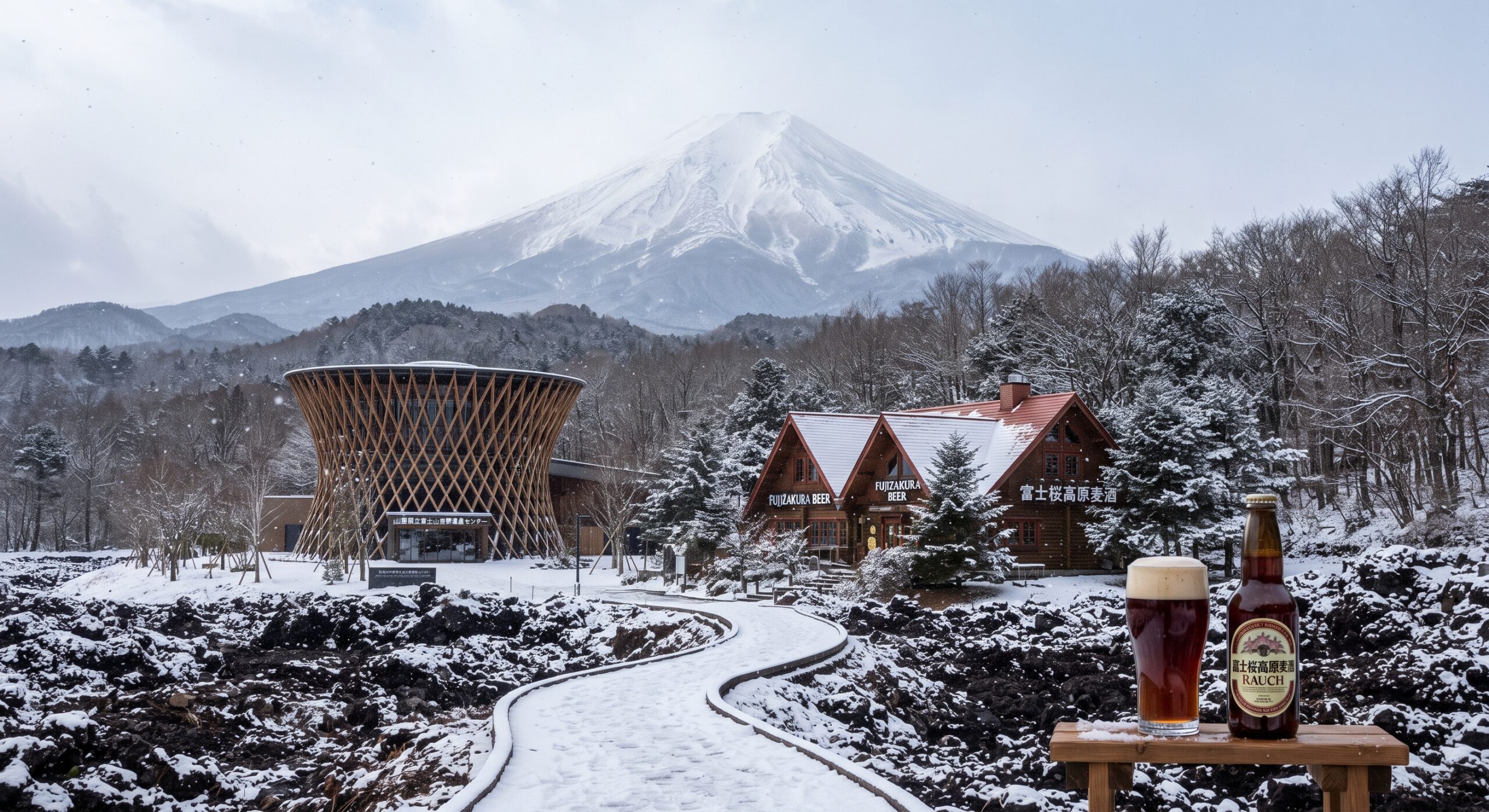
富士桜高原麦酒は、富士山の北麓、国道139号沿いの剣丸尾(けんまるび)という土地にあります。運営は富士観光開発株式会社。公式サイトが掲げる定番は4種類で、PILS(ピルス)、WEIZEN(ヴァイツェン)、RAUCH(ラオホ)、SCHWARZ WEIZEN(シュヴァルツ ヴァイツェン)。いずれもドイツのスタイルを土台にした銘柄で、公式サイトは「150を超える受賞歴」があると記しています。
今回合わせる「ラオホ」は、その4本のうちでもっとも性格の強い一本です。「ラオホ」はドイツ語で燻煙を意味します。公式サイトの説明によれば、ブナのチップで麦芽を燻煙して、モルトにスモークフレーバーを綴じ込めた「燻煙ビール」。スタイルはドイツ・バンベルクに伝わるバンベルクスタイル・ラオホビア、アルコール分5.5%、IBUは21。公式の記述は香りを「濃厚な燻煙香」、味わいを「スモーキーかつモルトの甘味」としています。そして2012年、World Beer Cup と World Beer Awards をダブル受賞した名作です。
ここで押さえておきたいのは、燻したのは麦芽だということです。できあがったビールに煙の香りを後から足すのではなく、原料の段階で、麦を乾かす火に木のチップを使う。つまりこのビールの香りは、瓶詰めされるずっと前に決まっています。麦が火のそばで過ごした時間が、そのまま香りとして残っている――そういう造り方の一杯です。
なお、醸造所に併設されていた地ビールレストラン「シルバンズ」は、のちに「FUJI GATEWAY」となり、公式サイトのお知らせによれば2024年3月末でサービスを終了しました。旧シルバンズ(醸造所2階部分)の運営は、しばらくの間クローズとされています。麦酒の醸造販売そのものは続いていますが、いま現地へ行っても、その場で注いでもらえる場は開いていません。訪ねる計画を立てる前に、ここは知っておいてください。
土地の話
醸造所の住所は、山梨県南都留郡富士河口湖町船津字剣丸尾6663-1。河口湖と富士吉田のあいだ、富士山の裾野が広がる標高の高い一帯です。「剣丸尾」という地名は、富士山から流れ出した溶岩流の跡を指す言葉で、この土地そのものが富士山の噴火の産物です。
同じ「船津6663-1」の番地には、山梨県立富士山世界遺産センターが建っています。2013年に「富士山-信仰の対象と芸術の源泉」として世界文化遺産に登録された富士山が、どのように信仰され、どのように描かれてきたかを展示する県立の施設で、観覧料は企画展を含めて無料です。醸造所と世界遺産センターが同じ番地に並んでいる――ビールを造る場所と、富士山への信仰を展示する場所が、同じ溶岩流の上にあるわけです。
そして、ここは雪が降る土地です。標高はおよそ850m前後の高原で、冬になれば富士山の北麓は白くなります。燻煙の香りを持つビールと、雪。この二つが同じ土地に揃っていることが、今回の組み合わせの出発点になりました。
音楽の話
レミオロメンは、公式サイトのバイオグラフィーによれば2000年12月6日、山梨県出身の小中高の同級生3人によって結成されたスリーピース・バンドです。藤巻亮太(ボーカル・ギター)、前田啓介(ベース)、神宮司治(ドラムス)。バンド名は「じゃんけんで勝った順に、一文字、二文字、三文字と好きな言葉をつなげて」決めたと公式サイトに書かれています。2003年にメジャーデビュー。
「粉雪」は2005年11月16日発売。作詞・作曲は藤巻亮太、レーベルはSPEEDSTAR RECORDS/浮雲レーベル。メジャーでは7作目(通算8作目)のシングルで、フジテレビ系ドラマ『1リットルの涙』の挿入歌として使われました。オリコン週間チャートでは最高2位を2週連続・通算4週記録し、日本レコード協会からトリプル・プラチナの認定を受けています。初出のオリジナルアルバムは『HORIZON』。公式サイトのバイオグラフィーは、この曲を世代を超えて聴き継がれる名曲として挙げています。
曲そのものは、サビで声が高く張り上がる、はっきりとした山を持った構造をしています。そして歌われているのは、降る雪と、うまく言葉にできなかった感情です。粉雪は、積もる雪ではありません。降ってもすぐ消える、残らない雪です。残らないものを歌にして、20年経っても残っている――そういう曲でもあります。
なぜこの組み合わせなのか
まず、山梨という土地が重なります。富士桜高原麦酒は富士山北麓の剣丸尾で醸され、レミオロメンは山梨県出身の同級生3人が組んだバンドです。どちらも富士山を背にした県から出てきました。
そして、この二つは「残るもの」と「残らないもの」の組み合わせになっています。粉雪は、積もらずに消えてしまう雪です。ラオホの燻煙香は、その逆です。麦を乾かすときにブナの煙を当てて、香りを麦芽の中に綴じ込めてしまう。一度閉じ込めてしまえば、瓶になり、グラスに注がれ、口に入るまで消えません。公式サイトの言う「濃厚な燻煙香」は、火のそばで過ごした時間の記録です。
消えてしまった雪のことを歌った曲を、消えない香りを持つビールと一緒に飲む。これは理屈というより、手触りの話です。グラスを鼻に近づけると、焚き火や燻製食品を思わせる香りが立ち上がります。その香りは、曲が終わっても残っています。残らなかったものを歌う曲と、残ってしまった香り。並べると、どちらの輪郭もはっきりします。
最後にもうひとつ。この一杯は、醸造所に行っても飲めません。現地のレストランは閉じていて、買って帰るか、送ってもらうしかない。富士山の裾野で醸された香りを、自分の家で開けることになります。それも悪くない飲み方だと思います。雪の歌は、たいてい部屋の中で聴くものです。
この一杯を、探すなら
※楽天市場へのリンクは広告(アフィリエイト)です。醸造所がタップルームや直営店を持っている場合は、できたてを現地で味わうのが一番のおすすめです。
🌡️ おすすめの飲み方(温度とグラス):10〜12℃に。ラオホは冷やしすぎると燻煙香が立たなくなるので、よく冷えたビールより少し温度を上げて注ぐのがおすすめです。グラスは口の広い厚手のタンブラーか、脚付きのビアグラス。鼻が入る口径のものを選ぶと、ブナの燻煙香がしっかり届きます。細口のピルスナーグラスはこのビールには向きません。
合わせたい「アテ」
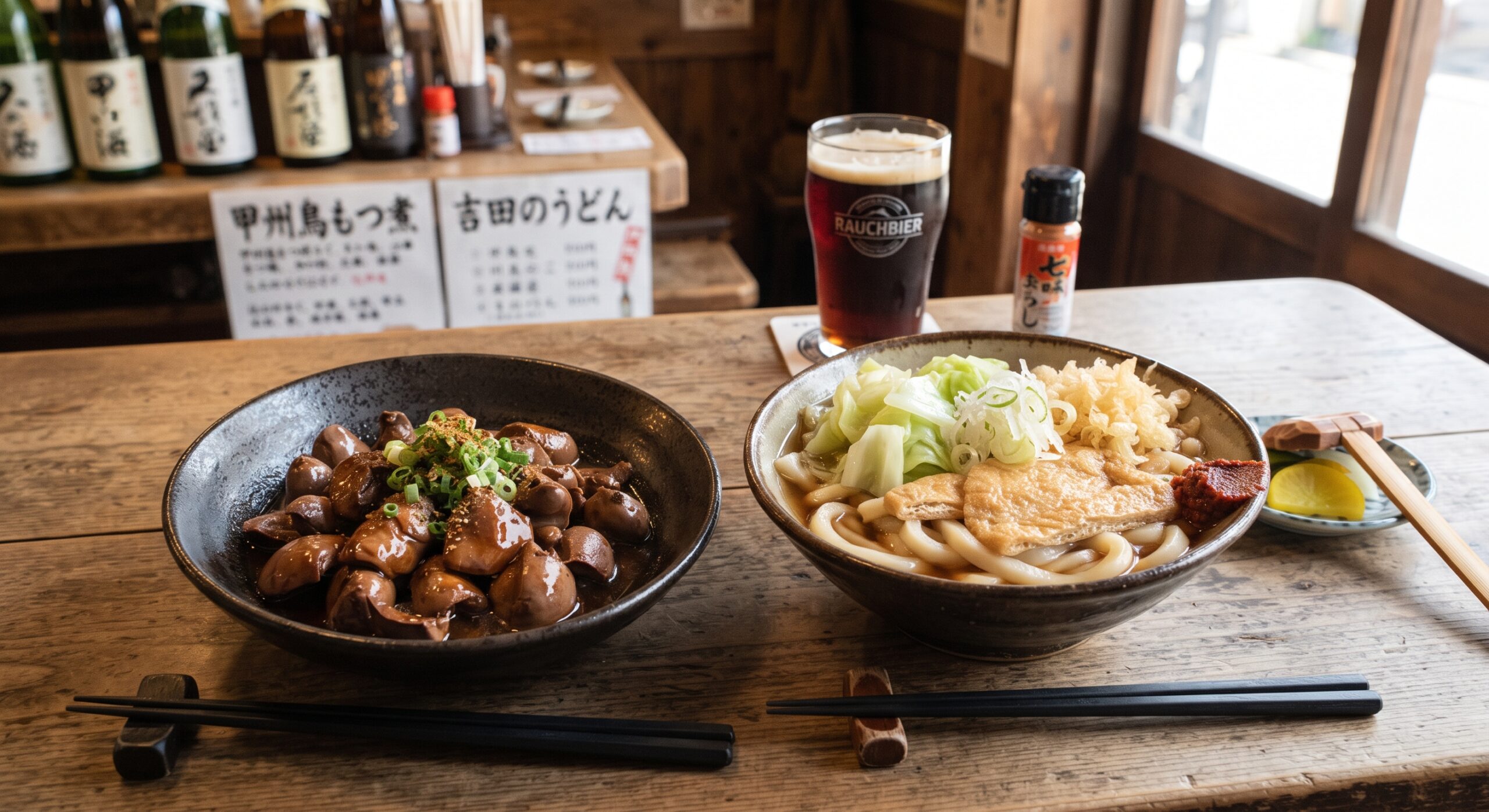
- 甲州鳥もつ煮
農林水産省「にっぽん伝統食図鑑」によれば、鳥レバー・砂肝・はつ・きんかん・ひもを、醤油・砂糖・酒の少量のタレとともに強火で一気に煮からめ、照りで表面をコーティングして、鳥もつのうま味や甘みをぎゅっと封じ込めた庶民の味です。レバーの濃い風味と甘辛い照りに、ラオホの燻煙香は同じ方向から重なります。燻製とレバーは、どちらも「火と時間」の味だからです。
- 吉田のうどん
同じ農林水産省「にっぽん伝統食図鑑」が、驚くほどの歯ごたえとコシの強さを特徴とする、富士吉田市に伝わる手打ちうどんとして挙げる一品。ほうとうと並び、山梨の粉食文化を代表する伝統食です。醸造所から車で20分ほどの富士吉田の味で、小麦の素朴な甘みに、燻した麦芽の香りがよく合います。麦と麦の組み合わせです。
科学的にひとこと:燻煙でついた香りの主成分はフェノール類で、これは焼いた肉や醤油の焦げた香り(メイラード反応でできる香り)と同じ系統の香りです。だから鳥もつ煮の照りや醤油の香ばしさとは、ぶつからずに足し算になります。またホップの苦みと炭酸はレバーやタレの脂とコクを流す働きをするので、濃い味の一皿を重く感じさせません。
この醸造所をたずねるなら
富士桜高原麦酒(富士観光開発株式会社)
〒401-0301 山梨県南都留郡富士河口湖町船津字剣丸尾6663-1/国道139号沿い、河口湖と富士吉田のあいだ、富士山の北麓です。
醸造所に併設されていた地ビールレストラン「シルバンズ」は、のちに「FUJI GATEWAY」となり、公式サイトのお知らせによれば2024年3月末でサービスを終了し、旧シルバンズ(醸造所2階部分)の運営はしばらくの間クローズとなっています。いま醸造所をたずねても、その場で飲める場は開いていません。ビールは公式オンラインショップや地元の酒販店で買うことになります(お問い合わせの受付は10:00〜18:00)。
近くの観光スポット
- 山梨県立富士山世界遺産センター/富士河口湖町船津|富士桜高原麦酒と同じ番地・歩いてすぐ
醸造所と同じ「船津6663-1」に建つ、山梨県立の展示施設。2013年に世界文化遺産に登録された「富士山-信仰の対象と芸術の源泉」について、富士山がどう信仰され、どう描かれてきたかを展示しています。開館9:00〜17:00(7〜8月は8:30〜18:00、12〜2月は9:00〜16:30、最終入館は閉館15分前)。観覧料は企画展も含めて無料です。北館は年中無休、南館は毎月第4火曜が休館(祝日の場合は翌日)。
- 北口本宮冨士浅間神社/富士吉田市上吉田|富士桜高原麦酒から車で約18分・約10km
世界文化遺産「富士山-信仰の対象と芸術の源泉」の構成資産のひとつで、富士山の吉田口登山道の起点にあたる神社。杉並木の参道と、富士講の人々がここから山へ向かったという歴史を持ちます。参拝時間・社務所の受付時間は公式サイトでご確認ください。
近くの温泉
- 富士眺望の湯 ゆらり/鳴沢村|富士桜高原麦酒から車で約13分・約8km
国道139号を西へ進んだ鳴沢村にある日帰りの天然温泉。営業は平日10:00〜21:00(最終入館20:00)、土日祝10:00〜22:00(最終入館21:00)。入館料は大人が平日1,400円(19時以降1,200円)、土日祝1,700円(19時以降1,500円)、子ども(4歳〜小学生)が平日750円・土日祝800円で、いずれも貸バスタオルとフェイスタオル付き。春季・夏季やゴールデンウィーク、年末年始・祝日は土日祝料金です。料金・時間は訪問前にご確認ください。
※営業時間・定休日・日帰り入浴の可否は変わることがあります。おでかけ前に各施設の公式情報をご確認ください。
ひとことメモ(ビールの用語)
- クラフトビール:小規模な醸造所が、造り手の個性を前面に出して仕込むビールの総称。大量生産の均一な味とは別の方向を目指しています。
- ラガー:低温で、酵母が下に沈みながら働く「下面発酵」で造るビール。すっきりと澄んだ切れ味になり、日本の大手ビールの多くがこの系統です。
- モルト:発芽させた大麦(麦芽)のこと。ビールの甘み・色・コクの土台になり、焙煎の深さで色と香ばしさが決まります。
- ホップ:ビールに苦みと香りを与えるつる性植物の毬花(まりばな)。品種によって、柑橘・トロピカルフルーツ・草原のように香りが変わります。
- ABV:アルコール度数(Alcohol By Volume)のこと。ビールでは5%前後が標準で、8%を超えると飲みごたえのある「強め」の部類になります。
- IBU:苦みの強さを表す国際的な数値。10前後だとほとんど苦みを感じず、60を超えるとはっきり苦いIPAの領域です。
参考
内容に誤りがございましたら、お手数ですが info@soundrecords.jp までご連絡いただけますと幸いです。
Today’s Pairing
- Craft beer: Fujizakura Heights Beer “Rauch” — Bamberg-style rauchbier; 5.5% ABV; IBU 21; brewed with malt smoked over beech chips / Fuji Kanko Kaihatsu Co., Ltd. (6663-1 Kenmaruo, Funatsu, Fujikawaguchiko Town, Minamitsuru County, Yamanashi Prefecture)
Official site: https://www.fujizakura-beer.jp/
- Music: “Konayuki” (“Powder Snow”) by Remioromen, 2005 / Words and music by Ryota Fujimaki
YouTube: https://www.youtube.com/watch?v=1wxTksLZ1Mw
▶ If the player above doesn’t play, open it on YouTube
The Story of the Brewery
Fujizakura Heights Beer sits on the northern foot of Mount Fuji, in a place called Kenmaruo along Route 139. It is run by Fuji Kanko Kaihatsu Co., Ltd. The official site lists four year-round beers: Pils, Weizen, Rauch and Schwarz Weizen — all built on German styles — and states that the brewery has “more than 150 awards.”
Rauch, the beer in this pairing, has the strongest character of those four. “Rauch” is German for smoke. According to the official site, it is a “smoked beer,” made by smoking the malt over beech chips to seal the smoke flavour into the grain. The style is Bamberg-style rauchbier, after the German city where it is traditional; 5.5% ABV, IBU 21. The official description calls the aroma “a dense smoke” and the flavour “smoky, with malt sweetness.” In 2012 it took a double win at the World Beer Cup and the World Beer Awards.
The point worth holding onto is that what was smoked is the malt. The smoke aroma is not added to finished beer; wood chips go into the fire that dries the grain, at the raw-ingredient stage. Which means this beer’s aroma was decided long before it was ever bottled. The time the barley spent beside a fire is still there, as scent. That is how this glass is made.
One practical note: the beer restaurant Sylvans that adjoined the brewery later became “FUJI GATEWAY,” and according to a notice on the official site it ended service at the end of March 2024. Operation of the former Sylvans space, on the brewery’s second floor, is closed for the time being. Brewing and sales continue, but if you go there today, there is no open space to be poured a glass. Worth knowing before you plan a visit.
The Story of the Land
The brewery’s address is 6663-1 Kenmaruo, Funatsu, Fujikawaguchiko Town, Minamitsuru County, Yamanashi. It is high ground between Lake Kawaguchi and Fujiyoshida, where the skirts of Mount Fuji spread out. The place name Kenmaruo refers to the traces of a lava flow that once ran down from Mount Fuji — this ground is itself a product of the mountain’s eruptions.
At the same address, 6663-1 Funatsu, stands the Yamanashi Prefectural Mount Fuji World Heritage Centre. It is a prefectural facility devoted to how Mount Fuji — inscribed in 2013 as the World Heritage site “Fujisan, sacred place and source of artistic inspiration” — has been worshipped and depicted, and admission is free, special exhibitions included. A brewery and a centre about faith in Mount Fuji, side by side at one address, on the same lava flow.
And this is a place where snow falls. The highland here sits at roughly 850 metres, and in winter the northern foot of Fuji turns white. A beer that carries a smoke aroma, and snow. The fact that both are gathered in the same place is where this pairing began.
The Story of the Song
According to the biography on their official site, Remioromen formed on December 6, 2000, as a three-piece band of three classmates from Yamanashi Prefecture who had gone through elementary, junior high and high school together: Ryota Fujimaki (vocals, guitar), Keisuke Maeda (bass) and Osamu Jinguji (drums). The official site says the band name was made by “connecting favourite words of one, two and three characters, in the order they won at rock-paper-scissors.” They made their major-label debut in 2003.
“Konayuki” was released on November 16, 2005, written and composed by Ryota Fujimaki and issued on SPEEDSTAR RECORDS / Ukigumo Label. It was their seventh major single (eighth overall), and was used as an insert song in the Fuji TV drama 1 Litre of Tears. It reached No. 2 on Oricon’s weekly chart, holding that position for two consecutive weeks and four weeks in total, and was certified Triple Platinum by the Recording Industry Association of Japan. It first appeared on the original album HORIZON. The band’s official biography names it as a song passed down across generations.
The song itself has a clear peak: the chorus lifts the voice high. What it sings about is falling snow, and feelings that never quite got put into words. Konayuki — powder snow — is not snow that settles. It is snow that falls and vanishes, that does not remain. A song about something that does not remain, which has itself remained for twenty years.
Why This Pairing
First, Yamanashi connects them. Fujizakura Heights Beer is brewed at Kenmaruo on Fuji’s northern foot, and Remioromen is three classmates from Yamanashi. Both came out of a prefecture with Mount Fuji at its back.
Second, the two make a pair of “what remains” and “what doesn’t.” Powder snow is snow that vanishes without settling. Rauch’s smoke aroma is the opposite. Beech smoke meets the grain as it dries, and the scent is sealed inside the malt. Once sealed in, it does not leave — not in the bottle, not in the glass, not in your mouth. What the official site calls “a dense smoke” is a record of time spent beside a fire.
Drinking a beer whose aroma does not fade, while listening to a song about snow that already has. This is less an argument than a matter of texture. Bring the glass to your nose and something like a bonfire, or smoked food, rises out of it. That scent is still there after the song ends. A song about what didn’t remain, and an aroma that did. Set side by side, each one’s outline gets sharper.
One last thing. You cannot drink this one at the brewery. The restaurant on site is closed, so you either buy a bottle to take home or have it shipped. An aroma brewed on the skirts of Mount Fuji, opened in your own room. Which is not a bad way to drink it. Songs about snow are usually heard indoors.
Where to Find This Beer
The Rakuten Ichiba link below is an affiliate link.
These are Japanese storefronts. If you are visiting the brewery, drinking it fresh at their own taproom is by far the best option.
🌡️ How to serve it:Serve at 10–12°C. Chill a rauchbier too hard and the smoke aroma stops rising, so pour it a little warmer than you would an ice-cold lager. Use a thick-walled tumbler with a wide mouth, or a stemmed beer glass — something your nose can get into, so the beech smoke actually reaches you. A narrow pilsner glass does not suit this beer.
Pairing Dishes Worth Trying
- Koshu tori motsu-ni (simmered chicken offal)
According to the Ministry of Agriculture, Forestry and Fisheries’ “Traditional Foods of Japan,” chicken liver, gizzard, heart, immature egg and oviduct are simmered hard and fast in a small amount of soy sauce, sugar and sake, until a glaze coats the surface and seals in the savouriness and sweetness of the offal — an everyday local dish. The deep flavour of liver and that sweet-savoury glaze meet Rauch’s smoke from the same direction: smoking and offal are both flavours made of fire and time.
- Yoshida no udon
The same Ministry of Agriculture source describes it as a hand-cut udon from Fujiyoshida City characterised by a startling chew and firmness, standing alongside hoto as a representative traditional food of Yamanashi’s flour-based cuisine. It is the taste of Fujiyoshida, about twenty minutes by car from the brewery, and the plain sweetness of the wheat goes well with the aroma of smoked malt. Grain with grain.
A note on the science: the main aromatic compounds that smoking leaves behind are phenols, which belong to the same family of aromas as grilled meat and the toasted smell of soy sauce (the aromas produced by the Maillard reaction). So they add to the glaze on the motsu-ni and the toasty soy sauce rather than colliding with them. Hop bitterness and carbonation, meanwhile, clear the fat and richness of liver and sauce, so a heavily flavoured dish doesn’t sit heavy.
Visiting the Brewery
Fujizakura Heights Beer (Fuji Kanko Kaihatsu Co., Ltd.)
6663-1 Kenmaruo, Funatsu, Fujikawaguchiko Town, Minamitsuru County, Yamanashi Prefecture. On Route 139, between Lake Kawaguchi and Fujiyoshida, on the northern foot of Mount Fuji.
The beer restaurant Sylvans that used to adjoin the brewery later became “FUJI GATEWAY,” and according to a notice on the official site it ended service at the end of March 2024; operation of the former Sylvans space (the brewery’s second floor) is closed for the time being. If you visit the brewery today, there is no open space to drink on site. The beer is bought through the official online shop or from local bottle shops (inquiries are handled 10:00–18:00).
Sights Nearby
- Yamanashi Prefectural Mount Fuji World Heritage Centre / Funatsu, Fujikawaguchiko | same street address as the brewery, a short walk away
A prefectural exhibition centre at the same address, 6663-1 Funatsu, as the brewery. It presents how Mount Fuji has been worshipped and depicted, as the World Heritage site “Fujisan, sacred place and source of artistic inspiration,” inscribed in 2013. Open 9:00–17:00 (8:30–18:00 in July and August, 9:00–16:30 from December to February; last entry 15 minutes before closing). Admission is free, special exhibitions included. The north wing is open year-round; the south wing closes on the fourth Tuesday of each month (the following day if that is a public holiday).
- Kitaguchi Hongu Fuji Sengen Shrine / Kamiyoshida, Fujiyoshida | ~18 min, ~10 km by car from the brewery
One of the component parts of the World Heritage site “Fujisan, sacred place and source of artistic inspiration,” and the starting point of the Yoshida climbing route up Mount Fuji. It has a cedar-lined approach and a history as the place from which Fujiko pilgrims set out for the mountain. Please check the official site for visiting and shrine office hours.
Hot Springs Nearby
- Fuji Chobo no Yu Yurari / Narusawa Village | ~13 min, ~8 km by car from the brewery
A day-use natural hot spring in Narusawa Village, west along Route 139. Open 10:00–21:00 on weekdays (last entry 20:00) and 10:00–22:00 on weekends and holidays (last entry 21:00). Admission for adults is ¥1,400 on weekdays (¥1,200 after 19:00) and ¥1,700 on weekends and holidays (¥1,500 after 19:00); children aged 4 to elementary school age are ¥750 on weekdays and ¥800 on weekends and holidays. All rates include a rental bath towel and face towel. Weekend rates apply during spring and summer seasons, Golden Week, the New Year period and public holidays. Please confirm prices and hours before visiting.
Opening hours, closing days and day-use bathing availability can change. Please check each facility’s official information before visiting.
A Quick Glossary of Beer Terms
- Craft beer: Beer made by small breweries that put the character of the maker front and centre, as opposed to the uniformity of mass production.
- Lager: Beer made by “bottom fermentation,” in which the yeast works slowly at a low temperature and settles toward the bottom of the tank. It tends to come out clean and crisp — the style behind most major Japanese beers.
- Malt: Germinated barley. It forms the foundation of a beer’s sweetness, colour and body.
- Hops: The cones of a climbing plant, which give beer its bitterness and aroma.
- ABV: Alcohol By Volume. Around 5% is standard for beer; anything above 8% is considered a stronger, more full-bodied style.
- IBU: An international scale for measuring bitterness. Around 10 registers as barely bitter at all; above 60 puts you in clearly bitter IPA territory.
Sources
If you notice any errors in this article, please don’t hesitate to reach out at info@soundrecords.jp.
コメントを残す