日本語で読む | This is the English version of a bilingual article.
Today’s Pairing
- Craft beer: Isekado Pale Ale (affectionately nicknamed “Ise-pe”) — American-style pale ale, malted barley from the US and Canada, three North American hop varieties, 5.0% ABV, 35 IBU / Nikenjayamochi Kadoya Honten, Ltd. (Ise City, Mie)
Official site: https://www.isekado.co.jp/ - Music: “Nagori Yuki” (“The Snow That Lingers”) by Kaguyahime (1974), written and composed by Shozo Ise (a cover by singer Iruka later became a nationwide hit)
YouTube: https://www.youtube.com/watch?v=3-y-VregNqg
▶ If the player above doesn’t play, open it on YouTube
The Story of the Brewery
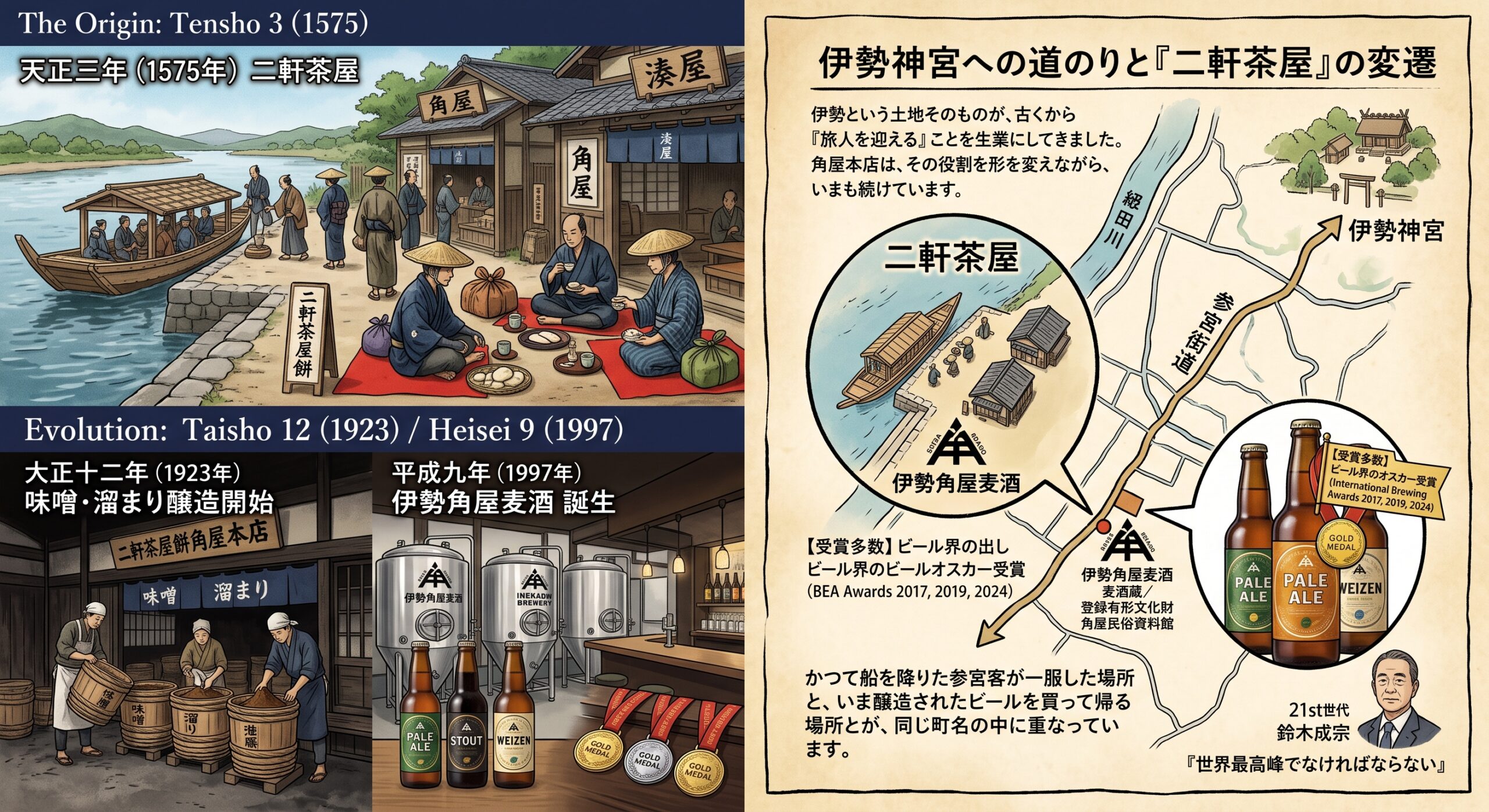
The company behind Isekado Pale Ale, Nikenjayamochi Kadoya Honten, traces back to 1575, when it opened as a single teahouse beside a boat landing on the Seta River — the port where pilgrims bound for Ise Grand Shrine came ashore. Two teahouses stood at that landing, “Kadoya” and “Minatoya,” and the area came to be known as “Nikenjaya” (“two teahouses”). Travelers would rest and eat there before setting out on the road to the shrine.
In 1923, the 18th-generation head of the family, Tokichi Suzuki, started a miso and tamari soy sauce business, which carried the company through the years of the Pacific War. The company incorporated in 1994, and in 1997 the 21st-generation head, Narihiro Suzuki, launched its craft beer venture with a stated resolve: it “had to be the best in the world.” The brewery started with three beers — Pale Ale, Stout, and Weizen.
That resolve did not stay just words. In 2003, the flagship Pale Ale won gold at the Australian International Beer Awards — the first such win for a Japanese craft beer. It has since won gold at the UK’s International Brewing Awards, often called “the Oscars of the beer world” and held once every two years, in 2017, 2019, and 2024. As a brewery, ISEKADO has taken gold at every edition of that competition from 2017 through 2024, four in a row. A shop that once served a cup of tea to travelers 450 years ago now pours beer for judges from around the world.
The Story of the Land
Isekado’s direct-sales shop, “Biyagura,” sits in the Kamiku area of central Ise City, about a 10-minute bus ride from Ise-shi Station (JR and Kintetsu lines), getting off at the “Nikenjaya” stop. Inside, visitors can buy the beers on the spot, including limited-batch brews. The place where boat pilgrims once stepped ashore to rest, and the place where people now buy freshly brewed beer to take home, sit within the same old neighborhood name.
Ise itself has long made a living from receiving travelers. Pilgrimage to Ise Grand Shrine — known as “Ise Mairi” — was a widespread aspiration for ordinary people throughout the Edo period, and teahouses and inns like Nikenjaya supported that final stretch of the journey. Kadoya Honten has kept playing that same role while changing its shape — from teahouse, to miso and soy sauce maker, to craft brewery — right up to today.
The Story of the Song
“Nagori Yuki” was released on March 12, 1974, on Sangaidate no Uta, an album by the folk group Kaguyahime. It was written and composed by band member Shozo Ise, then about 22 years old — said to be the first song he ever wrote professionally. It pictures a platform at Tokyo Station, someone seeing off another who is leaving, and a last, out-of-season snowfall that no longer settles on the tracks.
What turned the song into a nationwide hit was a cover version by the singer-songwriter Iruka, released as a single on November 5, 1975, arranged by Masataka Matsutoya. The result leaned closer to pop than folk, and it has been sung across generations ever since — today it’s often thought of as Iruka’s signature song more than Kaguyahime’s.
Shozo Ise’s real name is, in fact, Shozo Ise — but he was born in Tsukumi City, in Oita Prefecture, far from Ise Grand Shrine. He has no family ties or personal connection to Mie Prefecture or Ise City. What doesn’t change, though, is that the song was written by someone who happens to share that name.
Why This Pairing
The most obvious reason is the name itself. “Ise” in Isekado Pale Ale refers to Ise City in Mie Prefecture; the man who wrote “Nagori Yuki” is named Shozo Ise. There’s no blood tie or personal connection behind the coincidence, but it still felt like reason enough to pick this song.
There’s a deeper echo too, underneath the name. For 450 years, Nikenjaya has been a place that receives travelers and sends them on their way — first as a teahouse, then as a miso and soy sauce maker, and now as a craft brewery. The business has changed shape again and again, but the role of seeing people through and off has never changed. “Nagori Yuki” is also a song about seeing someone off on a journey. Its singer changed from Kaguyahime to Iruka, and it has been sung to different listeners for more than fifty years since. The shape changes, the singer changes, but what sits underneath stays the same. Both are stories like that.
Where to Find This Beer
The Rakuten Ichiba link below is an affiliate link.
- Brewery official site:https://www.isekado.co.jp/
- Buy on Rakuten Ichiba: View the product page (350ml, ¥396)
These are Japanese storefronts. If you are visiting the brewery, drinking it fresh at their own taproom is by far the best option.
Pairing Dishes Worth Trying
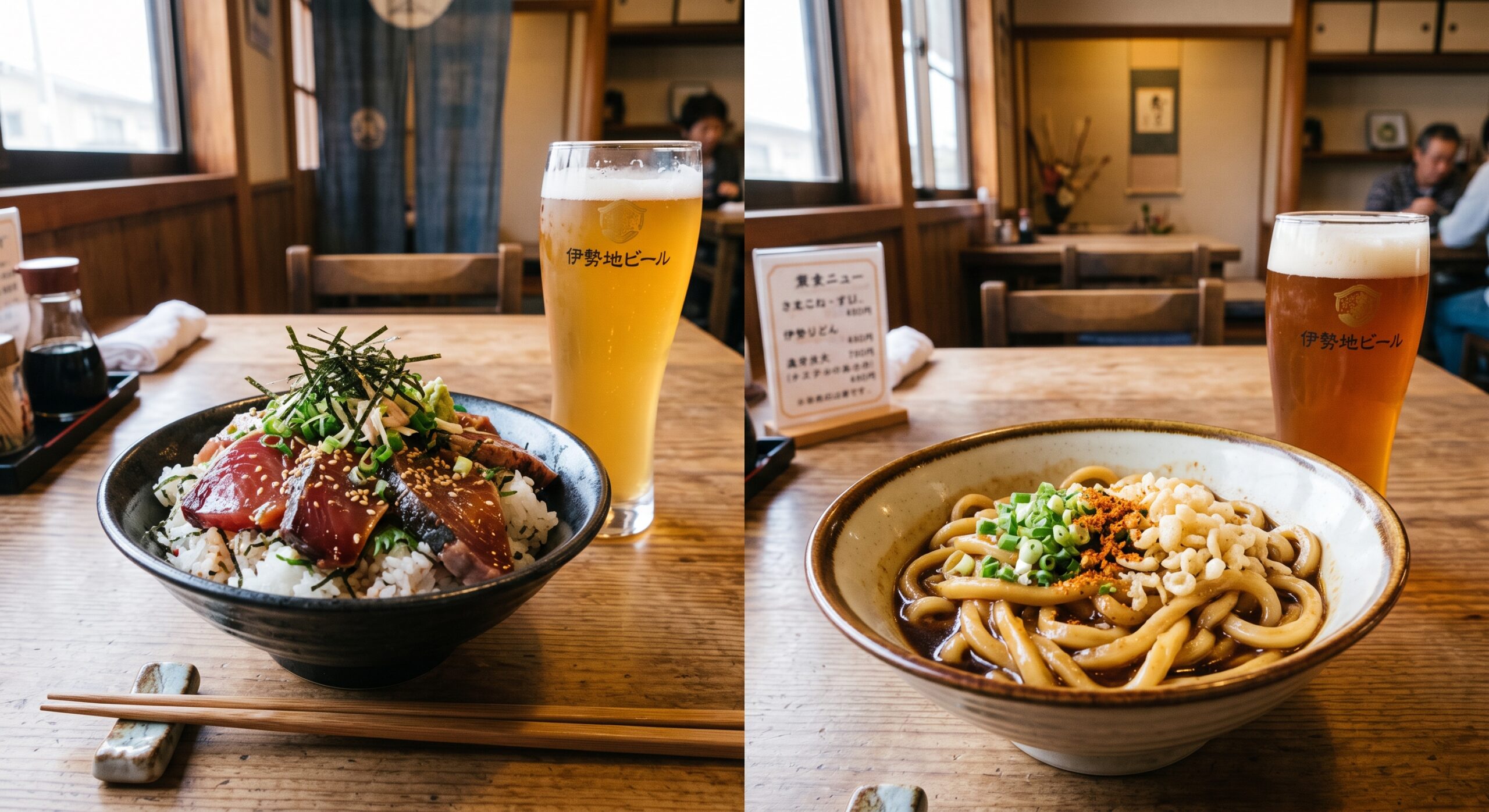
- Tekone-zushi
A fisherman’s dish from the Ise-Shima region: bonito or other red-fleshed fish marinated in a soy-based sauce and mixed with vinegared rice. The pale ale’s citrusy hop aroma and light bitterness cut cleanly through the richness of the marinade. - Ise udon
Ise’s signature noodle dish: thick, soft noodles coated in a small amount of dark, tamari-based sauce. It looks saltier than it tastes, carrying more umami and sweetness than salt, which sits well against the pale ale’s malt sweetness and bitterness.
A note on the science: the iso-alpha acids that give hops their bitterness, together with carbonation, are known to reset a palate weighed down by rich sauces or oil. The umami and saltiness in tekone-zushi’s marinade and in Ise udon’s tamari sauce come out cleaner against the pale ale’s citrus aroma and bitterness, making the next bite taste fresh again.
A Quick Glossary of Beer Terms
- Craft beer: Beer made by small breweries that put the character of the maker front and centre, as opposed to the uniformity of mass production.
- Pale ale: A pale-colored ale that balances malt sweetness with hop aroma — often considered an entry point into ales.
- Hops: The cones of a climbing plant, which give beer its bitterness and aroma. Depending on the variety, that aroma can read as citrus, tropical fruit or open grassland.
- Malt: Germinated barley. It forms the foundation of a beer’s sweetness, colour and body; how deeply it is roasted determines colour and toastiness.
- ABV: Alcohol By Volume. Around 5% is standard for beer; anything above 8% is considered a stronger, more full-bodied style.
- IBU: An international scale for measuring bitterness. Around 10 registers as barely bitter at all; above 60 puts you in clearly bitter IPA territory.
Sources
- “The History of ISEKADO,” ISEKADO (official)
- Company information, ISEKADO (official)
- Pale Ale (bottle), ISEKADO official online store
- “ISEKADO wins gold for the fourth consecutive competition at the world’s oldest international brewing awards,” Nikenjayamochi Kadoya Honten, Ltd. (official press release)
- “Nagori Yuki” — Wikipedia (Japanese)
- “Shozo Ise” — Wikipedia (Japanese)
If you notice any errors in this article, please don’t hesitate to reach out at info@soundrecords.jp.
Read this article in Japanese: 変わらずに、変わっていく