日本語で読む | This is the English version of a bilingual article.
Today’s Pairing
- Sake: Tamanohikari Junmai Ginjo “Shukon” — 100% domestic rice, rice-polishing ratio (seimai buai) 60%, 15% alcohol / Tamanohikari Shuzo Co., Ltd. (Higashi-Sakai-cho, Fushimi Ward, Kyoto City)
Official site: https://tamanohikari.co.jp/ - Kayoukyoku (classic Japanese popular song): “Ganpeki no Haha” (“Mother at the Pier”) by Futaba Yuriko, 1972
YouTube: https://www.youtube.com/watch?v=gAbJ9swls6c
▶ If the player above doesn’t play, open it on YouTube
The Story of the Brewery
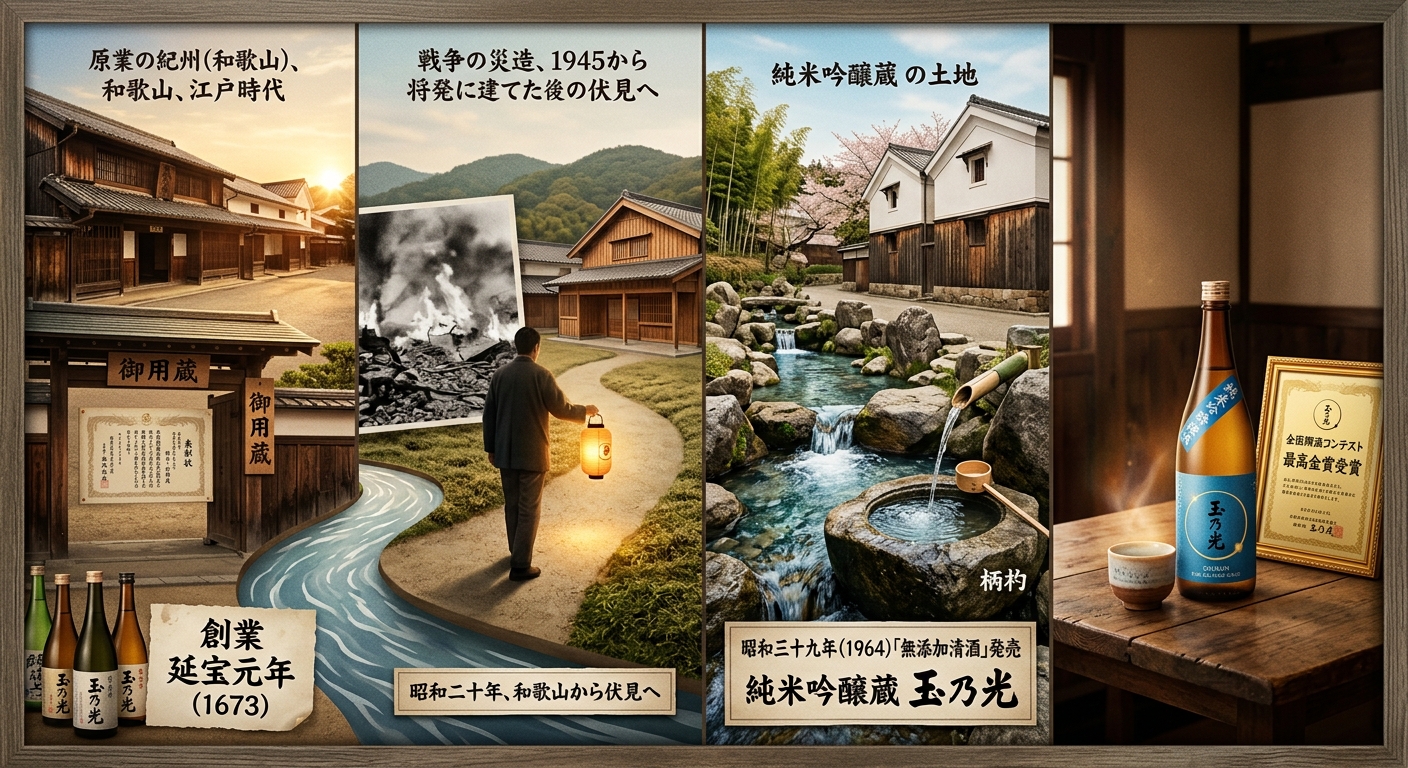
Tamanohikari Shuzo was founded in 1673 by its first-generation owner, Nakaya Rokuzaemon, in what is now Wakayama Prefecture. It operated as a goyougura — a brewery formally licensed by the ruling Tokugawa house — after receiving its brewing license from Tokugawa Mitsusada, second lord of the Kishu domain. Around twenty such Tokugawa-licensed breweries are said to have existed; today, Tamanohikari is the only one still standing. The brewery’s name, meaning “the light of the jewel,” was bestowed by the head priest of Kumano Hayatama Taisha, a shrine the Nakaya family deeply venerated, expressing a wish that the light of the divine spirit would shine through the sake.
That history nearly came to an end in 1945, when an air raid destroyed the brewery in Wakayama. Ujita Fukuji, the eleventh-generation owner, chose to rebuild in Fushimi, Kyoto, drawn by the fine underground water flowing from the Momoyama hills. From the ashes, the brewery was raised again, and the “light” carried in its name was relit in a new home.
In 1964, Tamanohikari became a pioneer in the industry, releasing a sake made with no added alcohol or sugar — what is known today as junmai sake — well ahead of most other breweries. Guided by the conviction that sake made from 100% rice is sake in its truest form, the brewery has since brewed only junmai and junmai ginjo sake, and is known today as a dedicated “junmai ginjo brewery.” Junmai Ginjo “Shukon,” the bottle in this pairing, is brewed from 100% domestic rice polished to 60%, and is one of the brewery’s best-known standards. It has twice taken the top gold prize at Japan’s National Kan-zake (warmed sake) Contest, in 2019 and 2023, and a gold prize in 2022, and is well regarded for how well it opens up when warmed.
The Story of the Land
Fushimi Ward in Kyoto City was once written with characters meaning “hidden water,” reflecting how richly it is blessed with fine groundwater. Rain that soaks into the Momoyama hills travels slowly underground for years before emerging as medium-hard water, well balanced in potassium and calcium. The saying “Nada’s sake is masculine, Fushimi’s is feminine” points to the soft, fine-grained character this water has long given the local sake. After Toyotomi Hideyoshi built Fushimi Castle, the town flourished as a crossroads of water and land routes between Kyoto and Osaka, and its brewing industry grew alongside that abundant water.
The water that flows here is rain that fell on the hills, spent years changing shape underground, and eventually returned to the surface as clear spring water. The way the brewery, having relocated from the ashes of war, was guided by this water back toward sake in its truest form echoes something already present in Fushimi itself — the quiet presence of things that return, in their own time.
The Story of the Song
“Ganpeki no Haha” is based on a real woman. Hashino Ise (1899–1981) sent off her adopted son, Shinji, from their home in Tokyo. In 1944, Shinji went to Manchuria and joined a Kanto Army training unit, and went missing amid the Soviet invasion. After the war, from her home in Omori, Tokyo, Ise stood at the pier in Maizuru, Kyoto Prefecture, every time a repatriation ship came in, for six years starting in January 1950.
Maizuru was one of postwar Japan’s principal repatriation ports, receiving more than 660,000 returnees from former Manchuria, the Korean peninsula, and Siberia. The sight of families reuniting on the pier, alongside those still searching for their own, gave rise to the phrases “the mother at the pier” and “the wife at the pier.” Some of the historical records related to this repatriation were inscribed on UNESCO’s Memory of the World register in 2015.
This mother’s story became the song “Ganpeki no Haha,” with lyrics by Fujita Masato and music by Hirakawa Nameryu. Kikuchi Akiko first recorded it in 1954. On February 5, 1972, Futaba Yuriko released a cover on King Records, reworked as a “kayou-rokyoku” — a popular song woven with spoken narration. Her version became a long-running hit, reaching number 3 on the weekly Oricon chart and number 5 on the 1976 annual chart. That same year it received the Judges’ Selection Award at the Japan Record Awards, and Futaba made her first appearance on NHK’s Kohaku Uta Gassen.
Why This Pairing
Both Tamanohikari and “Ganpeki no Haha” tell of something nearly severed by war. Having lost its Wakayama brewery to an air raid, Tamanohikari rebuilt itself, guided by the water of Fushimi, and nineteen years later arrived at a sake restored to its original, unaltered form. Ise, meanwhile, spent six years standing at the Maizuru pier, holding to her belief that her son would return. Two stories, shaped differently, set within the same postwar span of years.
The name “Tamanohikari” itself was born from a prayer that a divine light would shine through. That the brewery, having lost everything, relit that very light is a story that sits quietly alongside a mother who kept believing in the safe return of someone she loved. The sake’s own name, “Shukon” — the soul, or spirit, of sake — feels less about surface brilliance than about something that goes on quietly residing within.
Where to Find This Bottle
The Rakuten Ichiba link below is an affiliate link.
- Brewery’s official site: https://tamanohikari.co.jp/
- Buy on Rakuten Ichiba: View the product page (720ml, ¥1,820)
Note: both Rakuten and Amazon links above lead to Japan-based retailers. They’re most convenient for readers in Japan, or for those elsewhere who are able to arrange international shipping. Stock and availability change over time, so if you’re near a specialty sake shop, it’s well worth asking for this label by name.
Pairing Dishes Worth Trying
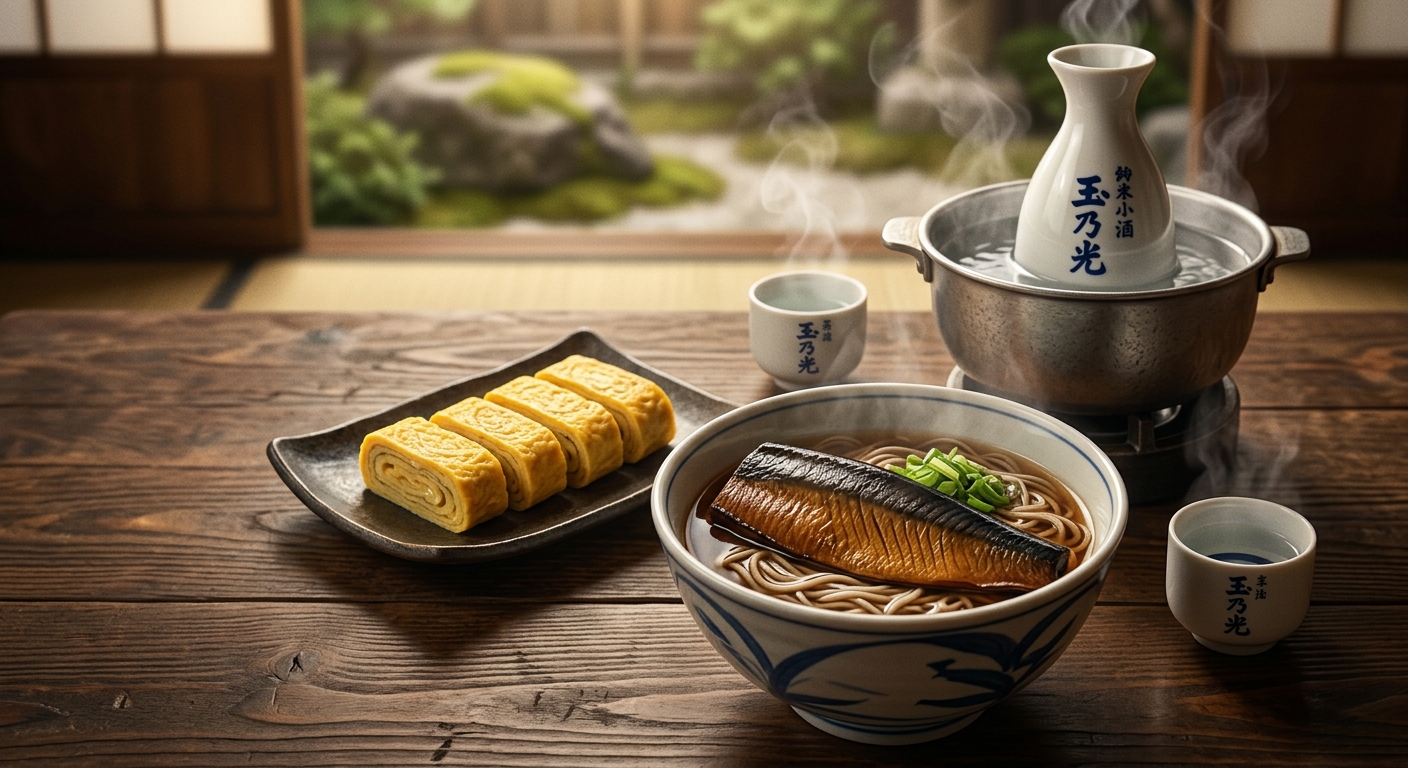
- Dashimaki tamago (dashi-rolled omelette)
A staple of the Kyoto table. The refined savoriness of the dashi broth and its gentle sweetness echo quietly against the rice-derived umami of a warmed junmai ginjo, with neither one crowding out the other.
Recipe (in Japanese): Kurashiru, “Dashimaki Tamago” - Nishin soba (herring soba)
Kyoto’s signature noodle dish, devised in 1882 by the second-generation owner of the restaurant Matsuba, who paired dried herring — shipped in from distant Hokkaido aboard kitamaebune trading vessels — with soba noodles. A dish born from welcoming something that traveled a long way pairs naturally with the gentle warmth of kan-zake.
Recipe (in Japanese): Cookpad, “Nishin Soba”
A note on the science: warming sake makes its aromatic compounds more expressive and heightens the perceived umami of its rice-derived amino acids. The glutamate-rich umami in dashi — whether in a rolled omelette or a bowl of soba broth — layers with that umami in the warmed sake, and the two together stretch out the lingering finish on the palate.
Visiting the Brewery
Tamanohikari Sake Brewery
545-2 Higashi-sakai-cho, Fushimi Ward, Kyoto. About a 10-min walk from Tanbabashi Station (Keihan / Kintetsu), or 8 min from Fushimi-momoyama Station (Keihan).
It sits in the district where Fushimi’s sake breweries cluster.
Sights Nearby
- Gekkeikan Okura Sake Museum / Fushimi Ward | ~7-min walk (~450 m) from the brewery
A museum in a 1909 brewery building, with exhibits on Fushimi sake-making and a tasting corner (9:30-16:30, last entry 16:00; closed mid-August and New Year). - Teradaya / Fushimi Ward | ~8-min walk from the brewery
The boatmen’s inn Sakamoto Ryoma used as his base, famous as the scene of a Bakumatsu-era incident; open to visitors inside. - Fushimi Inari Taisha / Fushimi Ward | ~10 min, ~3 km by car from the brewery
The head shrine of all Inari shrines, known for its thousands of vermilion torii gates. The grounds are open at all hours.
Hot Springs Nearby
- Natural hot spring Fushimi Chikara-no-yu / Fushimi Ward (~5-min walk from Takeda Station) | ~10 min, ~3 km by car from the brewery
A large bathhouse with an open-air natural hot spring and saunas. Sun-Thu 10:00-23:00, Fri-Sat until 24:00, open almost year-round.
Opening hours, closing days and day-use bathing availability can change. Please check each facility’s official information before visiting.
A Quick Glossary of Sake Terms
- Junmai: Sake made only from rice, rice koji, and water, with no added brewing alcohol. Its flavor carries the straightforward umami of rice.
- Junmai Ginjo: A junmai sake made from rice milled down to 60% or less of its original size and fermented slowly at low temperatures. Known for its fragrant, floral aroma.
- Seimai buai (rice-polishing ratio): The percentage of the original grain remaining after milling. The lower the number, the more the rice has been polished down.
Sources
- Tamanohikari Shuzo – Official Site
- Company Profile – Tamanohikari Shuzo Official Site
- Junmai Ginjo “Shukon” – Tamanohikari Shuzo Official Site
- Ganpeki no Haha – Wikipedia (Japanese)
- Futaba Yuriko – Wikipedia (Japanese)
- Maizuru Repatriation Memorial Museum – UNESCO Memory of the World Registration
If you notice any errors in this article, please don’t hesitate to reach out at info@soundrecords.jp.
Read this article in Japanese: すべてを失っても、光は消えなかった