今日のペアリング
▶ 上のプレーヤーで再生できない場合は、YouTubeで開く
酒蔵の話
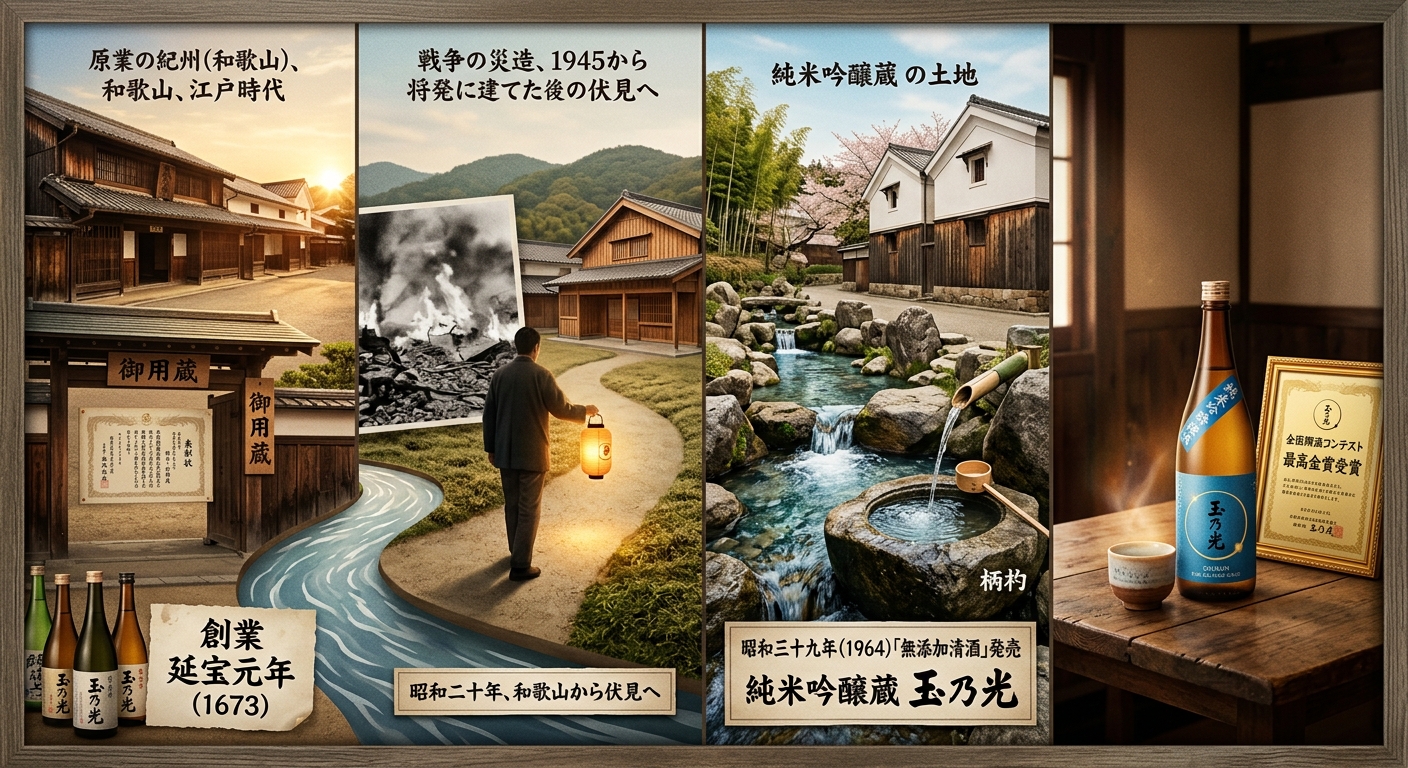
玉乃光酒造の創業は延宝元年(1673年)。初代・中屋六左衛門が紀州(現在の和歌山県)で興した蔵で、紀州藩2代目藩主・徳川光貞公から酒造免許を賜った「御用蔵」でした。徳川家が公に認めたこうした御用蔵はかつて二十ほどあったとされますが、今日まで残っているのは玉乃光ただ一蔵だといいます。酒銘「玉乃光」は、中屋家が篤く帰依していた熊野速玉大社の宮司から拝受したもので、御霊の光が映えるようにという願いが込められています。
その歴史は、昭和20年(1945年)に一度途切れかけました。空襲によって和歌山の蔵はすべてを失います。新天地を求めた十一代当主・宇治田福時が選んだのが、桃山丘陵の良質な伏流水に恵まれた京都・伏見でした。焼け跡から蔵を再建し、酒銘に込められた「光」を、場所を変えてもう一度灯し直したのです。
そして昭和39年(1964年)、玉乃光は業界に先駆けて、アルコールや糖類を添加しない「無添加清酒」=今日でいう純米酒を発売します。米100%こそが日本酒本来の姿だという信念のもと、以来一貫して純米酒・純米吟醸酒だけを造り続ける「純米吟醸蔵」として知られています。今回合わせる「純米吟醸 酒魂」は、国産米100%・精米歩合60%で醸した、蔵の大定番。全国燗酒コンテストでは2019年と2023年に最高金賞、2022年には金賞を受賞しており、燗をつけたときの伸びのよさに定評があります。
土地の話
蔵のある京都市伏見区は、かつて「伏水」とも書かれたほど、良質な地下水に恵まれた土地です。桃山丘陵に染み込んだ雨水が長い年月をかけて地中を巡り、カリウムやカルシウムをバランスよく含む中硬水として湧き出します。「灘の男酒、伏見の女酒」と並び称されるように、きめ細やかで柔らかな味わいの酒を育ててきました。豊臣秀吉が伏見城を築いてからは、京都・大坂を結ぶ水陸交通の要衝として町が栄え、水の豊かさを背景に酒造業も発展していきました。
この地に流れる水は、山に降った雨が地中でゆっくり時間をかけて姿を変え、やがて澄んだ湧き水として地上に戻ってくるものです。焼け跡から移り住んだ蔵が、この水に導かれるようにして「本来の酒」を取り戻していった歩みは、伏見という土地そのものが持つ、時間をかけて還ってくるものの気配と重なります。
音楽の話
「岸壁の母」には、実在のモデルがいます。端野いせさん(1899〜1981年)は、養子に迎えた息子・新二さんを東京から送り出しました。新二さんは昭和19年(1944年)に満州へ渡り、関東軍の教育隊に入りますが、ソ連軍の侵攻の中、消息を絶ちます。終戦後、いせさんは東京・大森の自宅から、昭和25年(1950年)1月以降の6年間、引揚船が入港するたびに京都府舞鶴市の岸壁に立ち続けました。
舞鶴は、旧満州や朝鮮半島、シベリアからの引揚者66万人余りを迎え入れた、戦後日本を代表する引揚港です。港で肉親と再会する人たちと、その傍らでなお家族の姿を捜し続ける人たちの様子は、いつしか「岸壁の母」「岸壁の妻」と呼ばれるようになりました。当時の引揚に関する資料の一部は、平成27年(2015年)にユネスコ「世界の記憶」にも登録されています。
この母の姿を歌にしたのが「岸壁の母」です。作詞・藤田まさと、作曲・平川浪竜。昭和29年(1954年)に菊池章子が最初に歌い、昭和47年(1972年)2月5日、二葉百合子が台詞を交えた「歌謡浪曲」としてカバーし、キングレコードから発売しました。この二葉百合子版がロングヒットとなり、オリコン週間チャートで最高3位、昭和51年(1976年)には年間5位を記録。同年の日本レコード大賞審査員会選奨受賞、NHK紅白歌合戦にも初出場を果たしています。
なぜこの組み合わせなのか
玉乃光も「岸壁の母」も、戦争によって断ち切られかけたものを描いています。空襲で和歌山の蔵を失った玉乃光は、伏見の水に導かれて酒を再建し、19年後には「本来の純米酒」を取り戻すところまでたどり着きました。一方、いせさんは6年もの間、舞鶴の岸壁で息子の帰りを信じて待ち続けました。同じ戦後の時間の中に、形を変えて置かれたふたつの物語です。
「玉乃光」という名前そのものが、御霊の光が映えるようにという祈りから生まれたものでした。すべてを失ってもなお、その名の通りに光を灯し直した蔵の歩みは、大切な人の無事を信じて待ち続けた母の姿と、静かに重なります。純米吟醸「酒魂」という酒名も、表面的な華やかさよりも、内に宿り続けるものを指す言葉のように感じられます。
この一本を、探すなら
※楽天市場へのリンクは広告(アフィリエイト)です。在庫・取扱いは変動します。お近くの酒販店でも、ぜひ銘柄名を伝えて探してみてください。
🌡️ おすすめの飲み方:常温から、ぬる燗(40℃前後)で。全国燗酒コンテストで最高金賞を2度受賞した実力どおり、温めることで米の旨みと穏やかな酸がふわりと広がります。もちろん、よく冷やして食前酒のように楽しむのもおすすめです。
合わせたい「アテ」
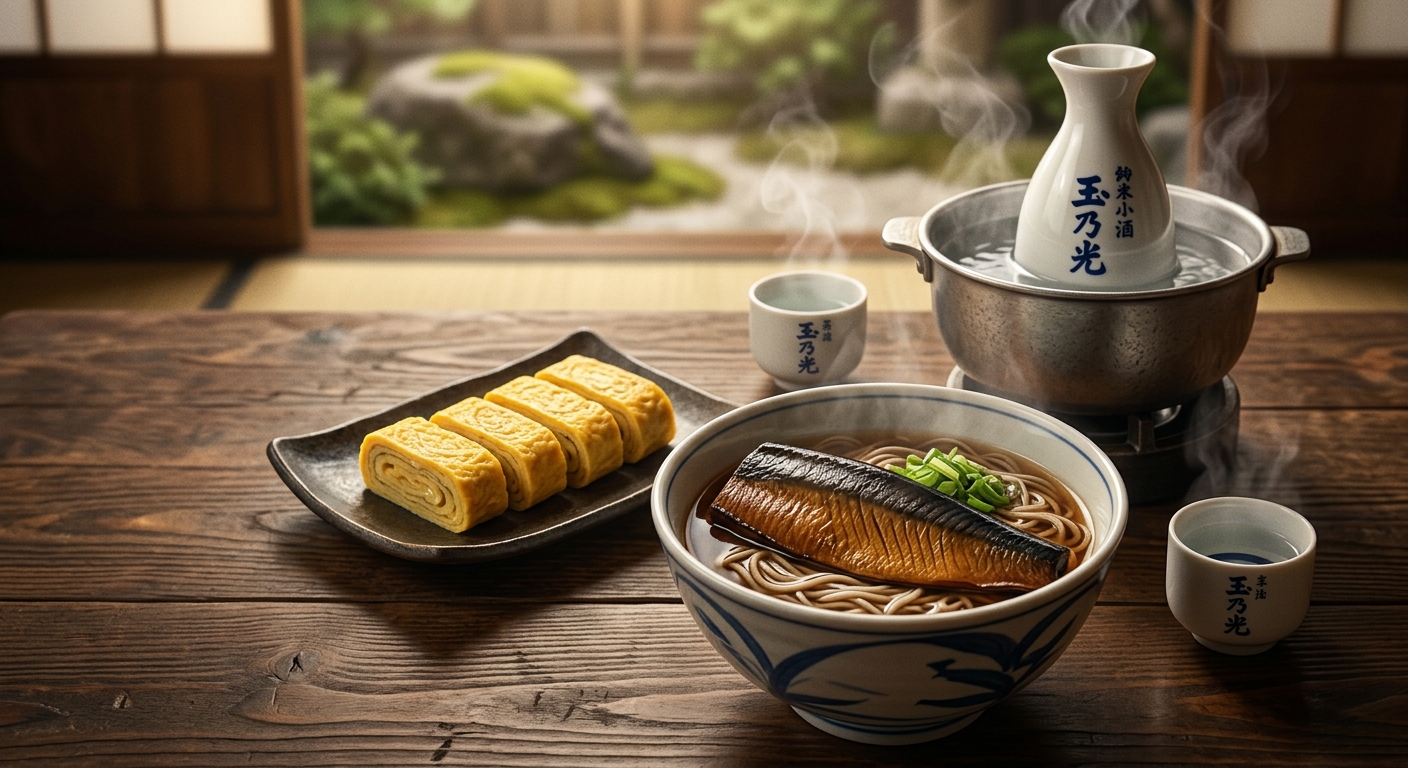
- だし巻き玉子
京都の食卓に欠かせない一品。出汁の上品な旨みとふんわりした甘みが、燗をつけた純米吟醸の米の旨みと静かに響き合い、どちらの輪郭も邪魔しません。
レシピはこちら:クラシル「だし巻き玉子」
- にしんそば
明治15年(1882年)、京都・松葉の2代目が、北前船で遠く北海道から運ばれてきた身欠きニシンを蕎麦に合わせて考案した、京都を代表する一杯です。遠くから届いたものを迎え入れて生まれた料理は、燗酒のやさしい温もりとよく合います。
レシピはこちら:クックパッド「にしんそば」
科学的にひとこと:日本酒は温度を上げると香気成分が立ちやすくなり、米由来のアミノ酸(旨み成分)の感じ方もふくらみます。だし巻き玉子やにしんそばの出汁に含まれるグルタミン酸系の旨みと、燗酒の旨みが重なり合うことで、口の中での余韻がより長く感じられます。
この蔵をたずねるなら
玉乃光酒造
京都市伏見区東堺町545-2/京阪・近鉄「丹波橋駅」から徒歩約10分、京阪「伏見桃山駅」から徒歩約8分。
伏見の酒蔵が集まる一帯にあります。
近くの観光スポット
- 月桂冠大倉記念館/伏見区南浜町|蔵から徒歩約7分(約450m)
1909年建造の酒蔵を使った史料館。伏見の酒造りの歴史を展示し、きき酒もできます(9:30〜16:30、入館受付16:00、盆・年末年始休)。
- 寺田屋/伏見区南浜町|蔵から徒歩約8分
坂本龍馬が定宿にした船宿。幕末の事件の舞台として知られ、内部を見学できます。
- 伏見稲荷大社/伏見区深草|蔵から車で約10分・約3km
千本鳥居で知られる、稲荷神社の総本宮。境内は終日参拝できます。
近くの温泉
- 天然温泉 伏見 力の湯/伏見区中島(竹田駅から徒歩約5分)|蔵から車で約10分・約3km
露天の天然温泉やサウナがそろうスーパー銭湯。日〜木10:00〜23:00、金土は24:00まで、ほぼ年中無休です。
※営業時間・定休日・日帰り入浴の可否は変わることがあります。おでかけ前に各施設の公式情報をご確認ください。
ひとことメモ(日本酒の用語)
- 純米酒:米・米麹・水だけで造られ、醸造アルコールを添加していない日本酒。米の旨みをまっすぐ感じられるのが特徴です。
- 純米吟醸酒:精米歩合60%以下まで磨いた米を低温でじっくり発酵させた純米酒。華やかな香りが特徴です。
- 精米歩合:玄米を削り、残った部分の割合。数値が低いほど、米を多く磨いていることを示します。
参考
内容に誤りがございましたら、お手数ですが info@soundrecords.jp までご連絡いただけますと幸いです。
Today’s Pairing
- Sake: Tamanohikari Junmai Ginjo “Shukon” — 100% domestic rice, rice-polishing ratio (seimai buai) 60%, 15% alcohol / Tamanohikari Shuzo Co., Ltd. (Higashi-Sakai-cho, Fushimi Ward, Kyoto City)
Official site: https://tamanohikari.co.jp/
- Kayoukyoku (classic Japanese popular song): “Ganpeki no Haha” (“Mother at the Pier”) by Futaba Yuriko, 1972
YouTube: https://www.youtube.com/watch?v=gAbJ9swls6c
▶ If the player above doesn’t play, open it on YouTube
The Story of the Brewery
Tamanohikari Shuzo was founded in 1673 by its first-generation owner, Nakaya Rokuzaemon, in what is now Wakayama Prefecture. It operated as a goyougura — a brewery formally licensed by the ruling Tokugawa house — after receiving its brewing license from Tokugawa Mitsusada, second lord of the Kishu domain. Around twenty such Tokugawa-licensed breweries are said to have existed; today, Tamanohikari is the only one still standing. The brewery’s name, meaning “the light of the jewel,” was bestowed by the head priest of Kumano Hayatama Taisha, a shrine the Nakaya family deeply venerated, expressing a wish that the light of the divine spirit would shine through the sake.
That history nearly came to an end in 1945, when an air raid destroyed the brewery in Wakayama. Ujita Fukuji, the eleventh-generation owner, chose to rebuild in Fushimi, Kyoto, drawn by the fine underground water flowing from the Momoyama hills. From the ashes, the brewery was raised again, and the “light” carried in its name was relit in a new home.
In 1964, Tamanohikari became a pioneer in the industry, releasing a sake made with no added alcohol or sugar — what is known today as junmai sake — well ahead of most other breweries. Guided by the conviction that sake made from 100% rice is sake in its truest form, the brewery has since brewed only junmai and junmai ginjo sake, and is known today as a dedicated “junmai ginjo brewery.” Junmai Ginjo “Shukon,” the bottle in this pairing, is brewed from 100% domestic rice polished to 60%, and is one of the brewery’s best-known standards. It has twice taken the top gold prize at Japan’s National Kan-zake (warmed sake) Contest, in 2019 and 2023, and a gold prize in 2022, and is well regarded for how well it opens up when warmed.
The Story of the Land
Fushimi Ward in Kyoto City was once written with characters meaning “hidden water,” reflecting how richly it is blessed with fine groundwater. Rain that soaks into the Momoyama hills travels slowly underground for years before emerging as medium-hard water, well balanced in potassium and calcium. The saying “Nada’s sake is masculine, Fushimi’s is feminine” points to the soft, fine-grained character this water has long given the local sake. After Toyotomi Hideyoshi built Fushimi Castle, the town flourished as a crossroads of water and land routes between Kyoto and Osaka, and its brewing industry grew alongside that abundant water.
The water that flows here is rain that fell on the hills, spent years changing shape underground, and eventually returned to the surface as clear spring water. The way the brewery, having relocated from the ashes of war, was guided by this water back toward sake in its truest form echoes something already present in Fushimi itself — the quiet presence of things that return, in their own time.
The Story of the Song
“Ganpeki no Haha” is based on a real woman. Hashino Ise (1899–1981) sent off her adopted son, Shinji, from their home in Tokyo. In 1944, Shinji went to Manchuria and joined a Kanto Army training unit, and went missing amid the Soviet invasion. After the war, from her home in Omori, Tokyo, Ise stood at the pier in Maizuru, Kyoto Prefecture, every time a repatriation ship came in, for six years starting in January 1950.
Maizuru was one of postwar Japan’s principal repatriation ports, receiving more than 660,000 returnees from former Manchuria, the Korean peninsula, and Siberia. The sight of families reuniting on the pier, alongside those still searching for their own, gave rise to the phrases “the mother at the pier” and “the wife at the pier.” Some of the historical records related to this repatriation were inscribed on UNESCO’s Memory of the World register in 2015.
This mother’s story became the song “Ganpeki no Haha,” with lyrics by Fujita Masato and music by Hirakawa Nameryu. Kikuchi Akiko first recorded it in 1954. On February 5, 1972, Futaba Yuriko released a cover on King Records, reworked as a “kayou-rokyoku” — a popular song woven with spoken narration. Her version became a long-running hit, reaching number 3 on the weekly Oricon chart and number 5 on the 1976 annual chart. That same year it received the Judges’ Selection Award at the Japan Record Awards, and Futaba made her first appearance on NHK’s Kohaku Uta Gassen.
Why This Pairing
Both Tamanohikari and “Ganpeki no Haha” tell of something nearly severed by war. Having lost its Wakayama brewery to an air raid, Tamanohikari rebuilt itself, guided by the water of Fushimi, and nineteen years later arrived at a sake restored to its original, unaltered form. Ise, meanwhile, spent six years standing at the Maizuru pier, holding to her belief that her son would return. Two stories, shaped differently, set within the same postwar span of years.
The name “Tamanohikari” itself was born from a prayer that a divine light would shine through. That the brewery, having lost everything, relit that very light is a story that sits quietly alongside a mother who kept believing in the safe return of someone she loved. The sake’s own name, “Shukon” — the soul, or spirit, of sake — feels less about surface brilliance than about something that goes on quietly residing within.
Where to Find This Bottle
The Rakuten Ichiba link below is an affiliate link.
Note: both Rakuten and Amazon links above lead to Japan-based retailers. They’re most convenient for readers in Japan, or for those elsewhere who are able to arrange international shipping. Stock and availability change over time, so if you’re near a specialty sake shop, it’s well worth asking for this label by name.
🌡️ Recommended way to drink it: From room temperature up to a gentle “nurukan” warmth (around 40°C/104°F). True to its two top gold prizes at Japan’s National Kan-zake Contest, warming it lets the rice’s umami and its mild acidity unfold. It’s just as good served well chilled, as an aperitif.
Pairing Dishes Worth Trying
- Dashimaki tamago (dashi-rolled omelette)
A staple of the Kyoto table. The refined savoriness of the dashi broth and its gentle sweetness echo quietly against the rice-derived umami of a warmed junmai ginjo, with neither one crowding out the other.
Recipe (in Japanese): Kurashiru, “Dashimaki Tamago”
- Nishin soba (herring soba)
Kyoto’s signature noodle dish, devised in 1882 by the second-generation owner of the restaurant Matsuba, who paired dried herring — shipped in from distant Hokkaido aboard kitamaebune trading vessels — with soba noodles. A dish born from welcoming something that traveled a long way pairs naturally with the gentle warmth of kan-zake.
Recipe (in Japanese): Cookpad, “Nishin Soba”
A note on the science: warming sake makes its aromatic compounds more expressive and heightens the perceived umami of its rice-derived amino acids. The glutamate-rich umami in dashi — whether in a rolled omelette or a bowl of soba broth — layers with that umami in the warmed sake, and the two together stretch out the lingering finish on the palate.
Visiting the Brewery
Tamanohikari Sake Brewery
545-2 Higashi-sakai-cho, Fushimi Ward, Kyoto. About a 10-min walk from Tanbabashi Station (Keihan / Kintetsu), or 8 min from Fushimi-momoyama Station (Keihan).
It sits in the district where Fushimi’s sake breweries cluster.
Sights Nearby
- Gekkeikan Okura Sake Museum / Fushimi Ward | ~7-min walk (~450 m) from the brewery
A museum in a 1909 brewery building, with exhibits on Fushimi sake-making and a tasting corner (9:30-16:30, last entry 16:00; closed mid-August and New Year).
- Teradaya / Fushimi Ward | ~8-min walk from the brewery
The boatmen’s inn Sakamoto Ryoma used as his base, famous as the scene of a Bakumatsu-era incident; open to visitors inside.
- Fushimi Inari Taisha / Fushimi Ward | ~10 min, ~3 km by car from the brewery
The head shrine of all Inari shrines, known for its thousands of vermilion torii gates. The grounds are open at all hours.
Hot Springs Nearby
- Natural hot spring Fushimi Chikara-no-yu / Fushimi Ward (~5-min walk from Takeda Station) | ~10 min, ~3 km by car from the brewery
A large bathhouse with an open-air natural hot spring and saunas. Sun-Thu 10:00-23:00, Fri-Sat until 24:00, open almost year-round.
Opening hours, closing days and day-use bathing availability can change. Please check each facility’s official information before visiting.
A Quick Glossary of Sake Terms
- Junmai: Sake made only from rice, rice koji, and water, with no added brewing alcohol. Its flavor carries the straightforward umami of rice.
- Junmai Ginjo: A junmai sake made from rice milled down to 60% or less of its original size and fermented slowly at low temperatures. Known for its fragrant, floral aroma.
- Seimai buai (rice-polishing ratio): The percentage of the original grain remaining after milling. The lower the number, the more the rice has been polished down.
Sources
If you notice any errors in this article, please don’t hesitate to reach out at info@soundrecords.jp.
コメントを残す