日本語で読む | This is the English version of a bilingual article.
Today’s Pairing
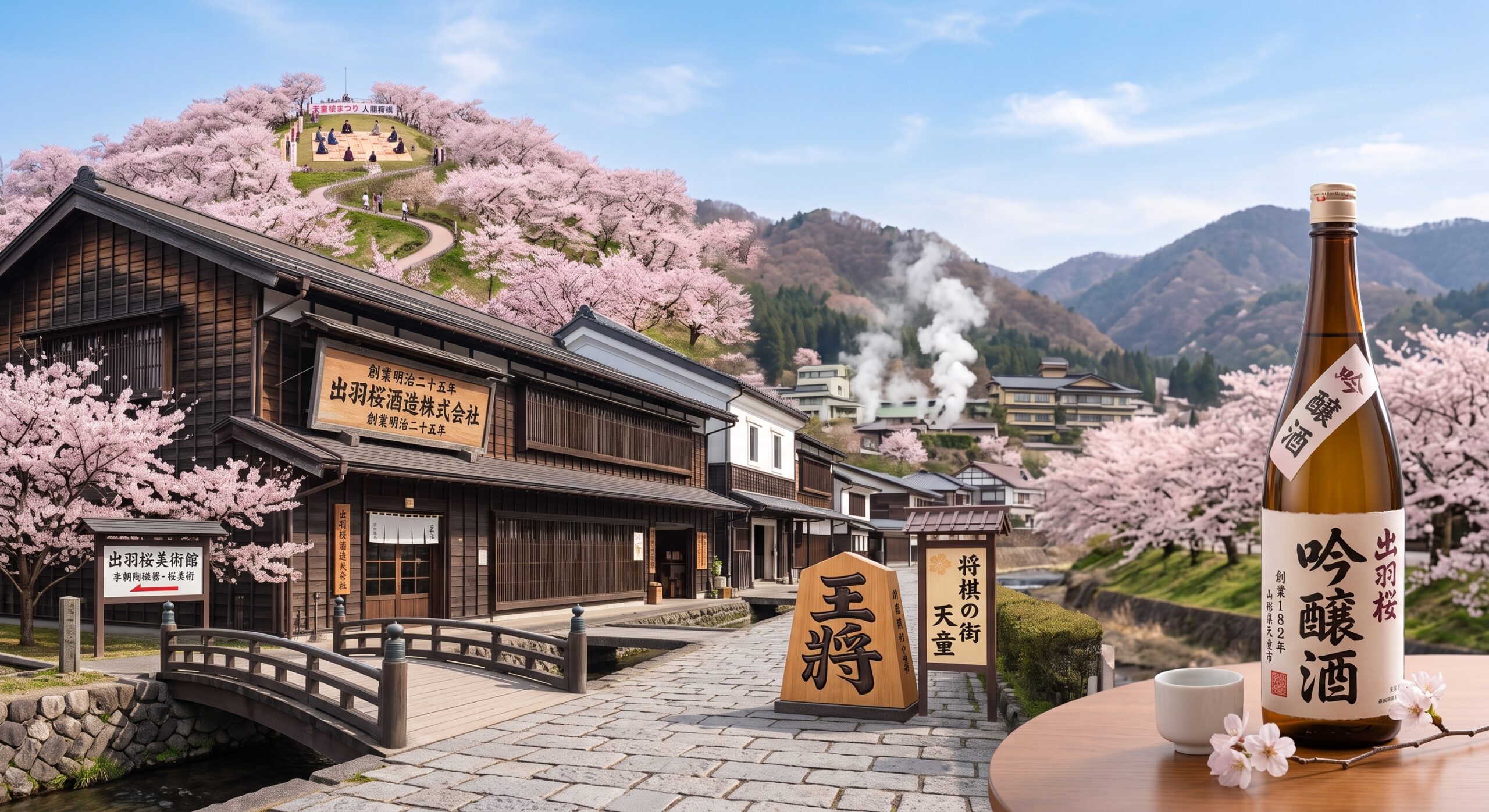
- Sake: Dewazakura “Oka Ginjo” (Cherry Blossom Ginjo) — rice-polishing ratio (seimai buai) 50%, 15% alcohol / Dewazakura Sake Brewery Co., Ltd. (4-6 Ichinichi-cho 1-chome, Tendo City, Yamagata Prefecture)
Official site: https://www.dewazakura.co.jp/ - Kayoukyoku (classic Japanese popular song): “Yoake no Uta” (“Song of the Dawn”) by Kishi Yoko, 1964
YouTube: https://www.youtube.com/watch?v=BVzv59DulGI
▶ If the player above doesn’t play, open it on YouTube
The Story of the Brewery

The history of Dewazakura Sake Brewery Co., Ltd. goes back to November 1892, when the first-generation Nakano Seijiro began brewing sake in Tendo City, Yamagata Prefecture. Seijiro was still only ten years old at the start of the Meiji era in 1868; he later took over as brewery owner, and the brewery’s early sake was sold under the name “Shirakume” — “shira” (white) for rice, “ume” (plum) for good fortune. Because other breweries around the country used the same name, as its market grew the brewery unified its label under “Dewazakura”: “Dewa” for the old Dewa Province the founder felt tied to, and “sakura” (cherry blossom) for Mt. Maizuru, the hill that symbolizes Tendo, in bloom each spring.
A turning point came in 1980. At the time, ginjo — sake brewed from rice polished to at least 60% of its original size and fermented slowly at low temperatures for a fragrant aroma — was a term barely known outside sake competitions, where it was primarily made. When sold at all, it was treated as a special, expensive gift item. Wanting “as many people as possible to drink it,” Dewazakura drew on its long experience with ginjo brewing and released “Oka Ginjo,” deliberately priced below the top-grade sake of the era. Because the word “ginjo” itself was still unfamiliar to most drinkers, the brewery printed “Ginjo-shu” in large letters at the center of the label instead of the product name — a design that remains unchanged today. Its fruity aroma and light, clean taste quickly built a reputation, and this single bottle helped set off what later became known across Japan as the “ginjo boom.”
The Story of the Land
Tendo City, home to the brewery, is known as the “town of shogi pieces,” producing roughly 90% of Japan’s shogi pieces. The craft is said to trace back to the late Edo period, when Yoshida Daihachi, a steward of the Tendo-Oda domain, encouraged impoverished samurai retainers to make shogi pieces as a means of support. It’s now designated a national traditional craft.
Mt. Maizuru, the hill that gave the brewery its name, is a small mountain clearly visible from central Tendo, covered in cherry blossoms each spring. The brewery’s former main residence still stands right beside it, now open to the public as the “Dewazakura Museum of Art,” where visitors can walk straight from the brewery to view Joseon-era ceramics and cherry-blossom-themed art. Inns of Tendo Onsen cluster near the station as well — a small basin town that quietly holds three identities at once: a sake town, a shogi town, and a hot-spring town.
The Story of the Song
“Yoake no Uta” was released on September 1, 1964, a single by Kishi Yoko. The lyrics are by Iwatani Tokiko, the music and arrangement by Izumi Taku. Its melody began as a theme song Izumi wrote for the TV musical “Kiri Awaku,” broadcast on NHK General TV on March 19, 1962. Kishi’s performance won her the Best Vocal Performance award at the 6th Japan Record Awards that year, and Iwatani won the award for lyrics; by May 1965, the single had sold 640,000 copies.
Kishi Yoko was born in 1935 in Sakata City, Yamagata Prefecture, under the name Oyama Yoko. She studied vocal music in the graduate program at Tokyo University of the Arts, initially aiming to become an opera singer, but a change in health redirected her path. In 1959 she passed an NHK audition and began working as a chanson singer, signed with King Records in 1961, and made her formal debut in 1962 with the single “Tawamurenaide.” At a time when the word “chanson” itself was still unfamiliar to most Japanese listeners, “Yoake no Uta” became the turning point that made Kishi Yoko a household name. On the strength of the song, she went on to appear on NHK’s Kohaku Uta Gassen for seven consecutive years, from 1964 to 1971.
Why This Pairing
In 1980, “Oka Ginjo” took ginjo — until then known mainly through competitions and gift-giving — and, by pricing it below the top-grade sake of the day, pulled it into everyday drinking. It was a quiet dawn that brought a fragrant sake once reserved for specialists into ordinary evenings.
“Yoake no Uta” (“Song of the Dawn”) was a dawn of its own, for one singer. Kishi Yoko, who had once aimed for opera and was then working in the still little-known genre of chanson, gained nationwide recognition through this single, going on to stand on the Kohaku stage for seven years running.
Neither began with a loud declaration or a grand scheme. A brewery’s simple wish that “as many people as possible” could drink its finest sake, and one carefully honed voice. A quiet cup and a quiet song, each bringing a new dawn to its own small world. A sake born in Tendo, Yamagata, and a singer born in Sakata, Yamagata — two dawns meeting within the same prefecture.
Where to Find This Bottle
The Rakuten Ichiba link below is an affiliate link.
- Brewery’s official site: https://www.dewazakura.co.jp/
- Buy on Rakuten Ichiba: View the product page (720ml, ¥1,650)
Note: the links above lead to Japan-based retailers. They’re most convenient for readers in Japan, or for those elsewhere who are able to arrange international shipping. Stock and availability change over time, so if you’re near a specialty sake shop, it’s well worth asking for this label by name.
Pairing Dishes Worth Trying

- Yamagata inland-style imoni
Yamagata’s signature regional dish: beef and taro simmered sukiyaki-style in a sweet soy sauce broth. The tender taro and rich beef umami pair naturally with the fruity aroma of Oka Ginjo.
Recipe (in Japanese): Kurashiru, “Homemade Yamagata Inland-Style Imoni” - Yamagata dashi with summer vegetables
A local specialty of finely chopped cucumber, eggplant, myoga ginger, and shiso, tossed with soy sauce and bonito flakes. Its bright, herbaceous aroma and crisp texture bring out the fragrant ginjo aroma with a cool, refreshing edge.
Recipe (in Japanese): Kurashiru, “Summer Vegetable Yamagata Dashi”
A note on the science: the sweet soy sauce in imoni highlights the richness of the beef fat, while the ginjo’s characteristic apple- and melon-like aroma compounds (such as ethyl caproate) cut through and refresh the palate. The green, herbaceous aroma of cucumber and myoga in Yamagata dashi shares the same “highly volatile aroma compound” character as the ginjo’s own fragrance, so the two resonate together for a cool, clean finish.
Visiting the Brewery
Dewazakura Sake Brewery Co., Ltd.
4-6 Ichinichi-cho 1-chome, Tendo City, Yamagata. About a 15–20 min walk from JR Tendo Station; about 10 min by car from the Tendo IC on the Tohoku Chuo Expressway.
The “Dewazakura Museum of Art,” housed in the brewery’s former main residence, sits right next door.
Sights Nearby
- Dewazakura Museum of Art / Ichinichi-cho, Tendo | ~1 min on foot from the brewery
A museum inside the brewery’s former main residence (a nationally registered tangible cultural property), displaying Joseon-era ceramics, works from Japan’s Six Ancient Kilns, and cherry-blossom-themed art. Open 9:30–17:00 (last entry 16:30); closed Mondays (or the next day if Monday is a holiday). - Tendo Shogi Piece Museum / Honcho, Tendo | ~5 min, ~1.3 km by car from the brewery
A museum devoted to shogi pieces, fitting for Tendo, which produces roughly 90% of Japan’s shogi pieces (next to JR Tendo Station). Open 9:00–18:00 (last entry 17:30); closed the third Monday of each month.
Hot Springs Nearby
- Tendo Hotel (Tendo Onsen) / Kamatahonmachi, Tendo | ~5 min, ~2.1 km by car from the brewery
One of the inns of Tendo Onsen, offering day-use bathing (11:30–15:00, ¥1,000 for elementary-school age and up). Closed on certain days for maintenance or private bookings, so check ahead.
Opening hours, closing days and day-use bathing availability can change. Please check each facility’s official information before visiting.
A Quick Glossary of Sake Terms
- Ginjo-shu: Sake brewed from rice polished to a seimai buai of 60% or less and fermented slowly at low temperatures for a fragrant aroma. Unlike junmai ginjo, a small amount of brewing alcohol is added to shape the aroma and flavor.
- Seimai buai (rice-polishing ratio): The percentage of the original grain remaining after milling. The lower the number, the more the rice has been polished down.
Sources
- Dewazakura Sake Brewery Co., Ltd. – Official Site
- Company Profile – Dewazakura Official Site
- “Shirabai and Dewazakura” (Company History) – Dewazakura Official Site
- “The Spread of Ginjo-shu” (Company History) – Dewazakura Official Site
- Oka Ginjo – Dewazakura Official Site
- Yoake no Uta – Wikipedia (Japanese)
- Kishi Yoko – Wikipedia (Japanese)
- Tendo and Shogi Pieces – Tendo City Official Site
If you notice any errors in this article, please don’t hesitate to reach out at info@soundrecords.jp.
Read this article in Japanese: 静かな盃から、夜が明けていく